
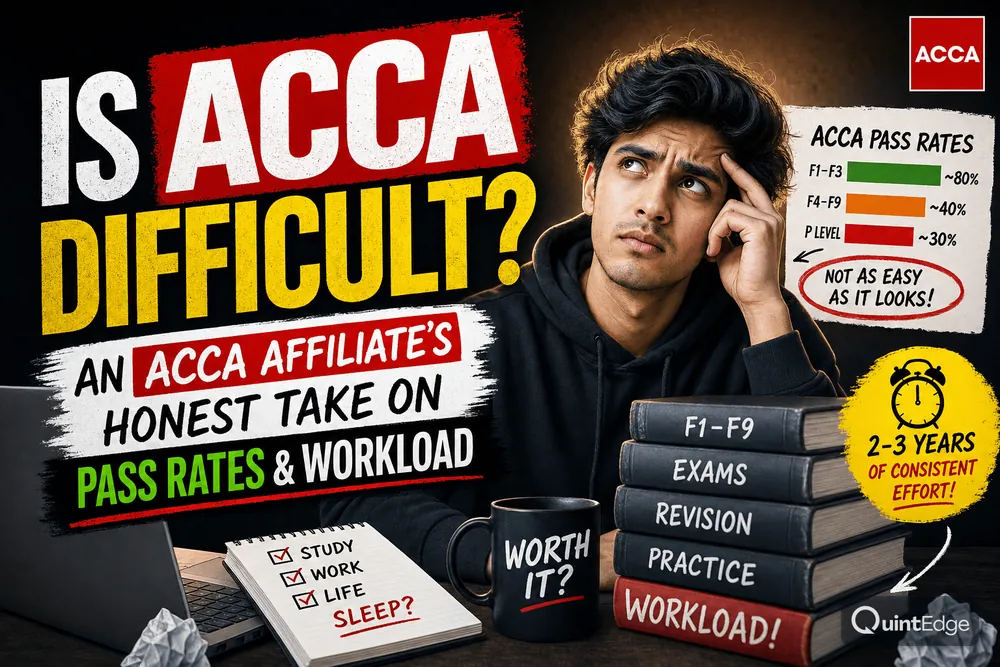
Honest Verdict: Is ACCA Difficult?
Yes, ACCA is genuinely difficult — but it is not unreasonably hard. That distinction matters enormously when you are deciding whether to commit two to four years of your life to a qualification.
The honest answer is that ACCA sits in the middle tier of professional accounting and finance qualifications globally. It is significantly harder than a standard B.Com or MBA Finance degree. It is meaningfully easier than the Indian CA qualification. And its difficulty is unevenly distributed — the Applied Knowledge papers are manageable, while the Strategic Professional options — particularly AAA, APM, and AFM — remain genuinely demanding even for experienced professionals.
This article gives you a paper-by-paper breakdown, real pass rate data from ACCA Global, an honest estimate of the study hours required, and practical tips from candidates who have been through it — so you can make an informed decision.
Key Takeaway
ACCA's overall difficulty is manageable with structure. The qualification rewards consistent effort and good exam technique far more than raw intelligence. Candidates who study strategically and use past papers extensively achieve far better results than those who rely on passive reading alone.
ACCA Structure: 13 Papers Across Three Levels
Before assessing difficulty, it helps to understand what you are actually signing up for. ACCA comprises 13 papers (plus an Ethics and Professional Skills module) organized across three levels.
| Level | Papers | Format | Difficulty |
|---|---|---|---|
| Applied Knowledge | BT, MA, FA | Computer-based, on-demand | Manageable |
| Applied Skills | LW, PM, TX, FR, AA, FM | Computer-based, quarterly (LW on-demand) | Moderate |
| Strategic Professional — Essentials | SBL, SBR | Paper/CBE, quarterly | Hard |
| Strategic Professional — Options (2 of 4) | AFM, APM, ATX, AAA | Paper/CBE, quarterly | Hard |
The three Applied Knowledge papers (BT, MA, FA) are entry-level and exist primarily to build foundational understanding. Most commerce graduates find these very approachable. The real difficulty begins at the Applied Skills level and peaks sharply at the Strategic Professional level.
It is worth noting that exemptions are available for candidates with prior qualifications. A B.Com graduate may receive exemptions from BT, MA, and FA. A CA Intermediate pass can receive up to 9 exemptions. This dramatically reduces the number of papers — and the total difficulty — for many Indian candidates.
ACCA Pass Rates by Paper: The Numbers Don't Lie
ACCA Global publishes pass rate data for every paper after each exam sitting. The pattern is clear and consistent: pass rates drop sharply as you move from Knowledge to Skills to Strategic Professional level.
Source: ACCA Global — Dec 2025 results (Knowledge/Law from Dec sitting) and average of Dec 2025 + Mar 2026 for Skills/Strategic Professional. AFM shown as representative options paper.
The chart tells the story plainly. Applied Knowledge papers pass at 64–87% — with BT the most accessible at 87% and MA the toughest of the three at around 64%. Applied Skills (excluding LW, which clears 82%) average 43–54%, meaning roughly half of all candidates fail on the first attempt. Strategic Professional papers are where ACCA earns its reputation: SBL now passes at around 50–52% (a meaningful improvement from earlier years), AFM has climbed to roughly 44–45%, and AAA remains the toughest options paper at 38–42%, alongside APM at 40–41%.
One important nuance: these are global pass rates, which include a large proportion of first-time takers attempting papers without adequate preparation. Candidates with proper coaching and structured mock practice consistently outperform the global average by a significant margin.
The Hardest ACCA Papers: AAA, APM, AFM, and SBR
Across candidate surveys and ACCA's own published data, five papers consistently emerge as the most challenging. Based on the most recent ACCA Global sittings (December 2025 and March 2026), here is an honest assessment of each — with the current pass-rate picture.
1. Advanced Audit and Assurance (AAA) — The Detail Trap
AAA (formerly P7) is now the lowest-passing ACCA paper, with December 2025 at 38% and March 2026 at 42% — the latter a notable 15-year high, but still the toughest of the options. It is notorious for requiring precision in professional judgments. Unlike Audit and Assurance (AA) at the Skills level, AAA expects candidates to justify every assertion with reference to specific standards — ISAs, ethical standards, and complex group audit scenarios. Candidates who rely on generic audit knowledge without deep standards familiarity consistently fail.
2. Advanced Performance Management (APM) — The Strategic Layer
APM extends PM (Performance Management) into strategic territory, requiring candidates to evaluate management information systems, strategic performance frameworks (Balanced Scorecard, value-based management), and complex variance analysis at a senior advisory level. Recent pass rates have hovered between 40% (March 2026) and 41% (December 2025). Like SBL, the difficulty lies in application and professional communication rather than pure calculation.
3. Advanced Financial Management (AFM) — The Numbers Beast
AFM has long been viewed as the hardest ACCA paper, although pass rates have improved markedly — 45% in December 2025 and 44% in March 2026. It still demands mastery of complex financial mathematics: option pricing models (Black-Scholes), interest rate hedging, corporate restructuring, emerging markets risk, and international investment appraisal — all under severe time pressure in a 3-hour 15-minute exam.
What makes AFM particularly brutal is that every question is a multi-part calculation problem. There is little room to pick up easy marks on theory. You either know how to set up the calculations or you don't. Candidates who struggle with FM (Financial Management at Skills level) almost always find AFM overwhelming.
4. Strategic Business Reporting (SBR) — The IFRS Marathon
SBR demands mastery of the full IFRS framework at an application level, not just recall. Consolidated financial statements, complex instruments (IFRS 9, IFRS 16, IFRS 15), and ethical reporting scenarios are tested in a 3-hour 15-minute exam. Recent pass rates: 48% (December 2025) and 50% (March 2026). Many candidates underestimate SBR because they found FR (Financial Reporting) manageable — the jump in complexity between the two is substantial.
5. Strategic Business Leader (SBL) — The Integration Exam
SBL is ACCA's most unique paper and the one that trips up the most experienced candidates. Rather than testing a single subject, SBL gives you a real-world business scenario (typically 40–60 pages of exhibits revealed entirely on exam day — ACCA removed pre-seen from September 2023 onwards) and asks you to apply skills from strategy, risk, leadership, governance, technology, and professional ethics simultaneously.
The challenge is not knowledge — most SBL candidates have the content knowledge they need. The challenge is synthesis, commercial judgment, and communication under time pressure. Many technically strong candidates fail SBL because they answer like accountants rather than senior advisors. SBL has actually improved sharply in recent sittings — 50% (December 2025) and 52% (March 2026) — making it the most accessible Strategic Professional paper today, though the perception of difficulty remains.
How Many Hours Does ACCA Actually Require?
ACCA's official guidance suggests approximately 150 hours per paper at all levels. In practice, the picture is more nuanced:
Across the full 13-paper qualification (assuming no exemptions), the realistic total study investment is 1,800–2,500 hours. Spread over two to four years while working full-time, that equates to roughly 12–15 hours per week on average — more during intensive exam preparation periods, less during lighter phases.
The study hours alone do not capture the full picture. Exam technique development — particularly for Strategic Professional papers — requires dedicated mock exam practice beyond your reading and notes revision. Candidates who do not practise full past papers under timed conditions consistently underperform relative to their content knowledge.
How ACCA Difficulty Compares to CA, CFA, and CPA
| Qualification | Overall Pass Rate | Total Duration | Hardest Stage | Difficulty Verdict |
|---|---|---|---|---|
| ACCA | 40–55% (Skills/SP papers) | 2–4 years | AAA / APM / AFM | Moderate–Hard |
| CA (India) | 4–15% per attempt (CA Final) | 4.5–6 years | CA Final | Very Hard |
| CFA | 35–50% per level | 2.5–4 years | Level II / III | Hard |
| US CPA | 45–60% per section | 1.5–3 years | FAR / REG | Moderate |
The comparison is instructive. Indian CA is substantially harder than ACCA — CA Final pass rates frequently land in the 4–15% per-attempt range, meaning the vast majority of attempts end in failure. The ACCA pass rate at the hardest papers (38–45% in the latest sittings) feels punishing, but it is meaningfully more achievable than CA Final.
The CFA is broadly comparable to ACCA's Strategic Professional level in terms of difficulty per paper, but CFA has a narrower scope (investment analysis) versus ACCA's broader accounting and business coverage. Both require roughly 300–400 hours of preparation per exam sitting at the harder levels.
ACCA's advantage over CA is not just lower difficulty — it is also the flexibility of computer-based exams, multiple attempts per year, and the ability to sit papers individually at your own pace.
Can You Pass ACCA While Working Full-Time?
Thousands of working professionals pass ACCA papers every year, and ACCA's flexibility is specifically designed to support this. The Applied Knowledge papers and LW are available as on-demand CBEs (computer-based exams) throughout the year at approved centres. The other Applied Skills papers and all Strategic Professional papers are offered in March, June, September, and December — four sittings per year.
The practical formula that works for working professionals:
- Sit a maximum of two papers per exam sitting to avoid burnout and protect pass rates.
- Study 1.5–2 hours per weekday consistently, scaling up to 3–4 hours in the final 4 weeks before the exam.
- Use weekends for mock exams and extended practice sessions, not passive reading.
- Plan 12–14 weeks of preparation for Applied Skills papers and 16–20 weeks for Strategic Professional papers.
- Do not underestimate the Ethics and Professional Skills module — complete it alongside or just before your first Strategic Professional paper, not after.
The biggest mistake working professionals make is trying to compress preparation into the final two or three weeks. ACCA papers, especially at the Strategic Professional level, reward candidates who have built deep familiarity with the material over months — not those who cram at the last minute.
7 Practical Tips to Make ACCA Manageable
1. Respect the Past Question Bank — It Is Your Best Resource
ACCA's official past question bank is the single most important study resource available. Questions repeat in style and structure even when the specific scenario changes. Candidates who work through the full past question bank for their paper consistently outperform those who rely on textbook reading alone. Do at least 60–70% of all available past questions before your exam.
2. Understand Exam Technique Before Exam Week
Strategic Professional papers are marked on both content and professional communication. A technically correct answer that is poorly structured and hard to read will not achieve a passing mark. Practice writing answers in the format examiners expect — clear headings, succinct paragraphs, and justified recommendations. This is a skill that must be developed, not assumed.
3. Do Not Skip the Ethics Module
The Ethics and Professional Skills module is mandatory and surprisingly time-consuming. Many candidates leave it too late, creating a bottleneck before Strategic Professional papers. Build it into your plan early and treat it as a meaningful commitment rather than an administrative checkbox.
4. Target the Easy Marks First
In every ACCA paper, professional marks and requirement marks for well-structured answers are relatively easy to earn compared to the most technical calculation marks. In a 3-hour 15-minute Strategic Professional exam, securing the available professional marks (typically 4–10 marks per question) through good communication can be the difference between a pass and a fail at the margins.
5. Use a Study Planner and Track Weekly Hours
Candidates who track their actual study hours consistently outperform those who study "whenever possible." Build a week-by-week study plan with clear syllabus area milestones and mock exam dates. Accountability — even just to a study planner — significantly improves preparation quality.
6. Join a Study Group or Coaching Programme
ACCA is significantly more manageable with structured support. A coaching programme provides expert guidance on syllabus priorities, exam technique, and mock feedback — reducing the time wasted on low-yield revision areas. Study groups provide accountability and the opportunity to discuss application scenarios that you would not encounter in solo study.
7. Treat Strategic Professional Papers as Professional Exams, Not Academics
The biggest shift between Applied Skills and Strategic Professional is the expected professional voice. ACCA's Strategic Professional papers are simulating what a senior finance professional would actually do. Your answers should reflect commercial awareness, professional judgment, and stakeholder sensitivity — not just technical knowledge. The sooner you internalize this shift, the better your results will be.
Frequently Asked Questions
ACCA is genuinely challenging but not impossible. Based on the latest December 2025 and March 2026 sittings published by ACCA Global, Applied Knowledge papers pass at 64–87%, Applied Skills papers average roughly 43–55%, and Strategic Professional papers sit in the 38–52% range. With structured preparation of 150–200 hours per paper and consistent practice of past questions, the majority of dedicated candidates pass within the recommended attempt window.
Based on the most recent December 2025 and March 2026 sittings, Advanced Audit and Assurance (AAA) and Advanced Performance Management (APM) are now the lowest-passing ACCA papers — AAA averages roughly 38–42% and APM around 40–41%. Strategic Business Leader (SBL), historically considered the hardest, has climbed to around 50–52%, while Advanced Financial Management (AFM) — long seen as the toughest — has improved to approximately 44–45%. Difficulty perception still favours SBL, AFM, and AAA because of their integrative, time-pressured exam format.
ACCA recommends approximately 150 hours of study per Applied Knowledge paper, 150–200 hours per Applied Skills paper, and 200–250 hours per Strategic Professional paper. Across the full 13-paper qualification, candidates typically invest 1,500 to 2,500 total hours. Most working professionals spread this over 2.5 to 4 years.
Yes, thousands of ACCA candidates worldwide pass while working full-time. The key is sitting no more than two papers per exam sitting, maintaining a consistent daily study routine of 1.5 to 2 hours on weekdays, and using weekends for mock exams and revision. On-demand computer-based exams for the Knowledge papers and LW allow flexible scheduling throughout the year, which helps working professionals immensely.
CA (Chartered Accountant) in India is widely considered harder than ACCA in terms of overall pass rates — CA Final pass rates typically fall in the 4–15% range per attempt, while ACCA Strategic Professional papers in the most recent sittings (December 2025 and March 2026) averaged 38–52%. However, ACCA covers a broader international syllabus and requires more papers (13 total). ACCA is more flexible and globally recognized, while CA has stronger domestic brand recognition and a more grueling examination process.
ACCA can be completed in as little as 2.5–3 years if you sit the maximum allowed papers per year and pass all on the first attempt. Realistically, most candidates take 2 to 4 years. ACCA allows up to 7 years to complete all Strategic Professional exams after passing your first Strategic Professional paper. Exemptions from prior qualifications such as B.Com or CA Foundation can significantly reduce the number of papers required.
According to ACCA Global's published December 2025 and March 2026 sittings, Strategic Professional pass rates ranged from approximately 38% to 52%. AAA had the lowest range (38–42%), followed by APM (40–41%) and AFM (44–45%). SBR sat around 48–50% and SBL was the strongest at 50–52% — a notable improvement from earlier years. ATX was steady at around 50%. These rates reinforce that Strategic Professional papers require significantly more preparation than earlier-level papers.
Yes, structured coaching significantly improves ACCA pass rates. Candidates who study with an approved learning partner or coaching institute consistently outperform self-study candidates, particularly at the Strategic Professional level where exam technique, case-study practice, and time management are critical. A good ACCA coaching programme provides structured study plans, mock exams, and expert doubt-solving sessions.


