
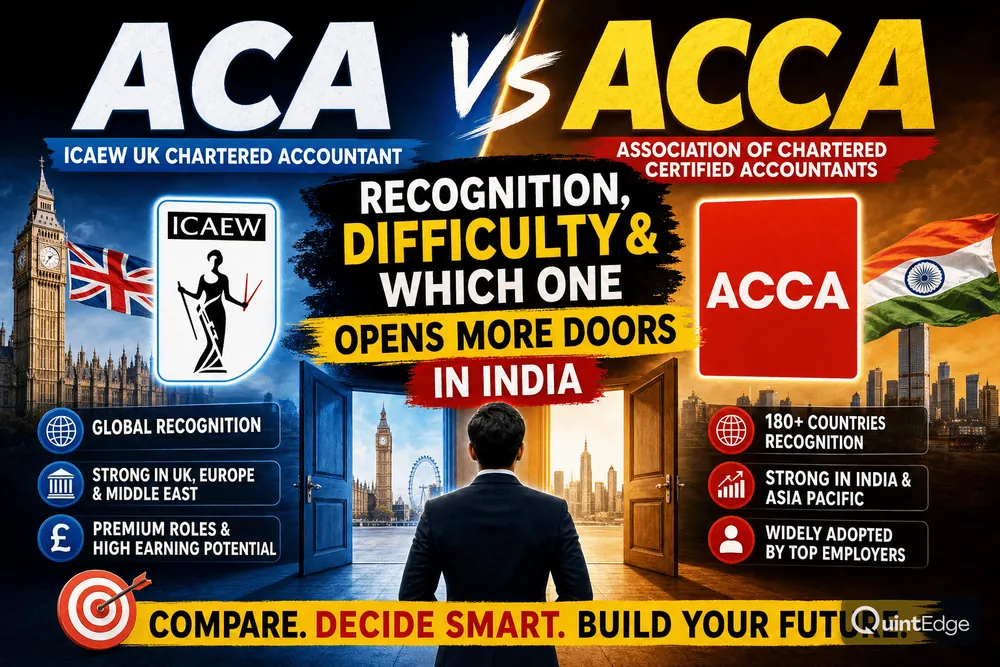
ACA vs ACCA: The Two UK Accounting Powerhouses
If you're an Indian student exploring global accounting qualifications, you've likely come across two prominent UK-based designations: the ACA (Associate Chartered Accountant) from ICAEW and the ACCA (Association of Chartered Certified Accountants). Both carry significant weight in the accounting world, but they differ substantially in structure, recognition, cost, and career outcomes — especially for professionals based in India.
This guide breaks down every dimension of the ACA vs ACCA comparison so you can make an informed decision based on facts, not marketing.
Key Takeaway
ACCA is the stronger choice for most Indian students due to its wider global recognition in 180+ countries, flexible exam structure, and established presence in India. ACA (ICAEW) is more UK-centric and primarily suited for those planning to work in the UK or with UK firms.
Governing Bodies: ICAEW vs ACCA
Understanding the organisations behind these qualifications provides essential context for evaluating their value.
- Full name: Institute of Chartered Accountants in England and Wales
- Founded: 1880 (Royal Charter, 11 May 1880)
- Members & students: 210,000+ worldwide
- Headquarters: London, UK
- Primary focus: UK-centric chartered accountancy
- Training model: Employer-sponsored (training agreement required)
- Full name: Association of Chartered Certified Accountants
- Founded: 1904 (Royal Charter granted 1974)
- Members: 257,900+ members, 530,100+ future members
- Headquarters: London, UK (offices in 50+ countries)
- Primary focus: Global accounting qualification
- Training model: Flexible — study independently or via coaching
The key philosophical difference: ICAEW designed the ACA as a qualification completed within a training contract at an authorised employer (typically Big 4 or mid-tier firms in the UK). ACCA was built from the ground up to be accessible globally, with no mandatory employer sponsorship required to sit exams.
Exam Structure: How They Compare
Both qualifications are rigorous, but their structures differ significantly. Here's a side-by-side comparison of what candidates face.
| Parameter | ACA (ICAEW) | ACCA |
|---|---|---|
| Total exams | 15 modules (reducing to 14 by July 2027 under Next Generation ACA) | 13 exams + Ethics & Professional Skills module |
| Levels | Certificate (6), Professional (6), Advanced (3 today; 2 from July 2027) | Applied Knowledge (3), Applied Skills (6), Strategic Professional (4) |
| Exam format | Mix of computer-based and written | Computer-based exams (CBE) globally |
| Exam windows | March, June, September, December | March, June, September, December |
| Practical experience | 450 days under training agreement | 36 months (PER — Practical Experience Requirement) |
| Training agreement | Mandatory with authorised employer | Not required to sit exams |
| Maximum completion time | Typically 3-5 years | No fixed time limit (exams valid for set period) |
| Ethics requirement | Integrated within modules | Separate Ethics & Professional Skills module |
ACA Exam Levels in Detail
Certificate Level (6 modules): Accounting, Assurance, Law, Management Information / Business Insight & Performance, Tax, and (under the Next Generation syllabus rolled out from September 2025) a dedicated Sustainability & Ethics paper that replaces Business, Technology & Finance. All Certificate-Level exams are computer-based.
Professional Level (6 modules): Audit & Assurance, Financial Accounting & Reporting, Tax Compliance, Business Strategy & Technology, Financial Management, Business Planning. The refreshed syllabus applies from the March 2026 sitting.
Advanced Level (3 modules today, reducing to 2 from July 2027): Corporate Reporting, Strategic Business Management and the Case Study. From July 2027 the Advanced Level transitions to a 2-exam structure, anchored by the Strategic Case Study — a capstone testing integrated knowledge across the qualification.
ACCA Exam Levels in Detail
Applied Knowledge (3 papers): Business & Technology (BT), Management Accounting (MA), Financial Accounting (FA). Available on demand at exam centres.
Applied Skills (6 papers): Corporate & Business Law, Performance Management, Taxation, Financial Reporting, Audit & Assurance, Financial Management. Session-based exams.
Strategic Professional (4 papers): Strategic Business Leader (SBL), Strategic Business Reporting (SBR), plus 2 optional papers from Advanced Financial Management, Advanced Performance Management, Advanced Taxation, and Advanced Audit & Assurance.
Difficulty Level: ACA vs ACCA
This is one of the most debated topics in accounting forums. Let us present the facts objectively.
ACA Difficulty
The ACA is often considered more intensive due to its compressed structure. Candidates typically complete all modules within 3-5 years while working full-time at an authorised training employer. The Advanced Level Case Study is known for being particularly demanding, requiring candidates to synthesise knowledge across multiple disciplines under time pressure. ICAEW's published pass rates for individual papers vary widely — Advanced Level results (July 2025) ranged from ~78% on the Case Study to ~87% on Strategic Business Management, while several Professional-Level papers sit in the 40-60% band depending on the sitting.
ACCA Difficulty
ACCA's 13 exams are spread across a wider curriculum. The Strategic Professional level — particularly Strategic Business Leader (SBL) and Strategic Business Reporting (SBR) — tests real-world application and integrated thinking. ACCA's December 2025 global average across all levels was 52%; the toughest papers (AAA, APM) recorded pass rates around 38-41%, while Applied Skills papers like TX and FR ranged from ~51-55%.
ACA bars reflect ICAEW Jul-Sep 2025 sittings (Advanced Level was unusually strong). ACCA bars reflect Dec 2025 global averages; AAA/APM came in lower at ~38-41%. Pass rates fluctuate every sitting — treat as directional.
Key Takeaway
Both ACA and ACCA are demanding qualifications. ACA may feel harder because it's compressed into a training contract with employer expectations. ACCA's difficulty is spread over time but is no less rigorous at the Strategic Professional level. Neither qualification should be chosen solely based on perceived difficulty.
Cost Comparison: ACA vs ACCA in India
Costs vary depending on where you study, whether you self-study or use a coaching provider, and exchange rate fluctuations. Here's a realistic breakdown for Indian candidates.
| Cost Component | ACA (ICAEW) | ACCA |
|---|---|---|
| Registration fee | ~INR 15,000-20,000 | ~INR 3,800 (GBP 30) |
| Annual subscription | ~INR 25,000-30,000/year | ~INR 17,900/year (GBP 140) |
| Total exam fees (all levels) | ~INR 2,50,000-3,50,000 | ~INR 2,86,000 (all 13 papers) |
| Coaching fees (India) | INR 2,00,000-4,00,000 (limited providers) | INR 1,50,000-3,50,000 (many providers) |
| Study materials | Often included in training contract | INR 30,000-60,000 (if purchased separately) |
| Estimated total cost | INR 5,00,000-8,00,000 | INR 5,20,000-7,50,000 |
In plain terms: ACCA's own fees (registration, about three years of subscription and all 13 exams) come to roughly INR 3.4 lakh, and coaching plus books take the ACCA total to about INR 5.2–7.5 lakh.
ACCA figures use ACCA's India price list for the December 2026 session (standard entry; checked in October 2026) at about INR 128 per GBP, so the rupee amounts are illustrative. BT, MA, FA and LW are on-demand computer-based exams whose fee the exam centre sets; they are counted at QuintEdge Mumbai's INR 18,880 (BT, MA, FA) and INR 24,780 (LW), incl. 18% GST.
A critical distinction: ACA candidates in the UK typically have their fees paid by their employer under the training agreement. In India, where such training agreements are rare, candidates must self-fund, making the ACA significantly more expensive with less institutional support.
UK vs Global Recognition
This is where the two qualifications diverge most sharply, and it's arguably the most important factor for Indian students.
ACA (ICAEW) Recognition
- UK: Extremely well-recognised; ICAEW is a Recognised Supervisory Body (RSB) under the FRC for UK statutory audit, sitting alongside ICAS and CAI (Ireland)
- Europe: Recognised under mutual recognition agreements in certain EU countries
- Middle East: Some recognition, but less established than ACCA
- India: Limited recognition — an ICAEW-ICAI MRA exists but it does not grant automatic equivalence (you still need additional exams to qualify as an Indian CA); very few employers specifically seek ACA holders
- Global reach: Primarily concentrated in UK-connected markets
ACCA Recognition
- UK: Fully recognised; ACCA is also an FRC-Recognised Supervisory Body (RSB) for UK statutory audit, with audit-rights granted to members holding the relevant practising certificate
- Global: Recognised in 180+ countries with active presence in 50+ nations
- Middle East: One of the most sought-after qualifications (UAE, Qatar, Saudi Arabia, Bahrain)
- India: Growing recognition among MNCs, Big 4, and shared services centres
- Asia-Pacific: Strong recognition in Singapore, Malaysia, Hong Kong, and other markets
India Relevance: Which Qualification Works Better?
For Indian students, this is the decisive section. Let's evaluate both qualifications through the lens of practical career outcomes in India.
ACCA in India
ACCA has a well-established presence in India with a dedicated country office, approved learning partners across major cities, and growing employer recognition. Key advantages include:
- Big 4 acceptance: Deloitte, PwC, EY, and KPMG India all recognise and hire ACCA members
- MNC preference: Multinational corporations with IFRS reporting requirements actively seek ACCA-qualified professionals
- Shared services centres: The booming GCC (Global Capability Centre) sector in India values ACCA for its international accounting standards expertise
- Exemptions: Indian commerce graduates and CA Intermediate holders can claim significant exemptions, reducing the number of exams required
- Coaching availability: Multiple reputed coaching providers across Mumbai, Delhi, Bangalore, Chennai, and other cities
ACA (ICAEW) in India
ICAEW has a presence in India through partnerships, but the ACA faces structural challenges for Indian candidates:
- Training agreement barrier: Few Indian employers are authorised ICAEW training partners, making it difficult to complete the mandatory practical experience requirement
- Limited coaching infrastructure: Far fewer coaching options compared to ACCA
- Employer awareness: Most Indian employers are familiar with CA, ACCA, or CPA — ACA awareness is comparatively lower
- Best suited for: Indians who have secured employment with UK-based firms or plan to relocate to the UK
Career Paths & Job Roles
Both qualifications open doors to accounting, audit, tax, and finance roles, but the specific career trajectories vary based on where you work and which designation you hold.
- Statutory Auditor (UK)
- Corporate Finance Analyst
- Tax Advisor (UK tax law focus)
- Financial Controller
- CFO (primarily UK-based firms)
- Management Consultant
- Investment Banking (entry via Big 4 UK)
- Financial Analyst / Reporting Analyst
- External/Internal Auditor (global)
- Tax Consultant (IFRS/international)
- Finance Manager / Controller
- CFO (MNCs, global companies)
- Risk & Compliance Manager
- Management Accountant (global firms)
Salary Comparison: ACA vs ACCA
Salary outcomes depend heavily on geography, years of experience, and the specific employer. Here's what candidates can broadly expect.
| Experience Level | ACA (UK, GBP) | ACCA (India, INR) |
|---|---|---|
| Newly qualified (0-2 years) | GBP 35,000-50,000 | INR 6,00,000-12,00,000 |
| Mid-level (3-5 years) | GBP 50,000-75,000 | INR 12,00,000-22,00,000 |
| Senior (6-10 years) | GBP 75,000-120,000 | INR 22,00,000-40,00,000 |
| Leadership (10+ years) | GBP 100,000-200,000+ | INR 40,00,000-80,00,000+ |
Important context: Comparing ACA salaries (predominantly UK-based) with ACCA salaries in India isn't a like-for-like comparison due to cost of living differences. ACCA holders working in the Middle East, for instance, can earn AED 15,000-45,000 per month (INR 3.9 lakh-11.8 lakh per month), which represents strong purchasing power with tax-free income.
For Indian candidates who stay in India, ACCA salaries are competitive with Indian CA salaries in the private sector, particularly in MNCs and GCCs. The advantage amplifies for those open to international roles.
Where Does Indian CA Fit In?
No ACA vs ACCA discussion for Indian students is complete without addressing the Indian CA qualification from ICAI.
| Parameter | Indian CA (ICAI) | ACCA |
|---|---|---|
| Recognition in India | Gold standard | Growing (MNCs, Big 4, GCCs) |
| Recognition globally | Limited (mainly India, some MRAs) | 180+ countries |
| Signing authority (India) | Yes | No |
| Difficulty (subjective) | Very high (CA Final group-wise pass rates typically 10-25%) | High (30-50% at Strategic Professional level) |
| Duration | 4.5-5 years minimum | 2-3 years (with exemptions) |
| Best for | Indian practice, statutory compliance | Global careers, MNCs, international mobility |
If your primary goal is to practise as a chartered accountant in India with signing authority, Indian CA is the only viable option. If your goal is international mobility, MNC career growth, or working across borders, ACCA provides a far more efficient path than either ACA or Indian CA.
Who Should Choose ACA and Who Should Choose ACCA?
Choose ACA If:
- You have a confirmed training contract with a UK-based firm (Big 4 or mid-tier)
- You plan to build your career primarily in the UK
- Your employer is sponsoring the qualification and covering all costs
- You want to specialise in UK taxation, auditing, or corporate finance
Choose ACCA If:
- You are based in India and want a globally portable qualification
- You want to work in the Middle East, Southeast Asia, Africa, or across multiple countries
- You need flexible study options without a mandatory employer tie-up
- You want to complement your Indian commerce degree or CA Inter with an international credential
- You aim to work in MNCs, GCCs, or Big 4 firms in India
- You want access to more exam exemptions based on your existing qualifications
Key Takeaway
For the vast majority of Indian students and professionals, ACCA is the more practical, accessible, and career-enhancing choice. ACA makes sense only in specific scenarios where you are already tied to the UK job market through an employer-sponsored training agreement.
Mutual Recognition Agreements (MRAs)
Both bodies have MRAs with other accounting institutes, but ACCA's network is significantly wider:
- ACCA MRAs / reciprocal pathways: Current agreements include CA ANZ (Australia/New Zealand), HKICPA (Hong Kong), MICPA (Malaysia), CA Sri Lanka, CPA Bulgaria, an enhanced ISCA pathway (Singapore) and a reciprocal route with Chartered Accountants Ireland (CAI). ACCA's previous MRA with CPA Canada expired on 30 April 2021 and has not been renewed; ACCA members moving to Canada now use CPA Canada's internationally-trained-accountant pathway.
- ACA (ICAEW) MRAs: Strong reciprocal agreements with CAANZ, HKICPA, CPA Canada, and SAICA (South Africa). The ICAEW-ICAI (India) MRA exists but does not grant automatic equivalence — members on either side must still sit additional papers to qualify with the other body.
- ACCA ↔ ICAEW: Not a direct mutual recognition. ICAEW offers a "Pathways to Membership" route under which fully-qualified ACCA members with at least five years of ACCA membership (plus relevant experience) can apply to join ICAEW. ACCA members can also take the ACA study route with up to 9 paper exemptions (12 for ACCA students/affiliates) via Credit for Prior Learning. ACCA membership is not automatically conferred on ACA holders, nor vice versa.
Neither ACA nor ACCA provides automatic signing authority as a Chartered Accountant in India — only the Indian CA from ICAI grants that privilege.
Can You Do Both ACA and ACCA?
While technically possible, pursuing both ACA and ACCA is rarely advisable. The qualifications have significant syllabus overlap, and holding both does not meaningfully enhance career prospects compared to holding one plus gaining strong work experience. Your time and investment are better directed toward completing one qualification and building domain expertise.
A more strategic combination for Indian professionals is ACCA + CFA (for those interested in investment analysis) or ACCA + Indian CA (for those wanting both domestic signing authority and international mobility).
Frequently Asked Questions
ACA is not inherently harder than ACCA, but it can feel more intense because candidates must complete 15 modules within a structured training contract, often while working full-time at a demanding pace. ACCA allows more flexibility in pacing, but its Strategic Professional papers (especially SBL and SBR) are widely considered very challenging. The difficulty comparison is subjective and depends on your study style, work situation, and prior education.
Yes, ACCA is increasingly recognised in India. The Big 4 firms (Deloitte, PwC, EY, KPMG), major MNCs, Global Capability Centres (GCCs), and banks actively recruit ACCA-qualified professionals. While ACCA does not grant signing authority for statutory audits in India (only Indian CA does), it is well-respected for roles in financial reporting, management accounting, internal audit, and corporate finance.
No. The ACA (ICAEW) requires a mandatory training agreement with an authorised employer to complete the qualification. While you can study for certain exams independently, you cannot qualify as an ACA without fulfilling the practical work experience under a recognised employer. In India, very few employers hold ICAEW training authorisation, making this a significant barrier.
In the UK, ACA and ACCA salaries are broadly comparable, with ACA holders sometimes earning slightly more in London-based roles. However, ACCA offers wider geographic salary potential — ACCA members working in the Middle East, Singapore, or Hong Kong can earn very competitive, often tax-free salaries. In India, ACCA salaries in MNCs range from INR 6-22 LPA at the early-to-mid career stage, with senior roles exceeding INR 40 LPA.
No. ACA (ICAEW) and Indian CA (ICAI) are separate qualifications from different bodies. While ICAEW and ICAI have a Mutual Recognition Agreement, it does not grant automatic equivalence. ACA holders must pass additional exams to qualify as Indian CAs and vice versa. In India, only the ICAI CA designation grants statutory signing authority.
ACA typically takes 3-5 years to complete within a training contract. ACCA can be completed in 2-3 years if you qualify for exemptions and pass exams consistently, though many students take 3-4 years. ACCA's flexibility is an advantage — there is no fixed maximum time limit, and you can pace your studies around work commitments.
Yes. ACCA is fully recognised in the UK for accounting and finance roles. ACCA members can apply for statutory audit qualification in the UK through ACCA's practising certificate route. Many Big 4 and mid-tier UK firms recruit ACCA-qualified accountants, and the designation carries equal professional standing to ACA in most corporate roles.
If international career mobility is a priority, ACCA is the stronger choice. It is recognised in 180+ countries, has a well-established global network, and its curriculum is based on International Financial Reporting Standards (IFRS), which is the dominant accounting framework outside the US. Indian CA, while highly respected domestically, has limited recognition in most international markets outside India.


