
Why Indian Graduates Are Choosing ACCA After Their Degree
If you have completed a B.Com, M.Com, BBA, BAF, or MBA in Finance from an Indian university, you already hold a qualification that ACCA recognises. The Association of Chartered Certified Accountants (ACCA) grants exemptions to graduates whose coursework overlaps with certain ACCA papers, allowing you to skip those exams entirely and finish ACCA faster. This means fewer papers, lower costs, and a shorter path to one of the most globally recognised accounting qualifications.
But the number of exemptions you receive depends heavily on your specific degree, your university, and the subjects covered in your curriculum. A B.Com from Delhi University does not carry the same exemption weight as a BAF from Mumbai University or an MBA in Finance from a top B-school. This guide breaks down exactly how many exemptions each qualification earns, what papers remain, and how to strategically plan your ACCA journey based on your educational background.
ACCA Exam Structure: Quick Overview
ACCA has 13 exams across three levels. Understanding this structure is essential before evaluating exemptions:
- Applied Knowledge (3 papers): Business and Technology (BT), Management Accounting (MA), Financial Accounting (FA)
- Applied Skills (6 papers): Corporate and Business Law (LW), Performance Management (PM), Taxation (TX), Financial Reporting (FR), Audit and Assurance (AA), Financial Management (FM)
- Strategic Professional (4 papers): Strategic Business Leader (SBL), Strategic Business Reporting (SBR), plus 2 Options from AFM, APM, ATX, AAA
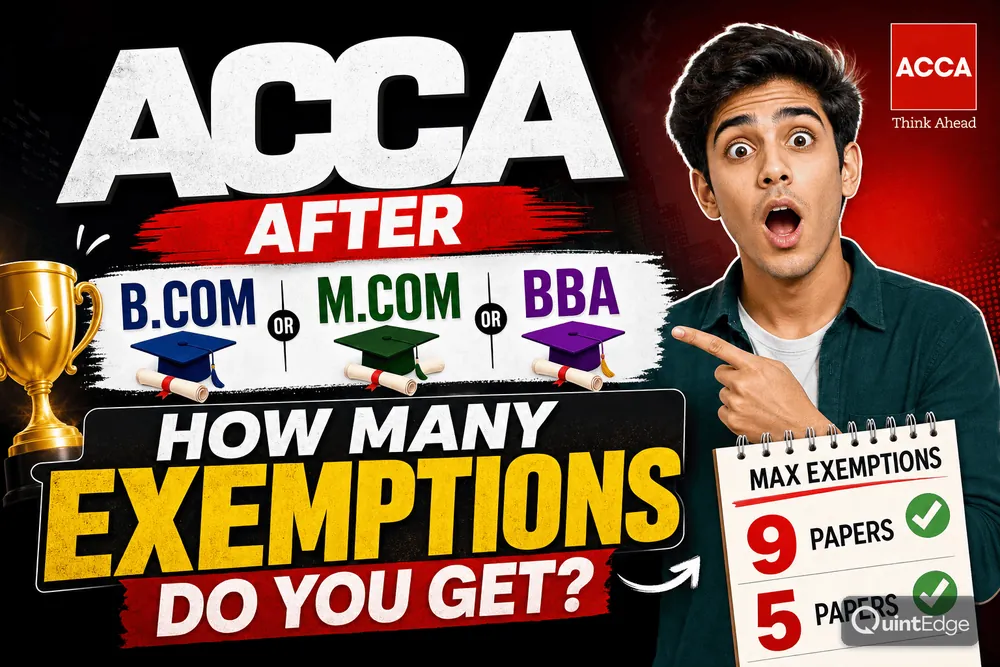
Exemptions can cover any combination of the first 9 papers. The maximum possible exemptions are 9 — meaning you would enter directly at the Strategic Professional level. For most Indian graduates, the number ranges from 4 to 7 depending on the degree and university.
ACCA Exemptions by Indian Qualification: Visual Comparison
ACCA After B.Com: 4 Exemptions
A B.Com degree from a recognised Indian university typically qualifies for 4 exemptions covering all three Applied Knowledge papers and one Applied Skills paper. The specific papers exempted are:
| Paper Code | Paper Name | Exemption Status |
|---|---|---|
| BT | Business and Technology | Exempted |
| MA | Management Accounting | Exempted |
| FA | Financial Accounting | Exempted |
| LW | Corporate and Business Law | Exempted |
| PM | Performance Management | Must sit |
| TX | Taxation | Must sit |
| FR | Financial Reporting | Must sit |
| AA | Audit and Assurance | Must sit |
| FM | Financial Management | Must sit |
| SBL | Strategic Business Leader | Must sit |
| SBR | Strategic Business Reporting | Must sit |
| Options | 2 Option papers | Must sit |
Papers remaining: 9 out of 13. B.Com graduates skip the entire Applied Knowledge level plus LW from Applied Skills. The core commerce subjects — financial accounting, cost accounting, and business organisation — map directly to BT, MA, and FA, while the business law component in most B.Com curricula covers enough of the LW syllabus to warrant the fourth exemption.
Note that B.Com (Honours) from certain universities like Delhi University may qualify for additional exemptions depending on the specific modules studied. Always verify through ACCA's Exemption Calculator using your exact university and programme.
B.Com: ACCA vs CA Comparison
Many B.Com graduates debate between ACCA and CA India. Here is a practical comparison:
| Parameter | ACCA After B.Com | CA After B.Com |
|---|---|---|
| Exemptions | 4 papers exempted | CA Foundation exempted (direct entry to Inter) |
| Papers to clear | 9 exams | 8 exams (Inter + Final) |
| Typical completion time | 2 to 2.5 years | 3 to 4 years (including articleship) |
| Articleship required | No (3 years PER needed post-qualification) | Yes (3 years mandatory during study) |
| Global recognition | 180+ countries | Primarily India & select countries |
| Exam frequency | 4 sessions per year | 2 sessions per year |
ACCA After M.Com: 5 Exemptions
An M.Com degree from a recognised Indian university typically qualifies for 5 exemptions — all three Applied Knowledge papers plus two Applied Skills papers. The additional exemptions over B.Com come from the deeper study of subjects like taxation and financial management at the postgraduate level.
| Paper Code | Paper Name | Exemption Status |
|---|---|---|
| BT | Business and Technology | Exempted |
| MA | Management Accounting | Exempted |
| FA | Financial Accounting | Exempted |
| LW | Corporate and Business Law | Exempted |
| PM | Performance Management | Exempted |
| TX | Taxation | Must sit |
| FR | Financial Reporting | Must sit |
| AA | Audit and Assurance | Must sit |
| FM | Financial Management | Must sit |
| SBL | Strategic Business Leader | Must sit |
| SBR | Strategic Business Reporting | Must sit |
| Options | 2 Option papers | Must sit |
Papers remaining: 8 out of 13. M.Com graduates benefit from one additional exemption compared to B.Com, as the postgraduate curriculum's advanced treatment of performance management and related topics aligns with the PM paper. The exact fifth exempted paper can vary by university — some M.Com programmes may earn TX or FM instead of PM, depending on the modules covered.
M.Com: ACCA vs CA Comparison
| Parameter | ACCA After M.Com | CA After M.Com |
|---|---|---|
| Exemptions | 5 papers exempted | CA Foundation exempted (same as B.Com) |
| Papers to clear | 8 exams | 8 exams (Inter + Final) |
| Completion time | 1.5 to 2 years | 3 to 4 years |
| Advantage of M.Com | 1 extra exemption over B.Com | No additional exemption over B.Com |
| Best suited for | International careers, MNCs, Big 4 | Indian audit & tax practice |
A significant advantage of ACCA for M.Com holders is that the extra postgraduate study is actually rewarded with an additional exemption. CA India does not differentiate between B.Com and M.Com for entry purposes — both get direct entry to CA Intermediate. This makes ACCA a particularly efficient choice for M.Com graduates who want to maximise the value of their postgraduate degree.
ACCA After BBA: 1 to 4 Exemptions
A BBA (Bachelor of Business Administration) from a recognised Indian university typically earns 1 exemption as a baseline — the Business and Technology (BT) paper. Unlike B.Com, the BBA curriculum is management-focused rather than commerce-focused, so it does not consistently cover the accounting depth required for MA and FA exemptions. BBA programmes with a strong finance or accounting specialisation may receive additional exemptions on a case-by-case basis.
| Level | Papers | BBA Exemption (Typical) |
|---|---|---|
| Applied Knowledge | BT, MA, FA | BT exempted; MA & FA depend on university |
| Applied Skills | LW, PM, TX, FR, AA, FM | All 6 must be sat |
| Strategic Professional | SBL, SBR, 2 Options | All 4 must be sat |
Papers remaining: 9 to 12 out of 13. A generic BBA typically gets only the BT exemption, leaving 12 papers to clear. BBA programmes with strong accounting and finance modules — such as BBA Finance from Christ University, Symbiosis, or NMIMS — may earn additional exemptions in MA, FA, or LW after ACCA's syllabus assessment. The actual number is determined paper-by-paper by ACCA based on your specific university and curriculum.
BBA: ACCA vs CA Comparison
BBA graduates face a unique situation with CA India because many BBA programmes are not recognised for CA Foundation exemption. This means BBA holders may need to clear CA Foundation before entering CA Intermediate, adding 6 to 8 months to the CA timeline. ACCA, by contrast, allows BBA graduates to register and begin studying immediately, with at least one exemption granted upfront and more possible after individual review.
ACCA After BAF: 5-6 Exemptions
The Bachelor of Accounting and Finance (BAF) — particularly from Mumbai University — is one of the most ACCA-friendly undergraduate degrees in India. BAF graduates typically receive 5 to 6 exemptions, making this one of the highest exemption counts among undergraduate qualifications.
| Paper Code | Paper Name | BAF Exemption |
|---|---|---|
| BT | Business and Technology | Exempted |
| MA | Management Accounting | Exempted |
| FA | Financial Accounting | Exempted |
| LW | Corporate and Business Law | Exempted |
| PM | Performance Management | Exempted |
| TX | Taxation | Exempted (select universities) |
| FR | Financial Reporting | Must sit |
| AA | Audit and Assurance | Must sit |
| FM | Financial Management | Must sit |
| SBL | Strategic Business Leader | Must sit |
| SBR | Strategic Business Reporting | Must sit |
| Options | 2 Option papers | Must sit |
Papers remaining: 7 to 8 out of 13. The BAF curriculum in Mumbai is specifically designed with accounting and finance at its core, covering advanced topics in taxation, cost management, and auditing that align well with multiple Applied Skills papers. Whether you get 5 or 6 exemptions depends on your university and the specific version of the BAF syllabus your batch followed.
ACCA After MBA Finance: Up to 7 Exemptions
An MBA in Finance from a recognised Indian institution can earn up to 7 exemptions — the highest count among non-professional qualifications. This essentially allows MBA Finance graduates to skip almost the entire Applied Knowledge and Applied Skills levels, entering ACCA with just 2 Applied Skills papers and the 4 Strategic Professional papers remaining.
| Level | Papers | MBA Finance Exemption |
|---|---|---|
| Applied Knowledge | BT, MA, FA | All 3 exempted |
| Applied Skills | LW, PM, TX, FR, AA, FM | Up to 4 exempted (LW, PM, FR, FM typical) |
| Strategic Professional | SBL, SBR, 2 Options | All 4 must be sat |
Papers remaining: 6 out of 13. The exact number depends on the MBA programme. Top institutions like IIMs, XLRI, MDI, and SP Jain tend to earn the maximum 7 exemptions because their finance curricula cover financial reporting, financial management, and performance management at a depth that satisfies ACCA's requirements. MBA programmes from tier-2 or tier-3 institutions may qualify for 5 to 6 exemptions.
MBA Finance: ACCA vs CA Comparison
For MBA Finance holders, ACCA is overwhelmingly the more practical choice compared to CA India. CA does not grant any additional exemptions for an MBA — you would still need to clear CA Foundation (unless your undergraduate degree qualifies for exemption) and then both groups of CA Intermediate and Final. ACCA, by contrast, rewards your MBA with up to 7 exemptions, potentially letting you finish the remaining 6 papers in 12 to 18 months of focused study.
University-Wise Differences in Exemptions
ACCA exemptions are not granted based on the degree name alone. The specific university and its accreditation status with ACCA determine the actual number. Here are key points Indian students should know:
| University / Institution | Degree | Typical Exemptions |
|---|---|---|
| Delhi University | B.Com / B.Com (H) | 4 (B.Com H may get 5) |
| Mumbai University | BAF | 5 to 6 |
| Mumbai University | B.Com | 4 |
| Bangalore University | B.Com | 3 to 4 |
| IGNOU | M.Com | 4 to 5 |
| IIMs / Top B-schools | MBA Finance | 6 to 7 |
| Tier-2 B-schools | MBA Finance | 5 to 6 |
| Generic BBA (most universities) | BBA | 1 (BT only) |
| Christ University / Symbiosis / NMIMS | BBA (Finance) | 2 to 4 (case-by-case) |
ACCA has formal accreditation agreements with many Indian universities. If your university has a direct partnership with ACCA, the exemption process is faster and the results are predictable. If your university is not listed, ACCA conducts a manual syllabus review, which can take 3 to 6 weeks.
Completion Timeline: With Exemptions vs Without
The timeline savings are substantial. An MBA Finance graduate with 7 exemptions can potentially complete ACCA in 12 to 18 months, compared to 30 to 36 months for a candidate starting from scratch with zero exemptions. Even a B.Com graduate with 4 exemptions saves roughly 6 to 8 months by skipping the Applied Knowledge level entirely.
How to Check and Claim Your ACCA Exemptions
The exemption process involves three clear steps. Here is what you need to do:
Step 1: Check Your Exemptions
Visit the ACCA Exemption Calculator on accaglobal.com. Select India as your country, then choose your university and qualification. The tool will instantly show you which papers you are eligible to have exempted. If your university is not listed, you will need to contact ACCA directly for a manual assessment.
Step 2: Register with ACCA
You must be a registered ACCA student before claiming exemptions. Registration requires your degree certificate (or final-year marksheet if results are pending), identity proof, and the registration fee. You can register online through ACCA's portal.
Step 3: Apply for Exemptions
Once registered, log into your myACCA account and navigate to the exemptions section. Upload your transcripts and degree certificate. ACCA will verify your documents and grant exemptions, typically within 2 to 4 weeks for universities with existing accreditation agreements. For manual reviews, expect 3 to 6 weeks.
ACCA Exemption Fees 2026
ACCA charges a fee for each exemption claimed. This is a one-time cost per paper. On ACCA's India price list, Knowledge-level exemptions (BT, MA, FA) cost GBP 84 per paper, while Applied Skills exemptions (LW, PM, TX, FR, AA, FM) cost GBP 111 per paper (the regular rates are GBP 86 and GBP 114). The estimates below add up the typical exempted papers for each degree:
| Qualification | Exemptions | Fee Per Exemption | Total Exemption Cost |
|---|---|---|---|
| B.Com | 4 | ~GBP 84-111 | ~GBP 363 |
| M.Com | 5 | ~GBP 84-111 | ~GBP 474 |
| BBA | 1 to 4 | ~GBP 84-111 | ~GBP 84-363 |
| BAF | 5-6 | ~GBP 84-111 | ~GBP 474-585 |
| MBA Finance | Up to 7 | ~GBP 84-111 | ~GBP 696 |
Keep in mind that ACCA revises its fee schedule periodically. Check the latest fees on ACCA's official website before applying. The exemption fee is payable at the time of application and is non-refundable, even if the exemption is subsequently denied after manual review.
Papers Remaining After Exemptions: Summary
Here is a consolidated view of what each qualification means for your ACCA exam load:
| Qualification | Exemptions | Applied Skills to Sit | Strategic Professional | Total Papers |
|---|---|---|---|---|
| B.Com | 4 | 5 (PM, TX, FR, AA, FM) | 4 | 9 |
| M.Com | 5 | 4 (TX, FR, AA, FM) | 4 | 8 |
| BBA (generic) | 1 | 6 (LW, PM, TX, FR, AA, FM) | 4 | 12 |
| BBA (Finance, top univ.) | 2-4 | 3-5 | 4 | 9-11 |
| BAF | 5-6 | 3-4 (FR, AA, FM + possibly TX) | 4 | 7-8 |
| MBA Finance | Up to 7 | 2 (TX, AA typical) | 4 | 6 |
The Strategic Professional papers (SBL, SBR, and two Options) are non-negotiable for every candidate. The real differentiation from exemptions lies in the Applied Skills level — where a B.Com graduate sits 5 Applied Skills papers, an MBA Finance graduate may need to sit only 2.


