
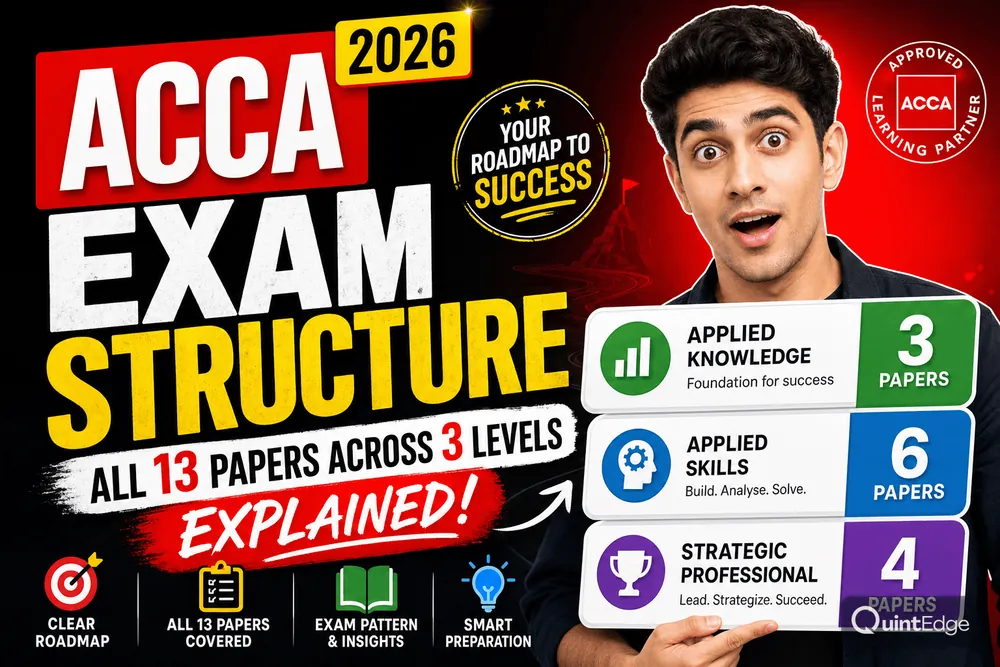
Understanding the ACCA Exam Structure: Three Levels, 13 Papers
The ACCA qualification is one of the most globally recognised accounting credentials, awarded by the Association of Chartered Certified Accountants (ACCA Global). To earn the full ACCA designation, candidates must complete 13 professional exams spread across three distinct levels, fulfil an ethics module, and demonstrate practical work experience.
Understanding the ACCA exam levels is critical before you begin — because each level builds on the last, and choosing the right study sequence can save you months of effort and thousands of rupees in re-sit fees.
Here is how the three levels are structured at a glance:
Let us now explore each level in detail, including what every paper covers, how long the exams are, and the pass rates you should realistically plan around.
Level 1: Applied Knowledge — Your Foundation in Accounting
The Applied Knowledge level is the entry point for all ACCA candidates. It consists of three papers designed to give you a broad, foundational understanding of business, management accounting, and financial accounting. These exams are computer-based and can be attempted at any time throughout the year at approved CBE centres.
| Paper Code | Paper Name | Duration | Format | Approx. Pass Rate |
|---|---|---|---|---|
| BT | Business and Technology | 2 hours | CBE (on-demand) | ~85% |
| MA | Management Accounting | 2 hours | CBE (on-demand) | ~75% |
| FA | Financial Accounting | 2 hours | CBE (on-demand) | ~72% |
BT — Business and Technology
BT covers the business environment, technology's role in organisations, and how people and teams function within a business context. It is largely conceptual — no complex calculations — making it an accessible starting point for most students.
MA — Management Accounting
MA introduces costing techniques, budgeting, variance analysis, and performance measurement. Students with a commerce background often find this paper manageable, but do not underestimate the numerical rigour required in variance calculations.
FA — Financial Accounting
FA teaches the preparation of financial statements for single entities, double-entry bookkeeping, and basic interpretation of accounts. It lays the groundwork for the more complex FR (Financial Reporting) paper at the next level.
Level 2: Applied Skills — Core Technical Expertise
The Applied Skills level is where the qualification becomes significantly more demanding. Six papers cover law, performance management, taxation, financial reporting, audit, and financial management. These exams (except LW, which is on-demand) are held four times a year (March, June, September, December) and mix objective-format questions with constructed response (written) questions.
| Paper Code | Paper Name | Duration | Format | Approx. Pass Rate |
|---|---|---|---|---|
| LW | Corporate and Business Law | 2 hours | CBE (on-demand) | ~82% |
| PM | Performance Management | 3 hours | CBE (session) | ~43% |
| TX | Taxation | 3 hours | CBE (session) | ~52% |
| FR | Financial Reporting | 3 hours | CBE (session) | ~48% |
| AA | Audit and Assurance | 3 hours | CBE (session) | ~46% |
| FM | Financial Management | 3 hours | CBE (session) | ~49% |
LW — Corporate and Business Law
LW covers contract law, company law, employment law, and governance frameworks. The English variant (LW-ENG) is the most commonly attempted globally. Unlike other Applied Skills papers, LW is on-demand and tests legal principles through objective test questions and scenario-based multi-task questions.
PM — Performance Management
PM extends management accounting concepts from MA into advanced decision-making territory: activity-based costing, throughput accounting, transfer pricing, and performance frameworks such as the Balanced Scorecard. With a pass rate around 43%, PM is considered one of the toughest Applied Skills papers.
TX — Taxation
TX is jurisdiction-specific — Indian students sit TX-UK (ACCA does not currently offer a TX-IND variant; the official TX variants are UK, China, Cyprus, Hong Kong, Ireland, Malaysia, Malta, Lesotho, Singapore, South Africa, Vietnam, and Zimbabwe). TX-UK covers income tax, corporation tax, VAT, capital gains, and inheritance tax. Understanding the legislative framework is essential, not just the calculations.
FR — Financial Reporting
FR involves preparing and interpreting financial statements under IFRS, including consolidated accounts for groups of companies. This paper is a significant step up from FA and requires thorough knowledge of accounting standards such as IFRS 15, IFRS 16, and IAS 36.
AA — Audit and Assurance
AA covers the audit process from risk assessment to audit reporting, internal controls, professional ethics, and evidence gathering. Students who have real-world audit experience at firms tend to perform better in this paper.
FM — Financial Management
FM brings together working capital management, investment appraisal, business valuation, and risk management. It is highly quantitative and pairs well with CFA Level 1 knowledge if you are pursuing both qualifications.
Level 3: Strategic Professional — The Leadership Tier
The Strategic Professional level is the final — and most prestigious — stage of the ACCA qualification. It consists of two mandatory papers (Essentials) and two optional papers chosen from a list of four. This level tests your ability to think strategically, advise senior management, and apply professional judgement in complex scenarios.
All Strategic Professional exams are session-based CBEs held four times a year, with longer durations and higher analytical expectations. According to ACCA Global, this level is intentionally designed to mirror the real-world challenges faced by senior finance professionals.
| Paper Code | Paper Name | Type | Duration | Approx. Pass Rate |
|---|---|---|---|---|
| SBL | Strategic Business Leader | Mandatory | 4 hours | ~52% |
| SBR | Strategic Business Reporting | Mandatory | 3 hours 15 min | ~49% |
| AFM | Advanced Financial Management | Optional | 3 hours 15 min | ~41% |
| APM | Advanced Performance Management | Optional | 3 hours 15 min | ~40% |
| ATX | Advanced Taxation | Optional | 3 hours 15 min | ~44% |
| AAA | Advanced Audit and Assurance | Optional | 3 hours 15 min | ~40% |
SBL — Strategic Business Leader
SBL is an integrated case study exam — a single case scenario revealed entirely on exam day (ACCA removed the pre-seen format from September 2023 onwards). It tests strategic analysis, leadership, governance, risk, and technology. The exam is open-book and requires candidates to produce professional-quality reports and recommendations.
SBR — Strategic Business Reporting
SBR is the advanced counterpart to FR, covering complex group accounting, integrated reporting, and financial instruments under IFRS 9. Strong FR knowledge is essential before attempting SBR.
Choosing Your Two Optional Papers
Your choice of optional papers should reflect your intended career path:
- AFM — ideal for those pursuing investment banking, corporate finance, or treasury roles
- APM — best for management consultants and those in performance or strategy functions
- ATX — suited for tax professionals, advisory roles, and Big 4 tax departments
- AAA — essential for those building a career in external audit or assurance at senior levels
Most Indian candidates pursuing Big 4 or MNC roles opt for AFM + SBR or AAA + SBR combinations. If you are unsure, speak to a counsellor who can map your career goal to the right optional papers.
Ethics Module and Practical Experience Requirement (PER)
Passing all 13 papers is not enough to become a fully qualified ACCA member. You must also complete two additional requirements that run alongside your exams:
Ethics and Professional Skills Module (EPSM)
The EPSM is an online, self-paced module accessed through your ACCA student portal. It covers professional ethics, scepticism, commercial awareness, and communication skills across multiple interactive units. The module typically takes around 20 hours to complete and must be finished before you can apply for ACCA membership. It is assessed via embedded online activities and a final reflective statement, not a traditional written exam.
When to complete it: ACCA recommends completing the EPSM after finishing the Applied Skills level, before you sit the Strategic Professional papers. Many students treat it as a bridge between the two levels.
Practical Experience Requirement (PER)
The PER requires you to complete a minimum of 36 months of relevant work experience in a finance or accounting role. This experience must be recorded in the ACCA's online My Experience portal and verified by an approved workplace mentor (usually a qualified accountant at your employer).
The PER is structured around nine performance objectives that you must achieve to qualify for ACCA membership:
- Essentials — 5 mandatory objectives covering ethics and professionalism, stakeholder relationship management, strategy and innovation, governance and risk, and leadership and management
- Technical — 4 objectives chosen from a list covering corporate reporting, financial management, performance measurement, taxation, audit and assurance, and advisory and consultancy
Exam Format and Duration: What to Expect on Exam Day
ACCA exams are delivered entirely via computer-based examination (CBE) — there are no pen-and-paper exams remaining in the qualification as of 2026. The format varies by level:
| Level | Exam Type | Duration | Question Types | Availability |
|---|---|---|---|---|
| Applied Knowledge (BT, MA, FA) | On-demand CBE | 2 hours | MCQ + MTQ | Year-round |
| LW (Applied Skills) | On-demand CBE | 2 hours | MCQ + MTQ | Year-round |
| Applied Skills (PM, TX, FR, AA, FM) | Session CBE | 3 hours | MCQ + MTQ + Constructed Response | Mar, Jun, Sep, Dec |
| Strategic Professional (all) | Session CBE | 3 hrs 15 min (SBR & optionals) / 4 hrs (SBL) | Scenario-based + Constructed Response | Mar, Jun, Sep, Dec |
MCQ = Multiple Choice Questions. MTQ = Multi-Task Questions (OT case-based questions worth 2 marks each). Constructed Response = written answers requiring calculations, analysis, or advisory-style responses.
All ACCA exams are delivered at ACCA exam centres or ACCA-licensed CBE centres (with select remote-invigilated options for on-demand papers in some markets). Reading and planning time is integrated within the total exam duration — there is no separate pre-exam reading window in the current Computer-Based Examination model. You can navigate, plan, and annotate freely on screen throughout your allotted time.
How to Plan Your ACCA Exam Order Strategically
One of the most common mistakes ACCA candidates make is attempting papers in the wrong sequence. ACCA does not mandate a specific order — but there are logical dependencies between papers that make certain sequences far more efficient.
Recommended Study Sequence
Phase 1 — Applied Knowledge (6–12 months): Complete BT, MA, and FA. Most candidates with a commerce background finish these within two to three sittings.
Phase 2 — Applied Skills (12–24 months): Complete LW early (it can be done simultaneously with Phase 1). Then proceed in this general order: PM → FM → FR → AA → TX. Study FR before AA, as audit relies on your ability to interpret financial statements.
Phase 3 — EPSM (concurrent): Begin and ideally complete the Ethics and Professional Skills Module during this period.
Phase 4 — Strategic Professional (12–18 months): Sit SBL and SBR together or in consecutive sittings. Follow with your chosen optional papers. Most candidates complete this level in 3–5 sittings.
Papers You Should Never Attempt Out of Sequence
- Do not sit FR before FA — the financial statements knowledge from FA is foundational
- Do not sit AA before FR — audit of financial statements requires FR understanding
- Do not sit SBR before FR — SBR is the advanced version of FR
- Do not sit AFM before FM — AFM builds directly on FM concepts
- Do not sit APM before PM — same principle applies
Frequently Asked Questions About ACCA Exam Levels
There are 13 papers in total across three levels: 3 in Applied Knowledge, 6 in Applied Skills, and 4 in Strategic Professional (2 mandatory + 2 optional). In addition to these exams, you must complete the Ethics and Professional Skills Module (EPSM) and 36 months of practical work experience (PER) to become a fully qualified ACCA member.
Based on historical pass rates published by ACCA Global, AAA (Advanced Audit and Assurance) and APM (Advanced Performance Management) consistently record the lowest pass rates in the Strategic Professional tier — typically around 40%. At the Applied Skills level, PM (Performance Management) is widely considered the most challenging, with pass rates around 43%. Strategic Professional papers as a whole are harder than Applied Skills papers due to their open-ended, scenario-based format.
ACCA does not mandate a specific order, but there are strong recommendations. You must complete all Applied Knowledge papers before progressing to Applied Skills, and all Applied Skills papers before attempting Strategic Professional. Within each level, a logical sequence — such as FA before FR, FR before AA, and FM before AFM — significantly improves your pass rates and reduces re-sit costs.
There is no formal limit set by ACCA on how many papers you attempt per session, but ACCA itself advises against attempting more than two session-based papers (Applied Skills or Strategic Professional) in the same sitting. Most experienced coaches recommend a maximum of two papers per quarterly session to maintain quality of preparation and avoid burnout. Applied Knowledge and LW (on-demand papers) can be taken at any time and do not count towards this limit.
Yes. ACCA offers exemptions for candidates who hold certain prior qualifications. Commerce graduates (B.Com, BBA with accounting focus) may receive exemptions from some Applied Knowledge papers. CA Inter-qualified candidates and those with relevant postgraduate degrees may receive exemptions up to and including some Applied Skills papers. The maximum number of exemptions available is 9 papers. Exemption fees apply per paper. You can check your eligibility on the ACCA Global exemptions checker tool.
The typical timeline for completing all 13 ACCA papers ranges from 2.5 to 4 years, depending on whether you are studying full-time or alongside work. Candidates with maximum exemptions (up to 9 papers) may complete the remaining exams in 1.5 to 2 years. ACCA sets a 10-year limit from registration to complete all exams, though very few candidates need that long. With structured coaching, a focused candidate studying part-time can complete all 13 papers in approximately 3 years.
The passing mark for all ACCA papers is 50 out of 100. There is no negative marking in ACCA exams. For papers with multiple sections (such as Applied Skills papers with MCQ, OT, and constructed response sections), marks are aggregated across all sections — you do not need to pass each section separately. A strong performance in one section can compensate for a weaker section, as long as the total exceeds 50.
Your optional paper choice should align with your intended career path. AFM is ideal for those targeting investment banking, corporate finance, or treasury. APM suits management consultants and those in strategy or performance roles. ATX is the right choice for tax advisory careers. AAA is essential for senior audit professionals at Big 4 or mid-tier firms. In India, the most popular combinations among candidates working in financial services are AFM + AAA and AFM + ATX. Speak to a qualified ACCA coach before finalising your selection.


