
ACCA Pass Rates 2026: What Every Student Needs to Know
If you are preparing for the ACCA qualification, understanding pass rates is not just academic curiosity — it is strategic intelligence. ACCA pass rates vary widely across the 13 papers, from above 80% on Applied Knowledge papers down to around 40% on the toughest Strategic Professional optionals. Knowing where the difficulty spikes can help you allocate study time, set realistic expectations, and choose the right coaching support.
This guide compiles the most current paper-wise ACCA pass rate data published by ACCA Global — drawing on the March 2026 and June 2026 sittings (upcoming sitting dates and entry deadlines live on our ACCA exam dates hub) — explains why certain papers are significantly harder, traces historical trends, and benchmarks ACCA against CFA and CA so you can walk into your exam fully prepared.
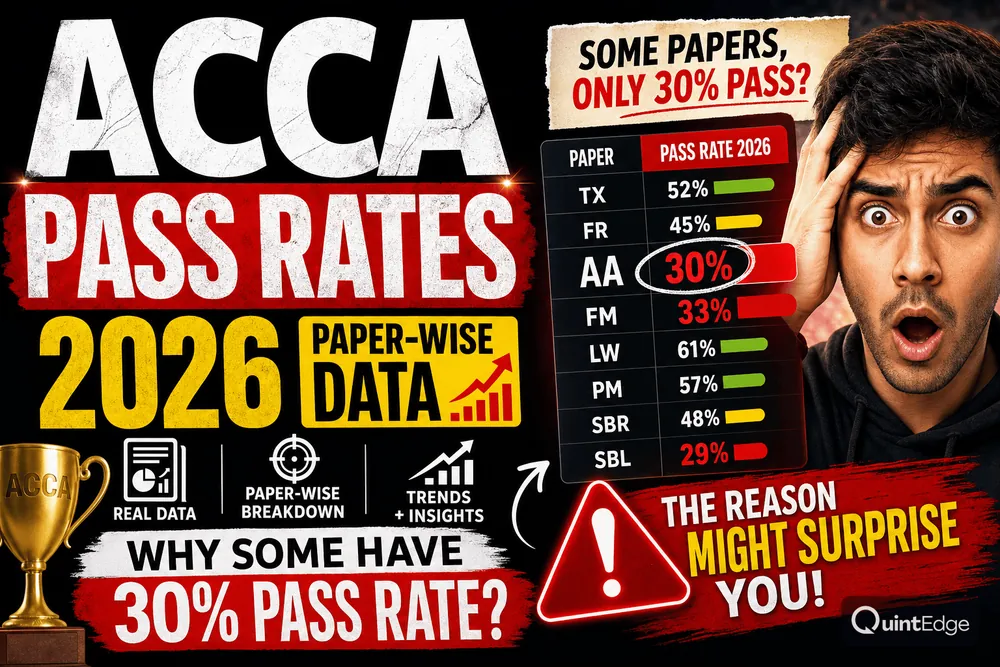
ACCA Pass Rates by Paper (2025–2026 Data)
ACCA Global publishes pass rate statistics after each exam session. The figures below are drawn from the most recent March 2026 and June 2026 sittings — the latest data ACCA Global had published when we checked in October 2026. Applied Knowledge papers (BT, MA, FA) and LW are on-demand computer-based exams, so figures reflect the June 2026 published rates; Applied Skills and Strategic Professional figures are averaged across the two most recent quarterly sittings.
ACCA's 13 papers are divided across three levels: Applied Knowledge (BT, MA, FA), Applied Skills (LW, PM, TX, FR, AA, FM), and Strategic Professional (SBL, SBR, AFM, APM, ATX, AAA). Note that students choose two optional papers at Strategic Professional from AFM, APM, ATX, and AAA.
| Paper Code | Paper Name | Level | Approx. Pass Rate | Difficulty |
|---|---|---|---|---|
| BT | Business & Technology | Applied Knowledge | 89% | Low |
| MA | Management Accounting | Applied Knowledge | 65% | Low–Medium |
| FA | Financial Accounting | Applied Knowledge | 71% | Low–Medium |
| LW | Corporate & Business Law | Applied Skills | 82% | Low–Medium |
| PM | Performance Management | Applied Skills | 43% | High |
| TX | Taxation | Applied Skills | 54% | Medium |
| FR | Financial Reporting | Applied Skills | 51% | Medium |
| AA | Audit & Assurance | Applied Skills | 45% | High |
| FM | Financial Management | Applied Skills | 49% | Medium–High |
| SBL | Strategic Business Leader | Strategic Professional | 52% | Medium–High |
| SBR | Strategic Business Reporting | Strategic Professional | 49% | Medium–High |
| AFM | Advanced Financial Management | Strategic Professional (Optional) | 46% | High |
| APM | Advanced Performance Management | Strategic Professional (Optional) | 41% | Very High |
| ATX | Advanced Taxation | Strategic Professional (Optional) | 49% | High |
| AAA | Advanced Audit & Assurance | Strategic Professional (Optional) | 41% | Very High |
Source: ACCA Global exam statistics, March 2026 & June 2026 sittings (accaglobal.com). Pass rates are approximate and vary session to session.
Pass Rate Bar Chart — All ACCA Papers
Why Strategic Professional Papers Are the Hardest
The clear step-down in pass rates between Applied Skills and Strategic Professional optional papers is not accidental — it reflects the fundamentally different nature of assessment at that stage. Even after the strong March 2026 sitting (AAA reached 42%, its highest in 15 years), AAA, APM, and AFM remain the lowest pass-rate papers in the qualification. Here are the core reasons why these papers are so much harder to pass.
1. Shift from Knowledge to Application and Judgment
Applied Knowledge and Skills papers test whether you understand concepts and can apply techniques. Strategic Professional papers test whether you can exercise professional judgment under ambiguous, multi-dimensional scenarios. The examiner is assessing how you think as a future CFO or audit partner, not merely whether you recall a formula.
2. Professional Mark Allocation
Papers like SBL and AAA include a significant chunk of marks for professional skills — communication, commercial acumen, analysis, scepticism, and evaluation. Many students prepare technically but fail to demonstrate these skills in their written answers, leaving marks on the table.
3. Time Pressure Is Extreme
Strategic Professional papers are long-form, case-study-based exams. AAA gives you four hours to work through complex audit scenarios. Students who have not practised under timed conditions consistently run out of time on question parts worth significant marks.
4. Breadth of Syllabus
AFM covers advanced derivatives, currency risk management, business valuation, and corporate restructuring — all at a level where small conceptual errors cost multiple marks. The syllabus breadth means no topic can be safely ignored, yet students often under-prepare the less familiar areas.
5. Examiner Report Insights
ACCA's published examiner reports for AAA consistently flag that candidates describe audit risks without explaining audit responses, or present generic answers that do not engage with the scenario. Students who rely on template answers without tailoring them to the specific case regularly fail even when they know the content.
6. Inadequate Practice with Past Papers
Data from ACCA Global's own student surveys suggests that a significant proportion of candidates sitting Strategic Professional papers have completed fewer than five full past papers under exam conditions. For papers where roughly 6 in 10 candidates fail, this is a critical preparation gap.
ACCA Pass Rate Historical Trends
Pass rates have shifted over the years as ACCA has reformed its qualification, moved to computer-based exams, and updated syllabi. The chart below tracks approximate pass rates for three representative papers across multiple years.
Several important observations emerge from the historical data:
- Applied Knowledge papers have stabilised at high pass rates since the transition to computer-based exams (CBE), which allows on-demand sitting and provides more flexibility for preparation.
- COVID-19 (2020) disrupted pass rates at the Strategic Professional level, with AAA dropping sharply as remote invigilation introduced additional stress and preparation disruptions.
- Applied Skills pass rates have gradually improved since 2021, partly due to better access to practice resources and stronger awareness of the applied, scenario-based question style.
- Strategic Professional optional papers have improved notably in 2025–26: AAA rose from the low-30s historically to 38% in December 2025 and 42% in March 2026 (its highest in roughly 15 years), with APM, AFM, and ATX similarly trending upward. AAA then came in at 39% in June 2026.
ACCA vs CFA vs CA Pass Rates: How Do They Compare?
One of the most common questions from students choosing between professional qualifications is: which is hardest? Pass rates offer one data point, though comparability is limited given the very different formats and assessment styles.
| Qualification | Overall / Hardest Paper Pass Rate | Number of Exams | Assessment Style |
|---|---|---|---|
| ACCA (overall average) | ~50% (all papers); 41% (AAA) | 13 papers | Mixed: MCQ + written + scenario-based |
| CFA Level 1 | ~37–44% | 3 levels | MCQ + constructed response (L3) |
| CFA Level 2 | ~40–46% | Item sets (vignette-based MCQ) | |
| CFA Level 3 | ~49–56% | Constructed response + item sets | |
| CA (ICAI, India) Final | ~10–20% (both groups) | 2 groups, 8 papers | Descriptive written |
| US CPA | ~45–55% per section | 4 sections | MCQ + task-based simulations |
Key takeaway: On raw pass rate numbers, Indian CA Final is undeniably the hardest, with pass rates regularly below 15%. ACCA's hardest papers (around 40%) and CFA Level 1 (37–44%) are broadly comparable in difficulty, though the nature of what is being tested is quite different — ACCA tests professional judgment and written communication while CFA Level 1 is entirely MCQ-based.
6 Proven Tips to Beat the ACCA Average Pass Rate
Getting above the average pass rate — especially for the harder papers — requires more than passive study. These strategies are drawn from examiner feedback, student performance data, and what separates first-time passers from repeat sitters.
1. Start with the Examiner's Report, Not the Textbook
ACCA publishes detailed examiner reports after every session. For low-pass-rate papers, these reports contain gold: they spell out exactly what candidates did wrong and what the marking team was looking for. Read the examiner report for your target paper before you open the textbook. This gives you the examiner's mindset from day one.
2. Do Full Past Papers Under Timed Conditions
There is a significant difference between working through questions comfortably at home and performing under strict time pressure. For a four-hour Strategic Professional paper, you need to complete at least eight to ten full past papers under exam conditions before sitting. Time management is the single most frequently cited reason for failure in examiner reports.
3. Master the Answer Structure Before You Master the Content
For written papers like SBL, SBR, and AAA, the structure of your answer often matters as much as the content. Learn the expected answer format: identify the issue, explain the implication, recommend a specific action. Generic answers that do not engage with scenario specifics consistently receive low marks even when the underlying knowledge is correct.
4. Focus Extra Time on Low-Pass-Rate Optional Papers
When choosing your two Strategic Professional optional papers, consider not just your interests but your ability to invest additional preparation time. AFM and AAA have the lowest pass rates. If you choose these, budget at least 200 hours of preparation — more than the typical recommendation for Applied Skills papers.
5. Use ACCA's Practice Platform and Mock Exams
ACCA Global provides an official practice platform with past questions and mock exams. Using the official platform is important because it replicates the actual interface you will use on exam day, including how to format written answers and navigate between question parts. Familiarity with the interface reduces anxiety and saves time on exam day.
6. Get Professional Coaching for the Hardest Papers
Self-study can carry you through Applied Knowledge and much of Applied Skills. But for the Strategic Professional level — particularly the optional papers, where pass rates still sit roughly 10 percentage points below the Applied Skills average — professional coaching provides structured feedback on your written answers that self-study simply cannot replicate. A tutor who has seen hundreds of student answers can spot structural weaknesses in your responses that you cannot see yourself.
Frequently Asked Questions: ACCA Pass Rates
The overall ACCA pass rate across all papers and sessions averages approximately 50%. However, this figure masks significant variation: Applied Knowledge papers (BT, MA, FA) and LW report pass rates in the 65–89% range, while Strategic Professional optional papers like AAA and APM typically sit in the 38–45% band. The overall average is therefore not a reliable indicator of any individual paper's difficulty.
AAA (Advanced Audit and Assurance) has historically recorded the lowest pass rate among all ACCA papers, though it has improved to 38% (December 2025) and 42% (March 2026) — the latter its highest in roughly 15 years. In June 2026 it was the lowest again, at 39%. APM (Advanced Performance Management) runs close behind at around 40–42%, with AFM in the mid-40s. These Strategic Professional optional papers require a fundamentally different preparation approach compared to lower-level papers.
Pass rates do vary between sessions, though the differences are generally modest (within 3–6 percentage points for most papers). Historically, the June and December sessions tend to have slightly higher sitter numbers for many papers, while March and September sessions see higher pass rates for some Applied Knowledge papers where on-demand CBE sittings have been available. ACCA Global publishes session-specific data in its exam statistics, which you can access directly from the ACCA website.
There is no officially published data from ACCA on the average number of attempts per paper. However, industry estimates suggest that for the harder Strategic Professional papers, a significant proportion of candidates require two or more attempts. For AFM and AAA specifically, anecdotal evidence from coaching providers suggests first-attempt pass rates are well below the already-low overall pass rate, as many first-time sitters underestimate the preparation required.
No. ACCA does not grade on a curve. The pass mark for all ACCA papers is 50%. Whether 40% or 80% of candidates pass a given paper depends on how many candidates actually achieve that mark — ACCA does not adjust marks to hit a target pass rate. This is an important distinction: when AAA reports a 40% pass rate, it means 60% of candidates genuinely scored below 50%, not that ACCA artificially failed them to maintain a quota.
While ACCA does not publish comparative data on coached versus self-study candidates, the pattern among professional qualification providers is consistent: structured coaching — particularly coaching that includes timed mock exams and written answer feedback — correlates with significantly higher first-attempt pass rates. For Applied Knowledge papers, self-study is often sufficient. For Strategic Professional papers, especially the optional papers in the 40–50% pass-rate band, professional coaching provides the feedback loop on written answer quality that self-study cannot replicate.
ACCA's own guidance suggests approximately 150–200 hours of study per paper at the Applied Skills level. For Strategic Professional optional papers like AFM, APM, and AAA where pass rates typically sit in the 40–50% band, many coaching providers — including QuintEdge — recommend budgeting 200–250 hours, with a significant portion devoted to timed past paper practice and answer review rather than passive content revision. The quality and type of study hours matters as much as the quantity.
ACCA Global publishes official pass rate statistics on its website after each exam session, typically within a few weeks of results being released. You can find this data under the "Exam Statistics" or "Student Resources" section of the ACCA Global website (accaglobal.com). The statistics include pass rates broken down by paper and by session, making it possible to track trends over time and compare your target papers specifically.


