
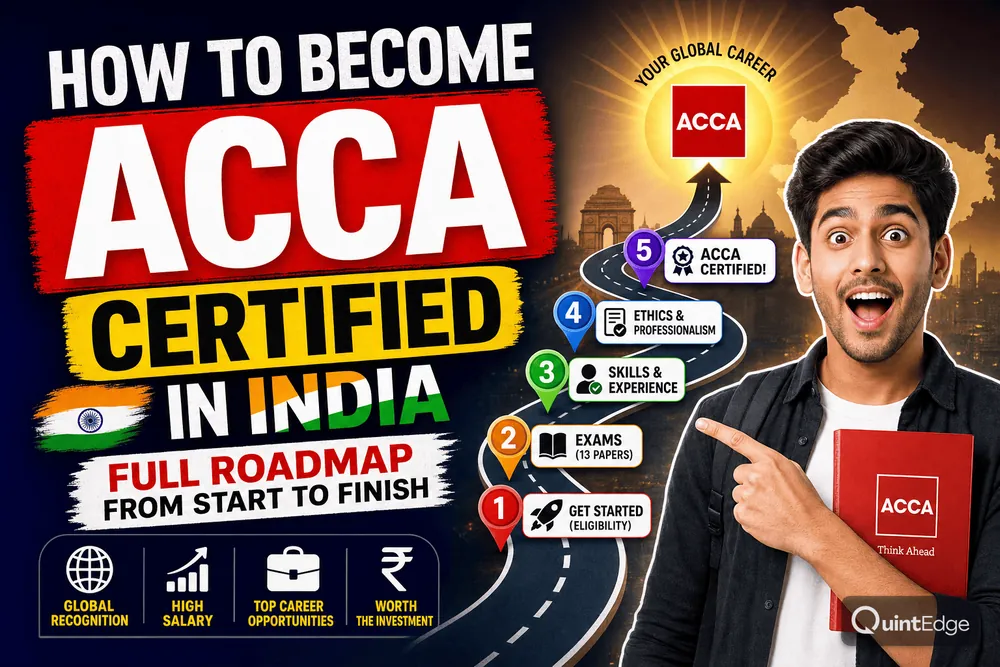
What Is ACCA and Why Indian Students Pursue It
The Association of Chartered Certified Accountants (ACCA) is a globally recognised professional accounting qualification headquartered in London, UK. Per ACCA's own published figures, it has over 252,500 members and 544,000 students across 178+ countries, making it one of the most sought-after finance qualifications for Indian students who want careers that extend beyond domestic borders.
Unlike the Indian CA (ICAI) qualification, ACCA does not require mandatory articleship, offers flexible exam scheduling across four windows per year, and provides a direct pathway to roles at Big 4 firms, multinational banks, and global corporations. For students in India — particularly B.Com, BBA, and CA Inter holders — ACCA offers a structured, internationally portable credential that can be completed alongside a job or degree.
Quick answer
To become ACCA certified in India: register on myACCA (eligibility from Class 12 with 65%+ in Maths/Accounts and English, or via graduation with exemptions), clear 13 papers across 3 levels (as few as 4 papers with CA Final exemptions), complete 36 months of Practical Experience (PER) plus the Ethics and Professional Skills Module, then apply for membership. Total cost is roughly ₹3.2–4.7 lakh (self-study vs with coaching), and most students finish in 2.5 to 3.5 years while working.
This roadmap covers every step of the ACCA journey: from checking your eligibility to completing the Practical Experience Requirement (PER) and earning your membership. We have included actual fee breakdowns in INR, realistic timelines, exemption details, and career outcomes specific to the Indian market.
Step 1: What Is the Eligibility for ACCA in India?
You are eligible for ACCA in India either after Class 12 (65%+ in Maths/Accounts and English, plus 50% in three other subjects) — sitting all 13 papers — or after graduation (B.Com, BBA, MBA) or a professional qualification (CA Inter/Final, CMA Inter), which unlocks exemptions on select papers. ACCA has relatively accessible entry requirements compared to many professional qualifications, with two primary entry routes for Indian students.
Route 1: After Class 12 (10+2)
If you have completed Class 12 with at least 65% aggregate in Mathematics or Accounts and English, plus 50% in three other subjects, you are eligible to register for ACCA. This means you can start ACCA right after school — a significant advantage for students who want to build their qualification early. You will need to appear for all 13 papers.
Students who do not meet the academic cut-off can still enter via the Foundations in Accountancy (FIA) route — an alternative entry pathway that builds up to the ACCA Qualification through introductory diplomas.
Route 2: After Graduation or Professional Qualifications
Graduates (B.Com, BBA, MBA, M.Com) and holders of professional qualifications (CA Inter, CA Final, CMA Inter) can register with potential exemptions from several papers. This is the more common route, and it substantially reduces both cost and completion time.
| Qualification | Eligible? | Typical Exemptions | Papers to Sit |
|---|---|---|---|
| Class 12 (65%+) | Yes | 0 | 13 |
| B.Com (Indian University) | Yes | Up to 4 | 9 |
| BBA / BBM | Yes | Up to 3 | 10 |
| CA Inter (ICAI) | Yes | Up to 5 | 8 |
| CA Final (ICAI) | Yes | Up to 9 | 4 |
| CMA Inter (ICMAI) | Yes | Up to 4 | 9 |
| MBA (Finance) | Yes | Up to 5 | 8 |
Exemptions are evaluated on a case-by-case basis depending on your university, syllabus, and grades. You can check your specific exemptions using the ACCA Exemption Calculator on the official ACCA website before registering.
Step 2: How Do You Register With ACCA?
Registration is entirely online through the myACCA portal: create an account, upload your Class 12 marksheet (and graduation certificate, if applicable), photo, and ID proof, apply for exemptions, and pay the registration fee of approximately ₹3,800 (£30 on ACCA's India price list, as of October 2026). ACCA typically processes registrations within 2–4 weeks. Here is the full step-by-step process:
- Visit the ACCA website and click "Register with ACCA"
- Create your myACCA account with your email and personal details
- Upload documents: Class 12 marksheet, graduation certificate (if applicable), passport-size photograph, and ID proof (Aadhaar or passport)
- Apply for exemptions by uploading transcripts and syllabus details from your university
- Pay the registration fee (approximately ₹3,800, i.e. £30, as of October 2026)
- Receive confirmation — ACCA typically processes registrations within 2–4 weeks
Once registered, you get access to the myACCA portal where you can book exams, track your progress, access study resources, and manage your PER (Practical Experience Requirement).
Key Takeaway
Apply for exemptions during registration, not after. This saves both time and money. Ensure your university transcripts clearly list subjects and credit hours — ACCA uses these to evaluate exemption eligibility.
Step 3: What Is the ACCA Exam Structure?
ACCA has 13 papers across 3 progressive levels: Applied Knowledge (3 papers), Applied Skills (6 papers), and Strategic Professional (4 papers — 2 compulsory plus 2 of 4 optional). All papers carry a 50% pass mark, and each level builds on the previous one, moving from foundational concepts to strategic decision-making. Here is the complete structure:
Level 1: Applied Knowledge (3 papers)
These are the entry-level papers that cover the basics of business, management accounting, and financial accounting. They are computer-based exams (CBEs) available on demand throughout the year.
- BT — Business and Technology
- MA — Management Accounting
- FA — Financial Accounting
Level 2: Applied Skills (6 papers)
The core of the ACCA qualification. These papers test technical proficiency in corporate law, performance management, taxation, financial reporting, audit, and financial management. LW is an on-demand CBE; PM, TX, FR, AA and FM are session-based exams offered in March, June, September, and December.
- LW — Corporate and Business Law
- PM — Performance Management
- TX — Taxation
- FR — Financial Reporting
- AA — Audit and Assurance
- FM — Financial Management
Level 3: Strategic Professional (4 papers — 2 compulsory + 2 optional)
The final level focuses on strategic leadership and specialised expertise. You must pass both compulsory papers and choose 2 out of 4 optional papers.
- SBL — Strategic Business Leader (compulsory)
- SBR — Strategic Business Reporting (compulsory)
- AFM — Advanced Financial Management (optional)
- APM — Advanced Performance Management (optional)
- ATX — Advanced Taxation (optional)
- AAA — Advanced Audit and Assurance (optional)
All ACCA exams have a pass mark of 50%. Applied Knowledge papers are 2 hours each, Applied Skills papers are 3 hours (LW is 2 hours), and Strategic Professional papers are 3 hours 15 minutes (SBL is 4 hours). You can attempt a maximum of 4 papers per exam session.
Step 4: How Do You Claim ACCA Exemptions?
Check eligibility on the ACCA Exemption Calculator, submit transcripts showing subjects/grades/credit hours, and pay the exemption fee — approximately ₹10,700–14,200 per paper (£84 Applied Knowledge, £111 Applied Skills), less than sitting the exam — with confirmation usually within 2–4 weeks. Exemptions are one of ACCA's most student-friendly features: if you have already studied relevant subjects as part of your degree or a prior professional qualification, you may be exempt from sitting certain papers, saving both time and exam fees.
Here is how the exemption process works:
- Check eligibility using the ACCA Exemption Calculator before registration
- Submit transcripts — detailed marksheets showing subjects, grades, and credit hours
- Pay exemption fees — each exemption costs approximately ₹10,700 (Applied Knowledge) or ₹14,200 (Applied Skills), less than the exam fee for that paper
- Receive confirmation — usually within 2–4 weeks of document submission
A critical point many students miss: exemptions are not free — you pay a fee for every exempted paper. However, the time saving is enormous — skipping 4 papers can save you 12–18 months of study time. The net ROI of claiming exemptions is overwhelmingly positive.
| Indian Qualification | Papers Exempted | Exemption Fee (Approx.) | Time Saved |
|---|---|---|---|
| B.Com (Most Universities) | BT, MA, FA, LW | ~₹46,400 | 8–12 months |
| CA Inter (Both Groups) | BT, MA, FA, LW, TX | ~₹60,600 | 12–18 months |
| CA Final | BT, MA, FA, LW, PM, TX, FR, AA, FM | ~₹1,17,400 | 24–30 months |
| CMA Inter (ICMAI) | BT, MA, FA, PM | ~₹46,400 | 8–12 months |
| MBA (Finance) | BT, MA, FA, LW, PM | ~₹60,600 | 12–18 months |
Step 5: How Do You Build an ACCA Study Plan?
Budget 100–130 study hours per Applied Knowledge paper, 150–200 per Applied Skills paper, and 200–250 per Strategic Professional paper, sitting exams in the recommended level order (PM, TX, FR, AA, FM and Strategic Professional run four session windows a year: March, June, September, December). With your exemptions claimed and registration confirmed, here is the recommended approach based on the experience of students who clear ACCA within 2.5–3 years:
Recommended Exam Order
ACCA does not mandate a strict order within each level, but a logical progression reduces difficulty spikes:
- Applied Knowledge: BT → FA → MA (if not exempted)
- Applied Skills: LW → FR → PM → TX → FM → AA
- Strategic Professional: SBR → SBL → Choose 2 optionals (AFM and AAA are the most popular among Indian students)
Study Hours Per Paper
ACCA recommends 150–200 hours of study per Applied Skills paper and 200–250 hours per Strategic Professional paper. Applied Knowledge papers require approximately 100–130 hours each. A student working full-time can realistically prepare for 1–2 papers per exam session, while a full-time student can attempt 3–4 papers per session.
Exam Windows
Session-based exams (PM, TX, FR, AA, FM and Strategic Professional) are held four times per year: March, June, September, and December. Applied Knowledge papers and LW can be taken on demand at any ACCA-approved CBE centre throughout the year.
Step 6: What Is the ACCA Practical Experience Requirement (PER)?
PER is 36 months (3 years) of relevant, salaried work experience under a supervisor, during which you must achieve 9 Performance Objectives (all 5 Essentials plus any 4 Technical). Passing all 13 exams alone does not make you an ACCA member — you also need to complete this practical-experience requirement, logged through ACCA's My Experience portal.
The PER is designed to ensure that ACCA members have real-world competence, not just theoretical knowledge. Here is what you need to know:
- Duration: 36 months of supervised work experience
- Performance Objectives: You must achieve 9 Performance Objectives in total — all 5 Essentials, plus any 4 Technical objectives of your choice
- Recording: Experience is logged through ACCA's My Experience portal in your myACCA account
- Employer type: Any relevant employer — Big 4, corporate, bank, startup, or accounting practice. It does not need to be an ACCA-approved employer (though it helps)
- Timing: PER can be completed before, during, or after passing your exams. Most students start it alongside their studies
- Supervisor: You need a practical experience supervisor (PES) — a workplace mentor who oversees your progress and signs off on your objectives
The biggest advantage of PER over CA articleship is flexibility and market-rate pay. You work in a regular, salaried role — there is no stipend-based training contract. This means you can earn ₹4–8 LPA even while completing your PER, rather than the ₹3,000–5,000/month stipends common in CA articleship.
Step 7: What Is the ACCA Ethics and Professional Skills Module?
It is an online, self-paced module taking approximately 20 hours, covering professional ethics, stakeholder management, communication, and commercial awareness, for a one-time fee of £83 (about ₹10,600). It must be completed before you can apply for ACCA membership, though it can be done at any point during your studies.
Key details about the ethics module:
- Format: Online, self-paced with interactive activities and assessments
- Duration: Approximately 20 hours to complete
- Cost: £83 (about ₹10,600), paid once
- Timing: Must be completed before you can apply for membership, but can be done at any point during your studies
- Assessment: Continuous assessment throughout the module — there is no single final exam
Most students complete this module alongside their Applied Skills or early Strategic Professional studies. It is straightforward and should not be a source of stress, but do not leave it until the last minute.
Step 8: How Much Does ACCA Cost in India (2026)?
For a B.Com graduate with 4 exemptions, total ACCA cost (with coaching) runs ₹4.0–4.7 lakh, or about ₹3.2 lakh via self-study — covering registration (₹3,800 one-time), annual subscription (₹17,900), and per-paper exam/exemption fees (₹10,700–34,300 depending on level). Here is the comprehensive breakdown of all fees in Indian Rupees (illustrative, at ₹127.9 per £, from ACCA's India price list for the December 2026 session, checked in October 2026):
| Fee Component | Amount (Approx. INR) | Frequency |
|---|---|---|
| Initial Registration Fee | ₹3,800 (£30 India price; regular £89) | One-time |
| Annual Subscription Fee | ₹17,900 (£140 in 2026) | Per year, due by 1 January |
| Applied Knowledge Exam Fee (per paper) | Set by the CBE centre (e.g. ₹18,880 at QuintEdge Mumbai, incl. 18% GST) | Per attempt |
| Applied Skills Exam Fee (per paper) | ₹19,300 (£151; LW is set by the CBE centre, e.g. ₹24,780 at QuintEdge Mumbai) | Per attempt |
| Strategic Professional Exam Fee (per paper) | ₹24,400–₹34,300 (£191 SBR and Options; £268 SBL) | Per attempt |
| Exemption Fee (per paper) | ₹10,700–₹14,200 (£84 Applied Knowledge; £111 Applied Skills) | Per exemption |
| Ethics Module | ₹10,600 (£83) | One-time |
| Membership Admission Fee (after qualifying) | ₹20,800 (£163) | One-time; members then pay £326 a year (about ₹41,700, 2026) |
For a B.Com graduate with 4 exemptions, the total ACCA cost (including coaching) typically falls between ₹4.0 lakh and ₹4.7 lakh. Without coaching (self-study route), the ACCA-only fees come to approximately ₹3.2 lakh. This is substantially lower than the total cost of a CA qualification when you factor in opportunity cost of articleship.
Step 9: How Long Does ACCA Take to Complete in India?
Timelines range from 3–4 years after Class 12 (0 exemptions, full-time) to 8–14 months after CA Final (9 exemptions, part-time), with B.Com and CA Inter starters typically finishing in 2–3 years. Here is the realistic timeline for each starting point, assuming consistent study with 1–2 papers per exam session and no retakes:
| Starting Point | Exemptions | Study Mode | Expected Duration |
|---|---|---|---|
| After Class 12 | 0 exemptions | Full-time student | 3–4 years |
| After B.Com | 4 exemptions | Part-time (working) | 2.5–3 years |
| After CA Inter | 5 exemptions | Part-time (working) | 2–2.5 years |
| After CA Final | 9 exemptions | Part-time (working) | 8–14 months |
| After MBA (Finance) | 5 exemptions | Part-time (working) | 2–2.5 years |
Remember that the 36-month PER runs concurrently with your exam preparation. If you start working in a relevant finance role from the beginning of your ACCA journey, your PER will be complete by the time you finish your exams. This is a significant time-saving advantage over the CA model where articleship and exams have more rigid sequencing.
Step 10: What Are the Career Outcomes After ACCA in India?
ACCA-qualified professionals in India work across audit & assurance, financial reporting/IFRS advisory, FP&A, taxation, and corporate finance at employers like the Big 4, Amazon, Google, and HSBC, with entry pay of roughly ₹6–16 LPA rising to ₹25–60 LPA at senior level (CFO tracks reach ₹50 LPA–1.5 Cr+). Here are the primary career paths and indicative salary ranges for ACCA-qualified professionals in the Indian market:
| Career Path | Typical Employers | Salary Range (INR) |
|---|---|---|
| Audit & Assurance | Deloitte, PwC, EY, KPMG | ₹6–12 LPA (entry) → ₹25–40 LPA (senior) |
| Financial Reporting & IFRS Advisory | Big 4, MNC GDCs, Consulting firms | ₹7–14 LPA (entry) → ₹30–50 LPA (senior) |
| Management Accounting & FP&A | Amazon, Google, Unilever, Siemens | ₹8–15 LPA (entry) → ₹35–55 LPA (senior) |
| Taxation & Transfer Pricing | Big 4, Law firms, MNCs | ₹7–12 LPA (entry) → ₹25–45 LPA (senior) |
| Corporate Finance & Treasury | HSBC, JP Morgan, Standard Chartered | ₹8–16 LPA (entry) → ₹35–60 LPA (senior) |
| CFO / Finance Director | MNCs, Listed companies, PE-backed firms | ₹50 LPA – ₹1.5 Cr+ (leadership) |
The international mobility factor is equally significant. Indian ACCA members frequently relocate to Dubai, Singapore, London, and Australia where salaries are 2–4x higher than domestic levels. ACCA's recognition in over 180 countries means your qualification travels with you — unlike the Indian CA, which has limited recognition outside India.
Key Takeaway
ACCA is not a replacement for CA India if your goal is domestic statutory audit or Indian tax practice. However, for MNC careers, Big 4 roles, IFRS advisory, international mobility, and corporate finance leadership, ACCA delivers a measurably higher return on investment with greater flexibility.
Frequently Asked Questions: How to Become ACCA Certified in India
Yes. If you have scored at least 65% in Mathematics or Accounts and English, plus 50% in three other subjects in Class 12, you are eligible to register for ACCA. You will need to appear for all 13 papers since no exemptions are available at this stage. Students who do not meet these marks can still enter via the Foundations in Accountancy (FIA) route. Many students pursue ACCA alongside their undergraduate degree, which allows them to complete both simultaneously.
B.Com graduates from recognised Indian universities can receive up to 4 exemptions, typically covering BT (Business and Technology), MA (Management Accounting), FA (Financial Accounting), and LW (Corporate and Business Law). The exact number depends on your university syllabus and subjects studied. Use the ACCA Exemption Calculator on the official website to check your specific eligibility.
The total cost of ACCA in India (including registration, annual subscription, exam fees, exemption fees, the Ethics module, and coaching) ranges from approximately ₹4.0 lakh to ₹4.7 lakh for a B.Com graduate with 4 exemptions. If you choose the self-study route without coaching, the ACCA-only fees come to about ₹3.2 lakh. Retakes add ₹19,300–₹34,300 per paper depending on the level.
Most Indian students complete ACCA in 2.5 to 3.5 years when studying part-time alongside work or college. With exemptions from B.Com (4 papers) or CA Inter (5 papers), the timeline shortens to 2–2.5 years. CA Final holders can complete ACCA in as little as 8–14 months since they receive up to 9 exemptions and only need to pass 4 papers.
PER requires 36 months of relevant work experience where you demonstrate competence across 9 Performance Objectives — all 5 Essentials plus any 4 Technical objectives. Unlike CA articleship, PER can be completed at any relevant employer — Big 4, corporate, bank, or startup — and you earn market-rate salaries. The experience can be gained before, during, or after passing your exams, and runs concurrently with your study period. Progress is logged via ACCA's My Experience portal under a workplace mentor.
Yes. ACCA is widely recognised by major employers in India including all Big 4 firms (Deloitte, PwC, EY, KPMG), multinational banks (JP Morgan, HSBC, Standard Chartered), tech companies (Amazon, Google, TCS, Infosys), and consulting firms (Accenture, Genpact, WNS). However, ACCA does not provide statutory audit signing authority in India — only ICAI-qualified Chartered Accountants have that right.
Yes, many students pursue ACCA alongside CA preparation. A common approach is to clear CA Inter first, then register for ACCA with 5 exemptions while continuing CA Final preparation. After clearing CA Final, you receive up to 9 ACCA exemptions and only need to pass 4 papers. This dual-qualification strategy takes more effort but provides both domestic statutory audit rights (via CA) and international mobility (via ACCA).
ACCA freshers (newly qualified members or affiliates) in India typically earn between ₹5–8 LPA depending on the employer and city. Big 4 firms offer ₹6–8 LPA, while corporate roles at MNCs start at ₹6–10 LPA. In metro cities like Mumbai, Bangalore, and Delhi, salaries tend to be at the higher end. With 3–5 years of post-qualification experience, ACCA professionals commonly earn ₹12–20 LPA, and senior roles exceed ₹30 LPA.


