
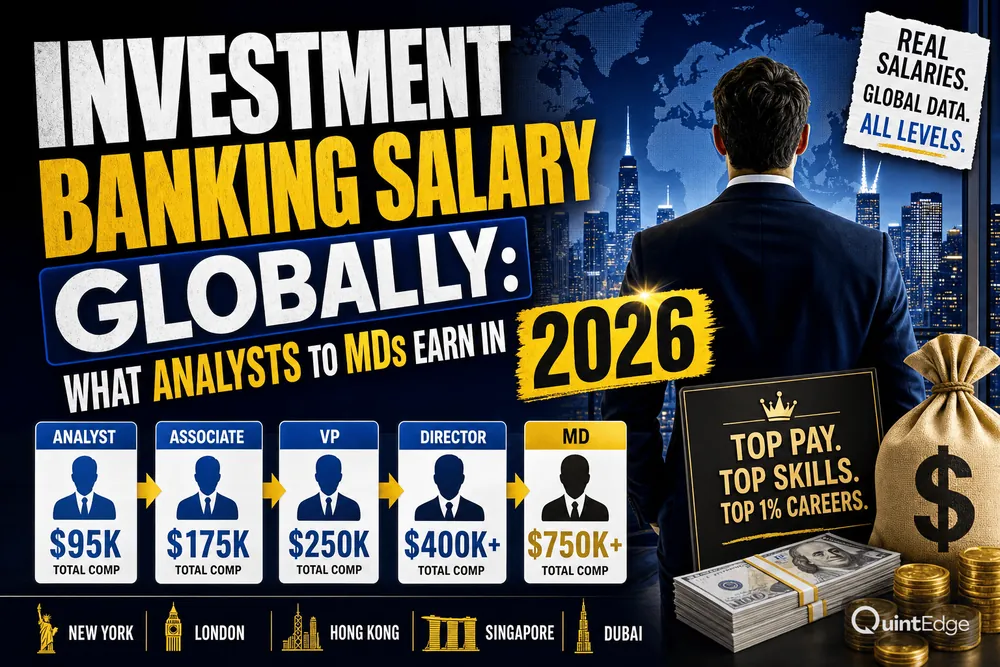
Investment Banking Salary in 2026: The Global Picture
Investment banking remains one of the most lucrative career paths in finance, attracting top talent from IIMs, ISB, and Ivy League institutions alike. Whether you are a fresher eyeing an analyst seat at Goldman Sachs Mumbai or a seasoned VP exploring a move to JP Morgan Hong Kong, understanding the compensation landscape is critical to making informed career decisions.
Across 2024-2025, the IB market saw a meaningful rebound in deal activity from the 2022-2023 trough, lifting banker bonuses overall. Yet the salary story is nuanced: junior compensation has remained relatively flat at the base-salary level, while Managing Directors and senior rainmakers captured a larger share of bonus increases. Banks remain in an employer-friendly market for entry-level talent, directing the largest pay increases toward senior bankers who generate deal flow. Specific bonus levels fluctuate year-to-year with market conditions.
This guide breaks down investment banking salaries from Analyst through Managing Director across six major financial centres — New York, London, Dubai, Singapore, Hong Kong, and Mumbai — with INR equivalents for every figure so Indian professionals can benchmark accurately.
Investment Banking Salary by Seniority Level (US Benchmarks)
The United States — specifically New York — sets the global benchmark for investment banking compensation. All other markets are typically priced relative to Wall Street pay. Below is a detailed breakdown of 2026 compensation across seniority levels at bulge bracket banks (Goldman Sachs, JP Morgan, Morgan Stanley, Bank of America) and elite boutiques (Evercore, Lazard, PJT Partners, Centerview).
| Seniority Level | Years of Experience | Base Salary (USD) | Total Comp (USD) | Total Comp (INR Approx.) |
|---|---|---|---|---|
| Analyst 1 | 0-1 | $110K-$115K | $190K-$245K | INR 1.85-2.35 Cr |
| Analyst 2 | 1-2 | $115K-$125K | $210K-$260K | INR 2.05-2.5 Cr |
| Analyst 3 | 2-3 | $125K-$135K | $230K-$280K | INR 2.2-2.7 Cr |
| Associate 1 | 3-4 | $175K-$200K | $325K-$450K | INR 3.15-4.35 Cr |
| Associate 2-3 | 4-6 | $200K-$225K | $400K-$550K | INR 3.85-5.3 Cr |
| Vice President | 6-10 | $250K-$350K | $500K-$1M | INR 4.85-9.7 Cr |
| Director / SVP | 8-12 | $300K-$400K | $800K-$1.5M+ | INR 7.75-14.5 Cr+ |
| Managing Director | 10+ | $400K-$500K | $1M-$5M+ | INR 9.7-48.3 Cr+ |
Important nuances: Analyst bonuses are paid 100% in cash. Starting at the Associate level, 20-30% of the bonus shifts to deferred stock or restricted compensation. At the MD level, 30-50% of bonuses may be deferred over 3-5 years, tying payouts to firm performance and retention.
Total Compensation Progression: Analyst to MD (USD, 000s)
Investment Banking Salary by Bank: Goldman Sachs, JP Morgan & Elite Boutiques
Not all banks pay the same. The gap between a bulge bracket and a mid-market firm can be $50K-$100K at the associate level alone. Here is how the top banks compare for first-year associate total compensation in 2026:
| Bank | Type | Associate 1 Base (USD) | Associate 1 Total Comp (USD) | Total Comp (INR Approx.) |
|---|---|---|---|---|
| Goldman Sachs | Bulge Bracket | $200K | $400K-$450K | INR 3.85-4.35 Cr |
| JP Morgan | Bulge Bracket | $190K-$200K | $375K-$425K | INR 3.6-4.1 Cr |
| Morgan Stanley | Bulge Bracket | $190K-$200K | $370K-$420K | INR 3.55-4.05 Cr |
| Bank of America | Bulge Bracket | $185K-$195K | $350K-$400K | INR 3.4-3.85 Cr |
| Evercore | Elite Boutique | $200K | $400K-$450K | INR 3.85-4.35 Cr |
| Lazard | Elite Boutique | $190K-$200K | $375K-$425K | INR 3.6-4.1 Cr |
| PJT Partners | Elite Boutique | $200K | $400K-$450K | INR 3.85-4.35 Cr |
| Centerview Partners | Elite Boutique | $200K | $400K-$450K | INR 3.85-4.35 Cr |
Base Salary vs. Bonus: How the Split Works
One of the most misunderstood aspects of investment banking pay is the base-to-bonus ratio. While base salaries are relatively standardised across banks (especially at junior levels), bonuses create enormous variance in total compensation. Understanding this split is essential for financial planning.
At the Analyst level: Bonuses typically range from 70-115% of base salary. A first-year analyst earning a $115K base might receive a $80K-$130K bonus, totalling roughly $190K-$245K. By the third year, bonuses often match or exceed base salary.
At the Associate level: Bonuses can equal or exceed base salary, but 20-30% of the bonus may be deferred into restricted stock or cash payable over 2-3 years. A first-year associate at a bulge bracket with a $200K base and $200K bonus may receive roughly $150K in cash bonus and $50K in deferred compensation.
At VP and above: The deferred percentage increases. VPs might see 25-35% of bonus deferred, while MDs typically defer 30-50% of their bonus. An MD earning a $450K base with a $1M bonus might receive only $500K-$700K in immediate cash, with the remainder vesting over 3-5 years.
For Indian professionals considering international IB roles, this deferred compensation structure is important when comparing offers. A seemingly lower-paying offer with 100% cash bonus may provide better short-term liquidity than a higher total comp package with significant deferrals — particularly relevant if you plan to repatriate funds to India.
Investment Banking Salary by City: New York, London, Dubai, Singapore, Hong Kong & Mumbai
Geography is one of the largest determinants of investment banking pay. The same role at the same bank can pay very differently depending on whether you sit in New York, London, or Mumbai. Below is a comprehensive city-by-city comparison.
New York: The Global Benchmark
New York remains the highest-paying market in gross terms. First-year analysts at bulge brackets earn $110K-$115K base with total compensation of $190K-$245K. VPs earn $500K-$1M all-in, and MDs at top-performing groups typically earn $1M-$5M+ in total comp. However, combined federal, state, and city taxes can reduce take-home pay by 40-45%.
INR equivalent: A first-year analyst's $215K total comp equals approximately INR 2.08 Cr. An MD's $2M package translates to about INR 19.3 Cr gross.
London: Europe's Finance Capital
London salaries are typically 5-10% below New York at junior levels and broadly comparable at senior levels. First-year analyst base salaries sit at approximately GBP 80K-90K (around $100K-$115K), with total compensation of GBP 140K-180K. Bonuses commonly run 70-100% of base at the analyst level. UK taxes are significant — the highest marginal rate is 45%, plus National Insurance contributions — which means net take-home is often lower than equivalent US positions.
INR equivalent: A London analyst's GBP 160K total comp translates to approximately INR 2.05 Cr.
Dubai: The Tax-Free Advantage
Dubai has emerged as a serious competitor for banking talent precisely because of its zero personal income tax policy. Gross packages at global banks are broadly comparable to New York in absolute terms — analysts earn roughly $110K-$120K base with total comp of $180K-$240K, VPs earn $500K-$900K, and MDs frequently exceed $1M total comp. Because there is no personal income tax, net take-home in Dubai often exceeds what bankers in New York or London keep.
INR equivalent: A Dubai analyst's $200K total comp (largely tax-free) translates to approximately INR 1.93 Cr net — meaningfully higher in net terms than the equivalent role in New York or London after taxes.
Singapore: Asia-Pacific Hub
Singapore offers competitive compensation with relatively favourable tax rates (top marginal rate around 24%). First-year analysts at bulge brackets typically earn SGD 140K-160K base, with total compensation of SGD 240K-320K including bonuses. Managing Directors can earn SGD 1M+ in strong years. Singapore also serves as the regional hub for Southeast Asian deal flow, providing excellent deal experience.
INR equivalent: An analyst's SGD 280K total comp equals approximately INR 2 Cr.
Hong Kong: Greater China Gateway
Hong Kong remains a critical market for investment banking in Asia, particularly for China-related deal flow. First-year analyst base salaries sit at approximately HKD 850K-950K ($110K-$120K), with total compensation typically in the HKD 1.5M-1.9M range ($190K-$245K). Top performers can earn higher. Hong Kong's maximum tax rate of 15-17% makes it highly attractive on a net basis.
INR equivalent: An analyst's HKD 1.7M total comp translates to approximately INR 2.1 Cr.
Mumbai: India's Financial Capital
India's investment banking market is distinct from Western markets. At global banks (Goldman Sachs, JP Morgan, Morgan Stanley, Citi) with India operations, starting analyst salaries are INR 18-22 LPA with bonuses of INR 5-15 LPA, bringing total compensation to INR 25-35 LPA. At domestic firms (Avendus, Kotak Investment Banking, ICICI Securities, JM Financial), analyst salaries start at INR 10-14 LPA with bonuses of INR 2-5 LPA.
The India compensation gap widens dramatically at senior levels. VPs at global banks in Mumbai earn INR 39-72 LPA, while Managing Directors at top firms earn INR 1.5-2.5 Cr base with total packages reaching INR 2-5 Cr in strong deal years.
First-Year Analyst Total Compensation by City (USD Equivalent)
Investment Banking Salary in India: Detailed Breakdown
India's investment banking landscape is split between global bank operations and domestic advisory firms, and the pay gap between these two categories is substantial. Here is a detailed breakdown specifically for Indian professionals.
| Level | Global Banks (GS, JPM, MS, Citi) - INR LPA | Domestic Firms (Avendus, Kotak, ICICI Sec) - INR LPA |
|---|---|---|
| Analyst (0-3 yrs) | INR 18-35 LPA | INR 10-18 LPA |
| Associate (3-5 yrs) | INR 25-45 LPA | INR 15-30 LPA |
| Vice President (5-10 yrs) | INR 45-75 LPA | INR 30-55 LPA |
| Director (8-12 yrs) | INR 75 LPA - 1.5 Cr | INR 50 LPA - 1 Cr |
| Managing Director (10+ yrs) | INR 1.5-5 Cr | INR 1-3 Cr |
Key factors affecting India IB salary:
- Firm type matters most: A Goldman Sachs analyst in Mumbai earns 60-80% more than an analyst at a mid-tier domestic firm.
- MBA pedigree: Graduates from IIM-A, IIM-B, IIM-C, ISB, and XLRI command the highest starting packages. Top IIM graduates entering IB can expect INR 25-30 LPA or more as first-year analysts at global banks.
- City premium: Mumbai remains the dominant IB hub and pays the highest salaries. Bangalore and Delhi NCR are growing, especially for global capability centres and offshore IB teams.
- CFA and financial modelling skills: Professionals with CFA Level 1 or above and strong financial modelling capabilities typically command a 15-25% premium over peers without these qualifications.
Buy-Side vs. Sell-Side Compensation: How They Compare
Investment banking (sell-side) is just one part of the finance compensation picture. Many IB professionals eventually transition to buy-side roles — private equity, hedge funds, and asset management — where the compensation structure and ceiling differ significantly.
| Factor | Sell-Side (Investment Banking) | Buy-Side (PE / Hedge Funds) |
|---|---|---|
| Entry Comp (Post-MBA) | $300K-$360K | $350K-$500K+ (PE); $300K-$600K (HF) |
| Mid-Career (VP equiv.) | $450K-$650K | $600K-$1M+ (PE Principal); variable at HFs |
| Senior (MD equiv.) | $500K-$1M+ | $1M-$5M+ (PE Partner); $1M-$10M+ (HF PM) |
| Compensation Structure | Base + cash/deferred bonus | Base + bonus + carried interest (PE) or P&L share (HF) |
| Upside Potential | Capped; tied to bank revenue | Uncapped; tied to fund performance |
| Job Security | Moderate; cyclical layoffs | Lower; performance-driven exits |
| Hours | 70-90 hrs/week (analyst/associate) | 60-80 hrs/week (varies widely) |
For Indian professionals, the buy-side premium is even more pronounced when considering offshore PE and hedge fund roles based in Mumbai or Bangalore. Senior professionals at firms like KKR India, Blackstone India, or Edelweiss Alternative Asset Advisors can earn INR 1-3 Cr at the Principal/Director level, with carried interest providing additional upside over 5-8 year fund cycles.
How to Break Into Investment Banking: A Roadmap for Indian Professionals
Knowing what investment bankers earn is motivating, but the real question is: how do you get there? Here is a practical roadmap tailored for Indian professionals looking to enter the field.
Step 1: Build the Right Academic Foundation
Target a B.Com, BBA, or B.Tech from a top institution, followed by an MBA from IIM-A/B/C, ISB, XLRI, or a top global school. Investment banks recruit heavily from campus placements at these institutions. If you are already working, a CFA charter combined with strong financial modelling skills can open doors to lateral entry.
Step 2: Master Financial Modelling
Technical skills are the price of entry. You must be proficient in DCF valuation, LBO modelling, merger models, comparable company analysis, and precedent transactions. Banks will test these skills rigorously in interviews, and you will use them daily on the job. Structured certification programmes are the fastest way to build this competency.
Step 3: Network Strategically
In India, networking is particularly important for IB recruitment outside the traditional campus placement cycle. Attend finance conferences, connect with alumni working at target banks on LinkedIn, and pursue informational interviews. Many lateral hires into Goldman Sachs or JP Morgan India come through referral networks rather than job postings.
Step 4: Target the Right Entry Points
If bulge bracket banks seem out of reach initially, consider starting at a Big 4 transaction advisory practice (Deloitte, PwC, EY, KPMG) or a domestic IB firm like Avendus or Kotak Investment Banking. Two to three years of deal experience at these firms creates a viable path to lateral into a global bank at the associate level.
Step 5: Prepare Intensively for Interviews
IB interviews test technical knowledge (accounting, valuation, M&A mechanics), market awareness (recent deals, sector trends), and behavioural fit (teamwork, handling pressure). Preparation should include 50-100 hours of dedicated practice across these categories.
Investment Banking Salary Outlook for 2026 and Beyond
Looking ahead, several trends will shape IB compensation through 2026 and into 2027:
- Flat bonuses at junior levels: Despite strong deal flow, banks are not under competitive pressure to raise analyst and associate pay significantly. Hiring in competing sectors like Big Tech, consulting, and law remains sluggish, giving banks leverage.
- Senior banker premiums continue: MDs and senior Directors who generate deal flow will continue to see outsized pay increases. The top-to-bottom pay ratio within IB teams is widening.
- India growth story: India's M&A market and IPO pipeline remain robust. Global banks are expanding their India coverage teams, which should gradually push domestic IB salaries higher — particularly at the VP and Director level.
- Dubai and Singapore gaining share: Both cities are attracting banking talent with favourable tax regimes. Expect continued salary inflation in these markets as banks build out regional teams.
- AI and automation impact: While AI tools are improving analyst productivity (particularly in pitchbook creation and data analysis), they have not reduced headcount or depressed salaries yet. Banks are using AI to increase output per banker rather than reduce teams.
Frequently Asked Questions: Investment Banking Salary
At global banks like Goldman Sachs, JP Morgan, and Morgan Stanley with India operations, first-year analysts earn INR 18-22 LPA base with bonuses of INR 5-15 LPA, bringing total compensation to INR 25-35 LPA. At domestic firms like Avendus, Kotak Investment Banking, and ICICI Securities, starting salaries range from INR 10-14 LPA with bonuses of INR 2-5 LPA. Graduates from IIM-A, IIM-B, IIM-C, and ISB typically command the highest starting packages.
Managing Directors at bulge bracket banks like Goldman Sachs and JP Morgan typically earn total compensation in the $1M-$5M+ range in the United States (approximately INR 9.7-48.3 Cr). Base salaries are typically $400K-$500K, with bonuses making up the bulk of total pay and tied closely to deal flow generated. 30-50% of MD bonuses are typically deferred into restricted stock or cash that vests over 3-5 years. Top-performing senior MDs leading major coverage groups can earn well into eight figures in banner years.
In gross terms, New York and Dubai pay broadly similar absolute amounts at most levels (banker packages in the UAE have moved up materially as global banks have expanded GCC coverage teams). The decisive difference is tax: Dubai imposes no personal income tax, while New York-based bankers lose roughly 40-45% to combined federal, state, and city taxes. A $200K package retained in full in Dubai therefore beats the same $200K headline figure in New York on a net basis, which makes Dubai particularly attractive for bankers focused on savings and wealth accumulation.
Yes, at the analyst and associate levels, elite boutiques like Evercore, Lazard, PJT Partners, and Centerview typically match or modestly exceed bulge bracket total compensation, with industry surveys (Wall Street Oasis, Mergers & Inquisitions) consistently placing these boutiques at the top of the analyst comp tables. At senior levels (VP and above), the comparison becomes more nuanced — bulge brackets offer broader platform benefits, deal flow diversity, and international mobility, while boutiques may offer higher per-deal economics but fewer total transactions.
Bonuses make up a significant and increasing share of total compensation as you advance. At the analyst level, bonuses represent roughly 40-55% of total pay (all in cash). At the associate level, bonuses are typically 45-60% of total pay, with 20-30% deferred. At the VP level, bonuses can be 50-65% of total pay, with 25-35% deferred. At the MD level, bonuses dominate total comp — often 70-85% of the package — with 30-50% deferred into restricted stock or cash that vests over multiple years.
The Big 4 to IB transition is one of the most common lateral moves in Indian finance. To maximise your chances: (1) target transaction advisory or deals teams within your Big 4 firm to build relevant experience, (2) earn your CFA Level 1 or 2 to signal commitment to finance, (3) master financial modelling — DCF, LBO, and merger models are essential, (4) network actively with alumni who have made the switch, and (5) apply through referrals rather than job postings. Most successful transitions happen at the associate level after 2-4 years of Big 4 experience, often coinciding with an MBA.
Investment banks prioritise: (1) Financial modelling proficiency — the ability to build DCF, LBO, and merger models from scratch in Excel, (2) Accounting knowledge — deep understanding of the three financial statements and their linkages, (3) Valuation expertise — ability to apply multiple valuation methodologies and assess reasonableness, (4) Attention to detail — a single error in a client presentation can be career-defining, (5) Communication skills — the ability to distill complex analysis into clear client-ready narratives, and (6) Stamina and resilience — 70-90 hour weeks are standard at the analyst and associate level.
As of 2026, AI has not reduced IB headcount or depressed salaries. Banks are deploying AI tools to automate parts of pitchbook creation, data gathering, and preliminary analysis — effectively increasing output per banker rather than replacing bankers. The relationship-driven, judgment-intensive nature of IB work (particularly at the VP level and above) remains difficult to automate. However, over the next 5-10 years, AI could reduce the number of analysts needed per deal team, potentially compressing entry-level hiring volumes while maintaining or increasing per-person compensation.


