
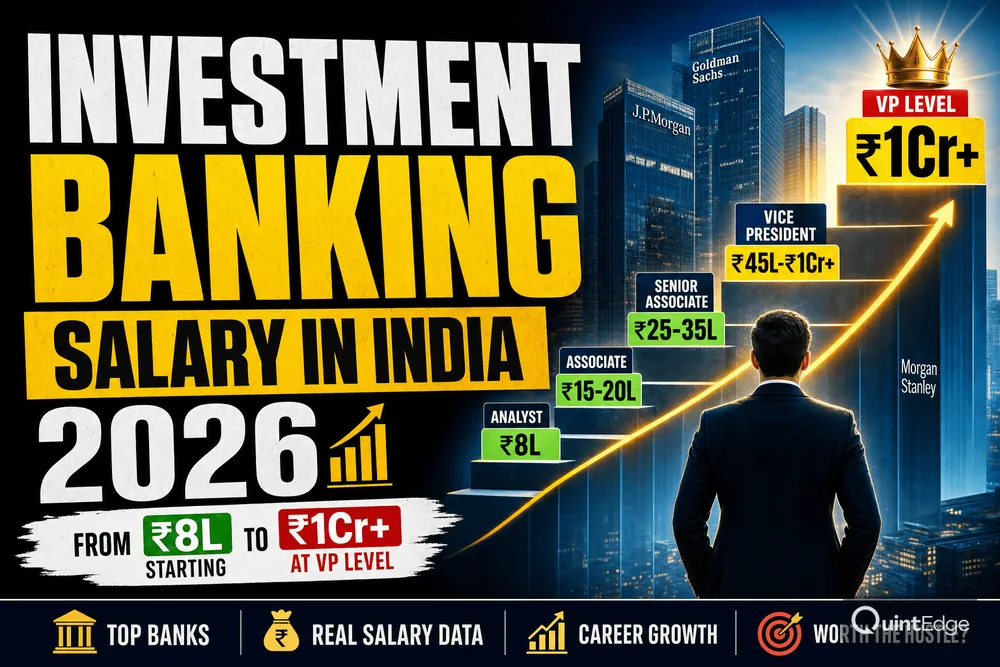
What Is the Investment Banking Salary in India in 2026?
Investment banking salaries in India in 2026 typically range from INR 12-25 LPA for a first-year analyst at a domestic firm or boutique to INR 15-30 LPA at a global bulge bracket bank. Total compensation scales to INR 60-150 LPA at the Vice President level and INR 3 Cr+ at the Managing Director level at global banks, per Glassdoor, AmbitionBox, and IIM placement reports. Whether you are a fresh graduate eyeing an analyst role at Goldman Sachs or a seasoned professional negotiating a VP-level package at Kotak Investment Banking, understanding the full compensation landscape is essential for making informed career decisions. It is also worth knowing upfront: the high pay comes with 80-100 hour work weeks during live deals.
India's IB market has matured significantly over the past decade. Global bulge bracket banks have expanded their Mumbai operations (with execution centres in Bangalore), domestic advisory firms have scaled their M&A practices, and the overall deal flow — driven by India's growing GDP, startup IPO activity, and cross-border transactions — has pushed compensation upward across every seniority level.
What Is IB Salary in India by Level, From Analyst to Managing Director?
IB total compensation in India in 2026 scales from INR 12-30 LPA at Analyst 1 through INR 30-70 LPA at Associate, INR 60-150 LPA at VP, INR 150-300 LPA at Director, and INR 300-600 LPA+ at Managing Director, per Glassdoor, AmbitionBox, and IIM/ISB placement disclosures. Compensation scales sharply with each promotion; the full table below breaks down base + cash bonus by level across global bulge bracket banks, domestic bank-owned IBs, and boutique advisory firms.
| Level | Experience | Base Salary (INR LPA) | Bonus (INR LPA) | Total Comp (INR LPA) |
|---|---|---|---|---|
| Analyst 1 | 0-1 years | 10-22 | 2-8 | 12-30 |
| Analyst 2 | 1-2 years | 12-24 | 3-10 | 15-34 |
| Analyst 3 | 2-3 years | 14-26 | 4-12 | 18-38 |
| Associate 1 | 3-4 years (or post-MBA) | 20-40 | 8-20 | 30-60 |
| Associate 2-3 | 4-6 years | 25-45 | 10-25 | 35-70 |
| Vice President | 6-10 years | 40-80 | 20-70 | 60-150 |
| Director / SVP | 10-14 years | 70-130 | 80-170 | 150-300 |
| Managing Director | 14+ years | 100-200 | 200-400+ | 300-600+ |
Important notes on the ranges: The lower end of each range reflects boutique and domestic bank-owned IBs, while the upper end represents global bulge brackets operating in India. Post-MBA hires from IIM-A, IIM-B, IIM-C, or ISB typically enter at the Associate 1 level with packages of INR 30-60 LPA at global banks. Bonuses at the VP level and above are increasingly tied to individual deal performance and group revenue, with a meaningful portion deferred into restricted stock at global banks.
Total Compensation Progression in India (INR Lakhs)
How Does Base Salary vs Bonus Work in Indian IB Compensation?
IB compensation in India follows a base + performance bonus structure where bonus grows from roughly 20% of total comp at the analyst level to 50%+ at VP and 60%+ at Director/MD. Understanding this split is critical because headline CTC numbers can be misleading without knowing the guaranteed vs performance-linked components.
Analyst Level (0-3 Years)
At the analyst level, base salary typically forms 70-80% of total compensation. Bonuses are largely formulaic — determined by group performance and individual reviews rather than personal deal contribution. A first-year analyst at JP Morgan India with a base around INR 18-22 LPA might receive a bonus of INR 4-8 LPA, generally paid in cash. At domestic firms and boutiques, the base-to-bonus ratio skews even more toward base since bonus pools are smaller.
Associate Level (3-6 Years)
The bonus component grows meaningfully at the associate level. Base salary accounts for 60-70% of total compensation at global banks. Associates begin to be evaluated on deal contributions, and top performers can see bonuses approaching 40-60% of base in strong years. An Associate 2 at a global bulge bracket in Mumbai with a base of INR 30-35 LPA might earn a bonus of INR 12-20 LPA in a healthy deal year.
VP Level and Above (6+ Years)
At the VP level and above, bonus can equal or exceed base salary in strong years. This is where the compensation structure shifts dramatically — VPs are expected to manage client relationships and contribute to revenue generation. A VP at a global bank in Mumbai earning INR 50-60 LPA base could receive a bonus of INR 30-70 LPA in a strong deal year, bringing total comp into the INR 80-120 LPA range. At the Director and MD levels, bonus can be 1.5-3x the base salary, with portions typically deferred into restricted stock units (RSUs) that vest over 3-4 years at global banks.
What Is the Salary Gap Between Global Banks and Domestic Firms?
Global bulge bracket banks pay a 20-40% premium over domestic bank-owned IBs and boutiques at the analyst and associate levels, widening to 30-50% at VP and above, based on indicative 2026 compensation data. Bulge brackets carry the biggest premium at the analyst level; the gap narrows at senior levels as domestic firms compete aggressively for experienced talent with client relationships.
| Level | Bulge Brackets (INR LPA) | Domestic / Boutique (INR LPA) | Premium (%) |
|---|---|---|---|
| Analyst 1 | 15-30 | 12-25 | 20-40% |
| Associate 1 | 30-60 | 25-50 | 20-40% |
| Vice President | 60-150 | 45-100 | 30-50% |
| Director | 150-300 | 100-200 | 30-50% |
| Managing Director | 300-600+ | 200-400+ | 30-50% |
Why the gap narrows at senior levels: Domestic firms like Kotak IB, Avendus, JM Financial and Edelweiss have built strong M&A and ECM franchises. Senior bankers at these firms often bring significant client relationships and deal flow. To retain them, domestic firms offer competitive base salaries supplemented by deal-linked incentives and, in some cases, equity or profit-sharing arrangements that can rival global bank packages on a risk-adjusted basis.
Which Are the Top Paying Investment Banks in India (2026)?
Among global banks, Goldman Sachs is consistently the top payer in India, with first-year analyst packages around INR 25-30 LPA; JP Morgan and Morgan Stanley pay broadly similar levels. Among domestic firms, Kotak Investment Banking leads on total compensation, particularly at senior levels. Below is a detailed look at compensation at the most prominent investment banking employers, broken down by category.
Global Bulge Bracket Banks in India
Goldman Sachs (Mumbai & Bangalore): Goldman's India franchise is consistently among the top-paying global banks. First-year analyst all-in packages from IIM/ISB campus typically fall in the INR 25-30 LPA range, with Associates earning INR 40-60 LPA. Mumbai houses front-office India coverage; the larger Bangalore office focuses on execution, analytics, and modelling support for global deal teams (and broader firmwide functions).
JP Morgan (Mumbai & Mumbai-Powai/Bangalore GCC): JP Morgan's India investment banking team is one of the largest among global banks. Front-office Analyst compensation is typically in the INR 22-28 LPA range, with Associates at INR 35-55 LPA. The firm is active across TMT, financial institutions and healthcare; top-performing VPs in Mumbai can comfortably reach INR 1 Cr+ in strong years.
Morgan Stanley (Mumbai): Morgan Stanley pays broadly in line with JP Morgan at the analyst and associate levels, with bonus dispersion driven by individual and group performance. The India practice is known for strong cross-border M&A activity.
Citi (Mumbai): Citi's IB division in India offers analyst packages typically in the INR 20-26 LPA range. The franchise is well-known for leveraged finance, ECM and debt capital markets advisory.
Bank of America (Mumbai): BofA's India IB pays in line with the bulge-bracket cluster, with Analyst packages in the INR 20-26 LPA range. The franchise has been historically strong in financial sponsors and ECM.
Domestic Bank-Owned IB & Boutiques
Kotak Investment Banking: India's leading domestic IB franchise typically pays analyst packages in the INR 15-22 LPA range, with associates earning INR 25-45 LPA. Kotak's brand prestige in the Indian market, deep client relationships and deal-linked bonuses help close the gap with global banks at senior levels.
Axis Capital: The investment banking arm of Axis Bank typically pays analysts in the INR 14-20 LPA range. The firm is particularly strong in ECM and IPO advisory; senior bankers benefit from the parent bank's extensive corporate relationships.
ICICI Securities & JM Financial: Both pay analyst packages broadly in the INR 14-22 LPA range, with strong ECM and mid-market M&A practices.
Avendus Capital: A leading independent boutique with a niche in tech, consumer and digital M&A advisory. Analyst salaries typically fall in the INR 14-22 LPA range, with a bonus structure that rewards individual deal contribution heavily.
Spark Capital, Equirus, IIFL Securities (IB) & Edelweiss: Independent and mid-market players typically pay analyst packages in the INR 12-20 LPA range, with strong mid-market M&A and ECM deal exposure.
What Is Investment Banking Salary by City in India?
Mumbai pays the highest IB salaries in India, with Analyst ranges of INR 15-30 LPA and VP ranges of INR 60-150 LPA, since over 80% of true front-office IB seats sit in Mumbai (BKC and Nariman Point). Bangalore ranks second (INR 14-25 LPA Analyst / INR 50-100 LPA VP), followed by Delhi/Gurgaon, Hyderabad, and Chennai/Pune, which host more execution and global capability centre (GCC) roles.
| City | Key Employers | Analyst Range (INR LPA) | VP Range (INR LPA) | Notes |
|---|---|---|---|---|
| Mumbai (BKC / Nariman Point) | All major global & domestic banks | 15-30 | 60-150 | India's primary IB hub; highest comp |
| Bangalore | Goldman Sachs, JP Morgan, Deutsche Bank | 14-25 | 50-100 | Primarily global bank execution & analytics centres |
| Delhi / Gurgaon | Barclays, Avendus, IIFL, select domestic IBs | 12-22 | 45-90 | Smaller IB footprint; lower cost of living |
| Hyderabad | JP Morgan, BofA, HSBC, Wells Fargo (GCCs) | 10-18 | 40-70 | Mostly support, analytics & modelling roles |
| Chennai / Pune | Barclays, BNP Paribas, Deutsche Bank (GCCs) | 8-16 | 35-60 | Back-office & middle-office heavy |
Mumbai vs Bangalore: Mumbai commands the highest salaries due to front-office deal coverage roles. Bangalore offers strong compensation for execution, modelling and analytics roles at global banks; the cost of living advantage means take-home savings can be comparable to Mumbai for similar roles. Goldman Sachs's Bangalore office, for instance, supports New York and London deal teams across functions including financial modelling and analytics.
How Does IB Salary Compare to Consulting and Private Equity?
At Year 5, IB total compensation (~INR 55 LPA at global banks) outpays management consulting (~INR 42 LPA at MBB) but trails top private equity (~INR 70 LPA), which pays the most at senior levels via carried interest though hiring is highly selective. Here is how compensation compares across these three premier career tracks in India.
Year 5 Total Compensation: IB vs Consulting vs PE (INR Lakhs)
Key observations from the comparison:
- Investment Banking vs Consulting: IB typically pays a meaningful premium to management consulting at comparable experience levels in India, with the trade-off being significantly tougher hours (80-100/week during live deals vs ~60 in consulting). At Year 5, an Associate at a global bank in Mumbai is generally in the INR 45-65 LPA range, versus INR 35-50 LPA for an Engagement Manager at McKinsey, Bain, or BCG in India. Consulting offers better lifestyle and broader industry exposure.
- Investment Banking vs Private Equity: Top PE firms in India typically pay above IB at equivalent levels, but hiring is extremely selective. Firms like KKR, Blackstone, Carlyle, Warburg Pincus and ChrysCapital hire primarily from IB analyst programmes. The real PE compensation edge comes from carried interest — a share of fund profits that can multiply cash compensation over a fund cycle.
- Long-term trajectory: PE typically offers the highest peak cash + carry compensation, but IB provides the strongest starting platform. Two to three years in investment banking gives you optionality to move into PE, hedge funds, venture capital, or corporate strategy at top companies.
How Can You Maximize Your Investment Banking Salary in India?
The most impactful levers are targeting bulge bracket banks over boutique/domestic firms for your first role, pursuing an MBA from IIM-A/B/C or ISB to enter at the Associate level, building strong financial modelling skills before recruiting, choosing high-revenue groups like TMT or M&A, and planning a strategic exit to private equity after 2-3 years. Compensation is not purely a function of time served; here are the levers in full.
1. Target Bulge Brackets Over Domestic / Boutique Firms for Your First Role
The pay premium at bulge brackets compounds over your career. A first-year analyst at a global bulge bracket in Mumbai earning INR 25-30 LPA will typically be in the INR 60-100 LPA range as a VP five to seven years later. An equivalent analyst starting at INR 14 LPA at a smaller boutique may reach INR 45-70 LPA in the same timeframe. The compounding effect of starting higher, receiving larger bonuses, and having access to bigger deals makes the initial firm choice one of the most consequential early-career decisions.
2. Get Into an MBA Programme at IIM-A, IIM-B, IIM-C, or ISB
Post-MBA hires typically enter IB at the Associate level, bypassing the analyst programme entirely. This accelerates your career by 2-3 years and gives you access to higher starting packages. Top IIMs and ISB place a meaningful cohort of students into IB roles each year, with packages typically in the INR 30-60 LPA range at global banks.
3. Build Technical Modelling Skills Before Recruiting
Banks test financial modelling proficiency extensively during interviews. Candidates who can build a DCF from scratch, understand LBO mechanics, and walk through an M&A accretion/dilution analysis stand out significantly. This technical edge often determines who gets the offer at the same target school.
4. Choose High-Revenue Groups
Within the same bank, compensation varies by group. TMT (Technology, Media & Telecom), Healthcare, Financial Sponsors and M&A groups tend to generate higher revenues per banker than infrastructure or public sector groups. At the VP level and above, group revenue directly impacts your bonus pool. Lateraling into a high-performing group can lift total compensation materially.
5. Plan Your Exit Strategically
The highest lifetime cash + carry earnings often come from transitioning to private equity or hedge funds after 2-3 years in IB. Top performers who move from a bulge bracket to firms like KKR, Blackstone, Carlyle or ChrysCapital can typically see an immediate compensation step-up, with carried interest providing substantial upside over a fund cycle.
6. Negotiate Using Competing Offers
At the VP level and above, lateral hires have significant negotiating power. Banks regularly use sign-on bonuses and guaranteed first-year bonuses to attract senior talent from competitors. Having multiple offers — even across sectors (PE, corporate strategy, consulting) — strengthens your negotiating position considerably.
Frequently Asked Questions: IB Salary in India
Starting salaries for IB analysts in India typically range from INR 12-22 LPA at boutiques and domestic bank-owned IBs (Kotak, Axis, ICICI, JM Financial, Avendus, Spark) to INR 15-30 LPA at global bulge brackets (Goldman Sachs, JP Morgan, Morgan Stanley, Citi, BofA). These figures include base salary plus the expected first-year bonus. Graduates from top IIMs and ISB typically secure packages toward the upper end of the bulge bracket range.
Vice Presidents at global investment banks in India typically earn INR 60-150 LPA in total compensation (base + bonus), while VPs at domestic firms and boutiques generally fall in the INR 45-100 LPA range. Top-performing VPs at bulge brackets who manage key client relationships and lead deals can comfortably cross INR 1 Cr+ in strong bonus years. The VP level typically requires 6-10 years of total experience.
Goldman Sachs is consistently among the highest-paying global banks in India at the analyst and associate levels, with first-year analyst packages typically in the INR 25-30 LPA range. JP Morgan and Morgan Stanley pay broadly similar levels, with bonus dispersion driven by group and individual performance. At the VP and MD levels, the differential among bulge brackets narrows further as banks compete aggressively for senior talent. Among domestic firms, Kotak Investment Banking is often cited as the leader on total compensation at senior levels, supported by strong deal-linked bonus structures.
Investment banking typically pays a meaningful premium over management consulting at comparable experience levels in India. A Year 5 IB associate at a global bank is generally in the INR 45-65 LPA range versus INR 35-50 LPA for an Engagement Manager at McKinsey, Bain, or BCG. The gap tends to widen at senior levels, where IB Directors and MDs in strong deal years can out-earn consulting Partners — though consulting offers more stable cash compensation and significantly better work-life balance.
Bonuses typically account for 20-30% of total compensation at the analyst level, 30-40% at the associate level, and 40-55% at the VP level. At the Director and MD levels, bonuses can represent 55-70%+ of total pay, with a significant portion typically deferred into restricted stock or cash vesting over 3-4 years at global banks. This variable component means total earnings fluctuate meaningfully with deal activity and market conditions.
Mumbai pays the highest investment banking salaries in India by a wide margin, as it is the dominant hub for front-office IB operations (over 80% of true IB seats sit in Mumbai). BKC (Bandra-Kurla Complex) and Nariman Point host the front-office teams of Goldman Sachs, JP Morgan, Morgan Stanley, Citi, Kotak IB, and most other banks. Bangalore ranks second, primarily due to global bank execution and analytics centres (Goldman Sachs, JP Morgan, Deutsche Bank). Delhi/Gurgaon and Hyderabad follow, with salaries typically below Mumbai for equivalent roles and a heavier mix of GCC/support seats than true coverage roles.
Yes. Top-performing Vice Presidents at global banks like Goldman Sachs, JP Morgan, and Morgan Stanley can reach INR 1 Cr+ in total compensation in India in strong years. This typically requires 8-10 years of experience and strong deal performance. At the Director and Managing Director levels, total compensation regularly exceeds INR 1 Cr, with MDs at global banks earning roughly INR 3-6 Cr+ including deferred compensation in good years. Senior Directors and MDs at domestic IBs like Kotak can also comfortably cross the INR 1 Cr mark.
The most impactful strategies are: (1) target bulge bracket banks over boutique or domestic firms for your first role, since the early-career pay premium compounds over time; (2) pursue an MBA from IIM-A, IIM-B, IIM-C, or ISB to enter at the associate level; (3) build strong financial modelling skills (DCF, LBO, M&A) before recruiting; (4) choose high-revenue groups like TMT, Healthcare, Financial Sponsors or M&A; (5) plan a strategic exit to private equity after 2-3 years for the highest long-term cash + carry earnings; and (6) negotiate using competing offers when lateraling at the VP level and above.


