
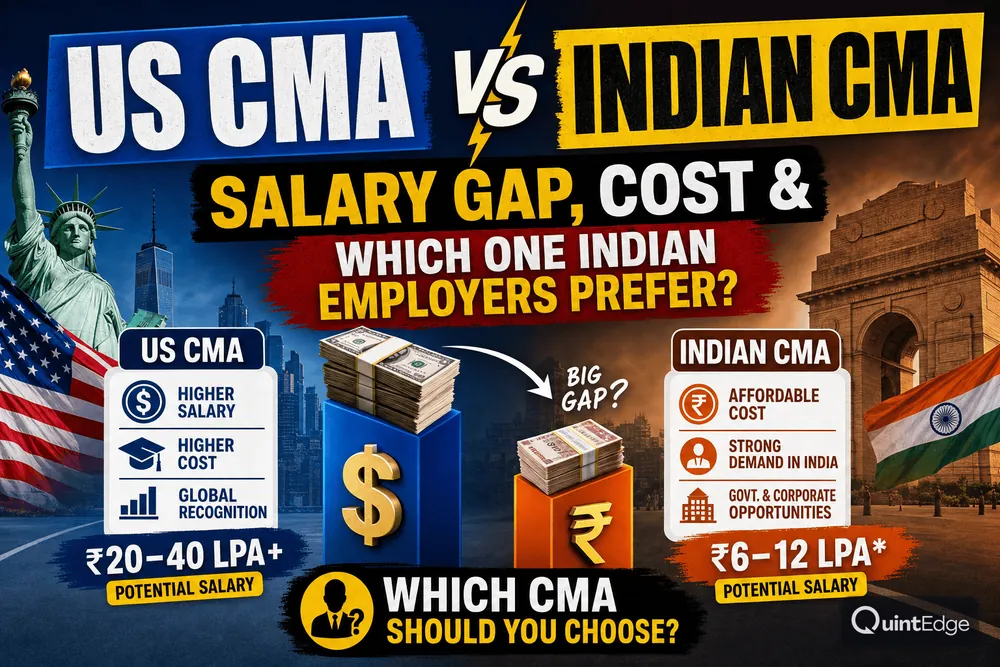
US CMA vs Indian CMA: Two Credentials, Two Very Different Career Trajectories
The letters “CMA” appear on two very different credentials — and the confusion costs Indian professionals years of misallocated effort. The US CMA, awarded by the Institute of Management Accountants (IMA, USA), and the Indian CMA, awarded by the Institute of Cost Accountants of India (ICMAI, formerly ICWAI), share a name but diverge sharply in curriculum depth, global recognition, salary outcomes, and employer perception.
If you are a commerce graduate, CA aspirant, MBA Finance holder, or working professional evaluating which CMA to pursue, this guide gives you the complete picture: exam structure, total cost in INR, difficulty and pass rates, salary data across experience levels, what Indian employers actually prefer in 2026, and a decision framework tailored to different career profiles.
Key Takeaway
US CMA (IMA) is a globally recognised management accounting credential with strong demand among MNCs, GCCs, and Big 4 firms in India, where indicative salaries typically range from ~₹6–45+ LPA depending on experience. Indian CMA (ICMAI) is a statutory qualification under the Cost and Works Accountants Act, 1959 — strong for government, PSU, and cost audit roles, with indicative salaries of ~₹3–25+ LPA. Your target employer type ultimately determines which credential delivers better ROI.
US CMA (IMA) at a Glance
- Body: IMA (Institute of Management Accountants, USA)
- Exam Parts: 2 parts
- Timeline: 6–18 months
- Total Cost: ₹1.2–2.5 lakh
- Recognition: 150+ countries
- Best For: MNCs, GCCs, FP&A, Corporate Finance
Indian CMA (ICMAI) at a Glance
- Body: ICMAI (Institute of Cost Accountants of India)
- Exam Levels: 3 levels (Foundation, Intermediate, Final)
- Timeline: 3–5 years
- Total Cost: ₹0.5–1.5 lakh
- Recognition: Primarily India
- Best For: Cost Audit, PSUs, Government Roles
Governing Bodies & Legal Standing
The US CMA is conferred by the IMA (Institute of Management Accountants), founded in 1919, with a global membership of roughly 100,000 across 150+ countries. The IMA is a professional membership body, not a statutory authority. US CMAs earn a professional certification that signals expertise in management accounting, financial planning, and strategic decision-making to employers globally.
The Indian CMA is conferred by the ICMAI (Institute of Cost Accountants of India), originally established in 1944 and statutorily constituted under the Cost and Works Accountants Act, 1959. ICMAI is a statutory body created by an Act of Parliament, which gives the Indian CMA a legal standing that the US CMA does not possess in India. Indian CMAs hold the exclusive right to conduct cost audits under the Companies Act, 2013 — a significant advantage in cost audit and government compliance roles.
This distinction matters: the Indian CMA opens doors that require statutory authority (cost audit sign-off, government tenders), while the US CMA opens doors that require global management accounting proficiency (MNC finance leadership, GCC roles, cross-border FP&A).
Exam Structure & Syllabus Comparison
The exam architecture of these two credentials could not be more different. The US CMA is a two-part examination designed for working professionals who want a focused, high-impact credential. The Indian CMA is a three-level examination system modelled after the traditional Indian professional qualification pathway, similar in structure to CA and CS.
| Parameter | US CMA (IMA) | Indian CMA (ICMAI) |
|---|---|---|
| Exam Levels | 2 Parts | 3 Levels (Foundation, Inter, Final) |
| Total Papers | 2 parts (100 MCQs + 2 essays each) | 20 papers across all levels (4 + 8 + 8) |
| Exam Format | MCQs + Essays (computer-based, 4 hrs/part) | Subjective written exams (3 hrs/paper) |
| Exam Windows | Jan–Feb, May–Jun, Sep–Oct | June & December |
| Practical Training | Not required for exam (2 years professional experience for certification) | Practical training required (per ICMAI regulations) |
| Core Focus | FP&A, Decision Analysis, Strategic Finance | Cost Accounting, Auditing, Taxation, Law |
| Completion Time | 6–18 months (typical) | 3–5 years (typical) |
| Study Hours | 150–200 per part (IMA estimate) | 1,500–3,000+ total (estimate) |
US CMA Syllabus Breakdown
Part 1 — Financial Planning, Performance & Analytics: External financial reporting decisions, planning and budgeting, performance management, cost management, internal controls, and technology & analytics. This part tests your ability to plan, measure, and improve business performance.
Part 2 — Strategic Financial Management: Financial statement analysis, corporate finance, decision analysis, risk management, investment decisions, and professional ethics. This part tests your ability to think strategically and support C-suite decision-making.
Indian CMA Syllabus Breakdown
The ICMAI syllabus spans three levels. The Foundation covers fundamentals of accounting, economics, mathematics, and business laws. The Intermediate level includes cost accounting, financial management, direct and indirect taxation, company accounts, and operations management. The Final level covers strategic financial management, cost and management audit, corporate laws, strategic performance management, and an elective paper.
The Indian CMA curriculum is significantly broader, covering taxation, company law, auditing, and economics in addition to cost and management accounting. The US CMA curriculum is narrower but deeper in the specific domains of management accounting, financial analysis, and strategic decision-making.
Total Cost Comparison in INR
| Cost Component | US CMA (IMA) | Indian CMA (ICMAI) |
|---|---|---|
| Entrance / CMA Entrance Fee | ~USD 300 (Professional) / ~USD 225 (Student) | ~₹6,000–7,000 (Foundation registration) |
| Exam Fees (per part / level) | ~USD 545/part (Pro), ~USD 407/part (Student) — effective September 2025; verify on imanet.org | ~₹7,000–17,000 per level |
| IMA Membership (Annual) | ~USD 295 (Pro) / ~USD 49 (Student) | ~₹1,000–2,000/year |
| Coaching / Study Material (India) | ₹40,000–1,20,000 (varies by provider) | ₹30,000–80,000 (varies by provider) |
| Approximate Total Cost | ₹1.2–2.5 lakh (incl. coaching) | ₹50,000–1.5 lakh (incl. coaching) |
| Opportunity Cost (Time) | 6–18 months | 3–5 years |
On paper, the Indian CMA is cheaper. However, the US CMA’s significantly shorter timeline means you can start earning a salary premium 2–4 years earlier. If the US CMA adds even ~₹3–5 LPA to your package — which is plausible in MNC and GCC settings, though not guaranteed — you can recover the higher upfront cost relatively quickly and accumulate meaningfully more lifetime earnings.
Total Cost & Time Investment Comparison
Difficulty Level & Pass Rates
The difficulty comparison between US CMA and Indian CMA is not straightforward, because they test different skills in fundamentally different formats.
The US CMA exam uses a computer-based format with 100 multiple-choice questions and two 30-minute essay questions per part. The MCQ section is adaptive in difficulty. Candidates who fail to meet the minimum MCQ threshold do not have their essays evaluated. Each part has a 4-hour time limit, and the content demands strong analytical reasoning, not just theoretical recall.
The Indian CMA exam uses a traditional subjective (written) exam format across roughly 20 papers (4 in Foundation, 8 in Intermediate, 8 in Final). Each paper is 3 hours, and questions demand detailed written answers, computations, and case-based responses. The sheer volume of papers, combined with the requirement for practical training, makes the Indian CMA a longer and more exhausting journey, even if individual papers may not be as conceptually dense as the US CMA parts.
| Difficulty Factor | US CMA (IMA) | Indian CMA (ICMAI) |
|---|---|---|
| Global Pass Rate (recent years) | ~45% per part (IMA-reported) | ~8–20% per level (varies by paper) |
| Exam Format | MCQ + Essay (computer-based) | Subjective written |
| Number of Attempts Allowed | Per IMA rules (within program window) | Unlimited |
| Conceptual Depth | High (analytical & strategic) | Moderate to High (procedural & theoretical) |
| Volume of Content | Focused (2 parts) | Very High (20 papers) |
| Practical Training | None for exam (work experience qualifies for certification) | Mandatory practical training (per ICMAI) |
Key Takeaway
The Indian CMA generally reports lower pass rates per level compared to the US CMA’s ~45% per part, but this reflects the volume-based exam structure and the large number of students attempting at the foundation level rather than a fundamentally harder conceptual standard. The US CMA tends to be harder per paper in analytical depth; the Indian CMA is harder in total time and effort required to clear all levels.
Salary Comparison in India (2026)
This is where the gap typically appears. The US CMA tends to command a salary premium over the Indian CMA in MNC, GCC and Big 4 environments. The Indian CMA holds its own in government, PSU, and cost audit roles, but tends to trail in the private MNC sector. The ranges below are indicative estimates compiled from job listings and salary aggregators; individual outcomes vary widely by employer, city, and role.
| Experience Level | US CMA Salary (India, indicative) | Indian CMA Salary (India, indicative) |
|---|---|---|
| Entry Level (0–2 years) | ~₹6–12 LPA | ~₹3–6 LPA |
| Mid Career (3–7 years) | ~₹14–25 LPA | ~₹6–12 LPA |
| Senior Level (8–15 years) | ~₹25–45 LPA | ~₹12–20 LPA |
| Leadership (15+ years) | ~₹40–70+ LPA | ~₹15–30+ LPA |
| Cost Audit / Compliance | Not directly applicable (no statutory standing) | ~₹8–18 LPA (statutory domain) |
Mid-Career Salary Comparison in India (₹ LPA)
The salary gap tends to be most pronounced at mid-career and senior levels, where the US CMA’s alignment with FP&A, business partnering, and strategic finance roles in MNCs often delivers a meaningful premium over the Indian CMA in those settings. However, Indian CMAs who build a cost audit practice or work in PSU finance departments can reach ~₹15–25+ LPA at senior levels — a space where the US CMA has no statutory standing.
Key Takeaway
At mid-career (3–7 years), indicative ranges suggest the US CMA can command roughly ~₹14–25 LPA in India compared to ~₹6–12 LPA for the Indian CMA — a notable gap in MNC settings. This gap tends to widen at senior levels. The Indian CMA closes the gap in cost audit, PSU, and government roles where statutory recognition matters more than international brand value.
Global Recognition & Portability
The US CMA is recognised in over 150 countries and is a benchmark credential for management accounting roles in the USA, Middle East, Southeast Asia, Europe, and Africa. Multinational companies with headquarters in the US, UK, or Europe treat the US CMA as a globally standard qualification. If your career plan includes any possibility of working abroad, the US CMA is the clear winner.
The Indian CMA has reciprocal recognition agreements with a handful of countries, including the UK (CIMA), Australia, and some South Asian nations. However, its recognition outside India is limited. In the Middle East — the most common international destination for Indian finance professionals — the US CMA is significantly more recognised and preferred by employers.
What Indian Employers Actually Prefer in 2026
This is the question that matters most to candidates. The answer depends entirely on the type of employer.
Employers That Prefer US CMA
- MNCs with global operations: Amazon, Deloitte, PwC, EY, KPMG, Microsoft, Google, Unilever, P&G
- GCCs (Global Capability Centres): JPMorgan, Goldman Sachs, Wells Fargo, Citi, HSBC back-office and finance hubs
- Big 4 advisory practices: Management consulting, finance transformation, and FP&A advisory teams
- FMCG, tech, and manufacturing MNCs: Companies with US GAAP or IFRS reporting and global FP&A functions
- Private equity and venture capital firms: Portfolio company finance roles
Employers That Prefer Indian CMA
- Public Sector Undertakings (PSUs): ONGC, SAIL, BHEL, Indian Oil, NTPC — where CMA is a qualifying credential
- Government departments: Cost audit and compliance roles under the Companies Act
- Medium-sized Indian companies: Firms requiring cost audit sign-off under statutory provisions
- Cost audit firms: Practices that conduct mandatory and voluntary cost audits
- Indian banks and insurance companies: Some public sector banks recognise ICMAI for internal finance roles
Employers That Value Both (or Either)
- Large Indian conglomerates (Tata, Mahindra, Reliance) may value either depending on the specific role
- Shared services centres of Indian companies expanding globally may prefer the US CMA for international alignment
Key Takeaway
If your target employers are MNCs, GCCs, Big 4 firms, or any company with a global FP&A function, the US CMA is the clear preference. If your target is PSUs, government roles, or cost audit, the Indian CMA is essential and the US CMA offers little direct advantage. Understanding your target employer profile is the single most important factor in this decision.
Career Paths: Where Each CMA Takes You
US CMA Career Trajectory
- Years 0–3: Financial Analyst, FP&A Analyst, Management Reporting Analyst, Business Finance Associate (₹6–14 LPA)
- Years 3–7: FP&A Manager, Finance Business Partner, Senior Financial Analyst, Cost Controller at MNCs (₹14–25 LPA)
- Years 7–12: FP&A Director, Head of Business Finance, Finance Controller, VP Finance at GCCs (₹25–45 LPA)
- Years 12+: CFO, VP Finance (Global), Global FP&A Head, Finance Transformation Lead (₹40–70+ LPA)
Indian CMA Career Trajectory
- Years 0–3: Cost Accountant, Junior Cost Auditor, Accounts Executive, Finance Trainee at PSUs (₹3–6 LPA)
- Years 3–7: Senior Cost Accountant, Cost Audit Manager, Finance Manager at mid-sized Indian firms (₹6–12 LPA)
- Years 7–12: Chief Cost Accountant, Cost Audit Partner, Finance Controller at Indian companies (₹12–20 LPA)
- Years 12+: Cost Audit Firm Partner, CFO at Indian companies, Senior Government Finance roles (₹15–30+ LPA)
The US CMA career path is distinctly oriented towards MNC corporate finance hierarchies, where the progression from analyst to CFO is well-defined and salary growth is aggressive. The Indian CMA career path is oriented towards cost audit practice, PSU finance departments, and Indian corporate environments where statutory compliance drives demand.
Which CMA Should You Choose? A Profile-Based Decision Framework
Rather than declaring one credential universally better, here is a practical framework based on your current profile and career goals.
Choose US CMA If You Are:
- A working professional (2+ years experience) who wants a globally recognised credential without spending 3–5 years
- Targeting MNC, GCC, or Big 4 roles in FP&A, corporate finance, or business partnering
- An MBA Finance graduate who wants to differentiate your CV for management accounting roles
- A CA or ACCA who wants to add a management accounting specialisation for career diversification
- Planning to work in the Middle East, USA, Southeast Asia, or any international market
- Looking for the fastest ROI — you want to start earning a salary premium within 6–18 months
Choose Indian CMA If You Are:
- A student or fresh graduate (after Class 12 or graduation) who wants a professional qualification at minimal cost
- Targeting PSU recruitment, where ICMAI qualification is a listed eligibility criterion
- Planning to build a cost audit practice under the Companies Act, 2013
- Interested in government compliance, taxation, and statutory reporting roles in India
- In a Tier 2/Tier 3 city where the local job market values statutory Indian qualifications over international ones
Consider Both If You Are:
- An Indian CMA who has cleared the ICMAI exams and now wants to add global recognition for MNC opportunities
- Targeting the CFO role at a large Indian company with both domestic compliance and international reporting needs
- Building a consulting practice that serves both Indian statutory clients and MNC advisory clients
Can You Pursue Both US CMA and Indian CMA?
Yes, and a growing number of professionals are doing exactly that. The two credentials are not mutually exclusive, and they complement each other well for candidates who want both statutory standing in India and global management accounting recognition.
The most common strategy is to complete the Indian CMA first (especially for those who started during their graduation years), then add the US CMA in 6–18 months to unlock MNC career opportunities. This dual-credential approach is particularly powerful for professionals transitioning from Indian corporate or PSU environments into GCC or MNC roles.
However, if you are starting fresh and your target is clearly the MNC or GCC sector, pursuing the US CMA directly is more time-efficient and cost-effective than completing the Indian CMA first.
Frequently Asked Questions: US CMA vs Indian CMA
Yes, the US CMA is widely recognised and valued by employers in India, particularly by MNCs, GCCs, Big 4 firms, and any company with a global FP&A or management accounting function. While it does not carry statutory authority for cost audits in India (that right belongs exclusively to ICMAI members), it is accepted as a globally benchmarked professional credential, and a sizeable and growing community of US CMA holders work across India today.
The US CMA generally commands higher salaries in the Indian private sector. At mid-career (3–7 years), indicative ranges put US CMAs at ~₹14–25 LPA compared to ~₹6–12 LPA for Indian CMAs. The gap tends to widen at senior and leadership levels. The Indian CMA’s salary competitiveness improves in PSU, cost audit, and government roles where statutory recognition drives compensation.
Absolutely. Many professionals complete the Indian CMA first and then add the US CMA to expand their career options. Your ICMAI qualification provides a strong foundation in cost and management accounting that makes the US CMA syllabus easier to cover. You can complete the US CMA in 6–12 months after your Indian CMA, and the dual credential significantly strengthens your profile for both domestic and international roles.
No. Despite sharing the “CMA” name, the two credentials are issued by different bodies, cover different syllabi, and serve different career purposes. The US CMA (IMA) is a globally recognised management accounting certification focused on FP&A and strategic finance. The Indian CMA (ICMAI) is a statutory qualification focused on cost accounting, cost audit, and Indian regulatory compliance. They are complementary, not equivalent.
The US CMA has higher reported pass rates (~45% per part, per IMA) compared to the Indian CMA (typically 8–20% per level, with wide variation across papers). However, the US CMA demands deeper analytical reasoning per paper, while the Indian CMA has a much larger volume of papers (20 across three levels). Most working professionals find the US CMA more manageable because IMA recommends roughly 150–200 study hours per part across just two exams, compared to a much larger cumulative study load for the Indian CMA.
GCCs (Global Capability Centres) in India strongly prefer the US CMA over the Indian CMA. GCCs typically handle global FP&A, management reporting, and business partnering for their parent companies, and the US CMA’s curriculum aligns directly with these functions. Indian CMA holders are not excluded from GCC roles, but they are at a disadvantage compared to US CMA holders when competing for the same positions.
Yes, the Indian CMA is one of the most useful qualifications for government and PSU finance roles. Many PSUs list CMA (ICMAI) as a qualifying criterion for recruitment. Additionally, Indian CMAs have the exclusive statutory right to conduct cost audits under the Companies Act, 2013, which creates a dedicated career path in government compliance. The US CMA has no statutory standing for government roles in India.
US CMA coaching in India typically costs ₹40,000–1,20,000 depending on the institute, delivery mode (online vs classroom), and inclusions (study materials, mock exams, mentoring). Including IMA registration, exam fees, and membership, the total investment is approximately ₹1.2–2.5 lakh. Many candidates recover this investment relatively quickly through the salary uplift the credential enables, though outcomes vary by background and role.


