
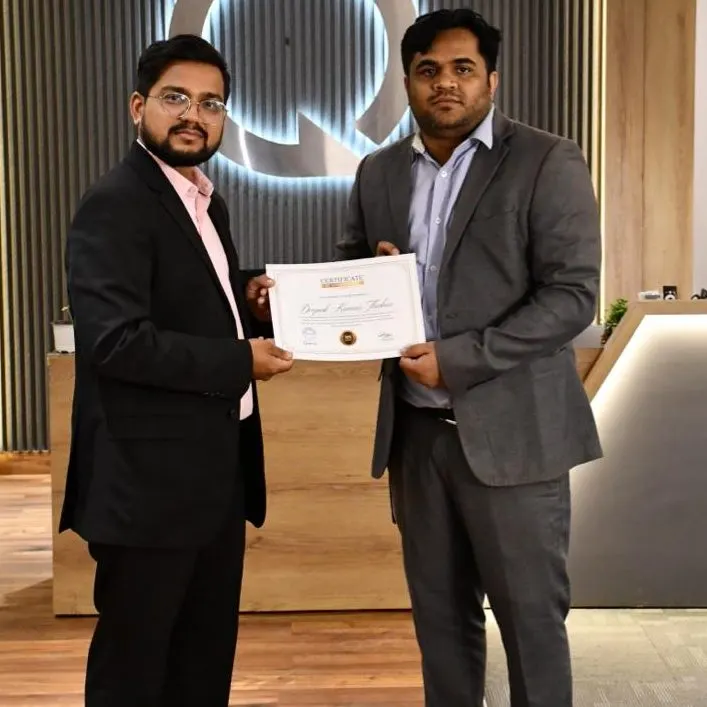
Deepak Kumar Thakur always knew he wanted to build a strong career in finance, even if the exact path wasn't clear at the start.
Coming from a middle-class Indian family, he grew up with values of discipline and hard work, and during his studies, his curiosity about how companies make financial decisions drew him toward Investment Banking.
Like many aspirants, he faced a key challenge: turning theory into a real core finance role. To bridge this gap, he chose the Certification in Investment Banking (CIB) at QuintEdge, where structured guidance and hands-on exposure helped him build confidence and direction.
Today, Deepak works as an Investment Analyst (M&A, IBC Solutions) at TSquare Capital Solutions LLP -- a milestone earned through focused preparation and persistence.
How did you develop an interest in Investment Banking?
My curiosity about finance grew through studying accounting and business fundamentals. What attracted me most was understanding how major financial decisions shape company growth. Exploring mergers, acquisitions, restructuring, and capital planning showed me the real-world business impact of finance. Working with financial statements and valuation models connected theoretical knowledge to practical corporate operations, and I knew this was the field I wanted to be in.
What steps did you take to enter the Investment Banking and core finance field?
Rather than pursuing scattered opportunities, I adopted a focused strategy. I first researched what analyst positions genuinely require. Recognising the gaps between academic learning and industry expectations, I chose to specialise in investment banking, M&A, and restructuring. I enrolled in a structured programme that would give me practical exposure and bridge the gap between what I knew and what the industry demanded.
What made you choose the Certification in Investment Banking (CIB) at QuintEdge?
I selected QuintEdge because it emphasised practical application over pure theory. The programme featured hands-on financial modeling, real deal case studies, and restructuring exposure — exactly what I needed for advisory roles. The accompanying Investment Banking Bootcamp provided analyst-level training covering resume building, interview techniques, pitch decks, and mock interviews.
What challenges did you face during your preparation journey?
Two major obstacles emerged: translating theoretical concepts into actual model-building, and managing time effectively while maintaining consistency. I addressed these by breaking complex concepts into smaller components, practicing regularly rather than cramming, and systematically revisiting weak areas with structured feedback.
How did QuintEdge support you and make a difference in your journey?
Mentor Yash Jain provided transformative guidance through clear explanations and hands-on modeling instruction. I learnt to think beyond just the numbers — examining assumptions, business drivers, and decision logic. Regular doubt-solving sessions, case discussions, and the bootcamp built my confidence significantly. Within one month of completing the programme, I was placed.
What outcome did you achieve after completing the programme?
I secured a position as Investment Analyst (M&A, IBC Solutions) at TSquare Capital Solutions LLP. This role allows me to apply financial modeling, valuation, and restructuring knowledge to actual transactions — fulfilling my ambition to build a sustainable investment banking career.
Can you share your preparation strategy with us?
- Fixed accounting fundamentals: I made sure I understood how line items flow across income statements, balance sheets, and cash flow statements, and how adjustments work.
- Built financial models from scratch: I created models step-by-step rather than using templates, rebuilding them for speed and accuracy with emphasis on structure, linking, and internal logic.
- Applied concepts to real companies: I engaged with actual company data through valuation, M&A, and restructuring case studies, analysing realistic scenarios end-to-end.
- Questioned assumptions, not just outputs: I examined whether assumptions aligned with business reality and analysed how changes in key variables affected outcomes.
- Used feedback to improve: I actively sought critique, fixed mistakes, and refined my approaches to prevent repeating errors.
What would you like to tell others starting their Investment Banking journey?
Be patient and trust the process. Focus on fundamentals, practice consistently, and do not be intimidated by complex models at first. Seek quality mentorship and maintain discipline — that is what creates pathways toward high-finance roles.


