
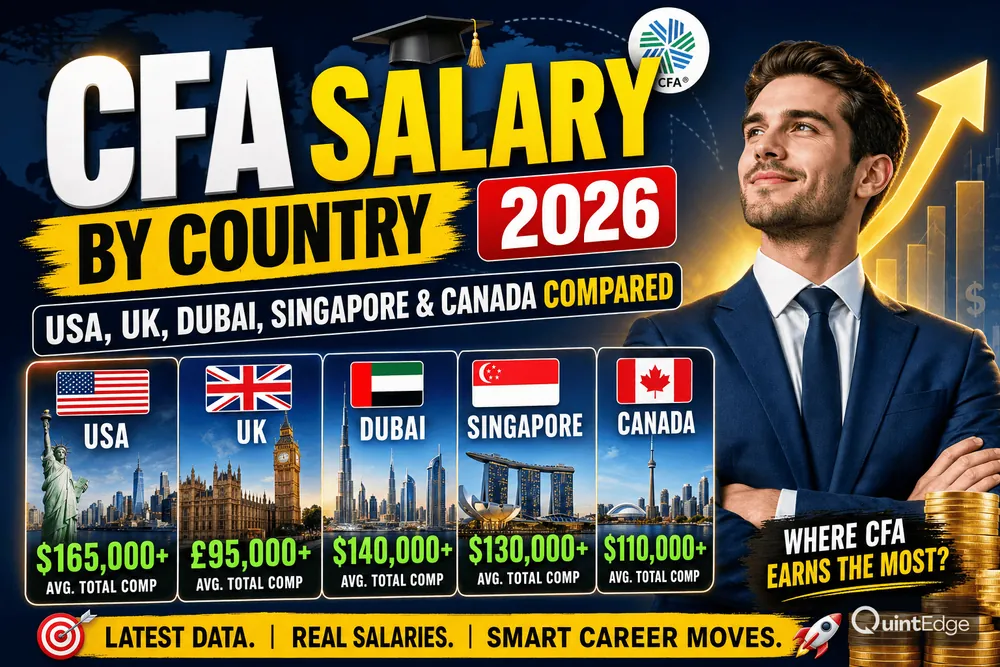
Global CFA Salary Overview 2026
The CFA charter is widely regarded as the most prestigious credential in investment management. Administered by the CFA Institute, it is recognised in 165+ countries and held by more than 200,000 charterholders across asset management, investment banking, equity research, and corporate finance. But one question dominates every candidate's thinking before they begin: how much does a CFA charterholder actually earn — and does the answer change dramatically by country?
The short answer is yes. CFA salary by country varies enormously — from roughly USD 11,000 at entry level in India to USD 500,000+ at senior level in the United States. That range reflects differences in financial market depth, cost of living, regulatory demand for credentialed professionals, and the density of institutional capital in each market.
This guide maps out 2026 salary benchmarks across nine major CFA markets — the USA, UK, Canada, UAE/Dubai, Singapore, Switzerland, Australia, Hong Kong, and India — with entry, mid-career, and senior-level data in both USD and local currency. Ranges below draw on the most recent CFA Institute Investment Professional Compensation Study (2024 reference), the Robert Half 2026 Salary Guide, the Hays Salary Guide, and live data from LinkedIn Salary and Glassdoor. We also analyse which countries offer the best career ROI for charterholder candidates.
CFA Salary by Country: Full Comparison Table 2026
The table below consolidates CFA salary benchmarks across all major markets. Figures represent total annual compensation (base + typical bonus) for CFA charterholders. Local currency values use approximate exchange rates as of early 2026.
| Country | Currency | Entry Level (0–3 yrs) | Mid Career (4–8 yrs) | Senior Level (9+ yrs) | Entry USD | Senior USD |
|---|---|---|---|---|---|---|
| United States | USD | $85,000 – $120,000 | $120,000 – $200,000 | $250,000 – $500,000+ | ~$100,000 | ~$375,000 |
| United Kingdom | GBP | £55,000 – £80,000 | £80,000 – £150,000 | £200,000 – £400,000 | ~$85,000 | ~$380,000 |
| Canada | CAD | CAD 70,000 – 100,000 | CAD 90,000 – 170,000 | CAD 180,000 – 320,000 | ~$63,000 | ~$184,000 |
| UAE / Dubai | AED | AED 200,000 – 290,000 (tax-free) | AED 300,000 – 720,000 (tax-free) | AED 720,000 – 1,500,000+ (tax-free) | ~$67,000 | ~$305,000 |
| Singapore | SGD | SGD 80,000 – 120,000 | SGD 120,000 – 220,000 | SGD 260,000 – 450,000 | ~$75,000 | ~$265,000 |
| Switzerland | CHF | CHF 100,000 – 130,000 | CHF 150,000 – 250,000 | CHF 250,000 – 450,000 | ~$129,000 | ~$392,000 |
| Australia | AUD | AUD 95,000 – 130,000 | AUD 130,000 – 220,000 | AUD 230,000 – 380,000 | ~$75,000 | ~$202,000 |
| Hong Kong | HKD | HKD 500,000 – 800,000 | HKD 720,000 – 1,800,000 | HKD 1,800,000 – 3,500,000 | ~$83,000 | ~$338,000 |
| India | INR | INR 8 – 14 LPA | INR 18 – 32 LPA | INR 35 – 65 LPA | ~$11,000 | ~$52,000 |
Note: All figures are approximate 2026 benchmarks for full CFA charterholders (base + typical bonus). Actual compensation varies by firm type (bulge bracket vs. boutique vs. buy-side), city within each country, asset class, and individual negotiation. Bonuses can add 30–100%+ to base salary at senior levels. USD conversions use approximate May 2026 rates: 1 USD ≈ £0.79 ≈ CHF 0.89 ≈ SGD 1.34 ≈ AED 3.67 ≈ HKD 7.78 ≈ AUD 1.51 ≈ CAD 1.36; India uses about ₹97 per US dollar (October 2026).
CFA Average Mid-Career Salary by Country (USD)
The chart below visualises average mid-career CFA compensation in USD across the eight countries with the deepest CFA hiring markets. It uses the midpoint of each country's mid-career range converted at the exchange rates noted above.
Country-by-Country CFA Salary Breakdown
United States: Highest Absolute CFA Salaries Globally
The United States remains the single most lucrative market for CFA charterholders worldwide. Wall Street, Chicago's trading floors, Boston's asset management corridor, and San Francisco's wealth management ecosystem collectively employ tens of thousands of charterholders. Entry-level analysts at US buy-side firms typically earn USD 85,000–120,000 including bonus, with New York commanding a clear premium. Mid-career charterholders (4–8 years) earn USD 120,000–200,000, while senior portfolio managers and directors with a decade of experience routinely earn USD 250,000–500,000+ in total compensation, per the Robert Half 2026 Salary Guide and CFA Institute compensation data.
The highest-paying roles for US-based charterholders are at hedge funds, private equity firms, and large asset managers such as BlackRock, Vanguard, and Fidelity. Senior portfolio managers, partners, and CIOs at these institutions can earn well into seven figures when long-term incentive plans and carried interest are included, though such outcomes depend heavily on individual fund performance.
United Kingdom: London's Global Finance Hub
London is Europe's premier financial centre and the UK's dominant market for CFA professionals. Entry-level CFA candidates in London earn GBP 55,000–80,000, with the upper end typically at investment banks and large asset managers in Canary Wharf and the City.
Mid-career professionals (4–8 years) in portfolio management or equity research earn GBP 80,000–150,000. Senior fund managers and investment directors with 10+ years and a CFA charter can command GBP 200,000–400,000 in total compensation including performance bonuses, per the Hays UK Salary Guide. Post-Brexit, London has retained its dominance as a European financial centre, though some roles have shifted to Frankfurt, Amsterdam, and Dublin.
Canada: Strong Demand in Toronto and Vancouver
Canada's financial sector is concentrated in Toronto (Bay Street), with secondary hubs in Vancouver, Montreal, and Calgary. Entry-level CFA professionals earn CAD 70,000–100,000, with Toronto commanding a slight premium. Canada's pension fund sector — home to giants like CPPIB, OTPP, and PSP — is a major employer of charterholders, with highly competitive compensation.
Mid-career salaries of CAD 90,000–170,000 are typical in portfolio management roles in Toronto. Senior charterholders at pension funds or large banks (RBC, TD, BMO) earn CAD 180,000–320,000, though compensation at Canada's largest pension managers can reach significantly higher for investment leadership roles.
UAE / Dubai: Tax-Free Salaries and Rapid Growth
The UAE — and Dubai in particular — has emerged as one of the most attractive CFA markets globally, largely due to its zero personal income tax regime. The DIFC (Dubai International Financial Centre) and ADGM (Abu Dhabi Global Market) host hundreds of international investment firms, private equity houses, family offices, and sovereign wealth funds including the Abu Dhabi Investment Authority (ADIA).
Entry-level CFA professionals in Dubai earn AED 200,000–290,000 per year (approximately USD 54,000–79,000). At mid-career, monthly packages commonly range from AED 25,000–60,000, equivalent to AED 300,000–720,000 annually. Senior charterholders at sovereign wealth funds or leading investment banks can earn AED 720,000–1,500,000+ in total compensation — and because all of this is tax-free, the net purchasing power is significantly higher than headline USD comparisons suggest.
Singapore: Asia's Premier Investment Hub
The Monetary Authority of Singapore (MAS) has actively promoted the city-state as Asia's premier wealth and asset management centre. CFA charterholders are in high demand at private banks (UBS, Julius Baer, DBS), sovereign wealth funds (GIC, Temasek), and regional investment arms of global asset managers.
Entry-level CFA candidates earn SGD 80,000–120,000 (approximately USD 60,000–90,000). Mid-career professionals in portfolio management or wealth advisory earn SGD 120,000–220,000. Senior charterholders — particularly in private wealth or alternatives — earn SGD 260,000–450,000. Singapore's personal income tax is relatively moderate (top marginal rate currently 24%), making net compensation highly attractive.
Switzerland: Private Banking and Wealth Management Premium
Switzerland — particularly Zurich and Geneva — remains one of the most compensation-rich CFA markets globally, anchored by its private banking, wealth management, and global asset management sectors. UBS, Pictet, Lombard Odier, Julius Baer, and Vontobel actively hire charterholders for portfolio management, multi-asset advisory, and family-office roles.
Entry-level CFA professionals in Switzerland earn CHF 100,000–130,000. Mid-career compensation typically lands at CHF 150,000–250,000, with senior portfolio managers and investment directors reaching CHF 250,000–450,000. While Swiss income taxes vary by canton, the combination of strong base salaries, stable employment, and a high quality of life keeps Switzerland near the top of any CFA salary ranking by absolute USD value.
Australia: Growing Superannuation Sector Drives Demand
Australia's compulsory superannuation system — with several trillion dollars in pooled retirement assets — creates sustained demand for credentialed investment professionals. CFA charterholders in Sydney and Melbourne earn AUD 95,000–130,000 at entry level, with mid-career compensation reaching AUD 130,000–220,000.
Senior roles at major super funds (AustralianSuper, UniSuper, Aware Super) or boutique asset managers can reach AUD 230,000–380,000. Australia's cost of living is high in major cities, but compensation benchmarks have risen sharply with the superannuation sector's growth.
Hong Kong: China-Access Finance Premium
Despite geopolitical headwinds, Hong Kong remains a critical gateway to Chinese and Asian capital markets. Major investment banks, asset managers, and private equity firms maintain significant Hong Kong operations. Entry-level CFA professionals earn HKD 500,000–800,000 (approximately USD 64,000–103,000). At mid-career level, monthly packages commonly range from HKD 60,000–150,000, equivalent to HKD 720,000–1,800,000 annually.
Senior charterholders with China-market expertise or Greater Bay Area exposure can earn HKD 1,800,000–3,500,000, placing Hong Kong firmly among the top CFA markets globally by absolute compensation. Hong Kong also has a relatively low effective personal income tax rate (capped at around 15% under the salaries-tax standard rate), preserving more take-home pay than many Western markets.
India: Fast-Growing Market with Compelling Trajectory
India's CFA market is smaller in absolute USD terms but is among the fastest-growing globally. Mumbai (Bandra-Kurla Complex), Bangalore, and Delhi-NCR are the primary hiring hubs. Entry-level CFA charterholders in India earn INR 8–14 LPA, typically at mutual fund houses, brokerages, Big 4 advisory firms, or NBFCs.
Mid-career professionals with CFA earn INR 18–32 LPA, particularly in portfolio management, equity research, and investment banking. Senior charterholders at leading asset management companies (HDFC AMC, ICICI Prudential, Kotak) or foreign investment banks in India earn INR 35–65 LPA. While these figures appear modest in USD terms, India's purchasing power parity is substantially more favourable, and the top talent increasingly mirrors global compensation at multinational firms.
Factors Affecting CFA Salary Globally
Raw country data tells only part of the story. Several factors substantially determine where a CFA charterholder lands within any country's salary range.
1. Employer Type
The single biggest salary driver is employer category. Hedge funds and alternative investment managers pay the most, followed by bulge-bracket investment banks, then large asset managers, then commercial banks and insurance firms. A CFA charterholder at a US hedge fund may earn 3–4× what a peer at a mid-tier commercial bank earns.
2. Asset Class and Specialisation
Equity research analysts, portfolio managers covering emerging markets, private equity analysts, and derivatives specialists consistently command premium compensation. Fixed income and credit roles are competitive but typically below equity-focused roles in total compensation.
3. City Within Country
Within the United States, New York pays 25–40% more than Dallas or Atlanta for equivalent roles. In the UK, London pays 20–30% more than Edinburgh or Manchester. In India, Mumbai pays 15–25% more than Bangalore or Pune for finance roles. City-level selection matters as much as country selection.
4. Years of Experience and Seniority
The CFA charter has a compounding salary impact. Many candidates report a meaningful salary uplift on earning the charter, and the premium tends to grow with seniority as the credential becomes a prerequisite for portfolio-management and senior investment roles. CFA Institute's Investment Professional Compensation Study indicates a clear charterholder premium relative to non-credentialed peers, with the gap widening at senior levels — though exact figures vary materially by market, role, and employer category.
5. Sector: Buy-Side vs. Sell-Side
Buy-side roles (asset managers, hedge funds, pension funds, family offices) typically outpay sell-side roles (investment banks, brokerages) at the senior level due to performance-linked compensation tied to fund returns. At junior levels, sell-side can pay more due to structured analyst programmes with fixed bonuses.
6. Tax Regime
Effective take-home pay diverges sharply across countries once taxes are applied. The UAE (0% income tax), Singapore (marginal rate up to 24%), and Hong Kong (flat cap at 15%) offer far more favourable net compensation than the US (up to 50%+ combined), UK (up to 45%), or Canada (up to 54% in some provinces).
Approximate effective combined tax rates at senior CFA salary levels. Figures include federal, state/provincial and local taxes where applicable.
Best Countries for CFA Career ROI
Choosing where to pursue a CFA career is not just about gross salary — it requires balancing exam cost, living costs, taxation, career trajectory, and lifestyle. Here is a structured ROI analysis of the top destinations.
| Country | Gross Senior Salary (USD) | Effective Tax Rate | Net Take-Home (USD) | Cost of Living Index | Overall ROI Rating |
|---|---|---|---|---|---|
| UAE / Dubai | ~$305,000 | 0% | ~$305,000 | Medium-High | ★★★★★ |
| Hong Kong | ~$338,000 | ~15% | ~$287,000 | Very High | ★★★★★ |
| Singapore | ~$265,000 | ~22% | ~$207,000 | High | ★★★★★ |
| Switzerland | ~$392,000 | ~30% (canton avg.) | ~$274,000 | Very High | ★★★★☆ |
| USA | ~$375,000 | ~40–48% (NY) | ~$195,000–225,000 | Very High | ★★★★☆ |
| UK | ~$380,000 | ~43% | ~$217,000 | Very High (London) | ★★★★☆ |
| Australia | ~$202,000 | ~38% | ~$125,000 | High | ★★★☆☆ |
| Canada | ~$184,000 | ~42% | ~$107,000 | High | ★★★☆☆ |
| India | ~$52,000 | ~30% | ~$36,000 | Low | ★★★★☆ (PPP adjusted) |
On a pure net take-home basis, the UAE, Hong Kong, and Switzerland lead the global rankings for senior CFA charterholders. The UAE's zero personal income tax, Hong Kong's capped salaries-tax rate, and Switzerland's combination of high base pay and stable cantonal taxation collectively make them the most attractive destinations for financial professionals seeking maximum financial returns from their CFA investment.
The United States offers very high gross compensation globally but loses a significant portion to taxation — particularly in New York, California, and Massachusetts. However, the sheer depth of the US financial market, the breadth of career opportunities, and the scale of the largest US employers still make it highly attractive for ambitious professionals. Singapore also remains a top-three net-pay destination thanks to its moderate income tax ceiling and deep asset-management ecosystem.
CFA Salary by Role Type Across Markets
Beyond geographic variation, role type is the second most powerful salary determinant for CFA charterholders. The table below shows typical senior-level compensation ranges by role, averaged across developed markets (USA, UK, Singapore, UAE).
| Role | Typical Seniority | Avg. Senior Salary (USD, developed markets) | CFA Relevance |
|---|---|---|---|
| Portfolio Manager | VP / Director | $180,000 – $350,000 | Core requirement |
| Equity Research Analyst | Senior / Lead | $150,000 – $280,000 | Strongly preferred |
| Investment Banker | VP / Director | $200,000 – $400,000 | Complementary |
| Private Wealth Manager | Senior / Managing Director | $160,000 – $320,000 | Core requirement |
| Hedge Fund Analyst / PM | PM / Partner | $250,000 – $1,000,000+ | Highly valued |
| Fixed Income Analyst | Senior Analyst | $130,000 – $230,000 | Strongly preferred |
| Corporate Finance (MNC) | Finance Director / CFO | $150,000 – $280,000 | Valued |
| Risk Manager (Investment) | Head of Risk | $140,000 – $260,000 | Complementary |
Frequently Asked Questions: CFA Salary by Country
In terms of gross absolute salary, the United States and Switzerland pay the most — senior charterholders in US portfolio management, hedge funds, or PE can earn USD 250,000–500,000+ in total compensation, while Swiss private-banking veterans command similar or higher numbers in CHF. However, when net after-tax income is considered, the UAE (zero income tax) and Hong Kong (capped around 15%) often deliver equal or superior take-home pay. The UAE is particularly compelling because AED earnings are entirely tax-free, meaning a Dubai-based CFA charterholder at AED 700,000 retains 100% of their salary.
In India, the average CFA charterholder salary varies significantly by city, employer, and seniority. Entry-level roles pay INR 8–14 LPA, primarily at mutual funds, brokerages, and financial advisory firms. Mid-career charterholders (4–8 years of experience) earn INR 18–32 LPA. Senior roles in portfolio management, equity research, or investment banking at major firms pay INR 35–65 LPA. Mumbai commands the highest salaries domestically, followed by Bangalore and Delhi-NCR. The top 5–10% of senior charterholders at MNC investment banks or leading AMCs can earn INR 80 LPA or more.
Yes, in virtually every major market the CFA charter delivers a strong financial return on investment. The total cost of the CFA programme (registration, exam fees, study materials) is approximately USD 4,000–6,000 if completed on the first attempt. A measurable salary premium for charterholders relative to non-credentialed peers is consistently reported by CFA Institute compensation studies, with the gap widening at senior levels. Even a modest premium at mid-career typically pays back exam costs within the first year or two of charterhood, and the cumulative lifetime benefit can easily run into six figures USD when compounded across a full career — though actual realised premiums depend on role, employer, and market.
Both the UAE and Singapore are among the most attractive markets globally for CFA charterholders when net compensation is considered. At mid-career, gross packages are broadly comparable — Singapore around SGD 120,000–220,000 (~USD 90,000–164,000), Dubai around AED 25,000–60,000 per month (~USD 82,000–196,000 annually). The UAE's zero income tax policy means Dubai professionals retain their full salary, while Singapore's top marginal income tax rate is 24%. In practice, the UAE leads on net take-home; Singapore offers greater career depth in asset management and a more diversified financial sector, while Dubai offers faster career advancement and access to regional MENA and GCC capital flows.
Yes, and increasingly so. The CFA charter is a globally recognised credential that is valued equally in every market — there is no country-specific version. Indian CFA candidates frequently secure positions in the UAE, Singapore, Hong Kong, the UK, and Canada. The most common pathways are: (1) joining a global firm in India and transferring internationally after 2–3 years, (2) applying directly to offshore positions in financial centres like Dubai or Singapore where English proficiency and quantitative skills are highly valued, or (3) pursuing a postgraduate degree abroad combined with the CFA charter. Dubai in particular has a large Indian professional diaspora in finance, making it a natural first international destination. Strong CFA results (passing early in your attempt window) and relevant internship or work experience are the key differentiators for international hiring.
Passing CFA Level 1 does provide some salary and hiring benefit, particularly for entry-level candidates or those transitioning into finance. Many employers — particularly in India, the UAE, and the UK — list "CFA Level 1 passed" as a preferred qualification in job descriptions for analyst roles. However, the most significant salary premium comes upon earning the full CFA charter (after passing all three levels). CFA Level 1 demonstrates commitment and foundational knowledge, but it does not carry the same weight as the charter itself. That said, for a fresher entering the job market, Level 1 clearance can make your CV stand out and open doors to finance analyst roles that might otherwise require more experience.
The highest-paying roles for CFA charterholders globally are concentrated in the alternative investments sector. Senior hedge fund portfolio managers and partners in the US and UK can earn total compensation well into seven figures when performance allocations vest. Private equity investment professionals at senior levels earn USD 300,000–800,000+ in developed markets. Multi-family office CIOs and sovereign wealth fund investment directors in Singapore and the UAE typically earn USD 250,000–500,000. At bulge-bracket investment banks, Managing Directors in coverage and capital markets routinely earn USD 400,000–700,000+ in total comp. The common thread across all high-earning CFA roles is a direct connection to investment performance and significant assets under management or advisory.
The typical trajectory to a high CFA salary in developed markets runs as follows: Years 1–3 (Entry Level) — USD 80,000–120,000 in developed markets, INR 8–14 LPA in India. Years 4–8 (Mid Career) — USD 120,000–200,000 in developed markets as you earn the charter and take on more responsibility. Years 8–15 (Senior Level) — USD 250,000–500,000+ in developed markets as you move into portfolio management, senior research, or advisory leadership. The pace of progression depends heavily on employer quality, performance track record, and geographic market. Professionals who pass all three CFA levels within the first 3–4 years of their career and work at a leading firm in a major financial centre will typically reach six-figure USD compensation within 5–6 years of starting work.


