
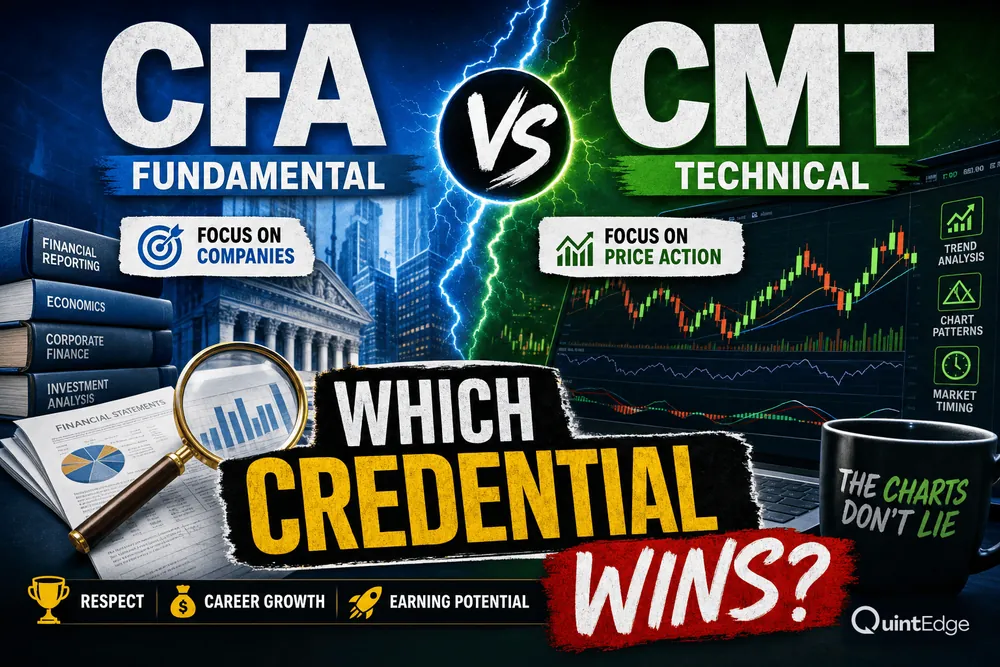
Quick Verdict: CFA vs CMT — Which Credential Wins?
The CFA vs CMT debate is fundamentally a question of investment philosophy: do you analyse companies from the inside out using financial statements and valuation models, or do you read markets from the outside in using price, volume, and momentum signals? Both credentials are rigorous, globally respected, and can unlock high-paying finance careers — but they serve very different purposes.
- Choose CFA if you want to build careers in portfolio management, equity research, investment banking, wealth management, or corporate finance. The CFA Institute’s charter is the gold standard for investment professionals worldwide, recognised in over 165 countries.
- Choose CMT if you want to master technical analysis for trading, market strategy, quantitative research, or algorithmic finance. The CMT Association’s credential is the definitive qualification for technical analysts and market strategists across institutional trading desks and hedge funds.
In practice, these two credentials are rarely in direct competition. The CFA evaluates what to buy or sell based on intrinsic value; the CMT evaluates when to buy or sell based on market structure and price behaviour. Together, they are genuinely complementary. Separately, each credential is powerful in its own domain.
This guide delivers a thorough, up-to-date comparison for 2026 covering what each credential requires, difficulty and cost, salary expectations, career paths, and a clear decision framework so you can choose — or combine — with confidence.
Key Takeaway
CFA = broad investment career with the highest global brand recognition and salary ceiling. CMT = specialised technical analysis credential that is faster, cheaper, and ideal for traders and market strategists. The two are more complementary than competitive.
What Is the CFA? What Is the CMT?
CFA — Chartered Financial Analyst
Administered by the CFA Institute (founded 1947, headquartered in Charlottesville, Virginia), the CFA programme has produced over 200,000 charterholders across 165+ countries. It is structured as three progressively difficult levels, each requiring roughly 300 hours of study.
The curriculum spans 10 subject areas: Ethics & Professional Standards, Quantitative Methods, Economics, Financial Statement Analysis, Corporate Issuers, Equity Investments, Fixed Income, Derivatives, Alternative Investments, and Portfolio Management & Wealth Planning.
To earn the charter, candidates must pass all three levels and accumulate at least 4,000 hours of qualifying professional experience in investment decision-making. The CFA is the benchmark credential for fundamental analysis — valuing assets based on earnings power, balance sheets, and discounted cash flows.
CMT — Chartered Market Technician
Awarded by the CMT Association (formerly the Market Technicians Association, founded 1973, rebranded in 2017, headquartered in New York), the CMT credential has a global community of charterholders and candidates across dozens of countries. It is structured as three exam levels that can typically be completed in 12–18 months.
The curriculum focuses entirely on technical analysis: chart patterns, trend analysis, momentum indicators, intermarket analysis, Elliott Wave theory, Fibonacci relationships, market breadth, volume analysis, behavioural finance, and the development of systematic trading strategies.
To earn the CMT charter, candidates must pass all three exams, agree to the CMT Association’s Code of Ethics, and have at least three years of approved professional experience in a role involving technical analysis or related financial work. The CMT is the premier credential for technical analysis — interpreting market behaviour through price and volume data.
CFA vs CMT: Side-by-Side Comparison
The table below compares every major dimension of the two credentials so you can evaluate them at a glance.
| Factor | CFA (Chartered Financial Analyst) | CMT (Chartered Market Technician) |
|---|---|---|
| Governing Body | CFA Institute | CMT Association |
| Founded | 1947 | 1973 |
| Number of Exams | 3 levels | 3 levels |
| Approach | Fundamental analysis (bottom-up & top-down) | Technical analysis (price, volume, patterns) |
| Avg. Study Hours | 900–1,000 hours total | 250–350 hours total |
| Time to Complete | 2.5–4 years | 1–2 years |
| Pass Rate (recent ranges) | Level I ~35–45%, Level II ~45–50%, Level III ~45–55% | Generally higher than CFA at each level; varies by sitting |
| Work Experience | 4,000 hours (investment decision-making) | 3 years (approved technical/financial role) |
| Exam Fees (USD) | L1/L2 ~$1,140–$1,490, L3 ~$1,240–$1,590 (early vs standard); no enrolment fee in 2026 | L1 ~$250–$500; L2/L3 ~$450–$700 (early vs standard); plus enrolment & annual membership |
| Exam Format | MCQ (L1 & L2); item sets + constructed-response (L3) | MCQ (L1 & L2); mix of multiple choice and constructed-response/essay (L3) |
| Exam Windows (2026) | L1: four windows/year (Feb, May, Aug, Nov); L2: three (May, Aug, Nov); L3: two (Feb, Aug) | June and December windows |
| Global Charterholders | ~200,000+ | Several thousand (much smaller community) |
| Ideal For | Portfolio managers, analysts, bankers | Traders, technical analysts, market strategists |
| Employer Recognition | Universal across finance | High among trading desks, hedge funds, prop firms |
Salary Comparison: CFA vs CMT in 2026
Salary outcomes for both credentials depend heavily on employer type, city, years of experience, and specialisation. Below is a realistic picture of what each credential unlocks at different career stages, both in India and globally.
CFA Charterholder Salaries
The CFA charter commands among the highest salaries in the finance industry owing to the scope and prestige of the credential. Global compensation surveys by industry sources consistently place experienced CFA charterholders well into six-figure USD totals (base plus bonuses), though the median varies meaningfully by region, role, and tenure. In India, the trajectory looks like this:
- Entry-level (0–3 years, CFA candidate): ₹7–14 LPA at boutique firms, ₹12–20 LPA at global investment banks or AMCs.
- Mid-career (3–7 years, charterholder): ₹18–35 LPA in equity research, portfolio management, or investment banking.
- Senior level (7+ years): ₹35–80+ LPA for portfolio managers, fund managers, and senior research heads.
- Globally (USA, UAE, UK, Singapore): USD 100,000–350,000+ depending on firm and specialisation.
CMT Charterholder Salaries
The CMT credential delivers strong compensation in specialised roles, particularly at hedge funds, proprietary trading firms, and technical analysis departments at brokerages and asset managers. The salary range is typically narrower than CFA because the credential is more specialised:
- Entry-level (0–3 years, CMT candidate): ₹5–10 LPA in India at brokerages or research firms; higher at foreign trading firms.
- Mid-career (3–7 years, charterholder): ₹12–25 LPA for senior technical analysts and market strategists.
- Senior level (7+ years): ₹25–60+ LPA for lead strategists at hedge funds, algorithmic trading heads, and chief market analysts at large brokerages.
- Globally (USA, UK, Singapore): USD 80,000–250,000+ for senior roles at prop trading desks or hedge funds.
Salary Verdict
CFA charterholders enjoy a broader salary range and a higher ceiling, particularly in portfolio management and investment banking. CMT charterholders can match or exceed CFA salaries in specialised trading and hedge fund roles. The comparison is most meaningful within respective career tracks rather than across them.
Career Paths: Fundamental Analysis vs Technical Analysis
This is arguably the most important dimension of the CFA vs CMT decision. Each credential opens a distinct set of doors in the finance industry.
CFA Career Paths: Fundamental Analysis
The CFA curriculum is built for professionals who evaluate investments by analysing business fundamentals — earnings quality, competitive advantage, management quality, valuation multiples, and macroeconomic factors. Typical career roles for CFA charterholders include:
- Portfolio Manager: Constructs and manages equity, fixed income, or multi-asset portfolios at mutual funds, pension funds, insurance companies, and sovereign wealth funds.
- Equity Research Analyst: Publishes buy/sell/hold recommendations on listed companies after building detailed financial models. Roles exist at sell-side brokerages (Goldman Sachs, Morgan Stanley) and buy-side asset managers.
- Investment Banking Analyst/Associate: Works on M&A advisory, IPOs, debt issuance, and corporate restructuring. The CFA is increasingly valued alongside an MBA at global investment banks.
- Wealth Manager / Private Banker: Advises high-net-worth individuals on asset allocation, estate planning, tax-efficient investing, and portfolio construction.
- Corporate Finance Manager: Manages capital structure, M&A evaluation, treasury, and financial planning & analysis (FP&A) within corporates.
- Credit Analyst: Evaluates the creditworthiness of corporate or sovereign borrowers at rating agencies, credit funds, or bank credit departments.
In India, top employers of CFA charterholders include ICICI Prudential AMC, HDFC AMC, Axis AMC, Goldman Sachs India, Morgan Stanley India, JP Morgan India, Motilal Oswal, Edelweiss, and Kotak Mahindra Bank.
CMT Career Paths: Technical Analysis
The CMT curriculum trains professionals to analyse securities using historical price and volume data, identifying patterns, trends, and momentum signals that predict future price behaviour. Typical career roles for CMT charterholders include:
- Technical Analyst / Market Strategist: Produces technical research and market outlook reports for institutional clients or internal trading desks. Roles exist at large brokerages, banks, and independent research firms.
- Proprietary Trader: Trades firm capital using systematic or discretionary strategies derived from technical analysis. Roles at prop trading firms, hedge funds, and bank trading desks.
- Algorithmic / Quantitative Researcher: Develops and tests trading algorithms based on technical signals (momentum, mean reversion, breakout). High overlap with quantitative finance roles.
- Derivatives Trader: Uses technical analysis to time entries and exits on options, futures, and structured products. The CMT is valued by commodity trading advisors (CTAs) and options desks.
- Portfolio Manager (Quantitative): Manages systematic, rule-based investment strategies at quantitative hedge funds or CTAs.
- Financial Advisor (with Technical Overlay): Some retail advisors and wealth managers add the CMT to improve their market timing and client communication capabilities.
In India, CMT charterholders find opportunities at ICICI Securities, Kotak Securities, Motilal Oswal (broking), Edelweiss, IIFL, Angel One, major proprietary trading firms, hedge funds, and domestic systematic trading desks.
Difficulty Comparison: CFA vs CMT
Both credentials are challenging, but they test very different cognitive skills. Here is an honest assessment of what makes each difficult.
Why the CFA Is Harder Overall
The CFA is considered one of the most demanding credentials in global finance for several reasons:
- Sheer volume: The curriculum covers 10 major subject areas across three levels, with the complete reading list running to thousands of pages. Candidates need to master everything from discounted cash flow models to fixed-income duration calculations to behavioural finance.
- Historically low pass rates: CFA Level I pass rates have typically ranged in the mid-30s to mid-40s percent in recent years, and the multi-year commitment (2.5–4 years) creates significant dropout risk.
- Constructed-response questions at Level III: CFA Level III includes a written constructed-response component, a format that catches many analytically strong candidates off-guard.
- Depth of accounting: Financial statement analysis — one of the most heavily weighted CFA topics — requires deep proficiency in IFRS and US GAAP, which many candidates find the most demanding subject.
Why the CMT Is Still Challenging
The CMT is generally regarded as more accessible than the CFA, but it is not a lightweight credential:
- Subjectivity of technical analysis: Many candidates struggle with the fact that chart interpretation involves judgment, not just calculation. The ability to identify patterns consistently is a skill developed over time with real market exposure.
- Level II is widely considered the toughest gate: It tests applied technical analysis across multiple market types, time frames, and indicator sets.
- Level III constructed-response format: CMT Level III has historically included essay/short-answer components that test conceptual depth and the ability to construct defensible market arguments under time pressure.
- Evolving curriculum: The CMT curriculum has expanded over the years to include intermarket analysis, quantitative methods, behavioural finance, and systematic strategy design.
Difficulty Verdict
The CFA is significantly harder in terms of total study commitment, breadth, and duration. The CMT is harder than most people expect, particularly at Level II and in the essay-based Level III. If you are looking for a faster, more focused challenge, CMT wins. If you want the career brand that comes from the most gruelling finance exam, CFA is the choice.
Who Should Choose CFA vs CMT?
This framework will help you make the right decision based on your background, goals, and risk tolerance.
Choose the CFA If You:
- Want to work in asset management, equity research, portfolio management, or investment banking at a recognised financial institution.
- Have a strong academic background in finance, economics, or accounting and can commit to 900+ hours of study over 2.5–4 years.
- Want the most globally recognised finance credential — one that opens doors from Mumbai to Manhattan to Singapore.
- Are a commerce or MBA student or graduate looking for the credential that signals investment expertise to top-tier employers.
- Prefer fundamental, valuation-driven investing and want to build careers evaluating businesses rather than reading charts.
- Are targeting high-AUM fund management or senior advisory roles where the CFA charter is often a minimum qualification.
Choose the CMT If You:
- Have a genuine passion for markets, charts, and price behaviour and have been trading or following technical analysis independently.
- Want to specialise in trading, market strategy, or algorithmic research at a hedge fund, prop trading firm, or brokerage.
- Need a credential faster — you can complete the CMT in 12–18 months versus 2.5–4 years for the CFA.
- Are in a trading or broking role and want formal recognition of your technical analysis skills to accelerate promotion or a move to a larger firm.
- Are a mathematics, statistics, or engineering graduate who wants a structured credential to bridge into quantitative market analysis.
- Want a lower-cost credential — total CMT costs (exams + enrolment + optional membership) are typically a fraction of total CFA investment, often roughly 40–55%.
Cost Comparison (Indicative 2026)
The figures below are indicative ranges. Exact pricing depends on registration window (early vs standard), regional/promotional adjustments, and whether the candidate also pays optional CMT Association membership dues. Always confirm current fees on the official CFA Institute and CMT Association websites before budgeting.
| Cost Component | CFA | CMT |
|---|---|---|
| Enrolment Fee (one-time) | Not charged in 2026 (CFA Institute removed it) | ~USD 250 enrolment fee |
| Annual Membership (optional/recommended) | Charterholder dues post-charter | ~USD 425/year (member pricing on exams) |
| Level I Exam Fee | ~USD 1,140–1,490 | ~USD 250–500 |
| Level II Exam Fee | ~USD 1,140–1,490 | ~USD 450–700 |
| Level III Exam Fee | ~USD 1,240–1,590 | ~USD 450–700 |
| Study Materials | USD 300–1,500 (3rd party) | USD 200–600 |
| Total Estimated Cost (illustrative) | ~USD 3,800–6,000 | ~USD 2,000–3,500 |
| Approx. Cost in INR | ~₹3.2–5.1 lakh | ~₹1.7–3.0 lakh |
Can You Do Both CFA and CMT?
Yes — and an increasing number of serious finance professionals are doing exactly that. The combination of CFA + CMT is genuinely powerful and is sometimes called the “complete analyst” credential stack. Here is why the two credentials are more complementary than competitive:
- Fundamental + Technical = Complete Market View: A CFA charterholder who also holds the CMT can determine what to buy (via DCF, comparative valuation, and earnings analysis) and when to buy it (via support/resistance, momentum, and trend confirmation). This is particularly valuable in portfolio management, where entry/exit timing can meaningfully affect returns.
- Hedge Fund and Multi-Strategy Roles: Hedge funds running long/short equity or macro strategies often value analysts who can blend fundamental analysis (sector selection, company conviction) with technical analysis (position sizing, risk management, stop-loss discipline).
- Equity Research with Technical Overlay: Sell-side research analysts with both credentials can produce more nuanced reports that address both intrinsic value and market structure, differentiating their research in a crowded field.
- CMT First Strategy: Because the CMT is significantly faster to complete, some candidates choose to earn the CMT while preparing for CFA Level I, establishing market credibility quickly before committing to the longer CFA journey.
The main challenge of pursuing both is time and cost. The combined credential stack requires roughly 1,150–1,350 hours of study and a total spend in the region of INR 5–8 lakh depending on study materials, sittings, and any optional memberships. For ambitious professionals with clear career goals in institutional finance, the combination is worth serious consideration.
Frequently Asked Questions: CFA vs CMT
For the majority of finance roles in India, the CFA is the stronger credential because India’s financial industry is dominated by asset management, banking, corporate finance, and equity research — all fields where the CFA charter is the recognised standard. The CMT is better suited to candidates specifically targeting technical analysis roles at brokerages, proprietary trading desks, or hedge funds. In India, the CMT is less widely known among mainstream recruiters but is highly valued in specialised trading circles. If you want the broadest career optionality in Indian finance, choose CFA. If you are already in a trading or broking role and want to formalise your technical expertise, CMT is an excellent add-on or alternative.
The CMT is significantly easier in terms of total commitment — roughly 250–350 study hours versus 900+ for the CFA, and typically completable in 12–18 months versus 2.5–4 years. CMT pass rates have historically been higher than CFA pass rates at each level, though both vary by sitting. However, CMT Level II and Level III are genuinely challenging, particularly the constructed-response component of Level III. Candidates who are strong in mathematics or already practise technical analysis may find CMT more intuitive. Candidates with accounting, economics, or MBA backgrounds may find CFA more aligned with their existing knowledge base.
Comparing salaries directly is difficult because the two credentials serve different roles. In India, CFA charterholders typically earn more on average because the credential is associated with senior portfolio management and investment banking roles that command higher compensation. Indicative mid-career CFA pay sits around ₹18–35 LPA versus roughly ₹12–25 LPA for CMT charterholders in comparable experience bands; senior CMT charterholders at hedge funds or proprietary trading firms can reach ₹25–60+ LPA, matching or exceeding many CFA roles. Globally (USA/Singapore/UK), both credentials can deliver strong six-figure USD compensation in the right roles. The CMT’s strongest pay outcomes are typically in quantitative trading and hedge fund environments.
Yes, absolutely. The CFA + CMT combination is increasingly popular among institutional investors and portfolio managers who want to integrate technical analysis into their fundamental investment process. There is no conflict between the two credentials — they are governed by different organisations and test entirely different skill sets. Many professionals pursue the CMT after completing CFA Level I or II, or after earning the full charter. The two programmes are widely seen as complementary rather than competing. If you are a CFA charterholder looking to add a market timing and trading overlay to your analytical toolkit, the CMT is the natural next step.
The CMT can be completed in 12–18 months if candidates sit for exams in consecutive windows, making it one of the faster-to-complete credentials in professional finance. The CFA typically takes 2.5 to 4 years to complete all three levels, with most candidates taking one level per year. The multi-year commitment of the CFA is one of its distinguishing characteristics — it is designed to test not just knowledge but sustained intellectual commitment to the investment profession. If speed to credential is important (for example, you are seeking a promotion or a new role within 18 months), the CMT offers a clear advantage.
This is one of the most debated questions in finance. Academic research on technical analysis has produced mixed results, with some studies supporting the predictive power of momentum strategies (which underlie much of technical analysis) and others finding limited evidence for classic chart patterns. The CMT Association positions technical analysis as a framework for understanding market psychology, supply-demand imbalances, and risk management discipline — not as a crystal ball. In practice, many of the world’s most successful traders and hedge fund managers rely on technical analysis, particularly for timing decisions, risk management, and systematic strategy design. For professionals specifically targeting trading-oriented roles, the CMT is absolutely worth pursuing. For fundamental investors and research analysts, the CFA remains the more relevant credential.
The CFA requires 4,000 hours of qualifying professional experience in investment decision-making — one of the most demanding work-experience requirements among finance credentials. It does not need to be completed before taking the exams, but it must be verified by the CFA Institute before the charter is awarded. The experience must specifically relate to investment decision-making (not just general finance work). The CMT requires three years of approved professional experience in a role that involves technical analysis or related financial work (research, trading, portfolio management, advising, market strategy and similar). The CMT’s lower work-experience bar generally makes it more accessible to earlier-career professionals.
It depends on the type of hedge fund. Long/short equity, global macro, and event-driven hedge funds typically prioritise the CFA charter (or MBA + CFA) for analyst and portfolio manager roles, as the work involves fundamental security analysis and valuation. Quantitative, systematic, and CTA (commodity trading advisor) hedge funds place higher value on the CMT (combined with programming skills in Python or R and quantitative research ability). Multi-strategy hedge funds increasingly value candidates who hold both credentials, as it signals the ability to integrate fundamental conviction with technical market discipline. If your target is a quant or systematic fund, CMT (plus quantitative skills) is the more direct path. If your target is a discretionary equity fund, CFA is typically the required credential.


