
ACCA Salary in Dubai at a Glance
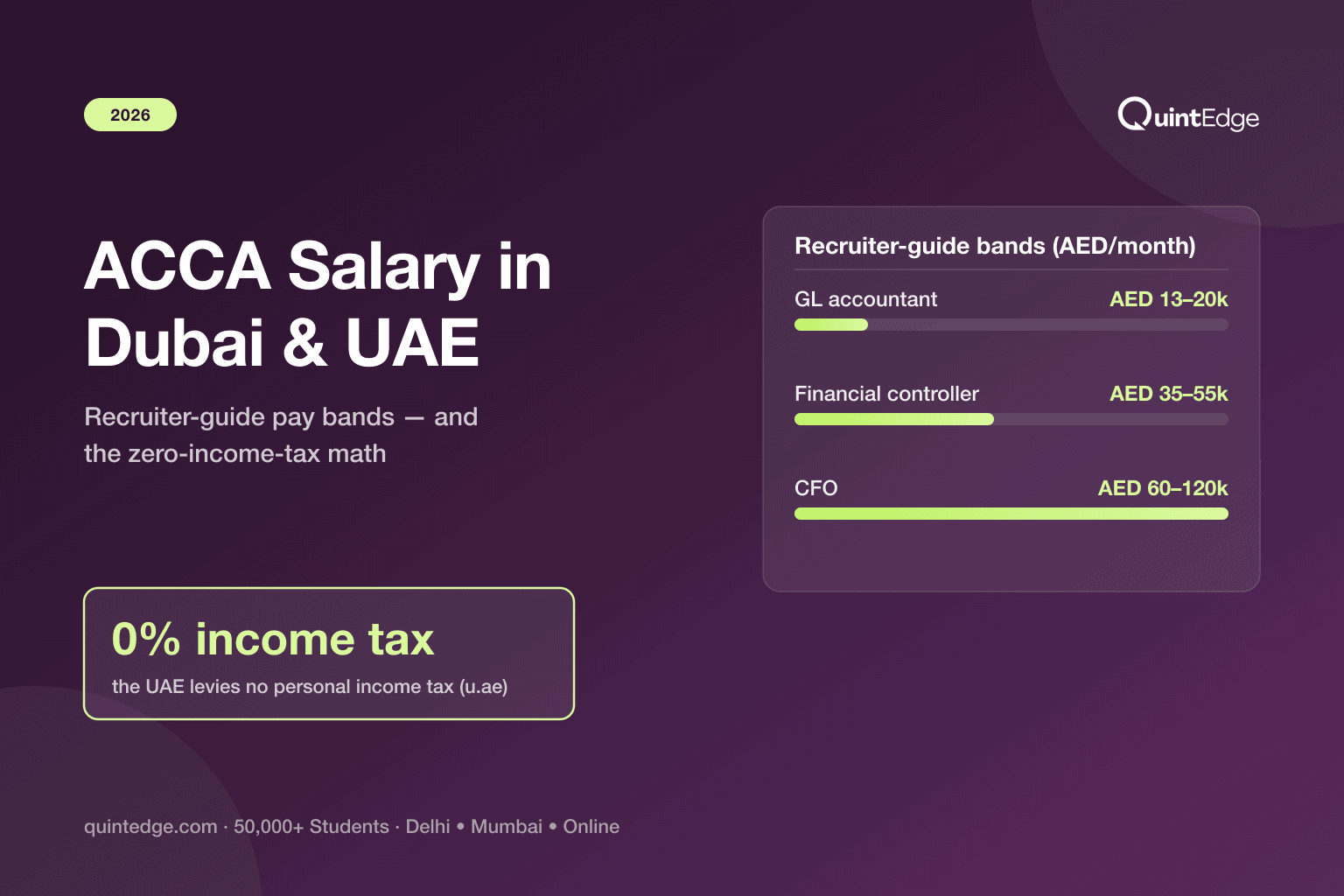
Qualified accountants in the UAE earn roughly AED 13,000 to AED 27,000 a month, per the Michael Page UAE Salary Guide 2026 (as reported by whatson.ae and The Finance Story). Junior roles sit at the lower end. Financial controllers, finance directors and CFOs earn well above this — into six figures a month at the top.
The UAE charges 0% personal income tax, so your gross salary is your take-home pay. There is no "ACCA member salary" figure published anywhere — ACCA does not release one, and the numbers you can trust are recruiter pay bands by role, not by qualification.
Here is the honest part most guides skip: earning these numbers assumes you already have a job offer. Landing the first UAE role is the hard part — most ACCA members from India build 2–4 years of experience at home first, then move once they have a visa sponsor lined up.
What Do Accountants Actually Earn in Dubai?
Pay in Dubai is set by role and seniority, not by which accounting qualification you hold. The clearest role-by-role numbers come from the Michael Page UAE Salary Guide 2026, reported by The Finance Story on 13 January 2026, and they show a wide ladder from junior bookkeeping roles to group CFO packages.
| Role | SME (AED/month) | MNC (AED/month) |
|---|---|---|
| General Ledger Accountant | 13,000–18,000 | 15,000–20,000 |
| AR/AP Accountant | 12,000–16,000 | 14,000–18,000 |
| Financial Controller | 35,000–45,000 (avg 40,000) | 45,000–55,000 (avg 50,000) |
| Finance Director | 60,000–75,000 (avg 65,000) | 65,000–80,000 (avg 70,000) |
| CFO | 60,000–90,000 (avg 75,000) | 80,000–120,000 (avg 100,000) |
| Group/Regional CFO | 70,000–120,000 (avg 90,000) | 110,000–200,000 (avg 150,000) |
Source: Michael Page UAE Salary Guide 2026, as reported by The Finance Story, 13 January 2026.
Plain-language takeaway: the jump from AR/AP accountant to financial controller is roughly 3x — that is the pay gap the ACCA qualification and a few years of experience are meant to close. MNCs also pay more than SMEs for the identical role, at every level on this table.
Two more data points round out the picture. Cooper Fitch's UAE Salary Guide 2026, reported by The National on 24 January 2026, found an average salary rise of 1.6% expected across the UAE in 2026, with most planned rises sitting in the 0–5% band — so pay growth this year is modest, not explosive. Separately, the Hays GCC Salary Guide 2026 reports that 78% of professionals across the region expect a salary increase in 2026, even though the average rise recruiters are actually planning is small — a gap between expectation and reality worth keeping in mind when you negotiate.
How Does Zero Income Tax Change the Math?
The UAE government states plainly: "The UAE does not levy income tax on individuals" (u.ae, the UAE's official government portal). That means the AED figure on your offer letter is the AED figure that lands in your bank account every month — no tax deducted, unlike in India.
You may have heard the UAE introduced a 9% corporate tax. It does not touch your salary. Per PwC's Worldwide Tax Summaries (UAE, last reviewed 12 March 2026), the corporate tax applies only to business profits above a threshold, and specifically "wages, personal investment income, and real estate investment income will not be considered" when working out whether that threshold is crossed. As an employee, this rule is not your problem — it applies to businesses, not to the salary you earn working for one.
Illustrative example (rounded figures, just to show the mechanics — not a forecast): say you take a General Ledger Accountant role at AED 15,000/month. Using the fixed peg of 1 USD = 3.67 AED (cited on our sister post on global ACCA salaries) and a rough ₹83/USD rate, that is close to ₹3.4 lakh a month, or roughly ₹40 lakh a year, before any India tax comparison — and because there is no UAE income tax, that full amount is yours to save, spend or remit home.
What's the Entry-Level Reality for Freshers?
If you are a fresher, do not anchor on the AED 13,000–27,000 band above — that describes qualified, recruiter-placed professionals. GulfTalent, a candidate-reported salary site, shows UAE accountants averaging closer to AED 4,000/month, with a range of AED 2,500 to AED 7,000, based on 1,528 individual reports across 1,453 companies.
These two numbers are not a contradiction — they describe different people. GulfTalent's dataset is self-reported and skewed toward junior, part-qualified general accountants. Michael Page's guide is built from roles recruiters actually place, which tilts toward qualified, experienced hires. Read GulfTalent as the entry/part-qualified floor and Michael Page as where you land once you are ACCA-qualified with a few years behind you.
The honest bridge: an unqualified or part-qualified fresher in the UAE is realistically in the AED 4,000–9,000/month zone. Clearing your ACCA papers and gaining 2–3 years of relevant experience is what moves you into the AED 13,000+ recruiter bands above.
Competition for that first UAE role is real. Most successful movers do not fly in cold — they qualify (or nearly qualify) in India first, build 2–4 years of relevant work experience with an Indian employer, and then apply to UAE offices of the same firm, a Big 4 network member, or a multinational with an India-UAE transfer path. Walking in with zero experience and an unfinished ACCA is the slowest route.
Where Do ACCA Members Work in the UAE?
ACCA members in the UAE work across Big 4 firms, banks, and a national qualification system that is literally built on the ACCA syllabus. Deloitte, PwC, EY and KPMG all maintain offices in Dubai and Abu Dhabi, and EY Middle East runs its own employer page on ACCA's official job board, ACCA Careers.
Two structural facts make the UAE unusually ACCA-friendly. First, the UAECA (the UAE's own national chartered accountant qualification) has the ACCA Qualification as its basis — per ACCA Global, once you qualify as an ACCA member you can also apply for AAA membership and use both the ACCA and UAECA titles, "with no additional financial commitment." Second, since December 2014, all ACCA exams in the UAE run under a Joint Examination Scheme (JES) with the AAA (Accountants & Auditors Association) — the syllabus, structure and content of the exams themselves do not change under this arrangement.
ACCA also has a physical presence: it maintains an office in Dubai Knowledge Park, and PwC's Academy Dubai is one of ACCA's Registered Learning Partners. Beyond the Big 4, banks are significant employers of finance and accounting talent — First Abu Dhabi Bank (the UAE's largest bank by assets) and Emirates NBD (Dubai's largest lender), alongside ADCB and Mashreq, all run sizeable finance functions. ACCA's own job board, ACCA Careers, lists live UAE roles across banking, financial services and graduate programmes on any given day.
Can You Sit ACCA Exams in the UAE?
Yes — but not remotely from home anymore. ACCA confirms that "all ACCA exams will be held in centres from March 2026, except in countries where we have no exam centre provision", and remote-exam tokens for on-demand papers stopped being sold from 4 November 2025. This is a global change, not an India-only or UAE-only rule — and because the UAE already has exam centres, the remote option simply does not apply there.
On-demand computer-based exams (CBEs) — the BT, MA, FA and LW papers — are delivered by the British Council at licensed venues in Dubai and Abu Dhabi. Other papers run at scheduled sittings through ACCA's regular exam windows. Always confirm your nearest venue and the exact papers on offer using ACCA's own Exam availability and booking page before you plan a sitting.
For live exam dates, fees and registration deadlines — which change every session — check our ACCA exam dates hub rather than relying on numbers in any blog post, including this one.
How Do You Plan the Move From India?
Moving to Dubai is a cost-of-living decision as much as a career one. Numbeo's Dubai cost-of-living data (last updated 2 July 2026) puts a single person's monthly costs, excluding rent, at roughly AED 4,118, and a family of four at roughly AED 14,478. A 1-bedroom apartment runs about AED 8,409/month in the city centre (range AED 6,000–14,000) or AED 5,366/month outside it (range AED 4,000–7,000).
Set against the Michael Page bands above, city-centre rent alone (~AED 8,400) can eat most of a General Ledger Accountant's pay (AED 13,000–20,000), while a Financial Controller's package (AED 40,000+) absorbs it far more comfortably. This is exactly why most people move up the ladder in India first.
A practical sequence that works for most ACCA candidates and members:
- Step 1 — Finish or get close to finishing ACCA in India. Employers sponsoring a UAE visa want to see you are qualified or clearly on track, not just registered.
- Step 2 — Build 2–4 years of relevant experience at home. Audit, controllership or finance roles at firms with a UAE presence give you an internal transfer path — the easiest way in.
- Step 3 — Target firms and job boards with a real UAE footprint. Big 4 networks, ACCA Careers listings, and multinationals with GCC operations are more realistic than cold applications to unknown local firms.
- Step 4 — Budget for the first 2–3 months before your first UAE salary lands. Use the Numbeo figures above as a floor, and add visa, flight and initial accommodation costs on top.
- Step 5 — Negotiate the full package, not just the base salary. Housing allowance, flights home and medical insurance are common in UAE offers and materially change your real take-home value.
If you are still building your ACCA foundation, it is worth comparing the India opportunity first — our ACCA salary and scope guide for India and our ACCA jobs abroad guide cover the wider international picture, while our ACCA salaries by country post benchmarks Dubai against the UK, USA and Australia. For the syllabus and fees you need to plan the qualification itself, see our ACCA course details guide.
Frequently Asked Questions About ACCA Salary in Dubai
No reliable single figure exists. No named salary guide publishes an "ACCA member salary" for Dubai — every trustworthy number is role-based, like accountant, controller or CFO pay from the Michael Page UAE Salary Guide 2026. Treat any single "average ACCA salary" figure you see online with caution unless it names its source and methodology.
No. The UAE government states there is no income tax on individuals, so your salary is not taxed. The UAE's 9% corporate tax applies to business profits, not to the wages an employee earns — per PwC's Worldwide Tax Summaries, wages are specifically excluded from that calculation.
Realistically AED 4,000–9,000 a month at the true entry level, based on GulfTalent's candidate-reported data, which skews toward junior and part-qualified accountants. The AED 13,000+ recruiter bands from Michael Page describe qualified professionals with some experience, not day-one freshers.
No. ACCA confirms all exams move to physical centres from March 2026, worldwide, except in countries with no centre provision. The UAE has established centres — including British Council venues in Dubai and Abu Dhabi for on-demand papers — so the remote option does not apply there.
Deloitte, PwC, EY and KPMG all have Dubai and Abu Dhabi offices, and EY Middle East runs its own page on ACCA's official job board, ACCA Careers. Major UAE banks including First Abu Dhabi Bank and Emirates NBD also employ significant finance and accounting teams, alongside multinationals across the Emirates.
Yes, closely. The UAECA, the UAE's national chartered accountant qualification, has the ACCA Qualification as its basis. Once you qualify as an ACCA member, you can also apply for AAA membership and use both the ACCA and UAECA titles, with no extra financial commitment, per ACCA Global.
Most successful movers build 2–4 years of experience in India before relocating. This makes visa sponsorship easier, lets you apply for an internal transfer within the same firm, and positions you for the higher recruiter-quoted pay bands rather than entry-level, junior-skewed pay.


