
Where Does ACCA Work Best Abroad?
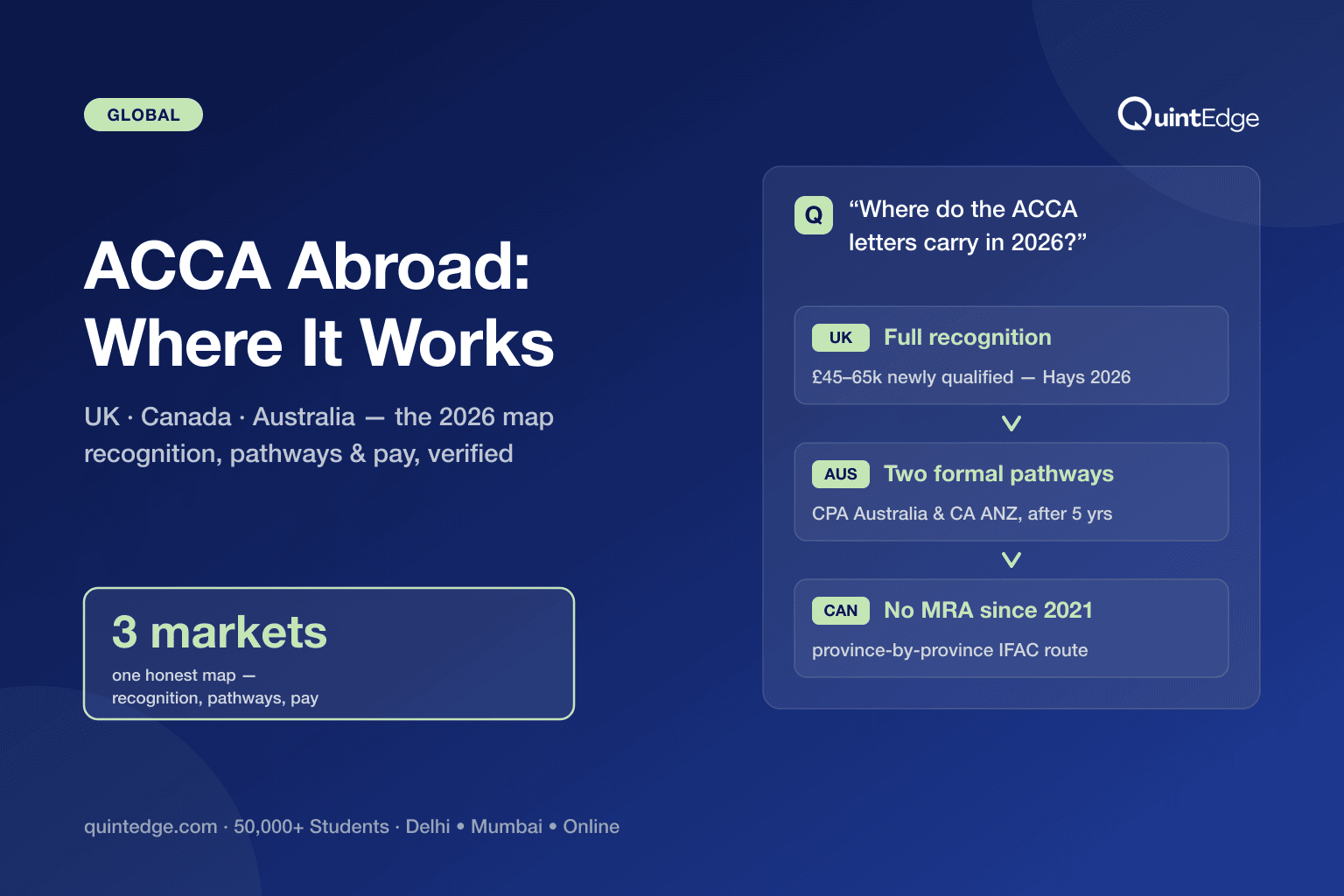
Short answer: the UK is ACCA's home turf, Australia gives you two formal pathways into its local bodies, and Canada is the honest hard case — the direct recognition agreement lapsed in 2021 and has not returned. The letters travel well almost everywhere; how much extra work they need on arrival differs sharply by country.
Here is the 2026 status in one view, with the detail and named sources in the sections below:
| Country | Recognition status (2026) | Newly qualified pay (named source) |
|---|---|---|
| UK | Full — ACCA is a UK-born chartered body | £45,000–65,000 (ACCA careers page citing Hays UK Salary Guide 2026) |
| Australia | Strong — formal pathways to CPA Australia and CA ANZ | A$80,000–95,000 average for accountants (SEEK, June 2026) |
| Canada | Partial — no MRA since April 2021; provincial IFAC routes exist | C$60,494–82,658 for accountants in Toronto (Robert Half 2026) |
Plain takeaway: pick the UK or Australia if local-body recognition matters to your plan; treat Canada as a market you enter on experience, not on automatic equivalence.
ACCA in the UK: Recognition, Jobs & Pay
ACCA was founded in London in 1904, and the UK remains its deepest job market. Your qualification needs no translation: employers, recruiters and regulators all know exactly what an ACCA member is. Members can go on to hold an ACCA practising certificate — and, with the audit qualification, statutory audit rights — under the UK's regulatory framework, something to plan with ACCA directly if public practice is your goal.
Pay is the strongest of the three markets. ACCA's own careers page, citing the Hays UK Salary & Recruiting Trends 2026 guide, puts newly qualified accountants at £45,000–65,000, rising to £65,000–110,000 with five or more years after qualification. Finance directors span £85,000–300,000. In London specifically, even ACCA finalists — students on the last papers — typically earn around £60,000.
The immigration door is the Skilled Worker visa. Accountancy roles appear on the UK's eligible occupations list, but you need a licensed employer sponsor, and salary thresholds have moved repeatedly since 2024 — check the current rules on gov.uk before planning around them. Practical reality from our students: the common entry routes are an internal transfer within a Big 4 or MNC after two to four years in India, or direct applications to UK firms via ACCA Careers, ACCA's official job board.
ACCA in Canada: The Honest Picture
Canada deserves the bluntest section, because most content online is out of date. The Mutual Recognition Agreement (MRA — a deal where two accounting bodies accept each other's members) between ACCA and CPA Canada was terminated on 30 April 2021. ACCA's own guidance states: "At this current time, a new MRA has not been reached." And in March 2026, CPA Canada renewed mutual recognition with ICAEW and CA ANZ — ACCA was not among them.
What that means in practice:
- No automatic CPA. An ACCA member arriving in Canada cannot convert to Canadian CPA by right. The available route is the IFAC member-body pathway, assessed by the provincial CPA body where you settle (CPA Ontario is the busiest for Indian members). Requirements are province-specific — expect a transcript assessment and possible additional modules or exams.
- Industry roles stay open. ACCA notes that members "are not required to have their local CPA designation to undertake many roles that fall outside the public accounting domain" — financial analysis, reporting, FP&A and internal audit hiring runs on experience. Public accounting (signing audits) is where the CPA is non-negotiable.
- Pay is solid but role-based. Robert Half's 2026 Canada Salary Guide puts staff accountants in Toronto at C$60,494–82,658 and senior accountants at C$76,250–106,000.
Plain takeaway: go to Canada for the role and the immigration points, not for the letters — and budget time for the provincial assessment if you want "CPA" on your card.
ACCA in Australia: Two Formal Pathways
Australia is the pleasant surprise of the three. ACCA holds a strategic alliance with Chartered Accountants Australia and New Zealand (CA ANZ) — extended for another five years around its tenth anniversary in April 2026 — and both major local bodies offer ACCA members a defined route in:
| Pathway | What you get | Core requirements (2026) |
|---|---|---|
| CPA Australia | Full CPA Australia membership | ACCA member in good standing · all exams + PER completed (not via another MRA) · 5 consecutive years of full ACCA membership · degree comparable to an Australian bachelor |
| CA ANZ | CA ANZ membership via its overseas-bodies pathway | Full ACCA membership through the standard exam route · 5+ years as a member · currently living in Australia or New Zealand |
Sources: cpaaustralia.com.au and charteredaccountantsanz.com pathway pages, checked in July 2026 — always confirm current terms before applying.
Plain takeaway: both Australian doors open properly only after five years of ACCA membership — qualify early so the clock finishes before you need it.
One separate process trips people up: skilled-migration points. For visa purposes, accountant occupations are assessed by CPA Australia, CA ANZ or IPA — you submit your ACCA record for assessment, and candidates are commonly asked to cover specific Australian gaps (typically local tax or law study) before a positive outcome. That is an immigration formality, not a judgement on ACCA. Salary-wise, SEEK's June 2026 data puts accountants at A$80,000–95,000 on average, with financial accountants at A$100,000–120,000.
What About Dubai & the Gulf?
For many Indian members the realistic first international move is not the UK, Canada or Australia — it is the Gulf. The UAE hires ACCA talent at scale, charges zero personal income tax, and sits three hours from home. We keep that guide separate because the market works differently: recruiter pay bands by role, visa sponsorship through employers, and a qualification landscape where ACCA maps directly onto the UAE's own national qualification.
Read the full picture — bands, tax math and the move plan — in our ACCA salary in Dubai & UAE guide, and see how members fare across markets in ACCA salaries globally.
How Should You Plan an International Move?
The members who relocate smoothly run the same five-step sequence. Copy it:
- Step 1 — Qualify first. Every market above prices you higher as a member than as a student. The five-year clocks for Australia's pathways only start at full membership.
- Step 2 — Bank two to four years of brand-name experience in India. Big 4, MNC or GCC names carry across borders and unlock internal transfers — often the easiest visa there is.
- Step 3 — Pick the market by rule-set, not vibes. UK = strongest recognition and pay; Australia = pathway plus points-based migration; Canada = experience-led entry with provincial CPA assessment if you need public practice.
- Step 4 — Use ACCA's own machinery. ACCA Careers lists international vacancies, and ACCA's country pages state current recognition terms — read them the month you apply, not from memory.
- Step 5 — Time the paperwork. Visa rules and salary thresholds shift yearly. Verify on official government sites (gov.uk, canada.ca, homeaffairs.gov.au) at decision time.
The mistakes we see: moving before membership (weakest CV point, strongest visa friction), assuming the lapsed Canada MRA still exists, and ignoring the five-year membership clocks until the year of the move. All three are avoidable with a calendar and this page. For which countries let ACCA members sign audits, see our signing-authority guide, and for the wider role map, ACCA jobs internationally.
ACCA Abroad: Frequently Asked Questions
Not automatically. The ACCA–CPA Canada mutual recognition agreement was terminated on 30 April 2021 and, per ACCA's own guidance, no new MRA has been reached. ACCA members apply through the IFAC member-body route with the provincial CPA body where they live, which involves a case-by-case assessment and possible additional requirements.
Of the three in this guide, the UK on paper: £45,000–65,000 newly qualified per ACCA's careers page citing Hays 2026, against roughly A$80,000–95,000 for accountants in Australia (SEEK) and C$60,000–83,000 in Toronto (Robert Half). Compare after tax and living costs, though — and remember the zero-income-tax Gulf often beats all three on take-home for early-career members.
ACCA has no mutual recognition agreement with the US CPA system. To sign audits in the US you would pursue the US CPA separately: a credential evaluation of your education, then all four CPA exam sections, with most state boards allowing a 30-month completion window. Non-licensed finance roles at US employers remain open to ACCA members on merit — our ACCA vs CPA guide covers the choice.
Both need five years of full ACCA membership, so the clock is identical. CA ANZ's route additionally requires you to already live in Australia or New Zealand, while CPA Australia's route can be applied for on eligibility, including the degree-comparability check. Many members simply pick the body their employer's partners hold. Verify current terms on both bodies' pathway pages before applying.
Only where local law grants ACCA audit rights, and usually only with additional local steps — a practising certificate and audit qualification in the UK, for example, or full local-body membership elsewhere. Audit signing authority is a country-by-country legal question, not a qualification feature. Our signing-authority guide lists where ACCA members can and cannot sign.
After membership plus two to four years of experience, for most people. You arrive as a qualified professional rather than a student, internal-transfer routes open up, and Australia's five-year membership clocks keep running either way. Moving mid-qualification means sitting exams at foreign centres while paying local living costs on a student CV — doable, rarely optimal.


