
What Is the ACCA Practical Experience Requirement?
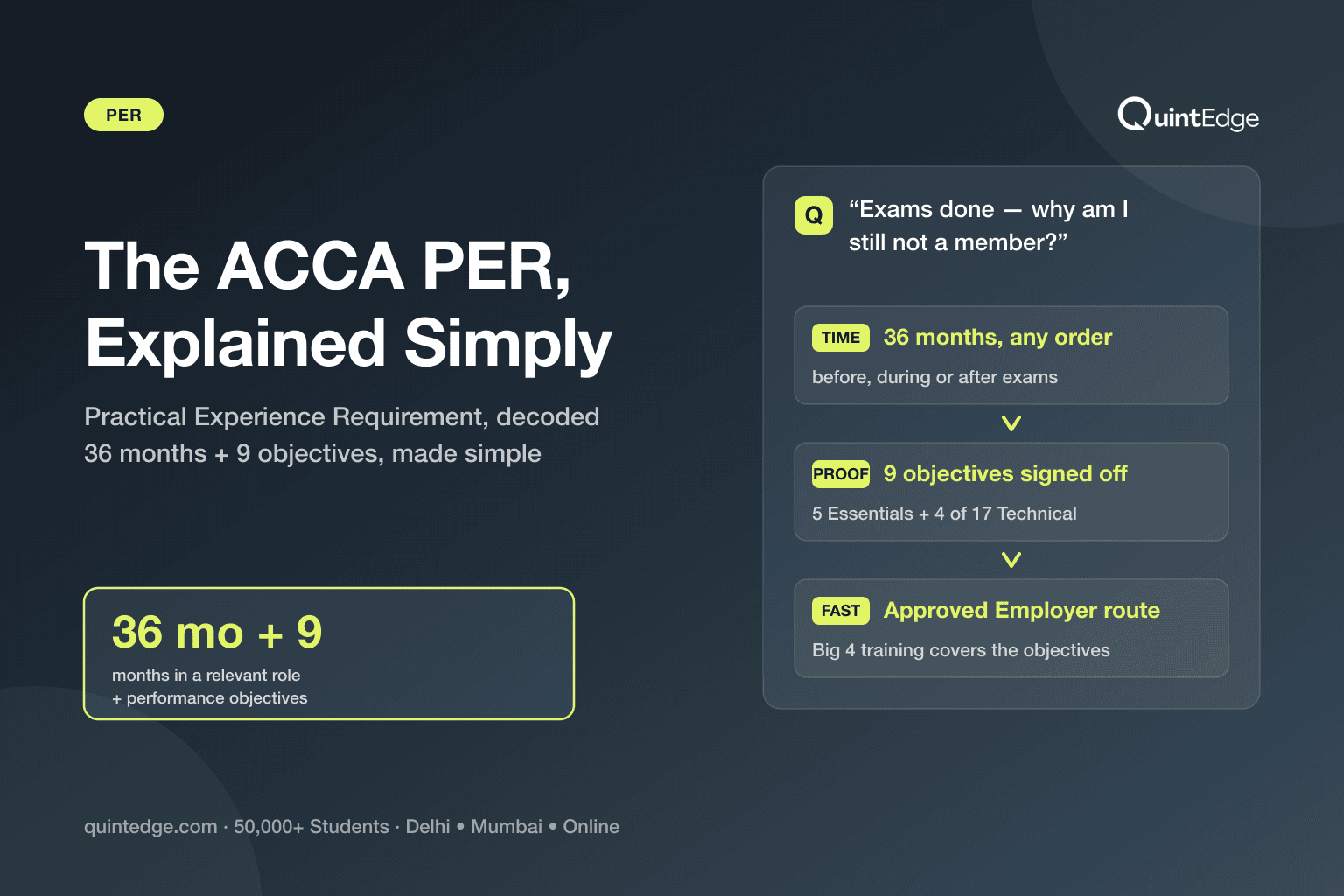
The Practical Experience Requirement (PER) is the work-experience half of becoming an ACCA member. Passing all 13 exams makes you an ACCA affiliate — not yet a member. To use the letters "ACCA" after your name, you must also complete 36 months in a relevant accounting or finance role and demonstrate 9 performance objectives, recorded online and signed off by a supervisor.
Think of it like a driving licence. Exams are the theory test. PER is your supervised driving hours — proof you can actually do the job, logged and countersigned. Nobody gets the licence on theory alone.
The three membership requirements are: all exams passed, the Ethics and Professional Skills Module (EPSM — ACCA's online ethics course) completed, and PER done. The good news for Indian students: your 36 months can come before, during or after the exams — most QuintEdge students bank their PER time while still studying.
What Counts as a Relevant Role?
A relevant role is one where most of your work uses accounting, finance, audit or closely related skills. The job title matters less than the duties. ACCA looks at what you actually do all day, not what your offer letter calls you.
Roles that typically count:
- Audit or assurance work at any firm — from a Big 4 giant to a local practice
- Accounts, financial reporting or bookkeeping roles in any company
- Tax preparation and advisory work
- Management accounting, FP&A (financial planning and analysis) and costing roles
- Finance roles in shared-service centres and GCCs (global capability centres — the India hubs of multinationals)
- Internal audit, credit analysis and treasury work
Time in clearly non-finance work — pure sales, general HR, IT support — does not count, even at a famous employer. If your role is mixed, the finance-related share of it is what your supervisor can honestly verify. Hunting for that first countable role? Our ACCA jobs in India guide and internships guide list where students start.
What Are the 9 Performance Objectives?
Performance objectives are ACCA's checklist of workplace skills. Each one describes something you must have done at work — not studied, done. You need all 5 Essentials plus any 4 of the 17 Technical objectives.
The five Essentials, straight from ACCA's list:
- 1. Ethics and professionalism — acting with integrity when real pressure appears
- 2. Stakeholder relationship management — dealing with clients, colleagues and managers professionally
- 3. Strategy, innovation and sustainable value creation — contributing beyond your task list
- 4. Governance, risk and control — working within (and improving) checks and controls
- 5. Leadership and management — planning work and guiding others, even informally
The 17 Technical objectives sit in families — corporate and business reporting, financial management, management accounting, taxation, audit and assurance, advisory and consultancy, and data and technology. You pick the 4 that match your actual job. An audit trainee naturally claims audit objectives; a GCC reporting analyst claims reporting ones. Choose objectives your daily work already produces evidence for — never ones you would have to manufacture.
How Do You Record It in MyExperience?
MyExperience is the recording tool inside your myACCA account. For each performance objective you write a 200–500-word personal statement describing what you did, in first person, with real workplace examples. Every objective has five elements, and all five must be covered before you submit the statement to your supervisor.
Four rules make statements pass review the first time:
- Write "I", not "we". The reviewer needs your role in the work, not your team's summary.
- Name real tasks. "I reconciled the fixed-asset register during the March 2026 year-end close" beats "I was involved in closing activities".
- Cover all five elements of the objective — statements bounce most often because one element is silently skipped.
- Log time as you go. Backfilling three years of detail in one weekend produces thin statements that supervisors hesitate to sign.
Alongside statements, you record your employment periods. The 36 months accumulate across jobs — switching employers does not reset anything, as long as each role is relevant and someone can verify it.
Who Can Be Your Practical Experience Supervisor?
Two different sign-offs exist, and mixing them up causes most PER confusion:
| What needs signing | Who can sign it |
|---|---|
| Your time (36 months in a relevant role) | Your line manager — they do not need to be an accountant |
| Your performance objectives (the 9 statements) | A qualified accountant — recognised by law in your country and/or a member of an IFAC body (the International Federation of Accountants; ICAI and ACCA both qualify) |
Plain takeaway: an unqualified boss can confirm you worked; only a qualified accountant can confirm you worked at the standard ACCA requires.
If your line manager is not a qualified accountant, ACCA's fix is simple: your manager signs your time, and you nominate an additional supervisor for the objectives — another qualified manager in the company, a consultant, or the organisation's external accountants or auditors. The one condition: they must have a genuine business connection to your employer and enough visibility of your work to vouch for it honestly.
The Approved Employer Shortcut
If you work for an ACCA Approved Employer holding trainee-development approval at gold or platinum level, PER gets dramatically lighter. In ACCA's own words: "you do not need to record the performance objectives in MyExperience and will achieve these through the training you'll receive" from your employer.
What the shortcut does not waive: you still complete the full 36 months, still record your employment in MyExperience (marking the Approved Employer status), and still submit the Approved Employer PER Confirmation form once you cross 36 months. Two practical checks before you rely on it:
- Confirm your entity's approval level. Approval sits with specific legal entities, not brand names — your HR or learning team can confirm whether your unit holds gold or platinum trainee development status.
- Confirm your employer permits this route. ACCA notes employers decide whether trainees may claim objectives this way — some still prefer full statements.
Deloitte, PwC, EY and KPMG in India — along with many banks and GCCs — appear in ACCA's Approved Employer directory. Our ACCA approved employers guide maps who holds which status in India.
How to Finish PER Without Delaying Membership
Most affiliates who drift for years after their last exam are blocked by PER admin, not ability. Run it like a project instead:
- Month 1 of your first relevant job: register your employment in MyExperience, nominate your supervisor (plus an additional qualified supervisor if your manager is unqualified), and shortlist your 4 Technical objectives against your real duties.
- Every 6 months: draft and submit 2–3 objective statements while the work is fresh. Nine objectives over three years is a gentle pace; nine in one month is not.
- At each appraisal: reuse the evidence — the projects your appraisal celebrates are exactly the examples your statements need.
- At 36 months: chase the final sign-offs (or the Approved Employer confirmation form), complete EPSM if you have not — see our EPSM guide — and apply for membership.
Common delays worth naming: supervisors who leave the company before signing (get sign-offs at exit, not later), statements parked "until after exams" (they take longer from cold memory), and affiliates who never nominated a qualified supervisor at all. The full journey from registration to member status is mapped in our how to become an ACCA guide.
ACCA PER: Frequently Asked Questions
Relevant work experience can count whether it comes before, during or after your exams — what matters is that the role was genuinely accounting- or finance-related and that a supervisor can verify it. If the employer and supervisor can still confirm your duties and dates, record it in MyExperience and let ACCA assess it.
They can, if the internship involves real accounting or finance work and someone qualified can verify what you did. A three-month audit internship with genuine client work is countable time; a shadowing stint with no responsibilities is weak evidence. Record it honestly and let the supervisor sign what they truly observed.
Your manager still signs off your time in the role. For the nine performance objectives, you nominate an additional supervisor who is a qualified accountant — recognised in law or a member of an IFAC body — with a business connection to your employer. Another qualified manager, a consultant, or your company's external accountants or auditors all work.
Yes — the test is your role, not your company's industry. A finance executive at a manufacturing firm, an accounts analyst at an IT company or a reporting specialist in a GCC all do countable work. What fails the test is non-finance work at any company, however large the brand.
Not yet. Finishing the exams makes you an ACCA affiliate, and you may describe yourself as one. The ACCA letters and "member" status come only after PER and the Ethics and Professional Skills Module are complete and your membership application is approved. Using the designation early is a conduct breach — it genuinely matters.
Often, yes. Where the employing entity holds ACCA Approved Employer trainee-development status at gold or platinum level and permits the route, trainees achieve the performance objectives through the firm's own training instead of writing MyExperience statements. The 36 months, the employment record and the final Approved Employer confirmation form still apply — confirm your entity's status with HR before relying on it.


