
Do the Big 4 Hire ACCA Candidates in India?
Yes — at scale, and increasingly by design. The Big 4 (Deloitte, PwC, EY and KPMG — the four largest global professional-services firms) collectively employ close to 2.3 lakh professionals in India, per The Finance Story's coverage of the firms, and their audit, tax, risk and advisory practices all recruit ACCA students, affiliates and members.
Two structural facts make this a durable pipeline rather than a trend. First, all four firms hold ACCA Approved Employer status — Deloitte India publicly announced its accreditation under the Trainee Development stream — which means their internal training is ACCA-vetted. Second, each firm runs huge global delivery centres in India (offices serving the firms' overseas clients), where work follows international standards like IFRS (the global accounting rulebook ACCA teaches) rather than Indian statutory formats.
The catch you should know upfront: signing an Indian statutory audit requires ICAI's CA qualification — ACCA does not grant Indian audit signing rights. That closes one specific door and leaves the rest open; the role map below shows exactly where ACCA fits.
Which Roles Do ACCA Candidates Actually Get?
Big 4 hiring for ACCA concentrates in the service lines where international standards and volume delivery matter most:
| Service line | What you do | ACCA fit |
|---|---|---|
| Assurance / audit delivery (incl. global delivery centres) | Audit fieldwork and reviews for overseas and Indian clients — testing, documentation, IFRS work | Strongest volume of ACCA hiring; AA/AAA papers map directly |
| Tax | Corporate tax compliance, international tax, transfer pricing support | Strong — TX/ATX knowledge carries |
| Risk advisory | Internal audit, controls testing, SOX work (US-listed clients' control checks) | Strong — governance and controls objectives align |
| Deal / transaction advisory | Due diligence, valuations support | Selective — FR strength plus Excel decides |
| Statutory audit sign-off (India) | Signing Indian audit reports | CA-only — ACCA staff support, never sign |
Plain takeaway: ACCA gets you into Big 4 audit rooms and tax teams across India — what it does not do is put your signature on an Indian statutory audit report.
A note on the delivery centres, because students underrate them: EY GDS, Deloitte USI, PwC Acceleration Centers and KPMG's delivery network are not back offices. They run substantial parts of global audits under UK, US and Australian standards — precisely the IFRS-based skill set ACCA trains. For many members they are also the springboard to onshore transfers abroad, as our international jobs guide covers.
What Salary Can You Expect at the Big 4?
Two kinds of numbers exist, and mixing them up causes bad decisions. Employer-wide medians describe everyone from freshers to managers; fresher offers are lower and narrower. Here are both, named sources attached:
| Firm | Reported pay for ACCA-certified staff (all levels) |
|---|---|
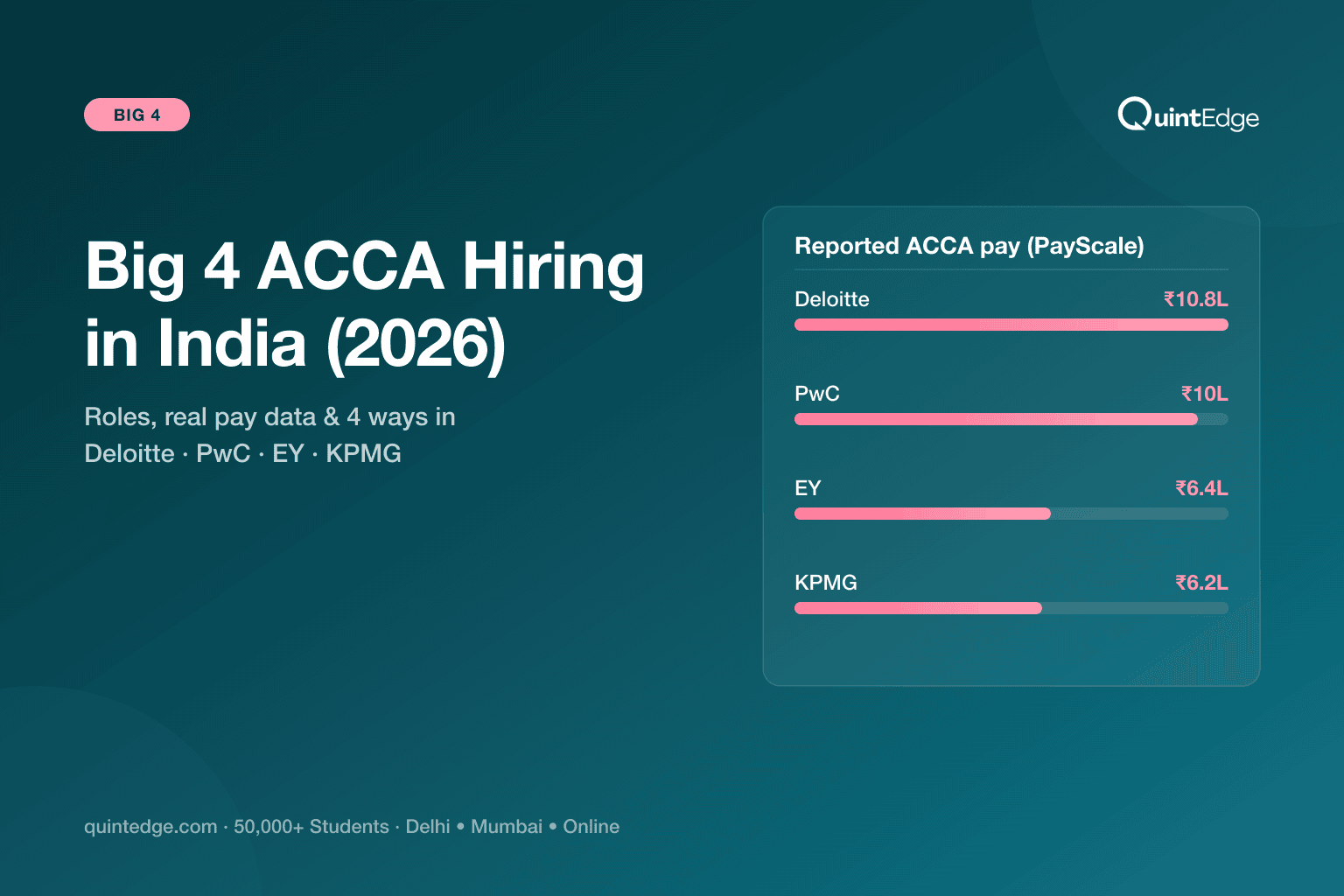
| Deloitte | ₹10,79,500 |
| PwC | ₹10,00,000 |
| EY | ₹6,40,000 |
| KPMG | ₹6,20,000 |
Source: PayScale India, ACCA certification page (173 profiles, updated 18 May 2026). Figures are medians across experience levels at each firm — not fresher offers. J.P. Morgan (₹12,00,000) and Accenture (₹10,00,000) top the same table outside the Big 4.
Plain takeaway: across-level medians at the Big 4 cluster between roughly ₹6 lakh and ₹11 lakh — where you personally land depends on level, service line and city.
For entry level, our counsellors' placement guidance puts ACCA affiliate freshers at the Big 4 in the ₹6–9 lakh band, varying by service line and city, with global delivery roles at the lower-middle of the band and client-facing metro roles higher. PayScale's all-India ACCA average — ₹7.01 lakh across all employers and levels — sits inside that same reality. Progression is level-based: associate to senior in roughly 2–3 years, assistant manager around year 4–6, with each jump repricing you. Full role-by-role bands live in our ACCA salary in India guide.
The Hidden Perk: Your PER Runs on Autopilot
Membership needs more than exams — 36 months of relevant experience and nine performance objectives, together called the Practical Experience Requirement (PER). At a Big 4 firm this becomes nearly automatic, for two reasons:
- The Approved Employer shortcut. Where the employing entity holds gold or platinum trainee-development approval — the level the Big 4 are recognised at — ACCA's rule is that "you do not need to record the performance objectives in MyExperience", because the firm's own training programme covers them. You still complete 36 months and file one confirmation form at the end. The mechanics are in our complete PER guide.
- Supervisors are everywhere. Performance objectives (where recorded) need sign-off from a qualified accountant. Big 4 teams are dense with CAs and ACCA members, so the "my manager isn't qualified" problem that stalls industry trainees rarely appears.
The result: Big 4 joiners typically convert from affiliate to member the month their 36-month clock completes — while industry peers chase statements and signatures. Which employers hold which approval level is mapped in our ACCA approved employers guide.
How Do You Actually Get Hired? The 4 Routes
Big 4 ACCA hiring runs through four repeatable routes. Work all four in parallel, not sequentially:
- Route 1 — Campus and partner drives. The firms recruit from commerce colleges and ACCA learning-partner institutes. If you study with a partner, register for every drive — this is the highest-conversion door for freshers.
- Route 2 — Careers portals. Each firm's India careers site posts assurance, tax and risk openings tagged for "CA/ACCA/CPA" — search "ACCA" directly, apply within days of posting, and keep your profile reusable.
- Route 3 — Referrals. The single strongest lever. Seniors from your coaching batch or college who already work there can refer you; most firms pay referral bonuses, so people genuinely respond to polite, specific requests.
- Route 4 — ACCA Careers. ACCA's official job board carries Big 4 postings in India and abroad, and firm recruiters use it precisely to find ACCA-tagged talent.
The process once you are in the funnel is consistent across firms: an aptitude and communication screen (often a versant-style English test), one or two technical interviews, then HR. Technical preparation that actually moves offers: IFRS basics and financial-statement mechanics, audit assertions and testing logic for assurance roles, working Excel, and two crisp minutes on "why this service line". Where freshers typically start — and what each role's interviews probe — is mapped in our ACCA jobs in India guide.
ACCA vs CA Inside the Big 4: The Honest Differences
Both qualifications thrive at these firms; they occupy different lanes. The honest comparison:
- Statutory audit practice (Indian clients): CA territory — Indian company audits are signed by ICAI members, so those teams hire and promote CAs first.
- Global delivery, IFRS reporting, international tax, risk, advisory: level ground. Hiring, pay bands and promotion in these teams track performance and service-line demand, not which institute's letters you carry.
- Long-run ceiling: partnership is open to both in advisory and consulting lines; audit-practice partnership in India effectively requires the CA. Members targeting audit leadership often add CA or shift to an overseas office where ACCA carries signing rights.
Plain takeaway: choose the lane, then the letters — for global-facing Big 4 work, ACCA competes at par; for Indian statutory audit leadership, CA is the license that matters. The full comparison sits in ACCA vs CA.
Big 4 ACCA Hiring: Frequently Asked Questions
On PayScale's May 2026 India data, Deloitte's ACCA-certified staff report the highest median at ₹10.8 lakh, then PwC at ₹10 lakh, with EY at ₹6.4 lakh and KPMG at ₹6.2 lakh. Treat these as across-level medians shaped by each firm's role mix, not as offer sheets — a fresher's package depends on service line and city far more than firm logo.
Yes. The firms hire part-qualified ACCA students and affiliates, especially into global delivery and assurance-support roles, and your remaining papers continue alongside work. Joining early also starts your 36-month practical-experience clock at an ACCA Approved Employer — often the fastest overall route to membership.
Yes, and dismissing it is outdated thinking. EY GDS, Deloitte USI, PwC Acceleration Centers and KPMG's delivery network execute substantial portions of global audits and advisory work under international standards, count toward your practical experience requirement, and regularly transfer strong performers to onshore teams abroad. The work is IFRS-heavy — exactly what ACCA prepares you for.
Support exists but varies by firm, entity and level — common forms include exam-fee reimbursement on passing, paid study leave and bonus-linked milestones. None of it is a universal entitlement, so confirm the current learning policy for your specific entity and grade during the offer conversation, in writing, before you count on it.
No. Indian statutory audit reports are signed by ICAI chartered accountants — that is a legal requirement, not firm policy. ACCA professionals work across audit delivery, IFRS reporting, tax, risk and advisory, and can hold audit signing rights in other countries where ACCA is recognised for it. For an Indian audit-partner track specifically, the CA is the license.
Four things reliably: IFRS and financial-statement mechanics at your papers-cleared level, audit assertions and basic testing logic for assurance roles, working Excel, and a specific two-minute answer on why that service line. Add one prepared example each of teamwork and handling a mistake — the behavioural rounds reuse those constantly.


