
FRM Part 1 Study Plan at a Glance
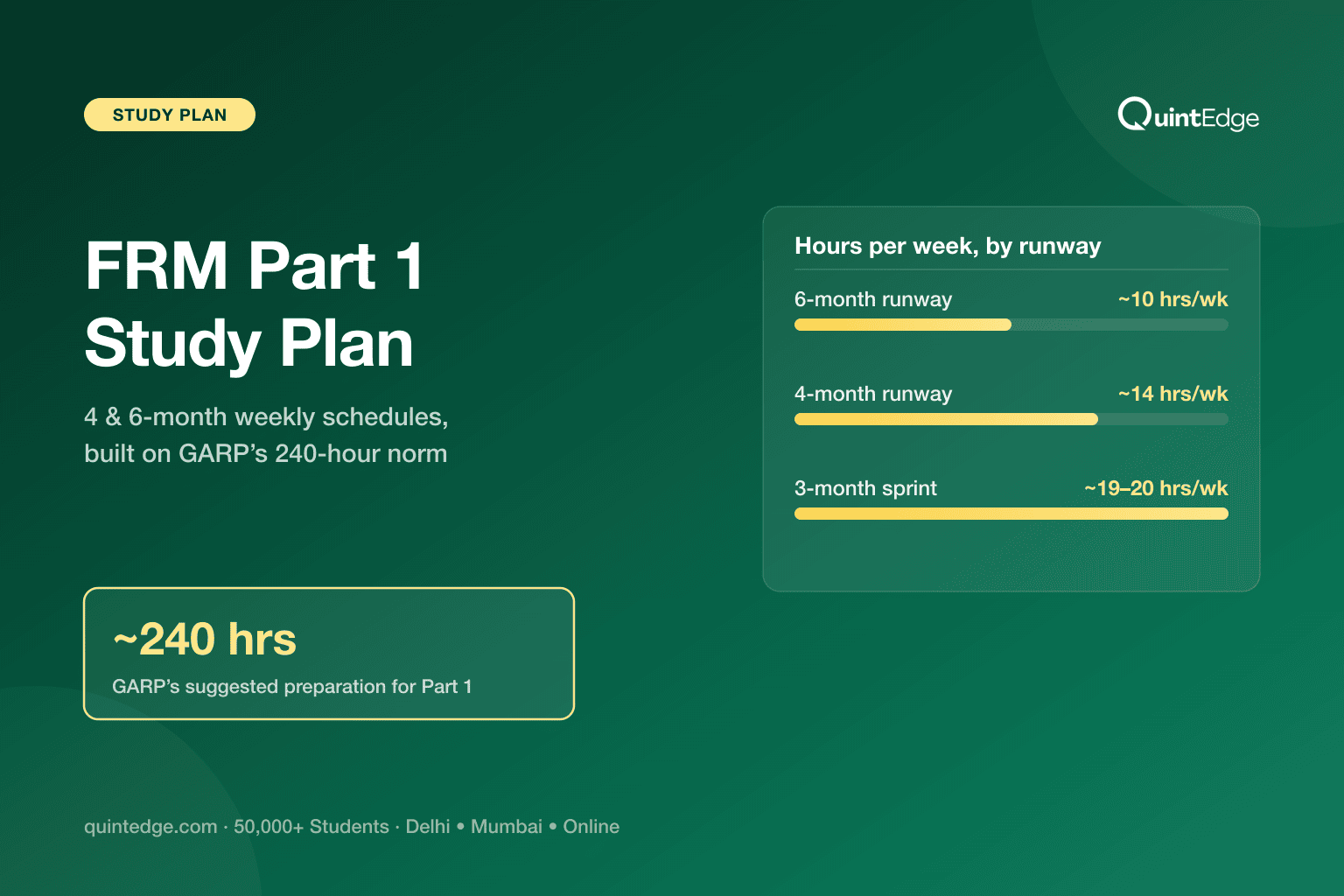
Here is the planning math in one breath. GARP (the Global Association of Risk Professionals) suggests roughly 240 study hours for FRM Part 1. Spread over 6 months that is about 10 hours a week; over 4 months, about 14; over a 3-month sprint, nearly 20. Pick the runway that matches your real week — then run the plan below, literally week by week.
What you are scheduling for: a 4-hour, 100-question multiple-choice exam with no negative marking, run at PSI test centers in May, August and November. Four topic areas carry the marks, per GARP's Study Guide: Foundations of Risk Management (20%), Quantitative Analysis (20%), Financial Markets & Products (30%) and Valuation & Risk Models (30%).
This plan is built the way we build them for QuintEdge students, with four working parts. A weekly grid that names the exact sub-topics and question count for every single week. Four measurable gates that tell you — with numbers, not feelings — whether you are on track. A question ladder that lands you past the 1,000-question mark our Part 1 strategy guide shows top-quartile scorers hit. And fall-behind rules for the weeks life wins.
One division of labour, so you use both posts correctly: this is the calendar. The strategy guide is the technique — exam-day pacing, question tactics, the classic failure patterns. Calendar first, technique alongside.
How Many Hours Does FRM Part 1 Really Need — and What Does a Week Look Like?
Plan on 240 hours as the honest baseline — GARP's own suggested preparation. The question that decides your runway is not the total; it is how many hours your normal week can genuinely give:
| Runway | Weekly load | A realistic week shape | Best suited for |
|---|---|---|---|
| 6 months (~26 weeks) | ~10 hrs | 2 weekday evenings (2 hrs each) + 4-hr Saturday + 2-hr Sunday questions | Working professionals; parallel CA/CFA prep |
| 4 months (~17 weeks) | ~14 hrs | 3 weekday evenings + 5-hr Saturday + 3-hr Sunday questions | The standard runway — steady job, no other exams |
| 3 months (~13 weeks) | ~19–20 hrs | 2 hrs daily + two 5-hr weekend blocks | Students on break; strong finance/quant base only |
Plain-language takeaway: all three rows finish the same 240 hours — the only variable is how much of your week the exam owns.
Inside each week, the mix shifts as you go. This ratio does more for pass odds than any single hack, because reading feels like progress while questions are progress:
- Phase 1 (foundations): roughly 65% concept study, 35% questions — you are building vocabulary and calculator workflows.
- Phase 2 (the 30% blocks): roughly 55/45 — every reading ends in its own question set, same sitting.
- Final month: flip it — 25% review, 75% questions and mocks. By now the syllabus lives in your error log, not the books.
Adjust the 240 honestly for who you are. A CA or quant-comfortable graduate can trim the accounting-adjacent and maths-basics readings. A fresh graduate meeting statistics properly for the first time should add 20–30% more time, concentrated in Quantitative Analysis — our FRM eligibility guide covers what the exam silently assumes.
And one date decision beats all others: register early, for a window you can truly hold. Early registration saves US$200 per part; the live deadlines are on our FRM exam dates hub, and the complete fee math is in our FRM fees breakdown.
What Should You Study First? (The Topic Order That Works)
Study the topics in the order they feed each other, not the order the books arrive. The weights say where the marks are; the dependencies say how to reach them:
| Topic area (GARP Study Guide) | Weight | What actually lives inside it |
|---|---|---|
| Foundations of Risk Management | 20% | Risk frameworks, governance, ERM, risk appetite, the classic disaster case studies (LTCM, Barings) |
| Quantitative Analysis | 20% | Probability, statistics, linear regression, time series, Monte Carlo simulation, machine-learning basics |
| Financial Markets & Products | 30% | Banks, insurance, funds; exchanges and OTC markets; forwards, futures, swaps, options; hedging; securitisation |
| Valuation & Risk Models | 30% | VaR, bond valuation, duration and convexity, option pricing (Black-Scholes, Greeks), credit risk models, stress testing |
Plain-language takeaway: 60 of the 100 questions sit in the bottom two rows — the plans below deliberately put those rows in your freshest middle weeks.
Three sequencing rules, learned from coaching this exam at scale:
- Quant before everything quantitative. Valuation & Risk Models keeps reaching for distributions, regression and simulation. Learn the tools before the tools get used on you.
- Instruments before valuation. Financial Markets & Products describes forwards, swaps and options; Valuation & Risk Models prices them. You cannot value what you cannot describe.
- Respect the time sinks. Three areas reliably eat more hours than candidates budget: options pricing (binomial trees to Black-Scholes), VaR mechanics, and regression/time series. The grids below give them their own weeks on purpose.
The 6-Month Plan: Every Week, Every Topic, Every Question Target (~10 hrs/week)
The working professional's plan. The Questions column is cumulative — it is your single most honest progress meter, and it is calibrated to land past 1,000 by exam day, in line with the 1,000-question rule. Gates are explained in their own section below.
| Week | Focus (specific sub-topics) | Questions (cum.) |
|---|---|---|
| 1 | Foundations — risk frameworks, governance, building the study system (error log, formula sheet) | 20 |
| 2 | Foundations — ERM and risk appetite; first calculator drills | 45 |
| 3 | Foundations — disaster case studies (LTCM, Barings) + full topic question set | 75 |
| 4 | Quant — probability and distributions | 100 |
| 5 | Quant — statistics, sampling, hypothesis testing | 130 |
| 6 | Quant — linear regression (the exam's favourite) | 160 |
| 7 | Quant — time series, Monte Carlo simulation, ML basics | 195 |
| 8 | Quant topic test + error review — GATE 1 | 250 |
| 9 | FMP — banks, insurance, funds (know the institutions) | 280 |
| 10 | FMP — exchanges vs OTC; forwards and futures mechanics | 310 |
| 11 | FMP — hedging with futures; interest-rate futures | 345 |
| 12 | FMP — swaps, end to end | 375 |
| 13 | FMP — options: mechanics, payoffs, strategies | 410 |
| 14 | FMP — securitisation + full topic test — GATE 2 | 450 |
| 15 | VRM — VaR and volatility measures | 480 |
| 16 | VRM — bond valuation, duration, convexity | 510 |
| 17 | VRM — option pricing: binomial trees → Black-Scholes | 545 |
| 18 | VRM — the Greeks; hedging option positions | 575 |
| 19 | VRM — credit risk models | 605 |
| 20 | VRM — stress testing + full topic test — GATE 3 | 640 |
| 21 | Revision — rebuild your two weakest topics from the error log | 700 |
| 22 | Revision — formula sheet from memory; mixed question sets | 760 |
| 23 | Half-length mixed test (50 Qs, 2 hrs) — GATE 4 | 820 |
| 24 | Mock 1 (full 4-hr) + full-day review; Mock 2 | 1,020 |
| 25 | Mock 3 + review; Mock 4 | 1,220 |
| 26 | Mock 5 (optional 6th), light review, exam logistics, rest | 1,320+ |
Plain-language takeaway: ~30 questions a week during topic study, then a final month that more than doubles the count through mocks — that is how 1,000+ happens without a heroic final fortnight.
The 4-Month Plan: The Same Skeleton, Compressed (~14 hrs/week)
The standard runway. Identical skeleton, identical gates, identical question ladder — the extra four weekly hours absorb the compression, and the Questions column climbs ~50 a week instead of ~30:
| Week | Focus (specific sub-topics) | Questions (cum.) |
|---|---|---|
| 1 | Foundations — frameworks, governance, ERM, risk appetite | 40 |
| 2 | Foundations — case studies (LTCM, Barings) + topic set | 90 |
| 3 | Quant — probability, distributions, statistics | 140 |
| 4 | Quant — hypothesis testing + linear regression | 195 |
| 5 | Quant — time series, simulation, ML basics + topic test — GATE 1 | 250 |
| 6 | FMP — institutions; exchanges vs OTC; forwards & futures | 300 |
| 7 | FMP — hedging; interest-rate futures; swaps | 350 |
| 8 | FMP — options: mechanics, payoffs, strategies | 400 |
| 9 | FMP — securitisation + full topic test — GATE 2 | 450 |
| 10 | VRM — VaR, volatility; bond valuation begins | 500 |
| 11 | VRM — duration, convexity; binomial trees | 550 |
| 12 | VRM — Black-Scholes, the Greeks | 595 |
| 13 | VRM — credit risk models, stress testing + topic test — GATE 3 | 640 |
| 14 | Revision — weakest-two topics from the error log; mixed sets | 720 |
| 15 | Formula sheet from memory + half-length mixed test — GATE 4 | 820 |
| 16 | Mock 1 + review; Mock 2 | 1,020 |
| 17 | Mock 3 + review; Mock 4; logistics and rest | 1,220+ |
Plain-language takeaway: the 4-month plan is not a different plan — it is the 6-month plan with the slack removed. Same gates, same 1,000+ finish, four mocks instead of five.
The 3-Month Sprint (~19–20 hrs/week): Who Should — and Shouldn't
The sprint works for exactly two profiles: students inside a break, and candidates who already speak finance — a CA, a CFA-track candidate, an engineer at ease with statistics. Twenty hours a week beside a demanding job is a plan built for regret. If that is you, take the 4-month runway or the next window.
| Week | Focus | Questions (cum.) |
|---|---|---|
| 1 | Foundations — frameworks, ERM, case studies | 50 |
| 2 | Quant — probability, distributions, statistics | 100 |
| 3 | Quant — regression, time series, simulation | 150 |
| 4 | Quant + Foundations mixed test — GATE 1 | 210 |
| 5 | FMP — institutions, forwards, futures, hedging | 270 |
| 6 | FMP — swaps; options mechanics and strategies | 330 |
| 7 | FMP — securitisation + topic test — GATE 2 | 390 |
| 8 | VRM — VaR, volatility, bond valuation | 450 |
| 9 | VRM — option pricing, Greeks | 510 |
| 10 | VRM — credit models, stress testing + topic test — GATE 3 | 570 |
| 11 | Revision — error log + formula sheet + half-length test — GATE 4 | 650 |
| 12 | Mock 1 + review; Mock 2 | 850 |
| 13 | Mock 3 + review; Mock 4; rest | 1,050 |
Plain-language takeaway: the sprint clears the 1,000-question bar with nothing to spare — which is exactly why it is reserved for candidates whose base lets them move at 50 questions a week from week one.
The honest arithmetic for a wavering sprinter: registering for the next window costs three months and nothing else. Deferring later costs US$250 and refunds nothing; a failed sprint costs a full exam fee (US$600–800) plus six months of confidence. The full cost ladder is in our FRM fees breakdown.
The Four Gates: How to Know You Are Actually on Track
Feelings lie about exam readiness; question data does not. Each gate is a measurable check with a defined action on failure — the thresholds below are the ones we hold QuintEdge students to, and they exist to catch drift early, while it still costs one week instead of one attempt.
Two mechanics make the gates work. Gate sets must be fresh questions — re-solving questions you have seen measures memory, not readiness. And the error log is the real syllabus from week one: every wrong answer gets a line (topic, why wrong, the fix), and "closing" the log — re-solving until it empties — is what the revision weeks are actually for.
If You Fall Behind: The Decision Rules
Every long plan meets a bad fortnight. What separates passers is not avoiding the slip — it is having pre-decided rules so the recovery is arithmetic, not panic:
- One week behind: compress Foundations reading or spend a revision-buffer week. Never compress Quantitative Analysis, and never surrender a mock — those two protect the 60 marks in the 30% blocks and your exam stamina respectively.
- Two or more weeks behind, before Gate 2: change the runway, not the standards. If you started on 4 months, re-cut to the 6-month grid against the next window — done before that window's early-registration deadline, the switch is free.
- Two or more weeks behind, after Gate 3: do not open new material in the final fortnight. Triage: mocks + error log + the two 30% topics only. A shaky Foundations week costs ~20 marks at worst; walking in mock-starved risks all 100.
- Deciding whether to push or postpone: use the cost ladder. Next window early-registration = free but three months. Deferral = US$250, once, no refund of the difference. Failed attempt = US$600–800 re-registration plus the window. The ladder almost always says: decide early, before deadlines convert a free choice into a paid one.
The Final Month: Mocks That Actually Predict Your Score
The last four weeks decide more outcomes than the first twelve, and they have their own rules. You are training three separate things: recall, stamina (four hours is a physical event), and pacing — at 100 questions in 240 minutes you get 2 minutes 24 seconds per question, average.
- Simulate properly. Full 4-hour sittings, morning start, approved calculator only (TI BA II Plus family or the permitted HP models), no pauses. A mock taken in three relaxed evening slices measures nothing.
- Read the trend, not the score. Four to six mocks give you a line, and the line should climb. A single bad mock after a review day is noise; two flat mocks in a row is a signal — go back to the error log's densest topic.
- Review longer than you sit. Every mock earns a same-week review session of at least half its length. An unreviewed mock is 100 questions spent for zero learning.
- Train the no-blank reflex. There is no negative marking — in every mock, every question gets an answer. Guessing habits are built in practice, not summoned on exam day.
Exam-day tactics — question triage, the pacing framework, what to do in the last thirty minutes — are the strategy guide's department. And for what a pass actually unlocks, our jobs after FRM Part 1 guide maps the roles and the honest salary bands waiting on the other side.
Frequently Asked Questions About the FRM Part 1 Study Plan
Both reach GARP's ~240-hour norm — the difference is weekly load: about 14 hours a week over 4 months versus about 10 over 6. Choose 6 months if you work full-time or run parallel exams; choose 4 months if your weeks are steady and you want momentum. The skeleton, gates and 1,000+ question ladder are identical either way.
Two weekday evenings of 2 hours each for concept study, a 4-hour Saturday block for the week's main topic, and a 2-hour Sunday session that is questions only. Early in the plan the mix is roughly 65% concepts to 35% questions; by the final month it flips to 25/75. The Sunday question block is the one session you should never trade away.
Foundations and Quantitative Analysis first, then the two 30%-weight blocks — Financial Markets & Products before Valuation & Risk Models — and mocks last. Quant comes early because valuation keeps using its tools, and instruments come before valuation because you cannot price what you cannot describe. This matches the weights in GARP's Study Guide: 20/20/30/30.
Cross 1,000 — the threshold our strategy guide associates with top-quartile scorers. The grids above build it in: roughly 30 questions a week during topic study (50 on the faster runways), topic tests at each gate, then a final month of 4–6 full mocks at 100 questions each. The cumulative column in each grid is the honest meter.
Apply the pre-decided rules. One week behind: spend a revision-buffer week — never cut Quant or a mock. Two-plus weeks behind before the FMP gate: re-cut to a longer runway against the next window, before its early-registration deadline (that switch is free). Behind after the VRM gate: no new material — triage into mocks, the error log and the two 30% topics. Deferral costs US$250; a failed attempt costs US$600–800 plus months.
Treat 240 as a floor, not a ceiling. FRM has no formal education requirement, but the exam assumes comfort with statistics and instruments that non-finance candidates build from scratch — realistically add 20–30% more time, concentrated in Quantitative Analysis and Financial Markets & Products. Keep the same gates; just give the early weeks more room.
At the start of your plan, inside the early-registration window — it saves US$200 per part and locks the commitment your calendar needs. FRM runs in May, August and November, and early deadlines close months before each window. Check the live dates on our FRM exam dates hub before picking your runway, and match the runway to the window rather than squeezing the window to fit.


