
Jobs After FRM Part 1 at a Glance
Let us answer the anxious version of the question first. Yes — you can get a job with only FRM Part 1 cleared. Analyst-tier risk roles hire at this stage: risk analyst, credit analyst, operational-risk analyst, junior desks at global banks' India centres. Fresh data for the seat family: risk analysts in India average ₹6.3 lakh a year, with entry level near ₹3.9 lakh (PayScale, 203 profiles, as of July 2026) — and strong Part-1-cleared profiles at banks and GCCs land at or above those averages.
Now the accurate version of what Part 1 is. It is a signal, not a certification. The FRM designation itself needs both parts plus two years of risk work experience. What a Part 1 pass tells a recruiter is precise and valuable: this candidate volunteered for a hard quantitative exam about risk, and passed it. For junior hiring, that is often exactly the filter.
Two rules and one tailwind complete the picture. GARP's usage rule: your CV may say "FRM Program – Passed FRM Exam Part I" — never "FRM" after your name until certified. GARP's clock: Part 2 must be passed by 31 December of the fourth year after passing Part 1. And the tailwind: RBI's expected-credit-loss deadline of 1 April 2027 has India's banks building credit-risk teams right now.
Can You Really Get a Job With Only Part 1?
Yes — because of how junior risk hiring actually works. Nobody expects a 22-year-old to be a certified FRM. Employers hiring analysts are buying trainability plus intent, and a Part 1 pass proves both: you chose risk deliberately, and you survived a 100-question quantitative exam that most candidates find genuinely hard.
Where Part 1 alone carries you, and where it does not:
- Enough on its own: analyst and junior roles — the recruiter's question is "can this person learn our desk?", and Part 1 answers it.
- Helpful but not decisive: lateral moves 2–3 years in — there, your work record leads and Part 1 supports.
- Not enough: roles titled risk manager and JDs that say "certified FRM preferred" — those want the full designation and the experience behind it.
One decision follows directly, and it is the one candidates most often get wrong: do not wait for Part 2 to start applying. The certification needs two years of full-time risk work experience anyway — a job is the requirement. Working while preparing for Part 2 runs both clocks at once; waiting runs neither.
Which Roles Open After Part 1?
Six role families reliably interview Part-1-cleared candidates in India. They differ in flavour more than entry bar — pick by the work you want to be good at in three years:
| Role | What you actually do | Typical employers |
|---|---|---|
| Risk analyst | Monitor limits, run risk reports, support portfolio reviews | Banks, NBFCs |
| Credit analyst | Assess borrowers — financials, ratings, repayment capacity | Banks, rating agencies (CRISIL, ICRA, CARE) |
| Credit-risk modeling junior | Support PD/LGD/EAD and ECL model builds | Banks, Big 4 teams, larger NBFCs |
| Market-risk / treasury junior | VaR runs, sensitivity reports, liquidity monitoring | Banks, GCC risk desks |
| Operational-risk analyst | Incident tracking, control testing, risk registers | Banks, GCCs, insurers |
| Risk consulting analyst | Client projects across credit, market and ops risk | Big 4 and consulting firms |
Plain-language takeaway: "risk" is not one job — it is at least six. Part 1 is the shared entry ticket; the desk you pick shapes everything after.
The strongest current of the moment is credit risk. RBI's final expected-credit-loss directions (issued 27 April 2026, effective 1 April 2027) require every large bank to build and document ECL models before the deadline — a genuine, dated hiring trigger. If that lane interests you, start with what credit risk modeling actually is and the pay picture in our credit risk analyst salary guide.
What Salary Can You Expect With Part 1?
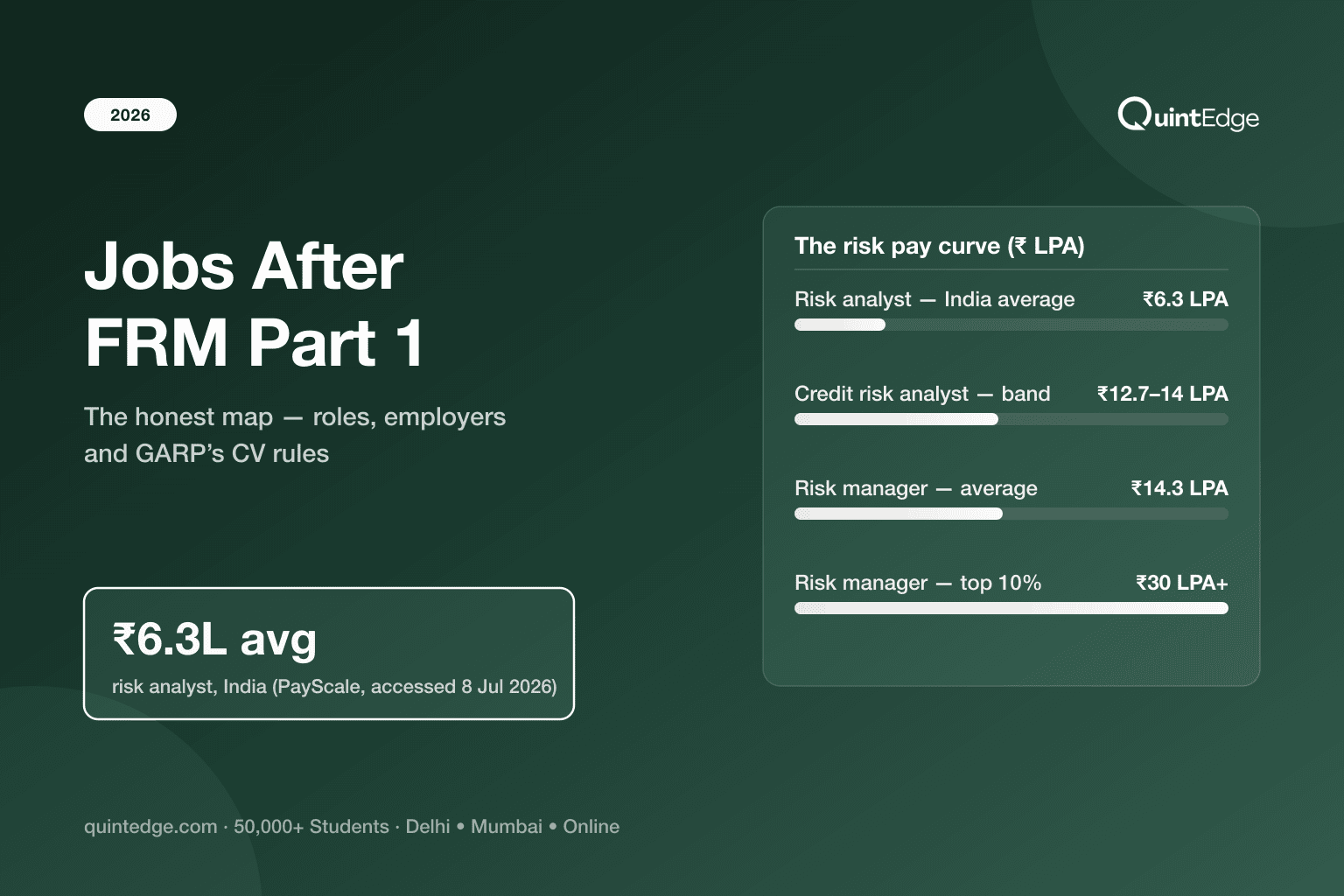
Anchor on the honest numbers: risk analysts in India average ₹6.3 lakh a year — entry level near ₹3.9 lakh and a ₹2.7–20 lakh span covering the middle 80% of profiles (PayScale, 203 profiles, as of July 2026). From there, the curve depends more on your desk than your certificate:
| Career point | Typical band | Basis |
|---|---|---|
| Risk analyst — entry / India average | ₹3.9 / ₹6.3 lakh | PayScale, 203 profiles, checked in July 2026 |
| Risk manager — early career (1–4 yrs) | ₹8.2 lakh average | PayScale, 97 profiles |
| Credit risk analyst — typical band | ₹12.7–14 lakh | AmbitionBox, 1.8k salaries, updated 2 July 2026 |
| Risk manager — average / top-10% threshold | ₹14.3 / ₹30 lakh | PayScale |
Plain-language takeaway: Part 1 gets you onto the curve near the risk-analyst averages; the certification, your desk choice and compounding experience drive the climb toward the risk-manager span (₹14.3 lakh average; only the top 10% cross ₹30 lakh).
Worth repeating from the table: the credit-risk band currently pays above the general risk-analyst entry band — the ECL build-out has made it the seller's market inside risk. Desk choice is a salary decision, not just a taste decision.
How Do You Put Part 1 on Your CV?
GARP polices its designation, so get the wording right — it is also a quiet competence test in interviews. The approved formula is simple:
- Write: "FRM Program – Passed FRM Exam Part I" (with the month and year if you like). After passing both parts but before certification: "FRM Program – Passed Levels I & II".
- Never write: "FRM" after your name, "FRM (Part 1)", or "FRM-certified" — GARP's FRM FAQ is explicit that the designation is off-limits until you are certified.
- In interviews, convert the line into fluency. A Part 1 pass earns you questions about VaR, default probability and instruments — answering them well is where the certificate becomes an offer.
Then add the thing most Part 1 CVs lack: proof of applied skill. A small built project — a PD scorecard on a public dataset, an ECL staging calculator — separates you from every other candidate holding the same exam result. That is precisely the layer our Credit Risk Modeling course builds, and it converts syllabus knowledge into interview-room evidence.
Where Should You Apply — and When?
Apply across all four employer families at once; they value the same signal differently, and their hiring calendars rarely align. The map:
- Banks and NBFCs. The volume hirer — risk analyst and credit roles across metros, with the ECL deadline pushing credit-risk requisitions hardest.
- Big 4 and consulting risk practices. Project-based risk work for lender clients; they read a Part 1 pass plus documentation discipline very well.
- GCCs (global capability centres). Global banks' India risk desks — structured training, brand names on the CV, heavy analyst intake.
- Rating agencies. CRISIL, ICRA and CARE hire credit analysts where Part 1's default-risk vocabulary lands directly.
Timing: start applying as soon as your Part 1 result lands — and browse curated openings on QuintEdge's finance job portal while you shortlist. Where students before you landed is visible on our placements wall.
When Does Part 2 Start to Matter?
Part 2 matters the day you want the title instead of the seat. Certified-FRM-preferred job descriptions, risk-manager roles, and the credential itself all sit behind it — and GARP runs two clocks you must respect:
- The 4-year exam clock. Pass Part 2 by 31 December of the fourth year after passing Part 1, or Part 1 lapses and the journey restarts.
- The experience clock. Certification needs two years of full-time risk-related work, submitted within five years of passing Part 2 — another reason the job comes before the second exam, not after.
The standard playbook writes itself: take the job now, register for a Part 2 window about a year out (both parts run in every May, August and November window — live deadlines on our FRM exam dates hub), and let the day job double as syllabus revision. Credit-risk work in particular pays twice: Part 2's largest topic blocks include exactly what an ECL team does all day.
If you are a CA weighing this same path, the combo math — including how GARP's broader experience definition treats risk-flavoured CA work — is in our FRM after CA guide, and the full pay arc by experience level is in FRM salary in India.
Frequently Asked Questions About Jobs After FRM Part 1
Yes. Analyst-tier risk roles hire Part-1-cleared candidates: risk analyst, credit analyst, operational-risk analyst and junior desks at global banks’ India centres. Risk analysts in India average ₹6.3 lakh a year, with entry level near ₹3.9 lakh (PayScale, 203 profiles, as of July 2026). Write the pass as "FRM Program – Passed FRM Exam Part I" and start banking experience straight away.
No. GARP's rules are explicit: the FRM designation may not be used in any form until you are certified — both parts passed and two years of risk experience verified. The approved CV line is "FRM Program – Passed FRM Exam Part I", and after both exams, "FRM Program – Passed Levels I & II". Recruiters in risk know these rules, so precision here quietly signals professionalism.
Anchor on the role data: risk analysts average ₹6.3 lakh in India, with entry level near ₹3.9 lakh and a ₹2.7–20 lakh span covering the middle 80% of profiles (PayScale, as of July 2026). Credit-risk desks pay above the general average — ₹12.7–14 lakh typical band (AmbitionBox, 2 July 2026) — which is exactly why the credit-risk lane is the smart first target while India’s ECL build-out runs.
Job first, almost always. The FRM certification itself requires two years of full-time risk work experience, so employment is part of the credential's own path — working while preparing runs both clocks simultaneously. Both parts are offered in every window (May, August, November), so a Part 2 attempt fits naturally about a year into the job.
Effectively yes, on a four-year clock: GARP requires you to pass Part 2 by 31 December of the fourth year after passing Part 1. Miss it and your Part 1 pass lapses — you would re-register and re-sit. A year or two of job-first sequencing fits comfortably inside the window; indefinite postponement does not.
If pay and momentum matter most right now, credit risk — India's ECL build-out (deadline 1 April 2027) is hiring on a calendar, and the typical credit-risk band currently sits above general risk-analyst entry pay. If you want breadth first, bank risk-analyst and Big 4 risk-consulting seats expose you to more risk types before you specialise. GCC desks trade some deal-table proximity for brand and training.
Part 1 is a real but partial signal: it clears CV filters for analyst-tier risk seats (a family averaging ₹6.3 lakh per PayScale) and shows quantitative seriousness. The full certification is what moves you up the curve — risk managers average ₹14.3 lakh and the top 10% cross ₹30 lakh (PayScale) — because GARP’s experience requirement makes certified candidates proven practitioners, not exam-passers.


