
FRM After CA at a Glance
Straight answer first. If you are a CA (Chartered Accountant) considering the FRM (Financial Risk Manager) — the global risk-management credential from GARP (Global Association of Risk Professionals) — you get zero exam exemptions. GARP waives nothing for any qualification. Both parts, in full, like everyone else.
Is it worth it? Yes — if your destination is risk: credit risk, market risk, model validation, bank balance sheets. India's credit-risk hiring is in a genuine build-out, because RBI's (Reserve Bank of India's) final expected-credit-loss directions land on 1 April 2027 and every large bank needs model-builders before that date. If your destination is investment banking or equity research instead, stop here and read our CFA after CA guide — that is the other lane.
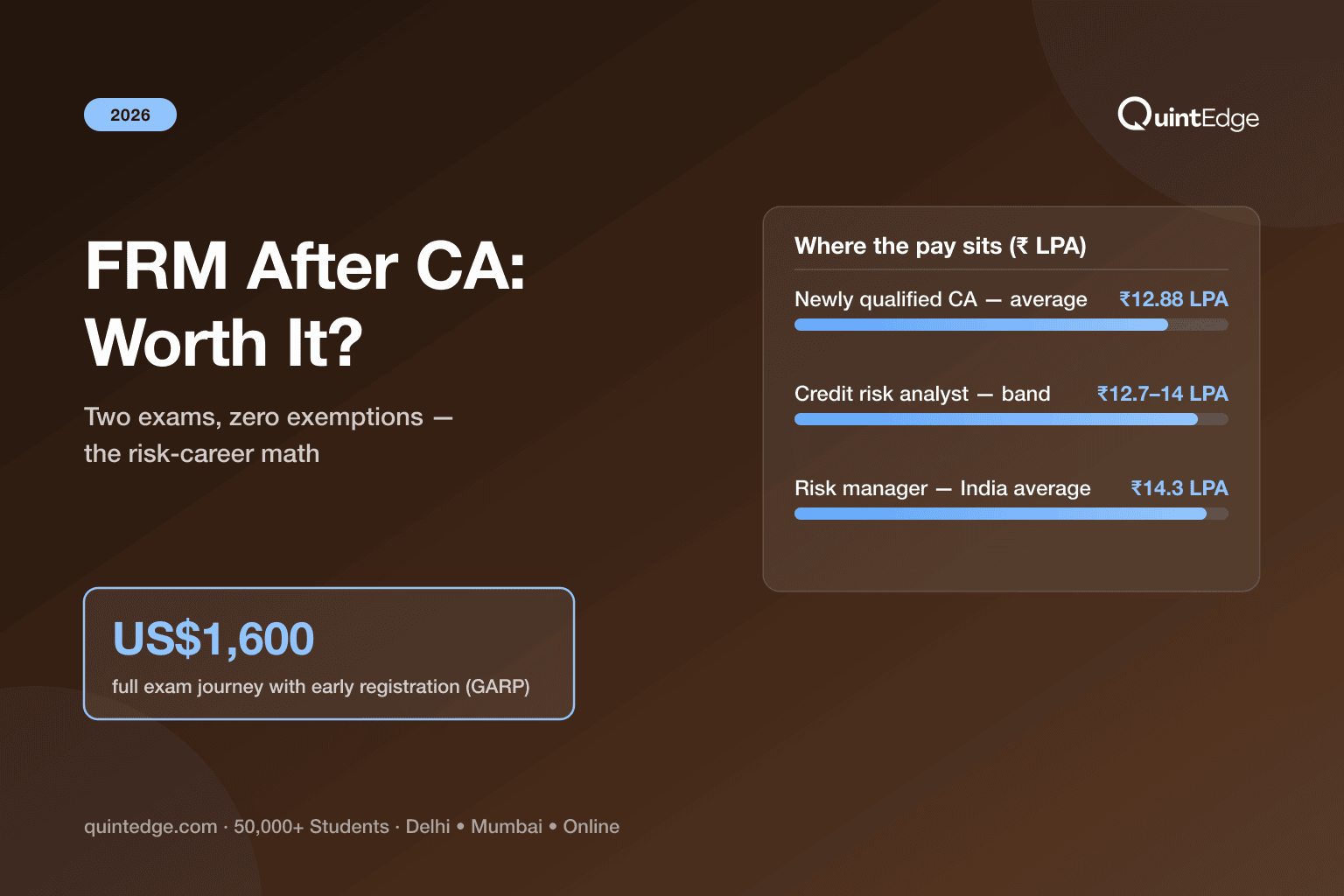
The honest numbers up front. The whole FRM exam journey costs US$1,600–2,000 — cheaper than most credentials of its weight. The exams alone can be done in about a year; the FRM certification also needs two years of full-time risk-related work experience, so plan on 2–3 years end to end.
And the uncomfortable baseline: newly qualified CAs already average ₹12.88 lakh a year (ICAI's 62nd campus placement programme). Early FRM-track pay bands sit below that. The FRM is not a day-one raise for a CA — it is an entry ticket to a function that compounds differently. This guide shows exactly where that trade makes sense.
Does a CA Get Any FRM Exemptions?
No. GARP grants no exemptions to any part of the FRM exam — not for CA, CFA, CPA or any other credential, as its own FRM FAQ makes clear. Every candidate passes Part 1 and Part 2 in sequence. Part 1 is 100 multiple-choice questions; Part 2 is 80.
Here is the flip side, and it surprises people: FRM has no education requirement at all. No bachelor's degree, no minimum marks, no age limit. You could register for Part 1 tomorrow, mid-articleship, if you wanted to. Our FRM eligibility guide covers the fine print.
So the gate is not at the entrance — it is at the exit. GARP hands you the certification only after you pass both parts and submit two years of qualifying work experience. Think of a gym with free entry: anyone can walk in and train, but the certificate on the wall is earned, not bought at the door.
What does a CA carry into the exam hall? Real assets: fluency with financial statements, provisioning logic from Ind AS 109 work (India's version of the IFRS 9 accounting standard), and the sheer stamina of having survived CA Final. What a CA typically lacks: the statistics. FRM is a quant-forward exam, and that is where your preparation load concentrates.
What Does FRM Actually Add to a CA?
A CA is trained to report what a company's numbers are. The FRM trains you to estimate what they could become — how likely a borrower is to default, how badly a portfolio bleeds if rates spike, what a bank should hold against a bad year. Accounting looks backward with certainty; risk looks forward with probability. The combo covers both directions.
The sharpest edge is in credit risk, and it is worth seeing why on the syllabus itself. FRM Part 2 is split across six topic areas, and per GARP's study guide, Credit Risk Measurement and Management carries 20% of the exam — 16 of its 80 questions:
Why does that 20% matter so much right now? Because Indian banks are racing a deadline. RBI issued its final expected-credit-loss (ECL) directions on 27 April 2026, effective 1 April 2027 — the biggest change to bank provisioning in decades. Banks still run the older "incurred loss" method today, so the models, teams and documentation all have to be built before the deadline. That is a hiring trigger, and the CA+FRM profile sits directly under it.
The pairing is genuinely complementary, not redundant:
- The CA brings the accounting half. Ind AS 109 provisioning, financial-statement depth, audit-grade documentation — exactly what ECL implementation and validation work demands.
- The FRM brings the measurement half. Default probabilities, loss models, capital frameworks — the theory a credit-risk interviewer expects you to already speak.
- Together they cover a full ECL project. Big 4 firms and banks staff these projects with people who can both build the number and defend it to an auditor and a regulator.
For the ground-level view of that work, start with what credit risk modeling actually is, and see what those roles pay in our credit risk analyst salary guide.
What Is the Realistic FRM Timeline for a CA?
The exams fit inside a year; the certification takes two to three. FRM runs three windows a year — May, August and November — at PSI test centers, and both parts are offered in every window. GARP suggests roughly 240 study hours per part, so back-to-back windows are doable alongside a job, if barely.
A clean, realistic run: Part 1 in a November window, Part 2 the following May, results and experience submission after that. Same-window back-to-back (Part 1 morning, Part 2 afternoon) exists, but stacking ~480 study hours into one cycle while working is a plan built for regret. Check the live registration deadlines on our FRM exam dates hub — early registration saves US$200 per part.
Three certification rules a CA should read twice:
- The experience must be risk-shaped. GARP looks for full-time roles where identifying, measuring, monitoring or managing risk is a meaningful part of the job. Its FAQ lists risk analysis, model validation, treasury, audit and consulting among qualifying examples — a broader net than CFA Institute's, and one where risk-focused CA work can genuinely count.
- Old experience counts. Qualifying work from up to ten years before passing both parts can be submitted. A CA who has spent two years in credit or treasury may be certifiable almost immediately after Part 2.
- The clock has a hard stop. Submit your experience within five years of passing Part 2, or the passes expire and you re-sit both parts. Do not park this paperwork.
What Does FRM Cost After CA?
The full exam journey costs US$1,600 if you register early both times, US$2,000 if you register standard — GARP's published fees, and one of the best cost-to-credibility ratios in finance. The pieces:
| Fee item | Amount |
|---|---|
| One-time enrollment fee (with first Part 1 registration) | US$400 |
| Early registration, per part | US$600 |
| Standard registration, per part | US$800 |
| Deferral to a later window (once only) | US$250 |
| GARP membership (optional; first year complimentary) | US$195/year |
Plain-language takeaway: both parts, registered early, cost US$400 + 600 + 600 = US$1,600 — missing the two early deadlines costs US$400 more for the same certificate.
In rupees, an illustrative conversion: US$1,600 ≈ ₹1.4 lakh at about ₹87–88 to the US dollar. Add coaching and materials and — as QuintEdge counsellor guidance — the realistic end-to-end investment is ₹2–3.5 lakh — roughly half of what a CFA journey costs, for comparison. Current-year deadlines and any GARP fee updates live on our FRM exam dates hub.
FRM After CA: Where Does the Salary Actually Move?
Here is the section most FRM-after-CA articles fudge, so let us not. A newly qualified CA averages ₹12.88 lakh (ICAI's 62nd campus placement programme — 3,795 offers, top domestic package ₹26.60 lakh from Power Finance Corporation). Early FRM-track bands sit below that. The FRM does not out-pay your CA on day one.
| Career point | Typical band | Basis |
|---|---|---|
| Newly qualified CA (all roles) | ₹12.88 lakh average | ICAI 62nd campus placement |
| Risk analyst — India average (entry ₹3.9L) | ₹6.3 lakh | PayScale, 203 profiles, checked in July 2026 |
| Risk manager — India average (top 10% cross ₹30L) | ₹14.3 lakh | PayScale, 97 profiles |
| Credit risk analyst, typical band | ₹12.7–14 lakh | AmbitionBox, 1.8k salaries, updated 2 July 2026 |
Plain-language takeaway: a CA’s ₹12.88 lakh average sits just under the risk-manager average (₹14.3 lakh) — the CA+FRM bridge crosses at manager level, while pure analyst seats (₹6.3 lakh average) would be a step down.
So where is the upside? Three places:
- The function is growing on a deadline. Every covered bank must run ECL models by 1 April 2027. Big 4 firms are staffing implementation and validation projects for lender clients now, and GCCs (global capability centres — offshore risk teams of international banks) hire the same profile.
- Risk careers compound past the crossover. Senior risk roles — portfolio risk heads, model validation leads, eventually chief risk officers — reach ₹30 lakh at the 90th percentile of risk-manager pay — the level only the top 10% cross (PayScale India, checked in July 2026) and climb beyond it at CRO level; our FRM salary in India guide maps the roles rung by rung.
- The CA+FRM pairing skips rungs. CAs with provisioning or audit backgrounds frequently enter at modeler or validator level rather than analyst level, because ECL work is half accounting documentation — your home turf.
For the full switch playbook — roles, employers, and a 90-day plan — read our companion guide on credit risk careers for CAs and FRMs.
Who Should Skip FRM After CA?
Skip the FRM if risk is not genuinely your destination. It is a specialist's credential: superb inside the risk function, close to invisible outside it. Three specific cases where your time is better spent elsewhere:
- You want markets, deals or research. Equity research, investment banking and portfolio management read the CFA as their native credential. That lane is mapped in our CFA after CA guide, and the head-to-head lives in CFA vs FRM.
- You are on a practice or partnership track. Audit and tax practices reward CA-specific depth. The FRM will neither win clients nor sign anything.
- You want a fast salary bump above the CA baseline. As the table above shows, there is not one — the FRM's return arrives with role progression inside risk, over years, not with the results email.
And if you are still comparing the whole post-CA menu — CPA, CFA, FRM, MBA, investment banking — our what to do after CA guide puts every path on one page.
How Should a CA Prepare for FRM Part 1?
Prepare for a quant exam, not an accounting exam. Part 1 is 100 multiple-choice questions leaning hard on statistics, probability and financial instruments — the exact areas the CA syllabus treats lightly. Your accounting depth helps you later, and most at Part 2's credit-risk block; Part 1 is where the new muscles get built.
- Front-load Quantitative Analysis. Distributions, hypothesis testing, regression — if college statistics is a distant memory, start here, weeks before anything else.
- Learn the instruments cold. Futures, options, swaps and bond mechanics dominate Financial Markets & Products. CAs know balance sheets; FRM wants the products that sit on them.
- Use your Ind AS 109 intuition at Part 2. Staging, provisioning and expected-loss logic map beautifully onto the credit-risk readings — a genuine CA advantage, one exam later.
- Budget ~240 hours and protect them. GARP's own guidance. Working CAs who respect that number pass; those who assume "CA Final was harder" and coast, often do not.
Our FRM Part 1 study strategy (written by a top-quartile scorer) and the complete Part 1 exam guide take it from here.
Frequently Asked Questions About FRM After CA
No. GARP grants no exemptions to any part of the FRM exam for any qualification — CA, CFA, CPA or otherwise. Every candidate passes Part 1 (100 questions) and Part 2 (80 questions) in sequence. The CA's advantage shows up as faster preparation on accounting-adjacent readings, especially Part 2's credit-risk block, not as fewer exams.
Yes, if risk is your destination — especially credit risk, where RBI's expected-credit-loss directions (final 27 April 2026, effective 1 April 2027) have banks building model teams on a deadline. The CA+FRM pairing covers both the accounting and measurement halves of that work. If you are aiming at investment banking, equity research or fund management instead, the CFA is the better-fitting add-on.
The exams fit in about a year — three windows run annually (May, August, November), both parts in every window, at roughly 240 study hours per part. Full certification then requires two years of full-time risk-related work experience, submitted within five years of passing Part 2. GARP counts qualifying experience from up to ten years before the exams, so risk-relevant CA work can shorten the wait to almost nothing.
US$1,600 to US$2,000 in GARP fees — a one-time US$400 enrollment fee plus US$600 per part with early registration or US$800 standard. That is roughly ₹1.4–1.8 lakh at current exchange rates. Including coaching and materials, the realistic end-to-end investment is about ₹2–3.5 lakh — roughly half a CFA journey's cost.
It can. GARP requires two years of full-time work where identifying, measuring, monitoring or managing risk is a meaningful part of the role — and its FAQ lists audit and consulting among qualifying examples, a broader definition than CFA Institute uses. Risk-focused audit, credit or treasury work by a CA may qualify; routine statutory audit with no risk dimension is weaker ground. Experience from up to ten years before passing both parts can be submitted.
You are allowed to — FRM has no education prerequisite, so you can register any time. Whether you should is a workload question: articleship under ICAI's New Scheme is two intense years, and Part 1 alone wants ~240 study hours of quant-heavy preparation. Doing Part 1 late in articleship and Part 2 after CA Final is the workable version; attempting both parts during articleship rarely is.
Choose by the desk you want to sit at. Risk desks — credit risk, market risk, model validation — read FRM as their native credential, and India's ECL build-out is hiring into them now. Investment desks — research, portfolio management, banking — read CFA the same way. Our CFA after CA guide covers that lane, and CFA vs FRM puts the two side by side on cost, difficulty and careers.


