
CFA After CA at a Glance
Here is the straight answer. If you are a CA (Chartered Accountant) considering the CFA Program (Chartered Financial Analyst — the global investment credential), you get zero exam exemptions. CFA Institute waives nothing for anyone, and there is no ICAI–CFA agreement. You sit all three levels, in full, like everyone else.
The combo still makes sense — but for one specific move: shifting from accounting and audit work into investment roles. Think equity research, investment banking, portfolio management. If your next five years are audit, tax or a controllership track, CFA adds letters, not leverage.
The honest numbers up front. The exams cost US$3,520–4,600 all-in — that is CFA Institute's own figure. The fastest realistic exam run is about two years; most candidates take longer. And the charter itself needs 4,000 hours of investment-related work experience — pure statutory-audit or tax hours generally do not count.
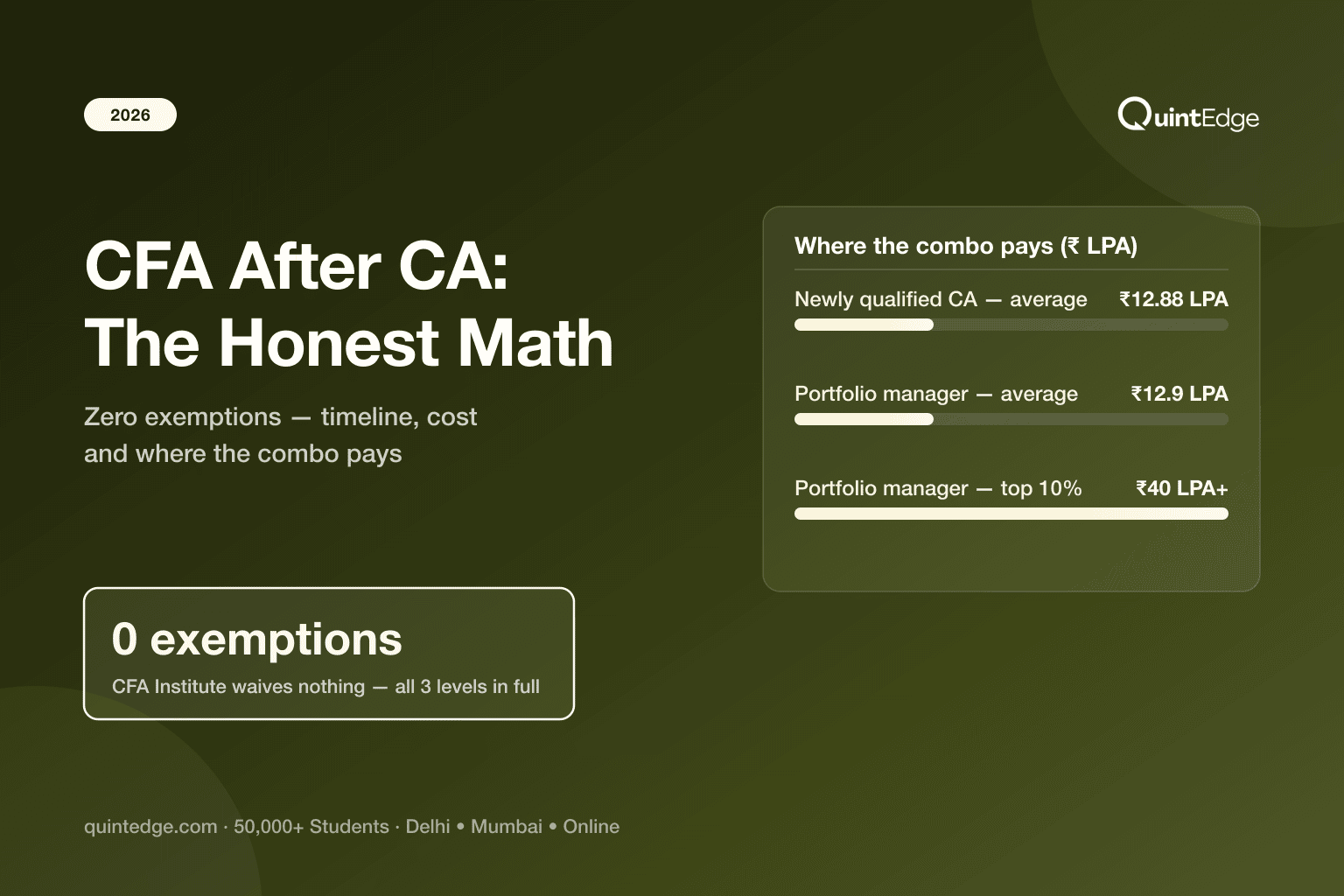
One more anchor before we start. Newly qualified CAs averaged ₹12.88 lakh a year in ICAI's 62nd campus placement programme. So CFA after CA is not a rescue plan for a weak salary — it is a lane change. The rest of this guide walks through that lane change: what carries over, what it costs, and who should skip it.
Does a CA Get Any CFA Exemptions?
No. CFA Institute grants no paper-wise or level-wise exemptions to anyone — not to CAs, not to CPAs, MBAs or PhDs. Every candidate passes Level 1, Level 2 and Level 3 in sequence. There is also no mutual recognition agreement between ICAI and CFA Institute, whatever a coaching brochure may hint. CFA Institute's own waivers page lists fee subsidies — never exam waivers.
Why so strict? The charter is built to mean the same thing everywhere. A charterholder in Mumbai passed exactly what a charterholder in London passed. Start waiving papers for one qualification and that promise breaks. So CFA Institute simply never does it.
Now the part the "no exemptions" headline hides: your CA still shortens the journey — in study hours, not in paperwork. Think of it like a toll road. No toll gate is waived for you. But you drive the first stretch on a road you already know.
The overlap is real and specific. Level 1's Financial Statement Analysis questions test ratio analysis, revenue recognition, inventories and consolidation — ground a CA has walked for years. Corporate finance basics and foundation-level economics also carry over from CA Intermediate and Final.
What does not carry over matters just as much. Portfolio management, equity and bond valuation depth, derivatives, and statistics-heavy quantitative methods are new ground for most CAs. So is Ethics, CFA-style — case-based questions on a code you have never read.
One caution inside the overlap itself. CFA tests financial statements under IFRS and US GAAP (the two global accounting rulebooks), from an analyst's angle — adjusting numbers to compare companies — not an auditor's angle of certifying them. Ind AS (India's converged standard) keeps you close to IFRS, but do not skip FSA revision entirely. The questions come at you sideways.
What Does CFA Actually Add to a CA?
A CA is trained to verify and report a company's numbers — the scorekeeper's view. The CFA Program trains you to act on those numbers as an investor — should you buy this stock, lend to this company, hold this bond? That is the entire point of the combo. It does not make you a better accountant. It makes you employable on the money-management side of finance.
In practical terms, three things change:
- The roles you can credibly apply for. Equity research (studying listed companies and recommending buy or sell), investment banking, portfolio management at mutual funds and AMCs (asset management companies), and credit research at rating agencies. Our is CFA worth it guide maps these roles in detail.
- A signal that travels. The CA is deeply respected in India but barely known to investment employers abroad. The CFA charter is the investment industry's shared benchmark across global markets — the same three exams everywhere.
- The vocabulary of markets. Valuation models, portfolio construction, risk-adjusted return. The CA syllabus touches valuation lightly; the CFA Program lives there for three levels.
Be equally clear about what CFA does not add. It does not let you sign audit reports — only a CA can. It adds no tax expertise. And it is not an automatic raise; we do the honest salary math two sections down.
If you are weighing several post-CA options side by side — CPA, FRM, MBA, investment banking courses — our what to do after CA guide compares the full menu. This post goes deep on just the CFA lane.
What Is the Realistic CFA Timeline for a CA?
Plan for two to three years for the three exams, plus however long it takes to bank 4,000 hours of qualifying work experience. The exam calendar — not your talent — sets the floor: CFA Institute allows at most two attempts per calendar year, with at least six months between attempts.
The windows have a fixed shape. Level 1 runs four times a year (February, May, August, November). Level 2 runs three times (May, August, November). Level 3 runs twice (February and August). For the live registration deadlines, check our CFA exam dates hub — deadlines close roughly three months before each window.
The fastest clean run looks like this: Level 1 in a February window, Level 2 in August the same year, Level 3 the following February. Three passes in about thirteen months of exam calendar. But that assumes a first-attempt pass at every level, while working. CFA Institute's published pass rates have hovered around 40–50% per level in recent cycles — so a stumble somewhere is normal, and 2.5 to 4 years is the honest typical range.
When should you start? Three common slots, from earliest to safest:
- During your B.Com. CFA Institute lets you register for Level 1 up to 23 months before finishing your bachelor's degree. Most CA aspirants run a B.Com in parallel, so Level 1 is technically open to you even before CA Final. Our CFA eligibility guide covers all four entry pathways.
- During articleship. Under ICAI's New Scheme (effective July 2023), articleship is two years, followed by a six-month study period before CA Final. Adding CFA Level 1 on top of office hours is possible — Level 1's four windows give you scheduling room — but it is a heavy load, and the CA Final study period is the worst possible time to split attention.
- Right after CA Final results. The common-sense slot. Your study muscle is still warm, and the charter journey starts exactly when you are choosing your career lane anyway.
Now the clock most people discover too late. Passing all three exams gets you to the charter's door; 4,000 hours of qualifying work experience is the key. CFA Institute requires those hours over at least 36 months, in work directly involved in — or producing output that informs — investment decision-making (their self-assessment tool lets you check your own role).
Here is the CA-specific catch: statutory audit and tax work generally do not qualify. Valuations, credit analysis, treasury, corporate finance and transaction advisory usually do. The hours can be earned before, during or after the exams — so a CA already in an investment-adjacent role has a running start, while an auditor's charter clock only starts after a role switch.
How Much Does CFA Cost After CA?
Exams alone run US$3,520–4,600 for all three levels — CFA Institute's own range. Where you land inside it depends entirely on how early you register. There has been no enrollment fee since April 2025, and no late-registration tier exists either: after the standard deadline, registration simply closes.
| Fee item | Amount (per level) |
|---|---|
| One-time enrollment fee | None — scrapped by CFA Institute in April 2025 |
| Early registration | US$1,140 (Levels 1 and 2) · US$1,240 (Level 3) |
| Standard registration | US$1,490 (Levels 1 and 2) · US$1,590 (Level 3) |
| Rescheduling within a window | US$250 |
Plain-language takeaway: registering early for all three levels saves US$1,050 versus standard pricing — three calendar reminders are the cheapest prep investment you will ever make.
In rupees, an illustrative conversion: early registration for all three levels is US$3,520 ≈ ₹3.1 lakh at about ₹87–88 to the US dollar. Coaching and study materials sit on top of that; as QuintEdge counsellor guidance, budget a realistic all-in range of ₹3.5–7 lakh, and our CFA fees in India breakdown does the full rupee math, forex markups included.
Set that against what you spent on CA — a few tens of thousands of rupees in ICAI fees, plus years of stipend-level pay. CFA inverts the deal: the money cost is front-loaded and visible, but the time cost is smaller and you can earn a full salary throughout.
What Salary Change Can a CA Expect From CFA?
Not an automatic raise — a lane change onto a different pay curve. A newly qualified CA already averages ₹12.88 lakh a year, per ICAI's 62nd campus placement programme (3,795 candidates received offers from 157 organisations; the top domestic package was ₹26.60 lakh from Power Finance Corporation). That is a strong baseline. CFA changes which roles you can hold, and those roles pay differently as they compound.
| Career point | Typical band | Basis |
|---|---|---|
| Newly qualified CA (all roles) | ₹12.88 lakh average | ICAI 62nd campus placement |
| Junior investment seat (equity / credit analyst averages) | ₹4.6–8.1 lakh | PayScale India, checked in July 2026 |
| Portfolio manager — India average | ₹12.9 lakh | PayScale, 57 profiles, checked in July 2026 |
| Portfolio manager — top 10% earn above | ₹40 lakh | PayScale; fund managers average ~₹24 lakh (6figr 2026) |
Plain-language takeaway: a fresh CA’s ₹12.88 lakh average already beats the junior investment seats — the combo pays at the portfolio-manager end of the curve (₹12.9 lakh average, with the top 10% above ₹40 lakh), not at entry.
Where does the combo bite hardest? Equity research and credit research desks, where reading financial statements fast (CA) meets valuing what you read (CFA). Investment banking coverage teams value the same pairing. And in fund management, the charter is close to a default expectation as you climb.
One more honesty check from our own data work: if you are already earning ₹40+ lakh, the charter will not meaningfully move your compensation — at that point your track record is the credential. Our is CFA worth it and CFA Level 1 salary guides map these roles in more depth.
Who Should Skip CFA After CA?
Skip the CFA if your next five years are audit, tax or an industry finance track. The charter cannot be converted into those careers — and its 4,000-hour experience rule actively works against you if you stay in non-investment roles. Three exams' worth of weekends deserve a better-fitting destination.
- Practice and partnership-track CAs. Audit opinions need a CA's signature; the CFA adds three letters to your visiting card, not clients to your book.
- Tax specialists. Direct or indirect tax mastery compounds on its own. Nothing in the CFA curriculum deepens it.
- Industry finance and CFO-track roles. Controllership and FP&A leadership reward operating depth. Experience — or, in some cases, an MBA — moves you further than the charter here. Our courses after CA guide compares these alternatives honestly.
- Anyone unwilling to switch roles. This is the quiet trap: exams passed, hours never qualifying, charter never arriving. Decide on the role change first; the exams second.
And if what pulls you is risk — credit models, market risk, bank balance sheets — the better-fitting credential is probably the FRM. We have written the mirror of this exact guide for that lane: FRM after CA, plus a head-to-head CFA vs FRM comparison.
How Should a CA Prepare Differently for Level 1?
Differently in two directions at once: bank your accounting edge, and respect the gaps it hides. CFA Institute's guidance is 300+ study hours per level. A CA can often trim Level 1 below that thanks to the FSA overlap — but only if the trimmed hours are reinvested where the CA syllabus never went.
- Revise FSA — do not skip it. The exam thinks like an analyst comparing companies under IFRS and US GAAP, not an auditor certifying one company under Ind AS. Same terrain, different camera angle.
- Treat Quantitative Methods as the rust zone. Probability, hypothesis testing, regressions — the CA syllabus barely touches them, and Level 1 tests them from day one.
- Give Ethics its own calendar slot. It is case-based application of a code you have never read. CAs consistently underestimate it, then meet it again with higher stakes at Level 3.
- Train for MCQ speed. Level 1 is 180 multiple-choice questions across two 135-minute sessions — about 90 seconds per question. CA Final's long-form writing habit is the wrong muscle; retrain it with timed mocks.
For a week-by-week structure — including 3, 6 and 9-month variants you can slot around a job — use our CFA Level 1 study plan.
Frequently Asked Questions About CFA After CA
No. CFA Institute grants no exam exemptions to any qualification — CA, CPA, MBA or otherwise — and no mutual recognition agreement exists between ICAI and CFA Institute. Every candidate passes all three levels in full. A CA's advantage is faster preparation in overlapping areas like Financial Statement Analysis, not fewer exams.
Yes, if you meet CFA Institute's eligibility — most commonly a bachelor's degree, or registering within 23 months of finishing one. Level 1's four windows a year give you scheduling room around articleship, which is now two years under ICAI's New Scheme. It is a heavy combination, though, and the six-month CA Final study period is the worst time to split attention. Many CAs sensibly start right after Final results.
The exam floor is about thirteen months for three first-attempt passes (two attempts allowed per year, six months apart, Level 3 only in February and August). Realistically, plan 2.5 to 4 years — CFA Institute's published pass rates have hovered around 40–50% per level in recent cycles. The charter additionally requires 4,000 hours of qualifying investment-related work over at least 36 months, which can overlap with the exam years.
Exam fees are US$3,520–4,600 for all three levels, per CFA Institute — roughly ₹3–4 lakh depending on the exchange rate and how early you register. There is no enrollment fee since April 2025. With coaching and materials, the realistic all-in range for Indian candidates is about ₹3.5–7 lakh. Registering early at every level saves US$1,050 versus standard pricing.
Generally no. The charter's value concentrates in investment roles — equity research, portfolio management, investment banking, credit research. It adds no audit authority and no tax depth, and its 4,000-hour work-experience rule counts investment-related work, which audit and tax roles typically are not. If you are staying in practice, your time compounds better inside your specialisation.
Usually not, because most articleship hours sit in statutory audit or tax — work CFA Institute does not class as investment decision-making. Hours in valuations, credit analysis, treasury or transaction advisory can qualify. CFA Institute's online work-experience self-assessment lets you test your specific role, and qualifying hours may be earned before, during or after the exams.
Pick by destination, not difficulty. CFA points at investment roles — research, portfolio management, banking. FRM points at risk roles — credit risk, market risk, model validation — where India's hiring is currently strong. Our FRM after CA guide mirrors this one for the risk lane, and our CFA vs FRM comparison puts the two side by side.


