
CFA Level 1 Study Plan at a Glance
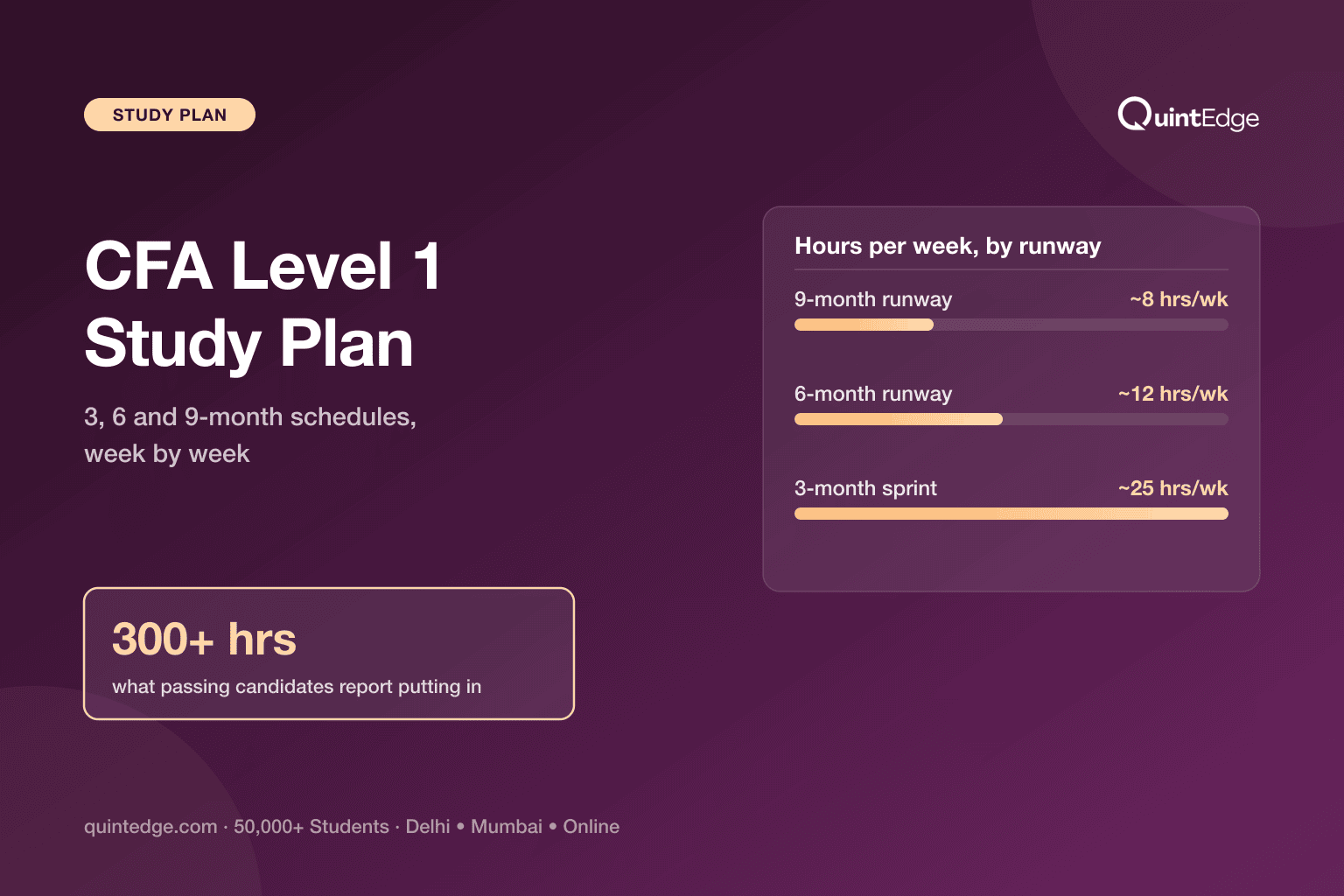
A CFA Level 1 study plan is simply a schedule that spreads your prep across the time you actually have. CFA Institute says successful candidates report spending over 300 hours preparing for each level. Spread that number over your runway and you get a rough weekly target.
Over 9 months, that is about 8 hours a week. Over 6 months, closer to 12 hours a week. Over 3 months, you need roughly 25 hours a week — doable, but only if nothing else in your life can wait.
Pick the plan that matches your exam window, not the one that sounds fastest. The exam itself is 180 multiple-choice questions, split into two 135-minute sessions of 90 questions each — about 90 seconds per question, so speed matters as much as knowledge.
How Many Hours Does CFA Level 1 Really Take?
CFA Institute's own guidance is: "Successful candidates report spending over 300 hours on average preparing for each level of the CFA exam." That is not a rule you must hit — it is what candidates who passed told CFA Institute they actually did.
Two things follow from that wording. First, "over 300 hours" is a floor reported by people who passed, not a guaranteed number for everyone — some need more, especially if your maths or English is rusty. Second, because it is self-reported, treat it as a planning anchor, not gospel.
Here is how that anchor turns into a weekly number, depending on how much runway you have before your exam window:
| Runway | Roughly how many weeks | Hours per week needed |
|---|---|---|
| 9 months | ~39 weeks | ~8 hours/week |
| 6 months | ~26 weeks | ~12 hours/week |
| 3 months | ~12 weeks | ~25 hours/week |
Plain-language takeaway: the total work is fixed at roughly 300+ hours; only the weekly pace changes. A longer runway means calmer weeks — a shorter one means CFA prep becomes close to a full-time job.
What Are the Topic Weights?
CFA Institute publishes an official weight range for each of the 10 Level 1 topic areas. These weights tell you how many exam questions come from each subject — so they decide how much time each one deserves in your plan, not just how "interesting" it feels.
| Topic | Weight |
|---|---|
| Ethical and Professional Standards | 15–20% |
| Quantitative Methods | 6–9% |
| Economics | 6–9% |
| Financial Statement Analysis | 11–14% |
| Corporate Issuers | 6–9% |
| Equity Investments | 11–14% |
| Fixed Income | 11–14% |
| Derivatives | 5–8% |
| Alternative Investments | 7–10% |
| Portfolio Management | 8–12% |
Plain-language takeaway: Ethics (15–20%) is the single biggest topic, and Financial Statement Analysis, Equity and Fixed Income each sit at 11–14% — those four alone can account for roughly half your marks (CFA Institute, Level I exam page, as of July 2026).
One more number from the same page matters for pacing: with 180 questions across two 135-minute sessions, you get approximately 90 seconds per question. Every plan below builds in timed practice for exactly this reason — knowing the material is only half the exam.
Which Order Should You Study Topics In?
Study the "foundation" subjects first, because later topics build on them. Quantitative Methods teaches the maths tools — time value of money, probability, statistics — that Fixed Income, Equity and Portfolio Management all reuse.
Ethics belongs early and late, not just once. Start it early because it sets the mindset for every other topic, then revisit it in your final weeks — Ethics questions get harder to answer from memory alone, and CFA Institute weights it as the largest topic (15–20%).
A sequence that works for most candidates, foundations first:
- Quantitative Methods — the toolkit every later topic borrows from.
- Economics — builds the macro context used in Fixed Income and Portfolio Management.
- Financial Statement Analysis — teaches you to read the statements Equity and Corporate Issuers depend on.
- Corporate Issuers, Equity, Fixed Income, Derivatives, Alternative Investments — the asset-class core, in roughly this order.
- Portfolio Management — ties every prior topic together, so it sits near the end.
- Ethics — start early, then re-run it in your final review weeks.
Illustrative example: think of it like building a house. You cannot fit the windows (Portfolio Management) before the foundation (Quant) and walls (FSA, Equity, Fixed Income) exist — study order should follow the same logic.
The 9-Month Plan (~8 hours/week)
The 9-month plan suits working professionals and students juggling a full course load, at roughly 8 hours a week — about an hour a day plus a longer weekend session. Nine months gives you the calmest possible pace to the ~300-hour target, with real breathing room before each new topic.
| Phase | Weeks | Focus |
|---|---|---|
| Learn — foundations | Weeks 1–10 | Quant, Economics, FSA (first pass, concepts only) |
| Learn — asset classes | Weeks 11–22 | Corporate Issuers, Equity, Fixed Income, Derivatives, Alternative Investments |
| Learn — portfolio + ethics | Weeks 23–28 | Portfolio Management (first pass) and Ethics (first pass) |
| Practice — full syllabus | Weeks 29–34 | Topic-wise question sets across all 10 subjects; revisit weak spots |
| Mocks — final review | Weeks 35–39 | Full-length timed mocks, Ethics re-run, formula and error-log review |
Plain-language takeaway: three-quarters of the 9-month plan is spent learning, because you have the time to go slow on new material — the last 11 weeks then compress into practice and mocks, same as the shorter plans.
Walk through it in plain words: for the first ten weeks, you are only meeting new ideas — no pressure to be fast yet. By week 22, you have seen every asset-class topic once. Weeks 23 to 28 close the loop with Portfolio Management and your first Ethics pass. From week 29, you stop "learning" and start "testing yourself" — first with topic quizzes, then with full mocks from week 35 onward, exactly like the 6- and 3-month plans below.
The 6-Month Plan (~12 hours/week)
The 6-month plan is the most common choice — about 12 hours a week, roughly 90 minutes on weekdays plus a longer weekend block. It fits candidates who want a serious pace without treating CFA prep as a second job.
| Phase | Weeks | Focus |
|---|---|---|
| Learn — foundations | Weeks 1–6 | Quant, Economics, FSA (first pass) |
| Learn — asset classes | Weeks 7–15 | Corporate Issuers, Equity, Fixed Income, Derivatives, Alternative Investments |
| Learn — portfolio + ethics | Weeks 16–18 | Portfolio Management and Ethics (first pass) |
| Practice — full syllabus | Weeks 19–22 | Topic-wise question sets across all 10 subjects; revisit weak spots |
| Mocks — final review | Weeks 23–26 | Full-length timed mocks, Ethics re-run, formula and error-log review |
Plain-language takeaway: the 6-month plan compresses the same five phases into 26 weeks instead of 39 — roughly 70% of the time goes to learning, and the final month is entirely practice and mocks.
In plain words: your first six weeks build the toolkit (Quant, Economics, FSA) you will lean on for everything after. Weeks 7 through 15 are the longest stretch — every asset-class topic, one after another. By week 18, you have touched all 10 subjects once, including your first Ethics pass. The last two months flip from "new material" to "prove you know it" — topic quizzes first, then timed mocks from week 23, same rhythm as the other two plans.
The 3-Month Plan (~25 hours/week — only if you have no choice)
The 3-month plan needs about 25 hours a week — close to a full-time commitment on top of whatever else you do. Only choose this if your exam window genuinely does not allow for 6 or 9 months; it is tight, not comfortable.
| Phase | Weeks | Focus |
|---|---|---|
| Learn — foundations | Weeks 1–3 | Quant, Economics, FSA (compressed first pass) |
| Learn — asset classes | Weeks 4–7 | Corporate Issuers, Equity, Fixed Income, Derivatives, Alternative Investments |
| Learn — portfolio + ethics | Week 8 | Portfolio Management and Ethics (first pass, dense week) |
| Practice — full syllabus | Weeks 9–10 | Topic-wise question sets across all 10 subjects; revisit weak spots |
| Mocks — final review | Weeks 11–12 | Full-length timed mocks, Ethics re-run, formula and error-log review |
Plain-language takeaway: every phase from the 9- and 6-month plans still happens here — there is just far less slack between them, so missing a week costs you more than it would on a longer plan.
In plain words: three weeks to build the toolkit, four to cover every asset class, one dense week for Portfolio Management and Ethics together. That leaves only two weeks of full-syllabus practice before you move into mocks in week 11. There is no room in this plan for a "catch-up week" — if life gets in the way, an extra month (the 6-month plan) is the safer call.
How Should You Use the Final 6 Weeks?
Your last six weeks, whichever plan you followed, should center on official mock exams, not new content. CFA Institute's Learning Ecosystem (LES) releases two official mock exams approximately 60 days before each exam window — time your final stretch so you are sitting these under real exam conditions, not just reading about them.
The LES also includes 1,000+ practice questions, a study planner and curriculum-based flashcards as part of your standard registration. If you want more mock-exam volume, CFA Institute's optional Practice Pack add-on gives Level 1 candidates 1,000 additional questions, five official mock exams in total, and one Prometric mock exam that simulates exam-day conditions (CFA Institute, Learning Ecosystem and mock-exam pages, as of July 2026).
A simple final-six-weeks rhythm:
- Weeks 6–5 out. Finish your last full-syllabus practice pass; log every mistake by topic.
- Weeks 4–3 out. Sit your first full-length, timed mock. Review it topic by topic — do not just check the score.
- Weeks 2 out. Sit your second mock. Focus remaining hours on your two or three weakest topics.
- Final week. Light revision only — formula sheet, Ethics vocabulary, your error log. No new topics.
Keep pass-rate reality in view while you plan, without letting it unsettle you: CFA Institute reported 45% overall (50% first-time) passed the February 2026 Level 1 exam, and 39% overall (45% first-time) passed in May 2026 — a 10-year Level 1 average of roughly 40% (CFA Institute, releases dated 19 March 2026 and 23 June 2026).
Plain-language takeaway: the pass rate sits near 40% because plenty of candidates under-practice against the clock, not because the material is unlearnable — a mock-exam-heavy final six weeks is the single highest-leverage habit you can build. Our CFA exam pass rates guide breaks these numbers down by level and year if you want the fuller picture.
What Does Level 1 Cost and When Do You Register?
Registering for your exam window is a separate step from choosing your study plan, but the deadline decides how much runway you actually have. For the current cycle, CFA Institute's dates-and-fees tool shows Early Registration at USD 1,140 and Standard Registration at USD 1,490 for Level 1 — registering early saves USD 350.
There is no separate enrollment fee — CFA Institute removed the one-time enrollment fee from April 2025, so you only pay the registration fee for your chosen window. A USD 250 rescheduling fee applies if you need to move your exam appointment within your window (CFA Institute, "CFA Exam Dates and Fees" page, as of July 2026).
Registration for a window typically closes roughly 3 months before the exam itself, with an earlier deadline for the discounted Early Registration rate. Because these dates shift with every cycle, check current windows and deadlines on our CFA exam dates hub rather than relying on a number in this post.
Plain-language takeaway: build your study plan backward from your registration deadline, not just your exam date — missing the early window costs USD 350, and missing registration entirely costs you the whole cycle.
Will the 2027 Curriculum Change Your Plan?
If you are sitting Nov 2026 or earlier, none of this affects you — you study the current 2026 curriculum described above. If you are sitting Feb 2027 or later, one detail matters for your plan: topic weights do not change, so the study-hour split you just read still applies.
What does change from 2027 is structure, not weight. Ethics grows in module count — restructured to roughly one module per Standard — while three topics get renamed: Corporate Issuers becomes Corporate Finance, Equity Investments becomes Equities, and Portfolio Management becomes Portfolio Construction. Our CFA curriculum changes 2027 guide covers the full detail if you are planning a Feb 2027 or later attempt.
If schedules are what you needed, this guide sets you up. For the technique that goes inside each week — how to take notes, how to run an Ethics review, how to use a formula sheet, how to handle exam day itself — our companion guide, how to study for CFA Level 1, walks through the 90th-percentile approach in full. For syllabus basics before you start, see all about CFA Level 1, and for free timed practice, try our CFA Level 1 practice questions quiz.
Frequently Asked Questions About the CFA Level 1 Study Plan
There is no single best duration — it depends on your exam window. Six months at about 12 hours a week is the most common choice, since it balances a manageable weekly pace with enough time to revisit weak topics. Nine months is calmer if you have the runway; three months works only if you have no other option.
Only if you stretch your runway to 9 months or more. Two weekend days at 4–5 hours each gets you to roughly 8–10 hours a week, which matches the 9-month plan's pace. Trying to compress that same weekends-only approach into 3 or 6 months will leave you short of the ~300 candidate-reported hours.
It depends on your plan length. The 9-month plan needs roughly 1 hour a day plus a longer weekend session; the 6-month plan needs closer to 1.5–2 hours a day; the 3-month plan needs 3–4 hours daily, which is why it suits only candidates with no other major commitment during that window.
Start Quantitative Methods first, since it builds the maths tools that Fixed Income, Equity and Portfolio Management all reuse later. Begin Ethics early too, in parallel, because it shapes how you read every other topic — then plan to revisit Ethics again in your final review weeks, since it is the single largest topic by weight.
Standard registration includes access to the Learning Ecosystem, which releases two official mock exams approximately 60 days before your exam window. CFA Institute's optional Practice Pack add-on takes Level 1 candidates to five official mock exams in total, plus one Prometric mock that simulates exam-day conditions.
Protect the mock-exam phase in your final six weeks before anything else — it matters more than finishing every topic slowly. If you are badly behind on a 3-month plan, consider rescheduling to the next window (a USD 250 fee applies) rather than sitting under-prepared; a 6- or 9-month plan usually has more slack to absorb a lost week.
Not for your hours or topic-weight split — those stay the same from February 2027 onward. What changes is structure: Ethics is reorganised into more, smaller modules, and Corporate Issuers, Equity Investments and Portfolio Management are renamed Corporate Finance, Equities and Portfolio Construction respectively.


