
CFA 2027 Curriculum Changes at a Glance
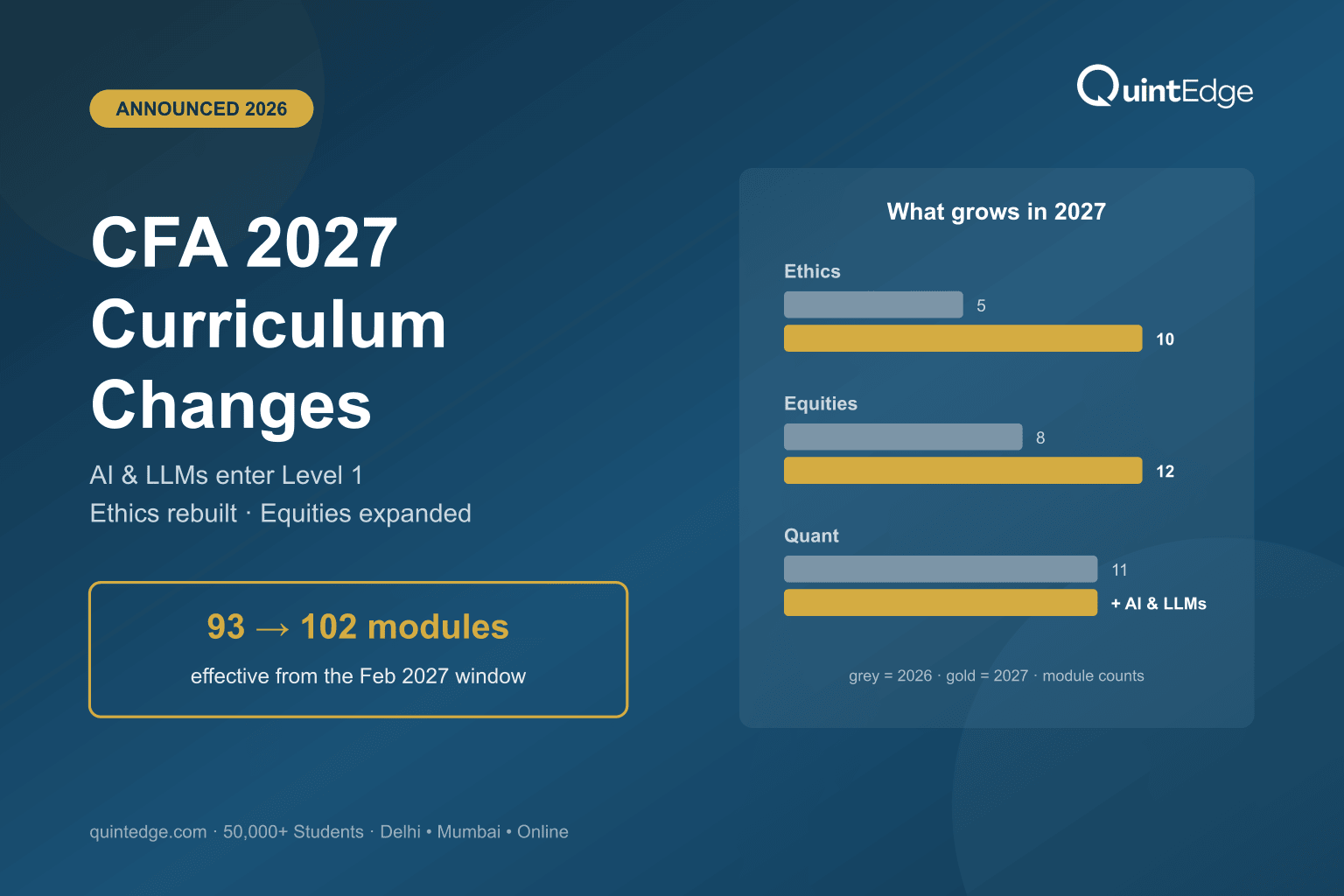
On 26 May 2026, CFA Institute announced the 2027 update to the CFA Program curriculum — and it is the most consequential refresh since the 2024 restructure. The headline: Level 1 gets a new reading on financial data science, AI, and large language models, the Equities section is substantially expanded with how-analysts-actually-work content, and Ethics is restructured at all three levels so that each Standard of Professional Conduct becomes its own module.
The changes apply to every exam from the February 2027 window onward. If you sit in August or November 2026, you study the current 2026 curriculum; if you sit in February 2027 or later, you study the new one.
Here is the one-paragraph summary before we go level by level. Level 1 changes materially in three of its ten topics (Quantitative Methods, Equities, Ethics) — prep providers who have mapped the module lists count roughly 93 modules growing to 102. Level 2 and Level 3 change only in Ethics. Topic weights move only at Level 1 — Ethics drops to 10–15% and Quant rises to 11–14% — and the Level 3 Specialized Pathways are untouched.
When Does the 2027 Curriculum Take Effect?
The switchover date is clean: February 2027 is the first window tested on the new curriculum. Everything before it — including the August 2026 and November 2026 windows — remains on the 2026 curriculum.
Registration timing is where candidates get caught. Registration for the February 2027 window opened on 5 May 2026, and its early-registration deadline is 7 July 2026 — days away as this post goes live. Registration for the May 2027 window opens on 12 August 2026.
Here is the full schedule of upcoming windows and which curriculum each one tests. For the complete registration-deadline and fee calendar, bookmark our CFA exam dates hub — we update it every cycle.
| Exam window | Levels offered | Curriculum tested | Registration status |
|---|---|---|---|
| August 2026 | L1, L2, L3 | 2026 (current) | Closed (6 May 2026) |
| November 2026 | L1, L2 | 2026 (current) | Open — standard deadline 11 Aug 2026 |
| February 2027 | L1, L3 | 2027 (new) | Open — early deadline 7 Jul 2026, standard 5 Nov 2026 |
| May 2027 | L1, L2 | 2027 (new) | Opens 12 Aug 2026 |
| August 2027 | L1, L2, L3 | 2027 (new) | Not yet announced |
| November 2027 | L1, L2 | 2027 (new) | Not yet announced |
CFA Level 1 Changes: Quant, Equities & Ethics
CFA Institute's official announcement is explicit that the 2027 refresh concentrates on three Level 1 topic areas — Quantitative Methods, Equities, and Ethical & Professional Standards — while the other seven topics carry forward with minimal edits. Prep providers who have compared the published module lists put the total at 93 modules in 2026 growing to about 102 in 2027.
Quantitative Methods: AI, LLMs and Hands-On Simulation
This is the change that will get the headlines, and deservedly so. The 2027 Level 1 curriculum adds a new reading introducing financial data science, artificial intelligence, and large language models — the first time LLMs appear in the CFA Program curriculum.
Just as practically useful: the estimation and simulation material is expanded, with historical simulation, bootstrapping, and Monte Carlo simulation now demonstrated step-by-step in Excel and Google Sheets. CFA Institute is also retiring the old Quantitative Methods pre-read and reorganising the topic around real-world applications, with portfolio-optimisation readings aligned to the Python Fundamentals Practical Skills Module.
For Indian candidates, this is a welcome shift. Most entry-level analyst roles in Mumbai and Gurgaon now expect basic comfort with data tooling, and "I studied AI and simulation methods in my CFA curriculum" is a far stronger interview line than citing legacy statistics chapters.
Equities: From Textbook Valuation to Analyst Workflow
The Equities section grows from 8 modules to 12, according to provider analyses of the new outline, and the added content is strikingly practical. New material covers how equity analysts actually produce research — initiating coverage, the difference between sell-side and buy-side research, and even the role of activist short sellers.
Valuation is now grounded in financial-statement forecasting with disaggregated models, scenario analysis uses explicit probability weighting, and industry frameworks like Porter's Five Forces and PESTLE are tied directly into valuation rather than floating as standalone theory. A new module also covers the practical application of CAPM and multi-factor models for estimating cost of equity.
If you plan to work in equity research, this makes Level 1 meaningfully more job-relevant. It also pairs naturally with the skills we teach in our financial modeling programme, where disaggregated forecasting and scenario builds are the daily bread.
Ethics: One Module per Standard
Ethics is restructured so that each of the seven Standards of Professional Conduct gets its own dedicated module, updated to the new 12th edition of the Standards of Practice Handbook. Provider counts put Level 1 Ethics at roughly 10 modules in 2027, up from 5.
Two housekeeping notes from the published outlines: GIPS no longer appears as a standalone Level 1 reading, and four topic areas are renamed — Corporate Issuers becomes Corporate Finance, Equity Investments becomes Equities, Derivatives becomes Derivatives and Risk Management, and Portfolio Management becomes Portfolio Construction. Same subjects, clearer labels.
Equation Explorers: Interactive Formula Practice
Alongside the content changes, CFA Institute is adding "Equation Explorers" to the Level 1 online learning ecosystem — interactive lessons where you adjust a variable and watch tables and graphs update dynamically, starting with Time Value of Money, implied returns, and cash-flow relationships.
Candidates who learn formulas by playing with them rather than memorising them tend to survive exam-day question twists far better. Pair this with a proper calculator workflow — if you have not yet mastered the BA II Plus, that skill compounds across all three levels.
CFA Level 2 Changes: Ethics Restructure Only
Level 2 candidates can exhale. The 2027 update leaves every technical topic area untouched — quantitative methods, economics, financial statement analysis, fixed income, derivatives, alternatives, and portfolio material all carry forward with no learning-outcome changes reported in the published outlines.
The only substantive change mirrors Level 1: the combined Standards guidance is split into per-Standard modules (provider counts suggest Ethics grows from 3 modules to 9), updated to the 12th edition Handbook. The same four topic renames apply.
Practical implication: if you passed Level 1 recently, your Level 2 prep materials remain almost fully current across the curriculum change — only your Ethics notes need refreshing.
CFA Level 3 Changes: Ethics Expands, Pathways Stay
Level 3 follows the same pattern. The only updated area is Ethics, which expands from 4 modules to roughly 10 under the per-Standard structure — and, importantly for L3 candidates, the Asset Manager Code is retained.
All three Specialized Pathways are unchanged: Portfolio Management, Private Wealth, and Private Markets carry the same module structure as 2026. Core topics — asset allocation, portfolio construction, performance measurement, derivatives and risk management — are likewise untouched.
If you are choosing between pathways, the curriculum change is a non-factor. Choose on career intent: Private Markets if you are targeting PE/VC roles, Private Wealth for advisory, Portfolio Management for the classic buy-side track.
Do Topic Weights Change in 2027?
Only at Level 1. Level 1 topic weights change for 2027. Ethics falls from 15–20% to 10–15%, and Quantitative Methods rises from 6–9% to 11–14%. Derivatives and Risk Management moves from 5–8% to 6–9%, and Alternative Investments from 7–10% to 6–9%. FSA, Equities and Fixed Income stay at 11–14% (CFA Institute's Level I exam page, checked October 2026). Level 2 keeps every topic in the 5–15% band, and Level 3 keeps the 65–70% core / 30–35% pathway split, with Ethics at 10–15% inside the core.
At Levels 2 and 3, that means the relative importance of what you study is stable — what changed is how the material is taught and organised, not how much each topic counts on exam day. There, your mock-exam strategy and topic prioritisation carry over intact. For a deeper look at what actually determines pass/fail, see our analysis of CFA pass rates by level.
Practical Skills Module Updates
The Practical Skills Modules (PSMs) — the mandatory hands-on components introduced in 2024 — also get a refresh. CFA Institute announced updates to the Equity Analysis, Macro Insights for Investing, and Python PSMs at Levels 1 and 2, and a brand-new Due Diligence PSM for Level 3, releasing later in 2026.
The rule is unchanged: you must complete at least one PSM per level to receive your exam result, and each takes roughly 10–20 hours. Treat the Python PSM as a genuine career investment rather than a checkbox — it is the same skill stack that the new Quant readings now assume.
Should You Sit in 2026 or Wait for 2027?
This is the real decision the announcement forces, and the honest answer depends on where you stand today.
- Already deep into 2026-curriculum prep? Sit in August or November 2026. Your materials are current, the exam is unchanged, and there is zero benefit to re-learning restructured Ethics modules mid-stream.
- Starting fresh from July–August 2026? Target February 2027 or May 2027 and study the 2027 curriculum from day one. Starting on the 2026 books now and switching later is the worst of both worlds.
- Between levels right now? If you passed L1 and can be ready for November 2026 L2, go — you avoid the Ethics re-learn entirely. If you would be rushing, wait for May 2027; only your Ethics notes change.
- Worried the new content is harder? Don't be. The additions (AI, simulation in spreadsheets, analyst workflow) are more intuitive than what they replace, and outside Level 1 the topic weights are identical. There is no evidence that first-window candidates on a new curriculum face a tougher exam — the minimum passing score process calibrates every administration separately.
One date matters more than any other if February 2027 is your target: early registration closes 7 July 2026 and saves USD 350 versus standard pricing (USD 1,140 vs 1,490 for L1). Also useful: the old USD 350 one-time enrollment fee no longer exists — CFA Institute eliminated it in April 2025, so your first registration now costs the same as any other. Full cost math in INR is in our CFA fees breakdown.
How to Prepare for the 2027 Curriculum
Three practical moves, in order:
- Match your materials to your window. Buying study material now for a Feb/May 2027 attempt? Make sure it is explicitly the 2027 edition — provider notes and question banks for 2026 will mislead you in Quant, Equities, and Ethics. Our guide to the best CFA study material covers which providers update fastest.
- Front-load the unchanged 70%. FSA, Fixed Income, Economics, Corporate Finance, Derivatives, and Alternatives are identical across both curricula. Starting now on those topics is zero-risk regardless of your window.
- Treat the new Quant reading as a gift. The AI/LLM and simulation content is the most interview-quotable material in the entire Level 1 syllabus. Learn it properly — in Excel, hands-on — not as flashcard trivia.
Registration mechanics, window-by-window deadlines, and fee tiers move fast around a curriculum change — our CFA exam dates page tracks every deadline for 2026 and 2027 in one place, and the official CFA Institute dates & fees tool is the source of record.
Frequently Asked Questions About CFA 2027 Curriculum Changes
The 2027 curriculum applies to all CFA exams from the February 2027 window onward. The August 2026 and November 2026 windows are still tested on the current 2026 curriculum, making November 2026 the final window on the old syllabus.
The three headline changes are all at Level 1: a new reading on financial data science, AI, and large language models in Quantitative Methods; an expanded Equities section (roughly 8 to 12 modules) covering real analyst workflows like initiating coverage and sell-side vs buy-side research; and a restructured Ethics section with one module per Standard, updated to the 12th edition Handbook. Levels 2 and 3 change only in Ethics.
From the February 2027 window, yes — Level 1 Quantitative Methods includes a new reading introducing financial data science, artificial intelligence, and large language models. It is an introduction to how these tools are used in investment workflows, not a programming course; the hands-on quantitative work is demonstrated in Excel and Google Sheets.
Only at Level 1. Level 1 Ethics falls from 15–20% to 10–15% and Quantitative Methods rises from 6–9% to 11–14%, with small shifts in Derivatives and Alternatives. Level 2 keeps all topics at 5–15%, and Level 3 keeps the 65–70% core / 30–35% pathway split. At Levels 2 and 3, what changed is the content and organisation of the material, not its exam-day weighting.
If you are already preparing on 2026 materials, finish the job in August or November 2026 — switching mid-prep has no upside. If you are starting fresh in mid-2026, register for February or May 2027 and study the 2027 curriculum from day one. The new content is more practical, not harder, and only Level 1's topic weights shift.
Based on the published 2027 outline, GIPS (Global Investment Performance Standards) no longer appears as a standalone Level 1 reading. Performance-standards material continues to live further along the programme, so you are not done with GIPS forever — it simply exits the Level 1 module list.
No. All three Specialized Pathways — Portfolio Management, Private Wealth, and Private Markets — carry the same structure as 2026. The only Level 3 change is the Ethics restructure (roughly 4 to 10 modules under the per-Standard format), and the Asset Manager Code is retained.
Partially, but don't risk it. Roughly seven of ten Level 1 topics are effectively unchanged, so 2026 notes for FSA, Fixed Income, Economics, Corporate Finance, Derivatives, and Alternatives remain usable. But Quantitative Methods, Equities, and Ethics are meaningfully different — for those, you need 2027-edition materials. At Levels 2 and 3, only Ethics notes need replacing.


