
Which Two ACCA Options Papers Should You Pick?
Pick your two Options papers by career target first, exam strength second, pass rates last. At ACCA's Strategic Professional level you sit two compulsory Essentials — SBL (Strategic Business Leader) and SBR (Strategic Business Reporting) — and then choose 2 of 4 Options: AFM, APM, ATX or AAA.
The short version: aiming at audit and the Big 4? Take AAA, usually with ATX or AFM. Building a tax career? ATX is non-negotiable. Heading for corporate finance, treasury or FP&A (financial planning and analysis)? AFM + APM is the natural pair. Each Options paper also extends one specific Applied Skills paper — so your marks there are real evidence of fit.
This guide explains what each paper covers in plain words, what ACCA's own June 2026 pass rates say, and gives you four ready-made pairing playbooks.
How Do the Options Fit into Strategic Professional?
Strategic Professional is ACCA's final level — the last four exams of the 13-paper journey. Everyone sits the two Essentials, SBL and SBR. Then you pick two Options. Think of it like the final year of college: the core subjects are fixed, and your electives decide the story you tell in job interviews.
All four Options papers share one exam shape, so none of them hides an easier format:
| Feature | Every Options paper (AFM, APM, ATX, AAA) |
|---|---|
| Duration | 3 hours 15 minutes, computer-based |
| Section A | One compulsory 50-mark case (40 technical + 10 professional skills marks) |
| Section B | Two compulsory 25-mark questions (20 technical + 5 professional skills each) |
| Choice within the exam | None — every question is compulsory |
| Fee per paper | £191 (about ₹24,400, illustrative) at standard entry; £430 at late entry (December 2026 session, India price list) |
Source: ACCA exam specifications and ACCA's India price list for the December 2026 session (checked in October 2026) — current dates and fees on our ACCA exam dates & fees hub.
Plain takeaway: 20 of the 100 marks in every Options paper are professional-skills marks — earned for how you analyse, structure and communicate, not just for the right answer.
That professional-skills layer is why Options papers feel different from Applied Skills. The examiner is marking you the way a manager reviews a junior's memo: is the advice commercial, is it structured, does it answer the actual question? Writing practice matters as much as technical revision here. Our ACCA exam tips guide covers this skill in depth.
What Does Each Options Paper Cover?
Each Options paper is the advanced version of one Applied Skills paper you have already passed. That "ladder" is the single most useful fact when choosing — you already hold evidence of how you perform on each ladder's lower rung.
AFM — Advanced Financial Management (ladder: FM → AFM)
AFM is the finance-decisions paper. You advise on big investments, company valuations, mergers and acquisitions, foreign-exchange and interest-rate risk, and how to fund it all. It suits careers in corporate finance, treasury, investment analysis and CFO-track roles. If FM felt like your strongest paper, AFM extends it — same logic, larger and messier scenarios. QuintEdge coaches it paper-wise: see AFM coaching.
APM — Advanced Performance Management (ladder: PM → APM)
APM is the "is the business actually performing?" paper. You design performance measures, evaluate strategy with tools like the balanced scorecard (a four-lens performance dashboard), and diagnose why divisions miss targets. It suits FP&A, management accounting and consulting-flavoured finance roles. APM rewards evaluation and scepticism more than calculation — many students misjudge that. Details at APM coaching.
ATX — Advanced Taxation (ladder: TX → ATX)
ATX is the tax-adviser's paper: income tax, corporation tax, capital gains, inheritance tax and — the real skill — planning across them for people and companies. Indian students typically sit the UK variant (ATX-UK), the same variant QuintEdge teaches, since there is no India-specific ATX paper. Choose it if you want tax practice, international tax or Big 4 tax advisory. See ATX coaching.
AAA — Advanced Audit and Assurance (ladder: AA → AAA)
AAA is the auditor's paper — planning complex audits, judging risk, handling group audits and writing audit reports that stand up to scrutiny. It leans heavily on financial-reporting knowledge: ACCA itself says AAA's accounting content is aligned with SBR and encourages candidates to pass SBR before attempting AAA. It is the natural pick for statutory audit and Big 4 assurance careers. Deep-dive: our AAA paper guide and AAA coaching.
What Do the Pass Rates Say?
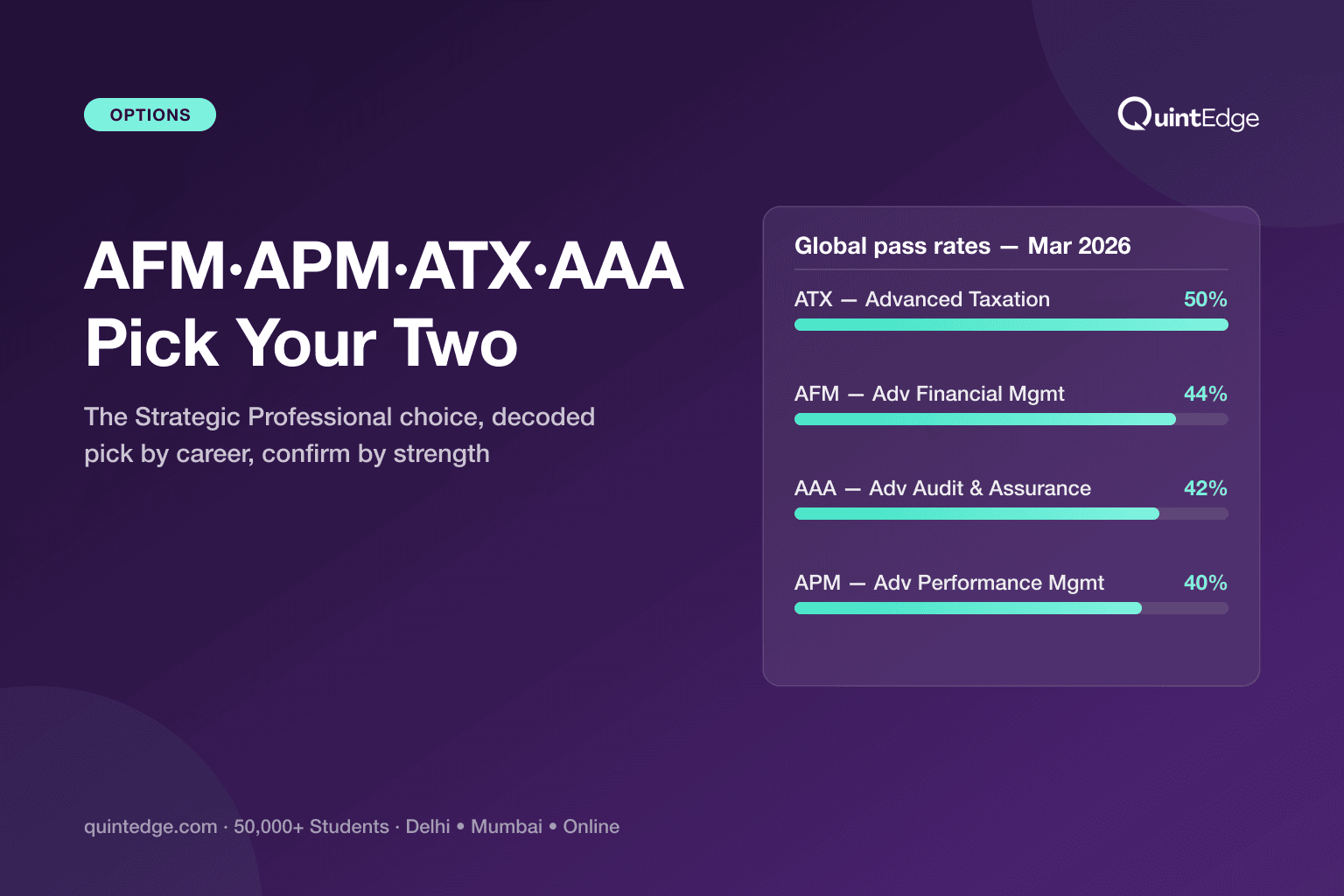
ACCA publishes global pass rates after every sitting. Here are the Strategic Professional numbers from the June 2026 sitting — the latest ACCA had published when we checked in October 2026. Read them as a difficulty signal, not a verdict: the spread between papers is real but modest, and it moves session to session.
| Paper | June 2026 global pass rate | What it suggests |
|---|---|---|
| SBL (Essentials) | 51% | Highest at this level — case format rewards preparation |
| SBR (Essentials) | 47% | Nearly half pass; strong FR foundations carry you |
| ATX | 47% | Steady for tax candidates — self-selected group |
| AFM | 47% | Mid-pack; calculations plus advice under time pressure |
| APM | 42% | Below the pack — evaluation skills decide it |
| AAA | 39% | Lowest this sitting — historically the toughest |
Source: ACCA's published global pass rates for the June 2026 sitting (accaglobal.com). Session-by-session history in our ACCA pass rates tracker.
Plain takeaway: roughly 4 to 5 of every 10 candidates worldwide pass each Options paper in a given sitting — preparation quality, not paper choice, is the bigger lever.
How Should You Pair Them? Four Career Playbooks
Here are the four pairings we see work, matched to the careers they serve. Each is a starting point — your Applied Skills marks can overrule it.
| Your target | Recommended pair | Why |
|---|---|---|
| Big 4 audit / assurance | AAA + ATX (or AAA + AFM) | AAA is the audit paper; ATX adds the tax fluency practice teams value |
| Corporate finance / treasury / FP&A | AFM + APM | Decisions plus performance — the complete industry finance toolkit |
| Tax practice / advisory | ATX + AAA (or ATX + AFM) | ATX is essential; the partner depends on firm (audit) vs industry (finance) |
| Undecided / broad profile | AFM + APM | Widest role coverage if you are not committed to audit or tax |
Plain takeaway: AAA and ATX point at professional practice (audit and tax firms); AFM and APM point at industry and corporate finance.
Three sequencing rules make any pair easier:
- Pass SBR before AAA. This is ACCA's own recommendation — AAA assumes SBR-level accounting knowledge, so sitting them in that order converts one hard exam into two manageable ones.
- One Options paper per sitting if you work full-time. Each paper realistically needs 150+ hours. Two at once while working squeezes both below the pass line.
- Extend your strongest ladder first. Scored 70+ in FM but scraped PM? Start with AFM. Early success protects momentum — and your exam-fee budget.
Common Mistakes When Choosing Options
We see the same five errors every cycle. All are avoidable on the day you register.
- Choosing by pass rate alone. A 5-point pass-rate gap will not save a candidate mismatched with the paper's skill. APM's 42% includes many who picked it as "the safe one".
- Ignoring Applied Skills evidence. Your TX or AA mark is a preview of ATX or AAA. A 50 at the lower rung is a warning, not a green light.
- Forgetting the variant question. Tax papers come in country variants. Indian students generally sit ATX-UK — confirm your variant before buying materials, because UK tax law is what the exam tests.
- Switching papers after one failed attempt. A 45 usually means technique gaps, not the wrong paper. Restarting a new syllabus costs a full sitting cycle; fixing exam technique rarely does.
- Booking both Options in one sitting alongside a job. The all-compulsory, case-based format punishes thin preparation twice as hard as Applied Skills did.
ACCA Options Papers: Frequently Asked Questions
Yes. ACCA does not lock your Options choice — you simply enter whichever paper you want each sitting. The real cost of switching is your preparation time and materials, so treat a switch as a last resort after diagnosing whether the problem is the paper or the exam technique.
There is no reliably easy pair. In ACCA's June 2026 global results the four Options sat within an 8-point band — AFM 47%, ATX 47%, APM 42%, AAA 39% — and the order shuffles between sittings. The "easiest" combination is the one matching your strongest Applied Skills papers and your target job, because motivation and existing knowledge drive marks more than format.
For audit and tax roles, yes — AAA signals audit intent and ATX signals tax intent, and recruiters read them exactly that way. For advisory, consulting and industry finance roles, the specific pair matters less than being exam-complete. If you know the service line you want, choose the paper that names it.
Yes — this is ACCA's own guidance, not just coaching advice. AAA's accounting content is aligned with the SBR syllabus, and ACCA encourages candidates to sit and pass SBR before attempting AAA. Doing it in that order means AAA becomes an audit-judgement exam rather than an audit-plus-accounting exam.
ACCA allows it, and full-time students can make it work. If you work full-time, we advise against it: each Options paper needs roughly 150+ preparation hours, and the 3-hour-15-minute all-compulsory case format exposes shallow preparation immediately. One well-prepared paper per sitting usually finishes faster overall than repeated dual attempts.
AFM plus APM. AFM covers investment decisions, valuations, M&A and risk management; APM covers performance measurement and strategic control. Together they map onto exactly what corporate finance, treasury and FP&A teams do daily, and neither audit (AAA) nor tax (ATX) depth is expected in those roles.


