
Financial Modeling Certifications at a Glance
Here is the honest starting point: no financial modeling certificate is mandatory the way a CFA charter or ACCA membership is. No regulator checks for one. What certificates actually sell you is structure — a syllabus, graded projects and a piece of paper that signals you can build a model, which helps when you have no work experience yet.
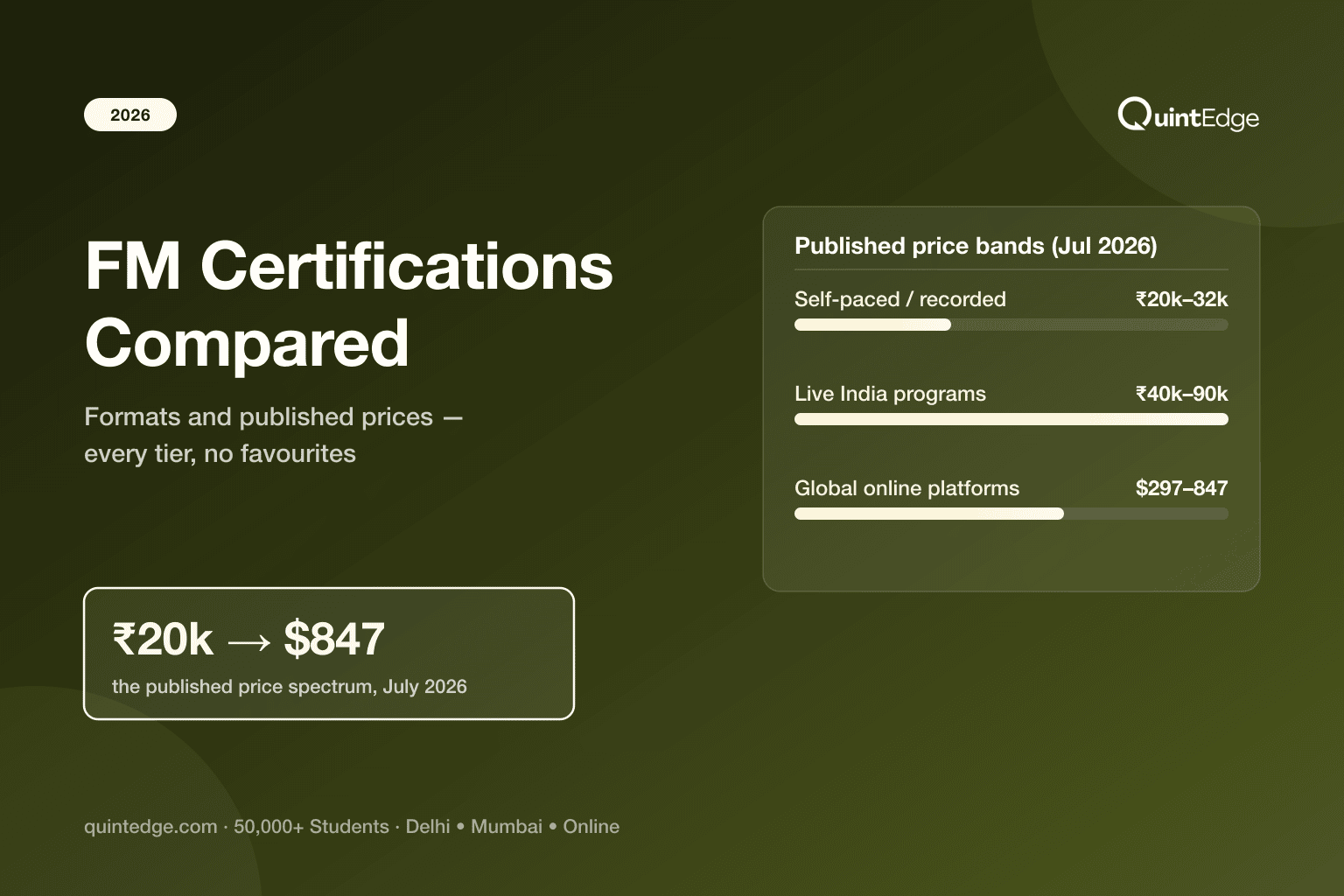
Prices cluster into three clear bands. Self-paced global courses (CFI, Wall Street Prep, BIWS) run $297–$847 a year or one-time. Live Indian programmes (TWSS, IMS Proschool, NSE Academy, QuintEdge) run ₹40,000–₹90,000. Fully self-paced Indian options sit lower, around ₹20,000–₹32,000.
This post lays out every published tier — price, format and what's included — from CFI's FMVA to QuintEdge's own tracks, so you can compare on facts instead of marketing copy.
Do You Actually Need a Financial Modeling Certification?
No — not in the way you need a CFA charter to call yourself a charterholder. Financial modeling has no licensing body and no legal requirement. What you need is the skill: the ability to build a working three-statement model, a DCF or an LBO from a blank sheet. If you're new to the term itself, our financial modeling explainer covers what it is and who uses it before you compare providers. A certificate is one way to prove you have the skill. It is not the only way.
Employers who hire analysts, associates and FP&A staff usually run their own skills test — a timed model-build, a case study, or a walk-through of a model you already built. A certificate from any provider can help you get shortlisted, especially with no work experience. It rarely replaces the live test once you're in the room.
So a certification is worth paying for when it gets you three things: a structured syllabus you would not build on your own, graded practice (models you actually complete, not just watch), and a portfolio project you can show in an interview. If a course gives you all three, the certificate on top is a bonus — not the reason to enrol.
What Should You Compare Before Paying?
Before you pick a provider, run every option through the same five checks. Price alone hides more than it reveals — a $199 course and a ₹90,000 course can both be the right choice, depending on what you actually need.
- 1. Format. Self-paced video, live instructor-led, or a hybrid? Self-paced is cheaper and flexible; live gives you a fixed schedule and direct doubt-solving.
- 2. What's actually included. Read the syllabus, not the sales page. Count real deliverables: how many models do you build end to end, not just watch someone else build?
- 3. Total cost, not the headline number. Some providers add GST on top of the listed price. Others charge a separate success-based placement fee only if you get placed. Add these before comparing.
- 4. Access window. Some courses give you the videos for 6 months. Others give lifetime access with years of updates. A cheaper course with a short window can cost more per hour of real use.
- 5. India recognition and placement support. A global brand name may mean little to an Indian hiring manager who has never heard of it. Ask what placement support actually means in practice — a list, a portal, or real introductions.
The Master Comparison Table
The table below lists every published program or tier we could verify directly on each provider's own site as of 5 July 2026 — not a cherry-picked "starting from" price. Where a provider does not publish a fee, the table says so rather than guessing.
| Provider | Program / tier | Format | List price | What's included |
|---|---|---|---|---|
| CFI | Self-Study membership | Self-paced, annual subscription | $497/year | 250+ courses, 7 certifications incl. FMVA, financial models & templates |
| Full-Immersion membership | Self-paced, annual subscription | $847/year | Everything in Self-Study plus AI tutor, premium templates, one-on-one guidance, model feedback | |
| Wall Street Prep | Premium Package | Self-paced, one-time | $499 | 7 modules (statement modeling, DCF, M&A, trading & transaction comps, LBO), 1-month PitchBook access, eligible for WSP's certification on passing final exams |
| Basic Package | Self-paced, one-time | $199 | Financial statement modeling only, no certification named | |
| Breaking Into Wall Street | Core Financial Modeling | Self-paced, one-time | $297 | 158 videos (~40 hrs), 10+ case studies, certification on scoring 90%+ on the quiz |
| BIWS Premium | Self-paced, one-time | $497 | Bundle of Excel & VBA + Core Financial Modeling + PowerPoint Pro, certificate on 90%+ quiz score | |
| BIWS Platinum (1-year plan) | Self-paced, annual access | $497/year | 15 courses incl. Advanced M&A, Oil & Gas, PE, Real Estate and Bank modeling — provider states an "immediate savings" versus buying each separately | |
| NSE Academy | Global Financial Modeling Program | Hybrid — self-paced + live sessions (Months 4–5) | ₹70,000 + GST 18% | ~6-month journey, 12 months resource access, dual certificate (NSE Academy + Financial Modeling Institute), includes the AFM exam fee |
| Coursera (Wharton) | Business and Financial Modeling Specialization | Self-paced, Coursera Plus subscription | ₹7,499/year (Coursera Plus India promo price, usual ₹13,999) | 5 courses — quantitative modeling, spreadsheets, risk, scenarios, capstone; cannot be completed for free despite the "Enroll for free" button |
| The WallStreet School | Financial Modelling & Valuations — 8-week full-time | Live, classroom/online | ₹50,000 + GST + ₹75,000 success-based placement fee | 240 training hours |
| Financial Modelling & Valuations — 3.5-month weekend | Live, weekend | ₹50,000 + GST + ₹75,000 success-based placement fee | 170 training hours | |
| Financial Modeling (self-paced video) | Self-paced | ₹24,000 + GST + ₹75,000 success-based placement fee | 60+ hours of videos and assessments, 6-month video validity | |
| Investment Banking course (self-paced video) | Self-paced | ₹23,500 + GST | 60+ hours of videos and assessments, 180+ hours of training content, 6-month validity | |
| IMS Proschool | Financial Modelling (classroom) | Live, classroom | ₹55,000 | 2.5-month programme, 8 hours of live training weekly |
| Financial Modelling with AI | Live | ₹90,000 | Named tier; page does not detail what it adds beyond the name | |
| Online classes | Live online | ₹40,000 | Live delivery over video | |
| EduPristine | Financial Modeling course | Not verifiable | Not published | Site was unreachable on 5 July 2026 (502 error) — no current fee can be quoted |
| QuintEdge | FM — Financial Modeling core track | Live / Self-paced | ₹25,000 (live) / ₹20,000 (self-paced), GST included | Core modeling track within the 8–12 week, 200+ hour programme |
| VA — Valuation Analyst track | Live / Self-paced | ₹25,000 (live) / ₹20,000 (self-paced), GST included | Valuation-focused track, GST included | |
| FMVA — Financial Modeling & Valuation Analyst | Live / Self-paced | ₹45,000 (live) / ₹32,000 (self-paced), GST included | Combined modeling + valuation track | |
| FMVA + CFA Level 1 (bundle) | Live / Self-paced | ₹65,000 (live) / ₹50,000 (self-paced), GST included | FMVA bundled with CFA Level 1 coaching |
Plain-language takeaway: the cheapest options are global self-paced courses under $200–$300, and the most expensive are Wharton-partnered certificate programs at $4,800 or live Indian courses once GST and placement fees stack on top. Format and inclusions vary as much as price does — a low number doesn't always mean less value, and a high one doesn't guarantee more.
A Closer Look at Each Provider
Each provider below is described using only what it publishes on its own site — pricing, format and stated inclusions. None of these are ranked; the right one depends on your budget, format preference and how much placement support you actually need.
CFI (Corporate Finance Institute) — FMVA
CFI sells memberships, not a standalone FMVA certificate. The Self-Study plan lists at $497/year and Full-Immersion at $847/year — both give access to 250+ courses and all 7 CFI certifications, including FMVA. To actually earn the FMVA credential, CFI's program page states you complete 15 required core courses, choose at least 3 electives from 11 available, then pass a final exam with a minimum 70% score. Most learners finish in 100–120 hours, fully self-paced.
Wall Street Prep
Wall Street Prep sells individual, one-time-purchase courses rather than a subscription. The Premium Package ($499) covers 7 modules — statement modeling, DCF, M&A, trading and transaction comps, and LBO modeling — and makes you eligible for WSP's certification after passing final exams in each of 6 core courses. The Basic Package ($199) is a narrower version focused only on financial statement modeling, with no certification named on the page. WSP's broader catalog also includes Wharton-partnered 8-week certificate programs (private equity, venture capital, FP&A and others) at $4,800 each.
Breaking Into Wall Street (BIWS)
BIWS prices in layers rather than one flat number. Core Financial Modeling is a one-time $297 purchase (158 videos, ~40 hours, 10+ case studies) with a certification on scoring 90% or higher on the quiz. BIWS Premium ($497, one-time) bundles Core with Excel & VBA and PowerPoint Pro courses. Separately, BIWS also sells three 1-year access plans — Silver ($97), Gold ($297) and Platinum ($497) — with Platinum unlocking 15 specialty courses that BIWS's own page says would cost far more bought individually. BIWS states plainly that its 1-year plans are not auto-renewing subscriptions.
NSE Academy
NSE Academy's Global Financial Modeling Program lists at ₹70,000 + GST 18% — one of the few providers that states its tax treatment upfront. It runs as a roughly 6-month hybrid: self-paced through the middle months with live sessions in Months 4–5, ending in the Financial Modeling Institute's Advanced Financial Modeler (AFM) exam, whose fee is included. You get a dual certificate — one from NSE Academy, one from FMI — plus 12 months of resource access.
Coursera — Wharton Business and Financial Modeling Specialization
This specialization is offered by the University of Pennsylvania (Wharton) through Coursera, made up of 5 courses on quantitative modeling, spreadsheets, risk, decision scenarios and a capstone. One detail matters more than the price: Coursera's own FAQ states "No, you cannot take this course for free" — despite an "Enroll for free" button on the page. Access runs through a Coursera Plus subscription, shown at ₹7,499/year for India as a promotional price against a usual ₹13,999/year.
The WallStreet School (TWSS)
TWSS runs live and self-paced formats with a distinctive fee structure. The 8-week full-time and 3.5-month weekend versions of its Financial Modelling & Valuations course both list at ₹50,000 + GST, while a fully self-paced video option lists at ₹24,000 + GST. On top of any of these, TWSS states on its pricing page: "We charge a 'Placement Success Fees' of Rs. 75,000 once the candidate gets Placed through us and Accepts the offer." That fee is disclosed but separate from the training fee — worth adding in before you compare totals against any other provider.
IMS Proschool
IMS Proschool publishes three formats on one page: classroom Financial Modelling at ₹55,000 (2.5 months, 8 hours of live training a week), a "Financial Modelling with AI" tier at ₹90,000 that names the addition without detailing it, and online live classes at ₹40,000. IMS's page does not state GST treatment, and its placement claims — including "100% placement assistance" — are the provider's own marketing wording, not independently verified figures.
EduPristine
EduPristine's course page was unreachable when checked on 5 July 2026, returning a server error. No current fee can be quoted as a result — treat any price you see elsewhere for EduPristine as unverified until its site is back and the page is re-checked.
QuintEdge
QuintEdge runs four tracks inside one 8–12 week, 200+ hour programme, each priced separately with GST already included in every figure: the FM core track and VA track at ₹25,000 (live) / ₹20,000 (self-paced), the combined FMVA track at ₹45,000 (live) / ₹32,000 (self-paced), and an FMVA + CFA Level 1 bundle at ₹65,000 (live) / ₹50,000 (self-paced). Recordings stay available for 6 months after a live batch, and self-paced access can extend up to 6 months.
How Do You Choose?
There is no single "best" answer here — only trade-offs that match different situations. Use your budget, preferred format, and how much India-specific support you need to narrow the list, not a ranking.
- By budget. Under $300 (roughly ₹28,500 at the ≈₹95/USD rate this cluster uses): BIWS Core or WSP Basic — narrow scope, self-paced. ₹20,000–₹32,000: Indian self-paced options like QuintEdge's FM/VA/FMVA tracks. ₹40,000 and up: live Indian programmes with instructor time built in.
- By format. If you learn best on a fixed schedule with live doubt-solving, self-paced-only providers (CFI, WSP, BIWS) will feel thin — you're on your own for pacing. If you want maximum flexibility and don't need live sessions, they're hard to beat on price per hour of content.
- By India recognition. Global brands (CFI, WSP, BIWS) are widely known among global IB and PE recruiters but less familiar to many domestic Indian hiring managers. Indian providers (TWSS, IMS, NSE Academy, QuintEdge) are built around the Indian job market and often layer in placement support.
- By placement support. Read what's actually offered, not just the word "placement." A success-based fee (like TWSS's disclosed ₹75,000) means the provider is paid only if you're placed — different from a flat course fee with no placement claims at all (CFI, WSP, BIWS make none).
Whichever provider you shortlist, weigh the fee against what modeling roles actually pay in India — our financial modeling salary guide breaks down entry to director-level bands by role so you can judge the payback period yourself.
What Do Employers Actually Check?
Most employers hiring for modeling-heavy roles run their own test rather than trusting a certificate at face value. Expect a timed model-build exercise, a case study built from a real or disguised company, or a walk-through of a model you bring with you — your certificate gets you the interview more often than it wins the interview.
- Live model-build tests. You're handed raw financials and asked to build a three-statement model or DCF within a fixed time — usually 1–3 hours.
- Sample models as a portfolio. Interviewers often ask you to bring or share a model you've completed yourself. A polished, well-labelled model from any course counts more than the certificate that came with it.
- Walk-through questions. Expect to be asked why you made specific modeling choices — a circularity switch, a revenue driver, a debt schedule assumption. This tests understanding, not memorisation.
- Excel fluency under pressure. Shortcuts, clean formatting and error-free formulas matter as much as the model's logic — sloppy Excel habits show up fast in a live test.
This is exactly why the "5 checks" in the earlier section matter more than the certificate name on your resume. A course that makes you build real models — graded, corrected, repeated — prepares you for this kind of test far better than one that's mostly video-watching.
Frequently Asked Questions About Financial Modeling Certifications
Neither is objectively "better" — they're structured differently. CFI's FMVA sits inside an annual membership ($497 or $847/year) covering 250+ courses, while Wall Street Prep and BIWS sell individual, one-time-purchase courses ($199–$499). Compare what each includes and how you like to learn before choosing, not a ranking.
No. Financial modeling has no licensing body, unlike CFA or ACCA. Most employers test the skill directly through a model-build exercise or by reviewing a sample model you bring. A certificate can help you get shortlisted, especially with no experience, but it does not replace passing the live test.
No. Coursera's own FAQ for the Business and Financial Modeling Specialization states, "No, you cannot take this course for free" — despite an "Enroll for free" button on the page. You need a Coursera Plus subscription, shown at ₹7,499/year as a promotional India price against a usual ₹13,999/year.
The WallStreet School discloses a "Placement Success Fees" of ₹75,000, charged only "once the candidate gets Placed through us and Accepts the offer" — separate from its training fee. This is a success-based structure: you pay more only if you're placed through the provider. Always add it to the training fee before comparing totals against other providers.
A subscription. CFI does not sell a standalone FMVA certificate — you get access to FMVA and 6 other certifications through an annual membership, billed yearly at $497 (Self-Study) or $847 (Full-Immersion). There is no monthly option. This differs from Wall Street Prep and BIWS, which sell individual one-time-purchase courses.
It varies by provider, and most don't say. TWSS and NSE Academy both explicitly add GST on top of their listed fee. CFI, Wall Street Prep and BIWS say nothing about India tax treatment on their pricing pages, and IMS Proschool is also silent on GST. QuintEdge states GST is included in every listed price. Always confirm before paying.
Among the published prices here, Wall Street Prep's Basic Package ($199) and BIWS's Silver 1-year plan ($97) are the lowest global entry points, while QuintEdge's self-paced FM or VA tracks (₹20,000, GST included) are the lowest Indian live-adjacent option. Check what each actually includes — the cheapest tier is often the narrowest in scope.

