
Financial Modeling vs CFA at a Glance
Financial modeling and the CFA are not competing options — they are different kinds of things. Financial modeling is a hands-on job skill: you can learn it in a focused course over roughly 8–12 weeks, for somewhere between ₹20,000 and ₹90,000 depending on the provider and format. The CFA (Chartered Financial Analyst) is a global credential built from three exam levels, and CFA Institute itself says it takes "three to four years to complete all three levels," at a total exam-fee cost of USD 3,520–4,600.
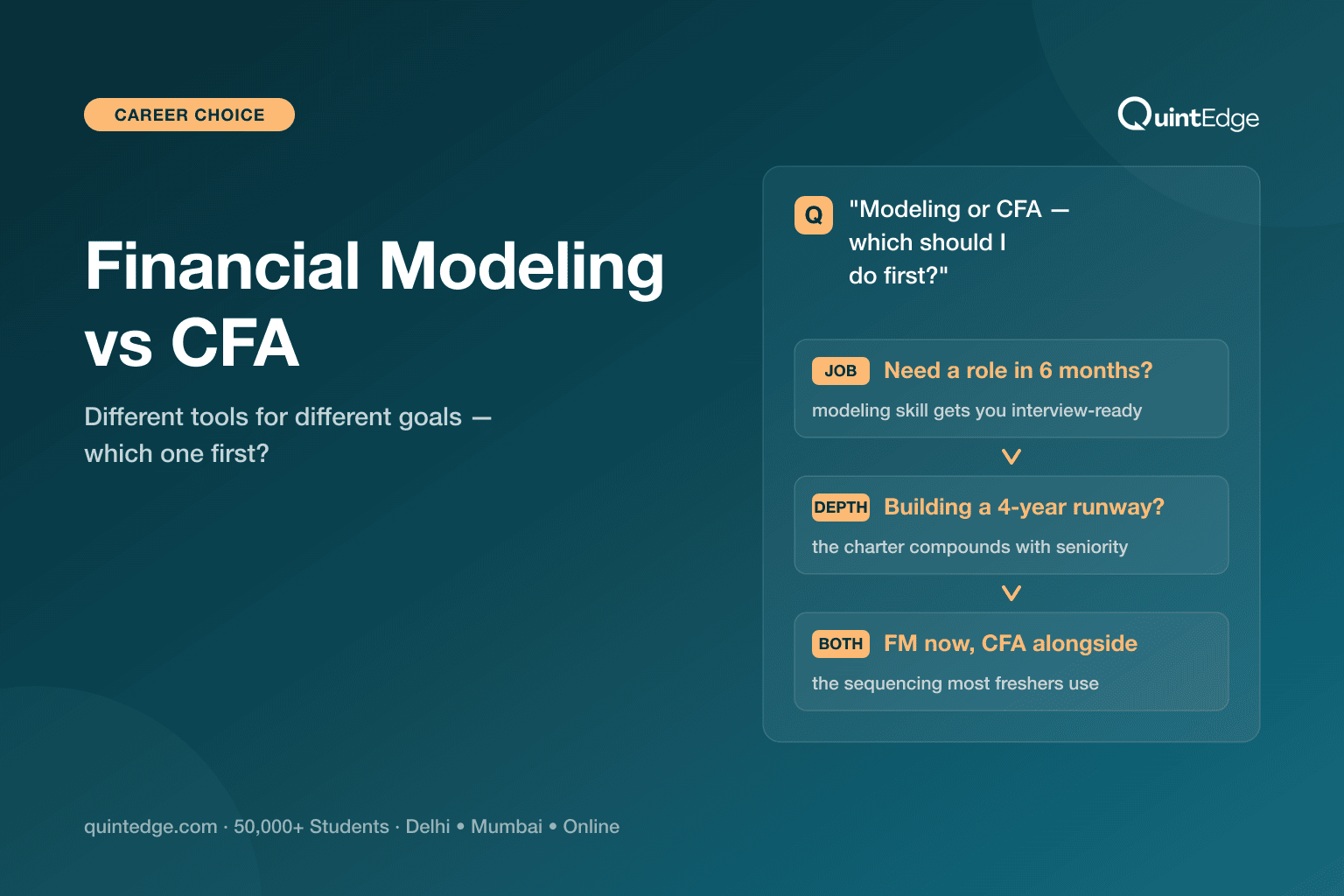
So the honest short answer depends on your goal. Want a job in 3–6 months — investment banking analyst, FP&A, equity research associate, startup finance role? Learn financial modeling first. Aiming for research, asset management or a long-term global credential and you have 3–4 years of runway? Start CFA now — it only gets harder to fit in once you have a full-time job. Most people can also do both, in sequence, without wasting either investment.
What Is Financial Modeling — and What Is the CFA?
Financial modeling is the skill of building a spreadsheet that predicts a company's future numbers. The CFA is a professional credential you earn by passing three exams over several years. One teaches you to do something; the other proves you know a large body of investment theory.
Financial modeling, in plain terms, means using Excel to link a company's three financial statements — income statement, balance sheet, cash flow statement — so that a change in one assumption (say, sales growth) flows through to a projected profit, cash balance and valuation. Analysts use these models to answer real questions: what is this company worth, should we lend to it, should we buy it. You can read the full breakdown in our financial modeling explainer.
The CFA (Chartered Financial Analyst) is a global charter awarded by CFA Institute after you pass Level 1, Level 2 and Level 3 exams and meet a work-experience requirement. The curriculum covers ethics, economics, financial statement analysis, corporate finance, equity, fixed income, derivatives, alternative investments and portfolio management — a broad map of investment knowledge rather than one buildable skill. Our what-is-CFA guide covers the syllabus and eligibility in full.
Here is the distinction that matters most: financial modeling is something you build and can show in an interview as a work sample. CFA is something you pass and list as a credential on your resume. Employers who want to see you can actually construct a DCF or LBO model will test modeling skill directly — a charter alone does not prove that.
How Do They Compare on Time and Cost?
The gap in time commitment is the single biggest difference between the two — financial modeling is measured in weeks, CFA in years. Cost follows the same pattern: modeling courses run a few thousand rupees to under a lakh; CFA's exam fees alone run into lakhs once you convert from dollars, before you add prep material.
| Factor | Financial Modeling | CFA (all 3 levels) |
|---|---|---|
| Typical duration | 8–12 weeks (self-paced tracks can stretch to 6 months) | "Three to four years to complete all three levels" (CFA Institute) |
| Recommended study time | 200+ hours across the full programme (course-dependent) | "300 hours per level" recommended by CFA Institute — roughly 900 hours total |
| Fee range (India, course only) | ₹20,000–₹90,000 depending on provider and live vs self-paced format | USD 3,520–4,600 total exam fees (CFA Institute), before prep materials |
| Per-level exam fee | Not applicable — one course fee | Level 1 & 2: USD 1,140 early / USD 1,490 standard. Level 3: USD 1,240 early / USD 1,590 standard |
| Enrollment fee | None — one course fee covers the programme | None since 29 April 2025 (CFA Institute eliminated the one-time USD 350 fee) |
| Exam centres | Not applicable (project/quiz-based certification) | Prometric test centres |
| What you walk away with | A working model + certificate of completion | A charter after all 3 levels + work experience |
What this table means in plain words: financial modeling costs less and finishes faster because it is one focused course, while CFA costs more and takes longer because it is three separate global exams spread over years, each with its own fee.
On the QuintEdge side specifically, our own Financial Modeling & Valuation Analyst (FMVA) track is priced at ₹45,000 live / ₹32,000 self-paced, with a lighter FM-only or Valuation Analyst (VA) track at ₹25,000 live / ₹20,000 self-paced — all GST-included, over an 8–12 week programme. For the wider market picture across every major provider (CFI, Wall Street Prep, TWSS, IMS Proschool and more), see our financial modeling course fees in India guide.
For CFA, do not memorise fee numbers from any blog post — they change with registration windows. Check the live, current fees and deadlines on our CFA exam dates hub, and see the full cost breakdown by level in our CFA fees guide.
What Does Each Do for Your Job Prospects?
Financial modeling gets you hired faster into roles that test the skill directly — investment banking analyst seats, FP&A, equity research support. CFA builds long-term credibility for research, asset management and portfolio roles, and pays off over a career rather than in the next interview cycle.
On the modeling side, entry-level equity research pay in India runs ₹4–6 lakh per year, per MentorMeCareers (2026 equity research pay guide, accessed July 2026), while FP&A freshers see ₹7–10 lakh per year per CA MONK (2026 FP&A guide, accessed July 2026). Investment banking analysts range ₹6–15 lakh at domestic firms and ₹20–40 lakh at global firms in India, per ACTE's 2026 salary guide — though treat both bands as directional rather than gospel, since ACTE is a training provider publishing its own estimates, not a primary salary database. Payscale's India data (1,102 salary profiles, updated 25 May 2026) puts the generic financial analyst average at ₹5,70,377 per year, with a 10th–90th percentile spread of ₹2,65,000–₹10,00,000. We break these down further, role by role, in our financial modeling salary in India guide.
On the CFA side, the salary ranges are indicative and triangulated from public sources such as Glassdoor, AmbitionBox and LinkedIn Salary — actual offers vary significantly by role, team, location and individual profile. With that hedge in place: freshers with CFA Level 1 typically land ₹5–8 lakh per year, rising to ₹8–14 lakh (2–3 years), ₹14–22 lakh (5–7 years), and ₹30–60 lakh or more at 10+ years — usually once the full charter is complete. Compare that to non-CFA entrants from Tier 2–3 MBA programmes, who see roughly ₹3.5–6 lakh at entry level, based on public salary data from Glassdoor, AmbitionBox and Naukri. See our CFA Level 1 salary in India guide for the full picture.
The practical read: financial modeling shows up in your next job search — it is a skill you demonstrate in the interview itself. CFA shows up over years, compounding as you clear more levels and gain experience, and matters most in research-heavy and buy-side roles that value the breadth of the curriculum.
Who Should Do Financial Modeling First?
Do financial modeling first if you need to be job-ready within months, not years — you are a fresher targeting investment banking, FP&A or a startup finance role right now, and you need a demonstrable skill more than a long-term credential.
Specifically, financial modeling first makes sense if:
- You are graduating soon or already out of college and want a job within the next 3–6 months, not a 3–4 year runway.
- Your target role tests modeling directly. Investment banking, private equity support, FP&A and corporate development interviews routinely include a modeling test or case study — a certificate alone will not get you through that round, but the skill will.
- You want a portfolio piece. A completed 3-statement model or DCF you built yourself is something you can walk an interviewer through — far more persuasive than a syllabus you have memorised.
- You are unsure CFA is your long-term path yet. Financial modeling is a shorter, lower-commitment way to test whether you enjoy the technical, number-building side of finance before betting 3–4 years on a charter.
- You need income sooner. A 2–3 month course that leads to a job this year beats a credential that starts paying off in year four, if cash flow is a real constraint.
This is also the more common starting point for B.Com and BBA graduates without an engineering or MBA pedigree — modeling skill is judged on the work sample, not the college name on your resume.
Who Should Do CFA First?
Do CFA first if you are aiming at research, asset management or a long global career and you have the 3–4 year runway to spare — the earlier you start, the sooner the charter compounds into senior roles.
CFA first is the better call if:
- You are still in your final year or two of college. CFA Institute allows registration up to 23 months before graduation, so starting Level 1 while you still have free time before placements is efficient use of that runway.
- Your target is equity research, asset management or portfolio management. These roles value the CFA curriculum's breadth — valuation theory, portfolio construction, ethics, fixed income and derivatives — more than a single modeling skill.
- You want a globally portable credential. The charter is recognised across markets, useful if you see your career taking you outside India eventually.
- You can commit roughly 300 hours per level (CFA Institute's own recommendation) alongside college or a light work schedule — CFA gets significantly harder to study for once you are in a demanding full-time job.
- You are comfortable with a multi-year payoff. The full charter, including work-experience requirements, plays out over years — this is a long-term credibility investment, not a quick resume line.
One planning note worth internalising early: CFA Program exams run four times a year — usually February, May, August and November — with no December sitting. Registration windows close roughly three months ahead of each exam date, so plan early rather than scrambling near a deadline. Always check current dates and fees on our CFA exam dates hub rather than an old blog post, since these shift.
Can You Do Both?
Yes — and for many students, doing both in sequence is the strongest combination: financial modeling first for an immediate, demonstrable skill, CFA alongside or after for the long-term credential. The two do not compete for the same months of effort in the way you might expect.
A practical sequencing path that works for most freshers:
- Step 1 — Learn financial modeling in your final semester or right after graduating (8–12 weeks). You now have an interview-ready skill and can start applying for jobs immediately, instead of waiting years for a credential to land.
- Step 2 — Register for CFA Level 1 once you have clarity on your target role. If a job you land through your modeling skill turns out to be research- or AM-adjacent, CFA becomes a natural next step rather than a guess made in college.
- Step 3 — Study CFA Level 1 while working, or squeeze it in during your last year of college if you started modeling early enough. Since financial modeling only took 2–3 months, it rarely delays a CFA start by more than a semester.
- Step 4 — Keep the modeling skill sharp on the job. Real deal work and client models are the best ongoing practice, and they reinforce the CFA curriculum's valuation sections rather than compete with them.
The one sequence to avoid: starting CFA Level 1 with zero modeling ability and no near-term income plan, if you are under real financial pressure to get a job soon. In that case, the 8–12 week modeling course gets you earning first, and the multi-year CFA path can run in parallel or right after — not instead of a job.
Frequently Asked Questions About Financial Modeling vs CFA
They test different kinds of difficulty. Financial modeling is hard in a practical, hands-on way — building a working spreadsheet under time pressure. CFA is hard in volume and duration — around 300 hours of study per level over 3–4 years, across a broad theory curriculum. Neither is harder overall; they demand different kinds of effort.
Not directly. The CFA curriculum covers valuation theory, financial statement analysis and corporate finance concepts, but it does not train you to build a working 3-statement model, DCF or LBO in Excel the way a dedicated financial modeling course does. Many CFA candidates learn modeling separately to be interview-ready for technical rounds.
No — they are not substitutes. A modeling certificate proves you can build financial models; the CFA charter proves you have passed three levels of investment theory exams and met a work-experience requirement. There is no CFA Institute-recognised exemption or equivalence for any financial modeling certification, and none should be advertised as CFA-approved.
Financial modeling courses in India run ₹20,000–₹90,000 depending on provider and format. CFA's exam fees alone total USD 3,520–4,600 across all three levels (no enrollment fee since April 2025), before adding prep material costs. Budget both separately rather than expecting a bundled discount, since they are different kinds of programmes.
Indirectly, yes. Financial modeling sharpens your comfort with financial statements, ratios and valuation mechanics — all tested in CFA's equity, corporate finance and financial statement analysis readings. It will not shorten the 300 recommended study hours per level, but it can make those specific topics click faster when you reach them.
For breaking into investment banking specifically, financial modeling matters more upfront — IB interviews test modeling directly through case studies and technical rounds. CFA is a longer-term credibility booster valued more in equity research, asset management and buy-side roles than at the entry-level IB analyst stage.
Typically within 3–6 months of starting a financial modeling course — 8–12 weeks to complete the programme, plus the time it takes to interview and land a role using that skill. CFA's payoff is measured in years rather than months, since it takes 3–4 years to clear all three levels per CFA Institute's own published timeline.


