
Can You Do CFA While Working Full-Time?
Yes — and not as an exception. Most CFA Program candidates worldwide prepare alongside a full-time job. The exam is designed for it: computer-based testing windows through the year, a syllabus split into self-contained readings, and no classroom attendance requirement at all.
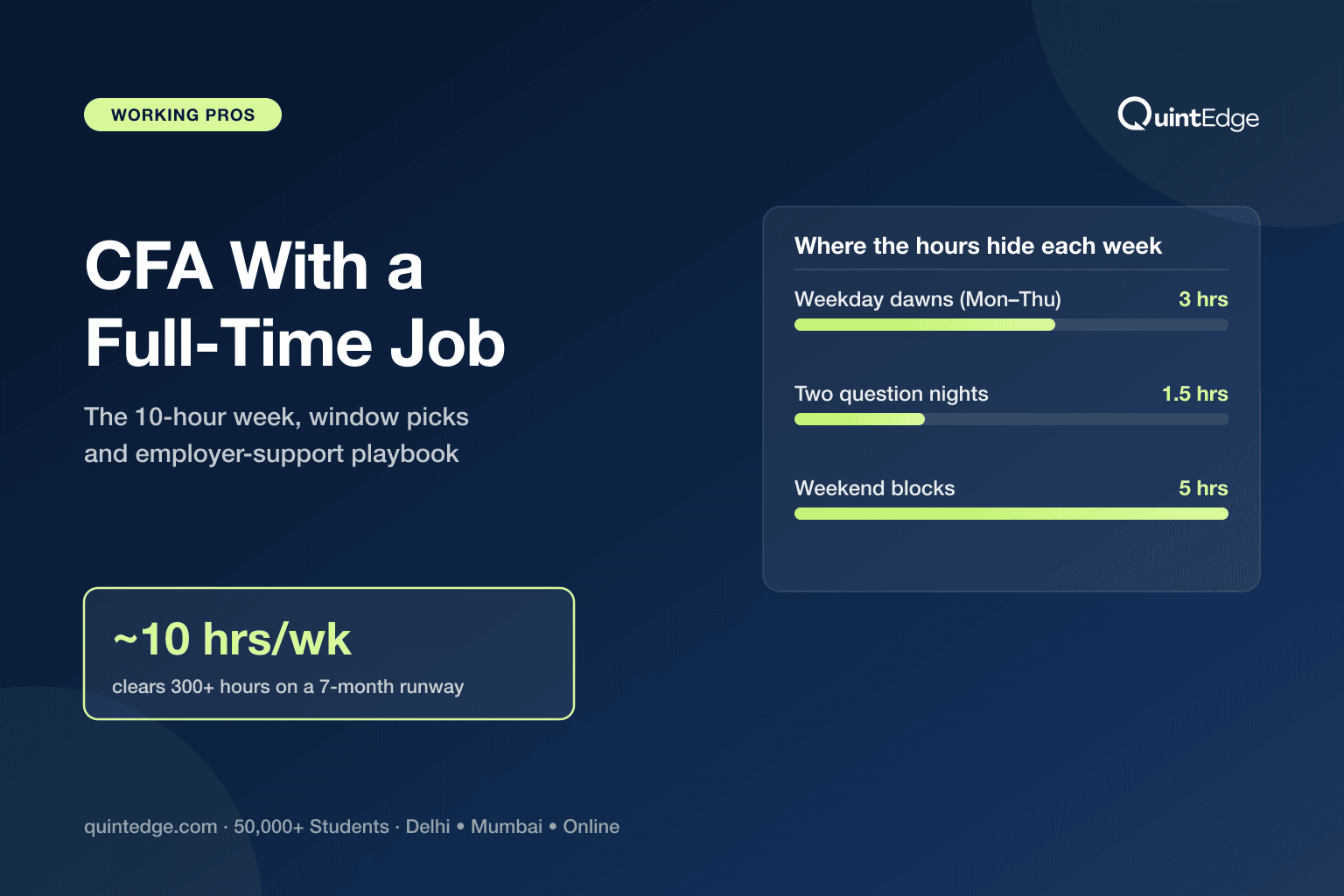
The real question is arithmetic, not permission. CFA Institute's guidance is 300+ study hours per level. At 10 hours a week — a load a working professional can actually sustain — that is about seven months per level. This guide turns those 10 hours into a concrete weekly grid, with checkpoints that tell you whether you are on track and rules for the weeks when work wins.
Treat the programme like a second, part-time job that lasts two quarters per level. Schedule it like one, and a demanding day job and a Level 1 pass fit in the same calendar year.
How Many Hours a Week Does CFA Really Need?
Start from the runway — the months between today and your exam window — and divide. CFA Institute recommends a minimum of 300 hours per level, and the total does not care how you slice it — but your energy does. Here is the honest math (a week-by-week version of each runway lives in our CFA Level 1 study plan):
| Runway | Hours per week | What it feels like | Best suited for |
|---|---|---|---|
| 9 months | ~8 hrs | Gentle — one skipped week is recoverable | Heavy jobs: audit season, banking, consulting travel |
| 6 months | ~12 hrs | Firm but sustainable — the standard working-pro choice | Most 9-to-6 roles with predictable weekends |
| 3 months | ~25 hrs | A sprint on top of a job — every evening and both weekend days | Only with strong finance background and a calm quarter |
Plain takeaway: pick the runway that fits your job's worst month, not its best one.
Two cautions from experience. First, hours logged half-asleep do not count — 45 focused minutes before work beats two foggy hours at midnight. Second, Level 2 is heavier than Level 1 for most candidates (more depth, denser question format — see our Level 2 preparation guide), so whatever runway you pick for Level 1, plan a longer one for Level 2.
The 10-Hour Week That Survives a Real Job
Here is a week that has survived contact with Indian office life. It banks 9.5–10 hours without touching Friday — your pressure valve for late meetings, travel and life. Anchor times to your own routine; the shape is what matters.
| Slot | Days | Duration | What goes in it |
|---|---|---|---|
| Before work (6:45–7:30 am) | Mon–Thu | 4 × 45 min | New reading — fresh mind, no phone, one topic at a time |
| After dinner (9:15–10:00 pm) | Tue & Thu | 2 × 45 min | 25 practice questions on the mornings' material, wrong answers into an error log |
| Saturday morning (9 am–12 pm) | Sat | 3 hrs | The week's hardest topic + end-of-chapter questions in one sitting |
| Sunday morning (9–10:30 am) | Sun | 1.5 hrs | Error-log review, flashcards, formula sheet |
| Sunday night (30 min) | Sun | 0.5 hr | Plan next week: which readings, which question sets |
Plain takeaway: mornings learn, nights question, Saturday goes deep, Sunday repairs — and Friday stays empty on purpose.
Three rules make the grid work in practice:
- Same slots every week. Deciding when to study each day burns more willpower than studying. Fix the slots once; then it is just attendance.
- Questions from week one. The two gold sessions are not optional extras. Reading feels like progress; questions are progress. Our Level 1 study techniques guide explains why practice-heavy preparation beats note-making at this exam.
- The error log is the syllabus. A running list of every question you got wrong and why. Sunday's 90 minutes exist to shrink that list — it is the highest-yield session of the week.
What Are the Gates That Tell You You’re on Track?
Working candidates cannot afford to discover in exam week that the plan failed in month two. So do not measure hours — hours lie. Measure gates: scores that must be true on specific dates. Think airport security checkpoints, not report cards — you either clear one and move on, or you stop and fix what beeped.
- End of every topic: score 60%+ on that topic's end-of-chapter and question-bank set at first attempt. Below 60%? The next Saturday deep block re-does this topic before anything new starts.
- Learning phase (roughly the first 70% of your runway): a minimum of 50 questions a week — the two weeknight sets. Finishing readings without questions does not clear the gate.
- Consolidation: cumulative topic tests at 65%+, question volume up to 75–100 a week.
- Six weeks out: first full timed mock at 60%+. This is the big checkpoint — the fall-behind rules below trigger off this number.
- Final three weeks: a mock every Saturday, trending to 70%+ on the final mocks — the comfortable-margin threshold our study guide uses, given roughly 40–50% of candidates pass each level (per CFA Institute's published pass rates).
Weight the gates by marks, too. Financial Statement Analysis, Quantitative Methods, Equity and Fixed Income carry the heaviest Level 1 weights — clear those gates first when time is tight. The full topic-weight table is in our Level 1 overview.
Which Exam Window Fits a Working Calendar?
Level 1 runs four windows a year — February, May, August and November. Level 2 runs three (May, August, November) and Level 3 two (February, August). Registration typically closes months before the window, so the choice is really about which quarter of work you can afford to study through. Check live dates and deadlines on our CFA exam dates hub before planning around any month.
| Your job | Typical crunch periods | Friendlier windows to target |
|---|---|---|
| Audit / Big 4 / consulting | April–September (FY-end audits, filings) | February — the study months land in the calmer October–January stretch |
| Banking & markets roles | Quarter-end results months; March year-end close | August or November — study through the mid-year trough, post-appraisal |
| Corporate finance / FP&A | December–March (budgets, year-end close) | August or November — keep the winter for work |
| Tech / engineering / non-finance | Release-driven, varies | Any — fix the window first, then count 6–9 months back and protect the runway |
Plain takeaway: pick the window whose six preceding months contain your job's quietest stretch — these patterns are typical, but your own calendar outranks any table.
Money note while planning: registering early saves real money — US$1,140 early versus US$1,490 standard for Level 1, per CFA Institute (full rupee math in our CFA fees guide). And if a project blows up close to the exam, a date move within the same window costs US$250; switching to a different window is not a routine option. Decide against the gates, early — not in a panic at the deadline.
How Do You Get Your Employer to Back You?
More employers will help than candidates think — but almost none volunteer. Banks, Big 4 firms, captives and larger corporates commonly run education-assistance or L&D (learning and development) policies that can cover courses and certifications. Three asks, in order of ease:
- Time: the two working days before your exam as leave, and a no-new-late-projects understanding for the final month. Cheapest for the employer, highest value for you.
- Money: part or full exam-fee reimbursement from the L&D budget. Ask HR for the education-assistance policy document — many candidates never do, and unclaimed budgets lapse quietly every year.
- Trajectory: a conversation with your manager about which roles the credential maps to internally. This converts your prep from a private project into a visible development plan.
A script that works, adapted to your context: “I’m registered for CFA Level 1 in [month] — it maps directly to the [valuation / credit / research] work our team does. My delivery stays unaffected. Could I take the two days before the exam as leave, and does our L&D policy cover professional exam fees?”
Timing the ask matters: right after appraisals, or when accepting new responsibilities. And read your policy's fine print — some reimbursements come with a service-period condition attached.
What If You Fall Behind?
You will fall behind at least once — a release, a deal, a wedding, a fever. The difference between candidates who recover and candidates who quietly drop out is that the first group decided the rules before the bad week. Here is the ladder:
| How far behind | The rule |
|---|---|
| Missed up to 3 sessions in a week | Do not “redistribute” them across the week — add one 90-minute Sunday-afternoon block and move on. Never skip the weeknight question sets to catch up on reading. |
| Lost a full week | The next two Saturdays become double blocks (add 2 hours each). Cut flashcards and note-making first; questions and error log are untouchable. |
| 2–3 weeks behind mid-plan | Stop covering everything. Re-plan around topic weights — heaviest topics to gate standard first, lightest topics to “questions-only” treatment. |
| First mock (6 weeks out) below 50% | Decision point, not a pep talk: either convert the final month to near-daily practice — realistic only if work allows — or move your exam date before rescheduling costs bite (US$250 within the window; live deadlines on the exam dates hub). |
Plain takeaway: protect questions over reading, weight heavy topics over complete coverage, and make the reschedule call at the mock gate — not in exam week.
One sunk-cost sentence worth memorising: a moved exam date costs US$250; a rushed failed attempt costs the full fee, six more months, and most of your momentum. Moving a window when the gates say so is not weakness — it is what the gates are for. (Wondering how hard the exam really is? Our honest read: Is CFA difficult?)
Do You Need Coaching, or Can You Self-Study?
Plenty of working candidates self-study successfully — the curriculum is self-contained, and disciplined grid-keepers can pass without a classroom. Coaching earns its fee in three specific situations: your finance foundation is thin, your job makes consistency hard without external structure, or you have failed a window and cannot locate why.
What matters for a working professional is when the teaching happens. QuintEdge's online CFA batches run at 7 PM IST on weekday evenings plus weekend morning blocks — built around office hours, not against them. Across 5,000+ students trained, our CFA Level 1 students have an 88% first-attempt pass rate. If you are weighing the decision, our study material guide covers the self-study stack too — we would rather you pick the right route than the expensive one.
Whichever route you choose, the grid, the gates and the fall-behind ladder above do the heavy lifting. Coaching compresses the learning curve; it never replaces the 300 hours.
Frequently Asked Questions About CFA While Working
The calendar allows about thirteen months at the absolute floor — two attempts per year, six months apart, with Level 3 offered only in February and August. Realistically, with a job, plan 2.5 to 4 years: pass rates run roughly 40–50% per level per CFA Institute, and one retake somewhere is normal. Two years is possible; it should not be the plan you bet your energy on.
Usually only on a long runway. Level 2 is deeper and its item-set format punishes shallow coverage, so most working candidates need more total hours than Level 1. At 10 hours a week that means starting 8–9 months out rather than 6. Keep the same weekly grid; stretch the runway instead of the weeknights.
There is no standard entitlement, but banks, Big 4 firms, captives and larger corporates commonly run education-assistance or L&D policies covering exam fees, and most managers will grant leave for the days before an exam if asked early. Ask HR for the written policy and make the request right after appraisals — check for service-period conditions on any reimbursement.
Use the gates, not your gut. If your latest mock sits at 60%+ and only the final polish is at risk, hold the date and protect the weekend blocks. If you are under 50% with a month left, move the exam date — a within-window reschedule costs US$250, far less than a failed attempt's fee, time and morale. Live deadlines are on our CFA exam dates hub.
In most finance and consulting teams, yes — the credential signals commitment to the field, and a manager who knows can protect your final month. Tell them once you have registered and have a plan to show, not at the idea stage. In roles where finance upskilling could be misread as exit planning, secure the exam-leave conversation with HR policy language instead.
Yes — online batches run at 7 PM IST on weekday evenings with weekend morning blocks, so sessions sit outside standard office hours. QuintEdge has trained 5,000+ students, and our CFA Level 1 students hold an 88% first-attempt pass rate. Afternoon and weekend classroom batches also run for students and professionals who prefer in-person teaching.
Most working candidates say Level 2 — the syllabus goes deeper, the item-set format demands sustained concentration, and the volume is unforgiving of missed weeks. Level 1 rewards consistency; Level 3's essay format rewards judgement and writing practice. Plan Level 2 on your longest runway and quietest work season, and see our Level 2 preparation guide for the specifics.


