
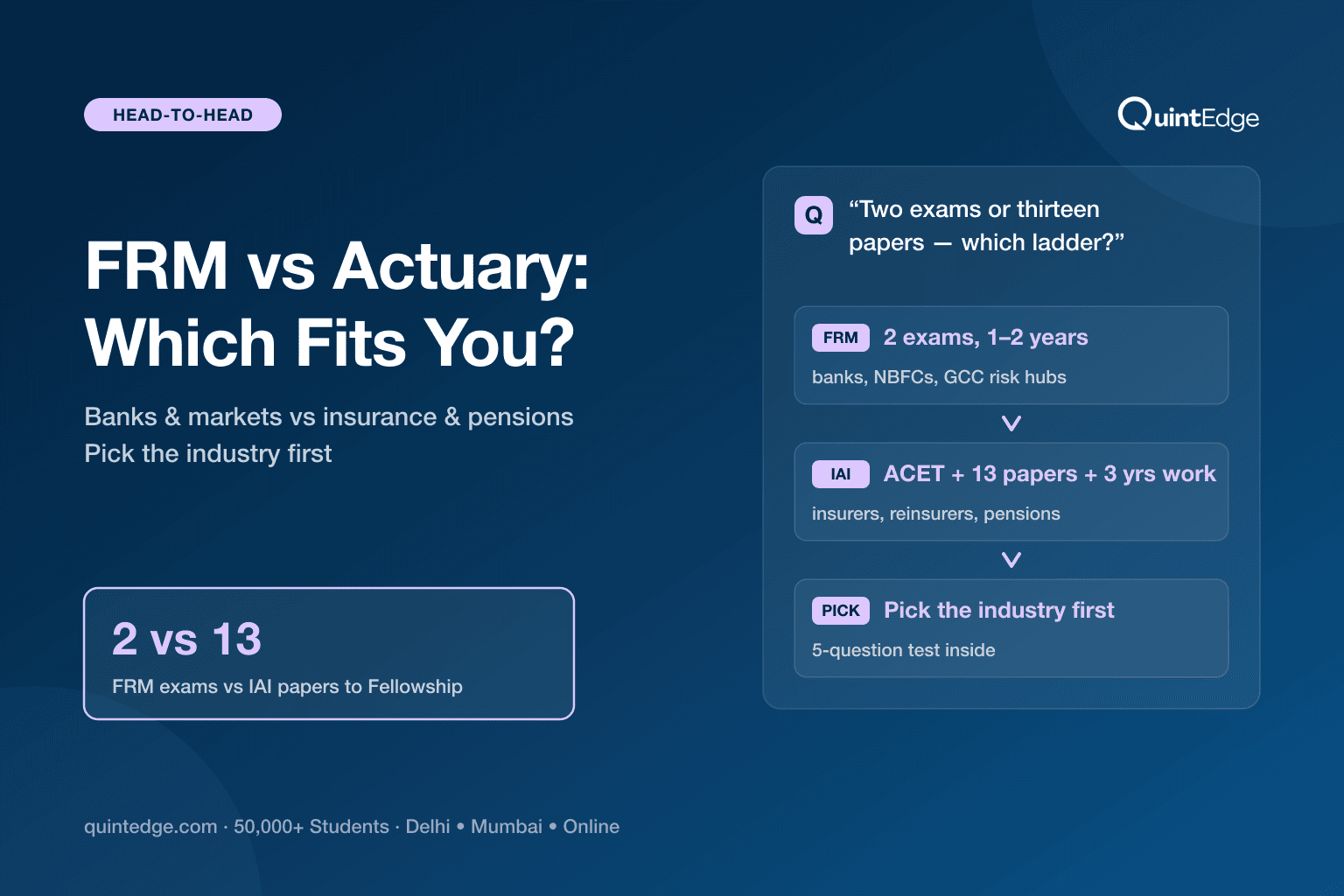
FRM vs Actuary: The Quick Answer
They are not two versions of the same job — they are two different worlds. The FRM (Financial Risk Manager), from GARP, is a two-exam certification for risk roles in banks, funds and fintechs. The actuarial route in India, run by the IAI (Institute of Actuaries of India), is a 13-paper professional qualification for pricing long-term promises — insurance, pensions and benefits.
The honest decision rule: pick by industry, then by patience. Want banking and markets, and a credential inside two years? FRM. Fascinated by insurance mathematics, and prepared for a multi-year exam ladder with a scarce, senior prize at the end? Actuarial. Money alone will not settle it — both pay well at the top.
What Does Each One Actually Do?
A financial risk manager answers a today question: how much could the firm lose this week, this quarter, this crisis — on its loans, its trades, its cash position? The work lives in banks, NBFCs (non-banking financial companies — lenders that are not full banks), asset managers and the India hubs of global banks. Deliverables are risk reports, limits, models and stress tests.
An actuary answers a decades question: what should this promise cost? Price a term-insurance policy for a 25-year-old, and the company has made a promise that may pay out in 2066. Someone must estimate deaths, illness, interest rates and inflation across forty years — and set today's premium so the promise survives. That someone is the actuary.
The work lives in life and general insurers, reinsurers, pension consultancies and, increasingly, insurance analytics teams.
One image to keep: the risk manager is the storm-watcher — eyes on the radar, protecting the ship this season. The actuary is the shipbuilder's mathematician — deciding, before the keel is laid, what storms the hull must survive for the next forty years.
How Do the Exams Compare?
This is where the two paths separate sharply. The FRM is a short ladder with two tall steps. The actuarial route is a long staircase with a gate at the bottom.
The FRM ladder: two computer-based exams — Part 1 (100 multiple-choice questions) and Part 2 (80 questions) — offered in three windows a year (May, August, November) at PSI centres. No entrance test, and GARP sets no education prerequisites at registration. Certification then needs two years of relevant work experience. Dates and deadlines: our FRM exam dates hub.
The IAI staircase: most students first clear ACET (Actuarial Common Entrance Test) — a 3-hour, 100-mark online exam of 70 questions across mathematics (30 marks), statistics (30), data interpretation (15), English (15) and logical reasoning (10). Pass mark is 50%, with no negative marking, held 2–3 times a year; a pass stays valid for three years (IAI, checked July 2026).
Certain listed categories — including some professional-body members and graduates — can skip ACET via IAI's direct-entry route; check IAI's current list.
Then come the papers:
| Stage (IAI) | Papers | What it makes you |
|---|---|---|
| Core Principles | CS1, CS2, CM1, CM2, CB1, CB2, CB3 — 7 papers | Associate (after all 10) |
| Core Practices | CP1, CP2, CP3 — 3 papers | |
| Specialist Principles | Any 2 of the SP series | Fellow (13 papers + 3 years' actuarial work + the India Fellowship Seminar) |
| Specialist Advanced | Any 1 of the SA series |
Plain takeaway: Associate status needs 10 papers; Fellowship needs 13 papers plus at least three years of actuarial work experience and a fellowship seminar (IAI qualification rules, checked July 2026). Against that, the FRM's whole exam journey is two sittings.
Which Takes Longer — and Which Costs More?
Time. The FRM's exam journey typically runs 12–24 months at one part per window-cycle; GARP's outer rope is Part 2 by 31 December of the fourth year after Part 1.
The actuarial staircase has no fixed length — you climb paper by paper, and each paper is a separate sitting. IAI's own membership table is the honest tell: as on its latest published statistics, 1,426 members still had all 14 subject-credits remaining, against only 80 members with a single subject left.
The staircase is long, and most people on it are near the bottom. Plan in years, not windows.
Cost. Two different meters:
| Cost line | FRM (GARP, USD) | Actuary (IAI, INR) |
|---|---|---|
| Entry | US$400 enrollment (one-time) | ACET fee + student admission (see IAI's current schedule) |
| Exams | US$600 early / US$800 standard, per part × 2 | ₹3,000–₹10,000 per paper × 13 papers |
| Exam-fee total, first attempt | US$1,600–2,000 + GST | ≈ ₹74,500 (one attempt at each of 13 papers, India/SAARC fee table) |
| The multiplier | Retakes at full part fee | Retakes per paper — over a long journey, they add up |
Plain takeaway: on paper the actuarial exam fees look cheaper — ₹74,500 across 13 papers versus roughly ₹1.55–1.93 lakh equivalent for FRM's two parts (at about ₹97 per US dollar, October 2026). But the actuarial figure assumes you pass all 13 first time, which the funnel data says is rare.
Budget honestly for both: QuintEdge counsellors put the realistic FRM all-in (fees plus prep) at ₹2–3.5 lakh; a full fellowship journey, with retakes and study materials over the years, commonly lands in the same territory or beyond. The FRM number in rupees is a full anatomy in our FRM cost guide.
What Do They Pay in India?
Named data first, small samples flagged. All rows from PayScale India role pages, checked July 2026:
| Role (PayScale India) | Average base | Entry level | Top 10% | Sample |
|---|---|---|---|---|
| Actuarial Analyst | ₹7.3L | ₹5.2L | ₹10L | n=51 (upd. May 2026) |
| Actuary | ₹10.2L | ₹8.4L | ₹50L | n=26 — small (upd. Apr 2026) |
| Risk Analyst | ₹6.3L | ₹3.9L | ₹20L | n=203 (upd. Aug 2025) |
| Risk Manager | ₹14.3L | ₹6.1L | ₹30L | n=97 (upd. Aug 2025) |
Plain takeaway: actuarial pay starts higher (₹5–8L entry against ₹4–6L for risk seats) — scarcity does that. But the risk lane has far more seats and a faster route to the ₹14L-plus manager band, while the actuary's ₹50L top-end belongs to the small club of qualified seniors.
Note the sample sizes: the Actuary page rests on just 26 profiles, so treat the exact rupees as direction, not promise. The deeper FRM-side numbers are in FRM salaries in India.
One scarcity number worth knowing in interviews: IAI's published membership statistics show 458 Fellows in the whole of India as on the latest table the institute publishes (31 July 2020). Fully qualified actuaries remain genuinely rare — which is exactly why the qualification pays, and exactly why it takes so long.
Who Should Pick Which? A 5-Question Test
Answer honestly — count your A's and B's:
- 1. Which headline grabs you first? (A) "Banks brace for rate shock." (B) "India's mortality tables are changing."
- 2. Your patience for exams: (A) Two intense years, then done. (B) A paper at a time for as long as it takes.
- 3. The maths you enjoy: (A) Applied statistics on market and loan data. (B) Long-horizon probability — survival models, discounting across decades.
- 4. First-job urgency: (A) I need a recognised credential and a role fast. (B) I can build slowly; early actuarial analyst pay is decent while I climb.
- 5. The employer that excites you: (A) A bank's risk desk or a GCC analytics hub. (B) An insurer, reinsurer or pension consultancy.
Mostly A's — take the FRM path; start with what FRM is and the Part 1 plan. Mostly B's — sit the ACET and begin the staircase with open eyes. A 3–2 split? Read the switching section below before you commit. And if your real comparison is FRM against another risk credential, that face-off is here: FRM vs PRM.
Can You Switch Between the Two Later?
Partially — the maths travels, the credentials do not. Neither body exempts you from the other's exams: passing FRM earns no IAI paper credits, and an actuarial Associate still starts FRM at Part 1. What does transfer:
- Statistics and modelling skill — survival analysis, regression and simulation are shared muscle, and both worlds now prize Python on top of them.
- The ERM bridge. Enterprise risk management is the genuine overlap: IAI's specialist menu includes an ERM paper (SP9), and insurers hire risk managers for exactly this seat. It is the most common crossing point in both directions.
- Credit and investment desks at insurers. Insurance companies run large investment books — an FRM inside an insurer is not a contradiction; it is the investment-risk desk.
The costly move is starting one ladder to abandon it mid-way. Half a fellowship is years of effort with no designation to show; a passed FRM Part 1 alone has modest market value (we say so honestly in jobs after FRM Part 1).
Decide the industry first — that is the whole game. Weighing the FRM against a switch from engineering specifically? The companion guide FRM for engineers maps that route step by step.
FRM vs Actuary: Frequently Asked Questions
It is longer rather than mathematically harder per paper. FRM compresses risk into two demanding sittings; the IAI route spreads deeper theory across 13 papers, each a separate hurdle, plus an entrance test, work experience and a fellowship seminar. IAI's own membership table — 1,426 members with all subjects remaining versus 80 with one left — shows how long the staircase runs in practice.
Sequentially, yes; together, rarely wise. Neither grants exemptions from the other, so you are running two full exam programmes. The sensible combination is one designation plus complementary skills — an actuarial Associate adding FRM for an insurer's risk function, or an FRM adding the ERM specialist paper's ideas. Finish one ladder before pricing the second.
Both fit a quantitative background — the split is industry and patience. FRM converts an engineer into a bank-risk professional in one to two years with no entrance test. The actuarial route rewards those genuinely drawn to insurance mathematics and comfortable with a multi-year climb. If speed to a credible finance role matters, FRM is usually the efficient first move.
Mostly, but not only. The core seats are life and general insurers, reinsurers and pension consultancies. Beyond them, actuarial skills appear in enterprise risk management, insurance analytics, banking treasury and consulting. The specialist-paper menu itself — health, life, general insurance, pensions, investment, ERM — is an honest map of where the jobs are.
Very few. The Institute of Actuaries of India's published membership statistics show 458 Fellows as on 31 July 2020 — the most recent table on its statistics page — alongside thousands of student members still climbing the papers. That scarcity is the actuarial trade-off in one number: a long staircase, and a small, well-paid club at the top.
Yes — for the right desks. Insurers run large investment books and enterprise risk functions, and both hire risk-certified professionals rather than only actuaries. An FRM fits the investment-risk and ERM seats; pricing and reserving remain actuarial territory. If insurance risk attracts you but thirteen papers do not, that is a legitimate middle path.


