
Can an Engineer Do the FRM?
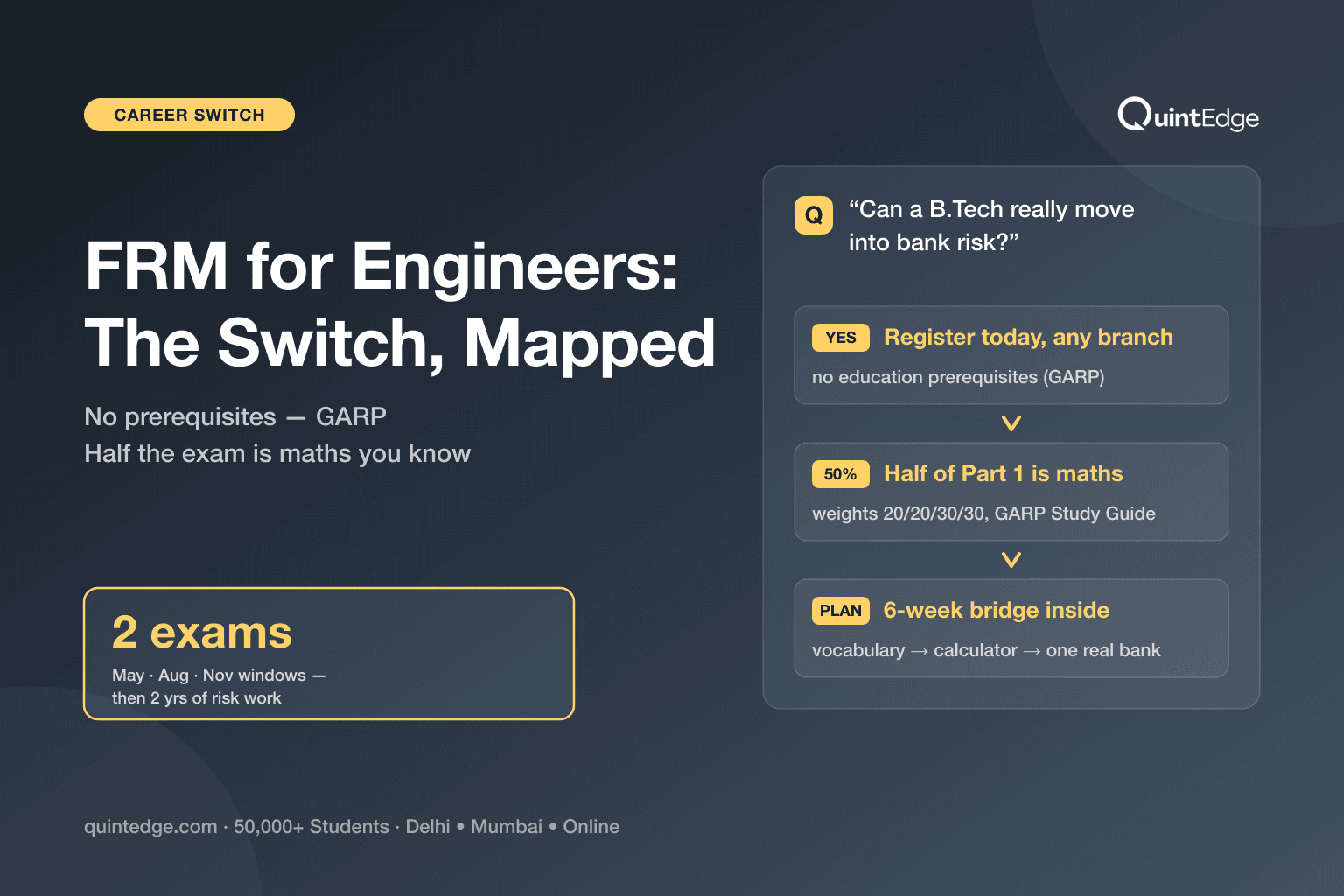
Yes — and more easily than most finance graduates. The FRM (Financial Risk Manager) is a global certification from GARP (the Global Association of Risk Professionals) for people who measure and manage risk at banks, funds and fintechs. GARP's own FAQ says it plainly: "there are no educational or professional prerequisites needed to register" (garp.org, checked July 2026).
No finance degree. No commerce background. A B.Tech in any branch — or a final-year student — can enrol today.
Here is the part nobody tells engineers: the FRM exam is mostly applied mathematics. Probability, statistics, regression, simulation, a little calculus. You have already passed harder maths than this. What you are missing is vocabulary — what a bond is, how a derivative works — and that is learnable in weeks, not years.
Think of a bank as a machine that runs on borrowed money. A risk manager is the engineer who stress-tests that machine: how much load can it take, where will it crack, what happens in a crash? Same instincts as engineering. Different machine.
Why Does the FRM Fit Engineers So Well?
Because half of Part 1 is material you have effectively studied before. GARP's FRM Study Guide weights Part 1 across four areas: Foundations of Risk Management (20%), Quantitative Analysis (20%), Financial Markets & Products (30%), and Valuation & Risk Models (30%).
Quantitative Analysis is probability, distributions, hypothesis testing and regression — a compressed version of your engineering maths papers. Valuation & Risk Models is applied computation: pricing instruments, measuring VaR (Value at Risk — a number that says "on a bad day, we could lose this much"), running scenarios.
The overlap looks like this:
There is a format advantage too. Part 1 is a 100-question multiple-choice exam; Part 2 is 80 questions — both computer-based. No essays, no interviews at the exam stage. If you grew up on JEE-style objective papers, this is familiar territory. Our plain-words overview of the whole certification is here: what is FRM?
What Will You Actually Need to Learn from Scratch?
Be honest with yourself about the gap. It is real — it is just narrow. Three things need building from zero:
- Market vocabulary. Bonds, yields, options, futures, swaps. This is the Financial Markets & Products area — 30% of Part 1. It is memory-plus-intuition work, and it is where engineers should spend their first study weeks.
- Financial statements, lightly. FRM is not an accounting exam, but you must read a balance sheet without flinching. A weekend with any bank's annual report gets you moving.
- The language of loss. Engineering optimises performance; risk work manages downside. Concepts like default, exposure and recovery have precise meanings — our PD, LGD and EAD explainer covers the core three in plain words.
What you do not need: an MBA, a commerce degree, or CFA-style breadth across corporate finance and ethics first. The FRM is a specialist's exam. It tests risk, deeply, and nothing else.
What Does the FRM Roadmap Look Like?
The certification has three checkpoints, and the clock rules matter, so read them once properly:
- Pass Part 1. Offered in three windows a year — May, August and November — at PSI computer-testing centres in India. Current dates and deadlines live on our FRM exam dates hub.
- Pass Part 2 — GARP requires this by 31 December of the fourth year after you pass Part 1. Most serious candidates finish within 12–24 months; the four-year rope is longer than you will need.
- Show two years of full-time relevant risk work experience. You can submit it up to five years after passing Part 2, and work done up to ten years before also counts. So a fresher can pass both parts first and earn the experience after — the certificate simply waits for you.
For a working engineer, the realistic cadence is one part per six-to-nine months alongside the job. For a final-year student, Part 1 in the May or August window right after graduation slots neatly before joining dates. The technique half — how to actually study — is covered in our FRM Part 1 study method guide and the week-by-week study plan.
What Does the FRM Cost an Engineer?
GARP bills in US dollars, and the meter has three readings (garp.org fees page, checked July 2026):
| Fee | Early registration | Standard registration |
|---|---|---|
| One-time enrollment (with Part 1) | US$400 | US$400 |
| Part 1 exam fee | US$600 | US$800 |
| Part 2 exam fee | US$600 | US$800 |
| Total exam fees | US$1,600 | US$2,000 |
Plain takeaway: registering early for both parts saves US$400 — the price of the enrollment fee itself. Taxes (GST) are added at payment based on your location.
In rupee terms, QuintEdge counsellors ask students to budget ₹2–3.5 lakh all-in — GARP fees, study materials and coaching together. That is a fraction of a top MBA (IIM-Ahmedabad's 2025–27 PGP fee alone is ₹27.5 lakh, per the institute), for a credential that targets the same risk desks. The full fee anatomy, with three worked rupee scenarios, is in our FRM total cost guide.
Which Jobs Open After FRM for an Engineer?
Risk teams hire engineers happily — the work is quantitative, and the tooling (Excel, SQL, Python) rewards people who build things. The common landing zones:
- Market risk analyst — measuring how trading positions behave when rates or prices move. The most maths-dense seat.
- Credit risk analyst / modeller — estimating who defaults and what it costs. India's biggest risk-hiring lane; see what credit risk modeling is.
- Risk analytics at GCCs — the India hubs of global banks run large risk and model teams; engineers with FRM-plus-Python are their staple hire (QuintEdge counsellor guidance from placement conversations).
- Treasury and liquidity risk — how a bank makes sure the cash is there on the day it is owed.
What the seats pay, from PayScale India role pages (checked July 2026):
| Role (PayScale India) | Average base | Entry level | Top 10% | Sample |
|---|---|---|---|---|
| Risk Analyst | ₹6.3L | ₹3.9L | ₹20L | n=203 (upd. Aug 2025) |
| Quantitative Analyst | ₹14.7L | ₹11.4L (n=8 — tiny) | ₹30L | n=21 — small (upd. Apr 2026) |
| Risk Manager | ₹14.3L | ₹6.1L | ₹30L | n=97 (upd. Aug 2025) |
Plain takeaway: entry risk seats pay ₹4–6L, quant-flavoured seats pay clearly more, and the manager band crosses ₹14L — but note the small samples on the quant rows and treat them as direction, not promise. Deeper role-by-role numbers: FRM salaries in India and jobs after Part 1 alone.
How Should an Engineer Start Preparing?
Run a short bridge before the syllabus proper. Six weeks is enough if you are honest about the gates:
- Weeks 1–2 — market vocabulary. Bonds, yield, options, futures, swaps. Gate: explain each to a non-finance friend in one sentence without notes.
- Weeks 3–4 — money maths on a calculator. Time value of money, discounting, bond pricing on the BA II Plus (the exam-approved calculator). Gate: price a simple bond in under three minutes.
- Weeks 5–6 — read one bank. Take any listed bank's annual report; find its loan book, deposits and capital ratio. Gate: say where the bank would hurt first in a downturn, and why.
Clear those gates and the official Part 1 material stops feeling foreign — the maths carries you from there. Then follow the week-by-week Part 1 plan against your chosen window on the dates hub. If you want the honest pros-and-cons before committing, read is FRM worth it — and if you are weighing the actuarial route instead, our companion piece FRM vs Actuary settles that choice properly.
FRM for Engineers: Frequently Asked Questions
No. GARP states there are no educational or professional prerequisites to register for the FRM exam. Engineers, science graduates and final-year students can all enrol directly. The finance vocabulary you are missing is covered inside the Part 1 syllabus itself, especially the Financial Markets and Products area.
Yes. Since there are no prerequisites, final-year and even earlier students can register and appear. Many engineers target the May or August window of their final year so the Part 1 result lands before placement season. The certification itself waits until you also pass Part 2 and complete two years of relevant work experience.
No — it is narrower and shallower than a B.Tech maths sequence, centred on probability, statistics and regression. What makes the exam hard is volume and application speed: 100 questions in four hours, with concepts applied to unfamiliar financial situations. Engineers usually lose marks on vocabulary and product mechanics, not on the mathematics.
Strongly. The FRM exam itself needs no coding, but risk teams — especially credit-risk modelling and analytics desks — run on Python, SQL and legacy SAS. An engineer who pairs the FRM with working Python is exactly the profile GCC risk hubs hire. It is the fastest way to stand out against commerce-background candidates.
Different tools. An MBA buys a campus network and a placement day across every finance role, at a fee of ₹26–27.5 lakh at the top IIMs plus two years out of work. The FRM costs a fraction of that, runs alongside your job, and targets risk roles specifically. If you know you want risk, FRM first is the efficient path; an MBA can still come later.
Plan 12 to 24 months for both parts at one exam per six-to-nine months, studying roughly 10–15 hours a week. GARP's outer limits are generous — Part 2 by 31 December of the fourth year after Part 1, and up to five years after Part 2 to submit your two years of work experience — so a busy quarter at work does not derail the credential.


