
ACCA vs MBA in India: Which Should You Pick?
ACCA and an MBA solve different problems, so neither is "better" for everyone. ACCA (Association of Chartered Certified Accountants — a UK-based global accounting qualification) makes you a specialist in accounting, audit, tax and reporting. An MBA (Master of Business Administration — a two-year management degree) makes you a generalist with a strong alumni network.
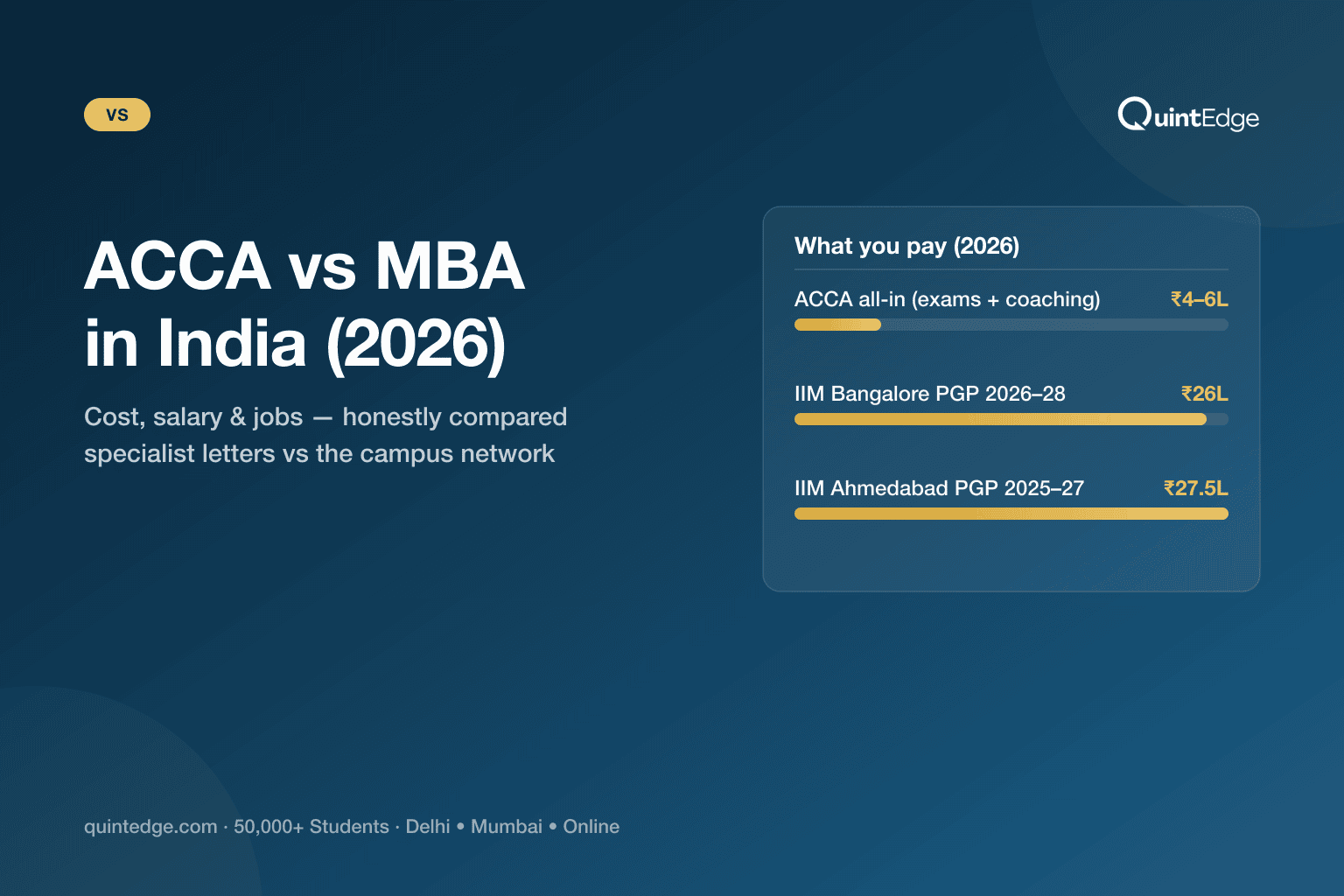
The money question splits the same way. ACCA costs a fraction of a top MBA — roughly ₹4–6 lakh all-in versus ₹26–27.5 lakh in fees alone at the top IIMs (Indian Institutes of Management). And you can earn a salary while you study ACCA. An MBA asks you to stop working for two years.
Pick ACCA if you want a career in finance, accounting or audit. Pick an MBA if you want to manage businesses, switch into consulting or general management, and you can crack a top-tier college. The full comparison below shows costs, salaries and jobs — with named sources for every number.
What Does Each Actually Train You For?
Think of it like medical training. ACCA trains you as a surgeon of one field — accounting and finance, cut deep. An MBA trains you as a general physician of business — you learn some marketing, some operations, some strategy, some finance, but none of them at specialist depth.
ACCA runs through 13 exam papers across three levels, from basic bookkeeping to strategic-level case exams. You study financial reporting (preparing company accounts), audit (checking those accounts), tax, financial management and business strategy. The final level tests you the way a senior accountant is tested at work — long case studies, not multiple choice. Our ACCA exam structure guide walks through all 13 papers.
An MBA teaches management through classroom cases, group projects and a summer internship. The real product of a top MBA is not the syllabus — it is the placement season and the alumni network. Recruiters come to campus and hire in bulk. That access is what the high fee actually buys.
One more difference matters for freshers. ACCA has no entrance exam — you can start after Class 12 or B.Com. An MBA worth paying for sits behind the CAT (Common Admission Test), where lakhs of aspirants compete for a few thousand top-college seats. Most MBA aspirants do not land a top-tier seat — and the value of an MBA falls quickly outside the top tier.
How Much Does Each Cost in 2026?
ACCA bills you per exam, in British pounds. The top IIMs bill one large programme fee. Here is what each route costs at 2026 prices, converted at roughly ₹128 to the pound (October 2026 rate).
| Cost head | ACCA (2026) | Top-IIM MBA (2025–27 / 2026–28) |
|---|---|---|
| Programme / exam fees | ≈ £2,500 ≈ ₹3.2 lakh (see worked example) | IIM Ahmedabad ₹27.5 lakh · IIM Bangalore ₹26 lakh · IIM Calcutta ₹27 lakh |
| Coaching / prep | ₹0.5–2.5 lakh (optional but common) | CAT coaching ₹30,000–80,000 (typical published prices) |
| Salary lost while studying | ₹0 — you can work through ACCA | Two years of pay — ₹10 lakh+ if you earn ₹5 lakh a year |
| Typical all-in | ₹4–6 lakh | ₹35–40 lakh including lost salary |
Sources: ACCA India price list for the December 2026 session, checked in October 2026 (see our ACCA exam dates & fees hub); IIM Ahmedabad PGP 2025–27 fee ₹27.5 lakh (institute fee structure, via iQuanta); IIM Bangalore PGP 2026–28 all-inclusive fee ₹26 lakh (iimb.ac.in); IIM Calcutta ≈₹27 lakh (Shiksha). All-in ACCA band: QuintEdge counsellor guidance.
Plain takeaway: a top-IIM MBA costs six to eight times more than ACCA once you count the two years of salary you give up.
Here is the ACCA arithmetic behind that ₹3.2 lakh figure — an illustrative example for a B.Com graduate who gets 4 paper exemptions and passes everything on the first attempt, at standard-entry fees on ACCA's India price list:
- One-time registration: £30 (India's reduced fee; the regular fee is £89)
- Exemption fees for 4 papers (3 at £84 + 1 at £111): £363
- 5 Applied Skills exams at £151 each: £755
- Strategic Business Leader £268 + Strategic Business Reporting £191: £459
- 2 Options papers at £191 each: £382
- Ethics module: £83
- Annual subscription, 3 years at £140: £420
- Total: about £2,490 ≈ ₹3.2 lakh (at ≈₹127.9/£, October 2026 — the rupee cost moves with the exchange rate)
Retakes, late entry (which can more than double a paper's fee) and coaching sit on top. That is why most Indian students realistically budget ₹4–6 lakh all-in — the band our counsellors quote. The full rupee breakdown lives in our ACCA cost in India guide.
What Salaries Do They Really Lead To?
This is where honest comparison matters most, because the two headline numbers are not measuring the same thing. MBA placement averages count fresh offers at graduation. ACCA salary data averages people across all career stages. Read them side by side, not as a race.
| Number | What it says | Source |
|---|---|---|
| ACCA in India — average pay | ₹7,01,000 a year across all experience levels (range roughly ₹2 lakh to ₹20 lakh; over half the sample is early-career) | PayScale India, 173 profiles, updated 18 May 2026 |
| ACCA at big employers — reported pay | J.P. Morgan ₹12 lakh · Deloitte ₹10.8 lakh · PwC ₹10 lakh · EY ₹6.4 lakh · KPMG ₹6.2 lakh (all-level medians, not fresher offers) | PayScale India, same page |
| IIM Ahmedabad — placement average | ₹35.5 lakh CTC (2025 report; 2026 PGP report awaited) | Careers360 / Shiksha |
| IIM Bangalore — placement average | ₹34.88 lakh CTC (2025); NIRF-2026 median ₹32.61 lakh | Shiksha / NIRF 2026 |
| IIM Calcutta — placement average | ₹36 lakh CTC (2026 report, 458 students) | Shiksha / Cracku |
CTC (cost to company) includes bonuses and one-time components, so take-home is lower than the headline.
Plain takeaway: a top-3 IIM offer pays far more at day one — but that comparison only applies to the small minority who get into a top-3 IIM.
Three honesty checks before you decide by salary alone:
- The MBA premium is top-tier specific. Those ₹35-lakh averages describe IIM A/B/C. Most MBA seats in India are not at these schools, and average packages fall steeply outside the top tier — often below what a Big 4 ACCA route reaches in a few years.
- ACCA freshers start moderate and climb. Entry-level ACCA affiliate roles at Big 4 firms (Deloitte, PwC, EY, KPMG — the four largest global professional-services firms) typically start in the ₹6–9 lakh band per our counsellor guidance, with the PayScale employer medians above showing where that grows. Our ACCA salary in India guide breaks this down by role.
- Timing differs. An MBA salary starts after 2 gap years and a ₹27-lakh fee. ACCA pay starts in year one and steps up as you pass levels — see real student outcomes on our ACCA results wall.
Which Jobs Does Each Open?
Qualifications are doors, not destinations. Here is where each door actually leads in the Indian market, in plain terms.
| If you hold… | Typical roles | Typical employers |
|---|---|---|
| ACCA | Statutory audit support, internal audit, financial reporting, tax associate, management accountant, finance analyst | Big 4 and their global delivery centres, MNC shared-service hubs (GCCs), banks, IFRS-reporting Indian companies |
| MBA (top-tier) | Management consultant, product manager, brand manager, corporate strategy, investment banking front office, general management | Consulting firms, FMCG majors, tech companies, banks — via campus placement |
| MBA (outside top tier) | Sales and business development, operations, HR, branch banking — finance specialist roles are rarer | Mid-size companies, NBFCs, insurance — mostly off-campus hiring |
Plain takeaway: ACCA doors are steady across employers of many sizes; MBA doors swing on which campus name sits on your CV.
Two boundaries to know before choosing ACCA: it does not give Indian statutory audit signing rights (only ICAI's CA does — our ACCA vs CA comparison covers this), and front-office investment banking hiring in India still leans on top-MBA campuses. If either of those is your goal, plan for it now, not after three years of exams.
Can You Do Both ACCA and an MBA?
Yes — and the order matters. The combination that works financially is ACCA first, MBA later if a leadership ceiling appears. You qualify by around age 23–24, work three to five years, and then let your employer's tuition support or a strong profile fund an MBA — often an executive one.
The reverse order is costlier. Doing ACCA after an MBA means spending 2.5–3 more years on exams just as your MBA batch starts climbing. It suits only those who discover late that they want deep finance work — if that is you, our ACCA after MBA roadmap shows which exemptions an MBA earns you.
Also note: an MBA earns ACCA exemptions only at the foundation level, and the exact count depends on your university — run our exemptions calculator before registering. ACCA gives an MBA nothing formally, but audit-and-finance work experience strengthens a CAT-year application in interviews.
How Should You Decide? A 5-Question Test
Answer these five questions honestly. Count your A's and B's — the majority wins.
- 1. What do you want to be doing at 9 am in year five? Reviewing financial statements or tax positions → A. Running a team, a product or a P&L → B.
- 2. Can your family fund ₹26–28 lakh without debt stress? No → A. Yes, comfortably → B.
- 3. Can you realistically reach a top-tier CAT percentile? Unsure or no → A. Yes, with evidence from mocks → B.
- 4. Do you need income in the next two years? Yes → A. No → B.
- 5. Does a global, portable qualification matter to you? Yes — ACCA is recognised across 180 countries → A. My plans are India-centred → B.
Mostly A's: start ACCA — see how to become an ACCA member step by step. Mostly B's: prepare seriously for CAT and aim top-tier only. Split down the middle: start ACCA now while you keep the MBA option open for later — that sequence wastes nothing.
Still comparing qualifications? Read ACCA vs CFA and ACCA vs CPA next, or talk to a counsellor about your specific profile.
ACCA vs MBA: Frequently Asked Questions
Neither is universally better. ACCA is stronger for specialist accounting, audit and reporting careers, costs ₹4–6 lakh all-in, and lets you work while studying. A top-IIM MBA is stronger for consulting, marketing and general management, but costs ₹26–27.5 lakh in fees plus two years out of work. Decide by target role, budget and whether a top-tier MBA seat is realistically within reach.
Yes, by a wide margin. ACCA exam-side costs come to roughly ₹3.2 lakh at October 2026 exchange rates for a first-attempt journey, and most students budget ₹4–6 lakh including coaching. IIM Ahmedabad's PGP fee alone is ₹27.5 lakh for 2025–27, before counting two years of salary you give up while studying.
At day one, a top-3 IIM graduate earns more — 2025–26 placement averages ran ₹34.9–36 lakh CTC at IIM A/B/C. But that applies only to top-tier campuses. ACCA professionals in India average ₹7 lakh across all experience levels per PayScale (May 2026), with Big 4 and bank employer medians of ₹6.2–12 lakh, and pay grows with post-qualification experience. Outside top-tier MBA campuses, the salary edge often reverses.
Yes, and it is the cheaper sequence. Qualify as an ACCA member first, build three to five years of finance experience, then add an MBA — often executive-format and sometimes employer-supported — only if you hit a general-management ceiling. Many members find the network they need without the degree.
Sometimes, and only at the foundation level. Depending on your university and specialisation, an MBA can earn exemptions from some Applied Knowledge papers — the exact count varies. Check your position on ACCA's official exemptions database or our exemptions calculator before registering, because each claimed exemption also carries a fee.
Yes. Deloitte, PwC, EY and KPMG hire ACCA students, affiliates and members in India for audit, tax, risk and advisory work — no MBA required — and all four hold ACCA Approved Employer status. Their global delivery centres are among the largest ACCA recruiters in the country. See our ACCA approved employers guide for the current list.
Run the 5-question test in this guide. If you want finance work, need income sooner, or cannot bank on a top-tier CAT percentile, start ACCA in your B.Com years — exams and degree run in parallel, and B.Com earns exemptions. If you genuinely want general management and your mock scores support a top-college shot, give CAT one serious attempt. The middle path — ACCA now, MBA later — wastes nothing.


