
CFA After B.Com at a Glance
Straight answer: yes, you can do CFA after B.Com — and you can even start before your degree ends. The CFA Program (Chartered Financial Analyst — the global investment credential) has no entrance exam, no minimum percentage, and no stream requirement. Its final-year rule lets you sit Level 1 while still in college.
Why do so many B.Com students pick it? Because it is the cheapest credible entry signal into investment jobs — equity research, asset management, investment banking support — without fighting for an MBA seat. The exams cost US$3,520–4,600 in total, CFA Institute's own figure. A Tier-1 MBA costs ₹15–25 lakh.
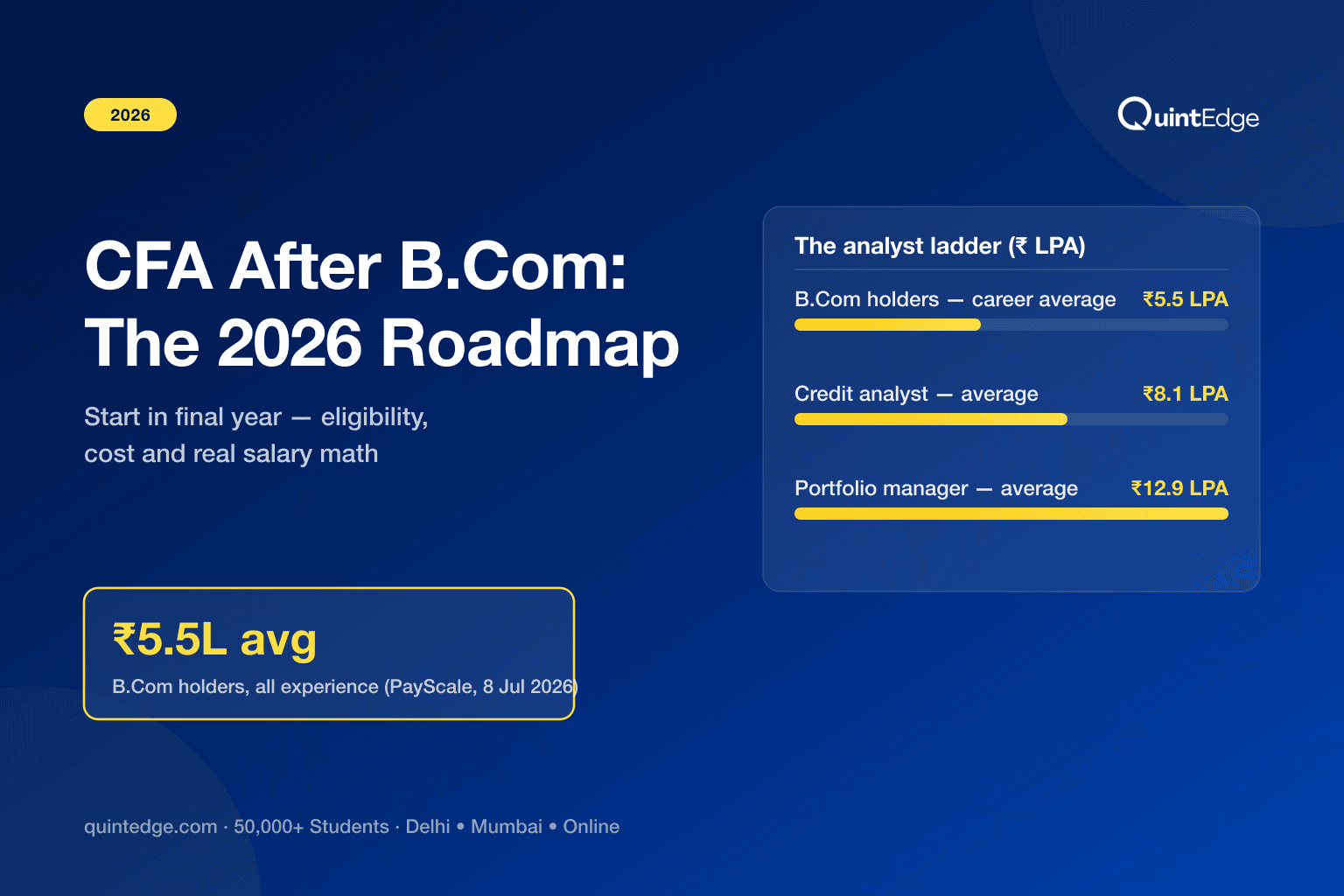
The honest baseline first. B.Com holders average about ₹5.5 lakh a year across their whole careers (PayScale, 2,226 profiles, as of July 2026) — a number weighed down by generic accounting and back-office desks. The analyst ladder CFA points at starts near ₹4 lakh at entry but climbs fast: credit analysts average ₹8.1 lakh and portfolio managers ₹12.9 lakh (same source). Getting onto that ladder early — instead of a generic B.Com desk — is the whole story of this post.
One thing to know before you commit: passing exams and holding the charter are different finish lines. The charter also needs 4,000 hours of investment-related work experience. As a fresher you do not need to worry about it on day one — but you should know the road has two halves.
Can You Do CFA Right After B.Com — or Even During It?
You can register for CFA Level 1 during B.Com itself. CFA Institute's rule is time-based, not year-based: your chosen exam window must fall within 23 months of your graduation month. For a standard three-year B.Com, that window opens partway through your second year — and covers all of your final year comfortably.
The full eligibility menu has four pathways, and a B.Com student or graduate almost always fits the first two:
- Pathway 1 — completed bachelor's degree. Any stream, any percentage. A pass-class B.Com from any recognised university qualifies exactly like a topper's degree from a metro college.
- Pathway 2 — final-phase undergraduate. The 23-month rule above. Register, sit Level 1, and have your result in hand around graduation.
- Pathways 3 and 4 — work experience routes. 4,000 hours of professional work (or a mix of study and work) can substitute for a degree. Rarely needed by B.Com candidates, but it exists.
Two practical requirements trip people up more than eligibility ever does. You need a valid international passport — CFA Institute accepts no other ID at registration or on exam day. And Level 2 has a harder gate: your degree must be complete before you can register for Level II. Our CFA eligibility guide walks through every pathway and edge case.
What Does CFA Actually Add to a B.Com Degree?
A B.Com hands you a map of the whole finance city — a survey of accounting, economics, law, tax and business. The CFA Program is a licence to work in one specific, high-paying district of that city: investments. The degree shows you know about finance; the CFA syllabus trains you to do investing work.
Concretely, three things change for a B.Com candidate who clears even Level 1:
- Your CV clears screening filters. Thousands of B.Com graduates apply for every analyst opening. "CFA Level 1 cleared" is a sorting signal recruiters actually use — it says you volunteered for a hard, globally standardised exam and passed.
- You can hold an investment conversation. Valuation, portfolio construction, financial statement analysis at an analyst's depth — interview topics a general B.Com syllabus never reaches.
- You unlock a specific role set. Equity research associate, credit and rating analyst, asset-management and wealth-desk roles, investment banking support. Our is CFA worth it guide maps the full role landscape and its ceilings.
Now the honest counterweight. Level 1 is not a job guarantee. It is a signal plus a syllabus — you still need internships, spreadsheet skills and interview practice around it. And plenty of commerce careers do not need it at all; our highest-paying commerce jobs guide shows several high-paying lanes that run on different fuel.
When Should You Start — Final Year or After Graduation?
The final year is the sweet spot for most students, and the arithmetic explains why. Level 1 runs four times a year — February, May, August and November — and CFA Institute's guidance is roughly 300 study hours. A final-year student who registers early in the year can sit a mid-year window and hold the result before placement season peaks.
The case for final year:
- The result lands with your degree. You graduate holding B.Com + "CFA Level 1 cleared" — a different CV from every parallel applicant, at the exact moment it matters most.
- Study time is cheaper now. 300 hours is far easier to find in a college schedule than alongside a first job's 9–10 hour days.
- Placements leverage. Campus recruiters for finance roles read the signal immediately.
The case for waiting until after graduation: the registration fee is serious money (next section), a failed attempt while juggling college exams wastes it, and some students genuinely need the degree year for internships instead. Waiting six months costs little — Level 1's four windows mean the next chance is never far. Our CFA Level 1 study plan has 3, 6 and 9-month schedules for both situations.
Either way, the sequencing rules are fixed: at most two attempts per calendar year, at least six months between attempts, and Level 2 only after your degree is complete. For the live registration deadlines, use our CFA exam dates hub — deadlines close roughly three months before each window.
How Much Does CFA Cost After B.Com?
Exam fees total US$3,520–4,600 for all three levels — CFA Institute's own range, and the spread depends purely on how early you register. There is no enrollment fee (scrapped in April 2025) and no late-registration tier: miss the standard deadline and that window simply closes.
| Fee item | Amount (per level) |
|---|---|
| One-time enrollment fee | None — removed by CFA Institute in April 2025 |
| Early registration | US$1,140 (Levels 1 and 2) · US$1,240 (Level 3) |
| Standard registration | US$1,490 (Levels 1 and 2) · US$1,590 (Level 3) |
| Rescheduling within a window | US$250 |
Plain-language takeaway: registering early at all three levels saves US$1,050 — for a student budget, that is a semester of expenses recovered by setting three calendar reminders.
An illustrative rupee picture: early registration for Level 1 alone is US$1,140 ≈ ₹1 lakh at about ₹87–88 to the US dollar. All three levels early ≈ ₹3.1 lakh. Add coaching and materials, and as QuintEdge counsellor guidance, budget a realistic all-in journey of ₹3.5–7 lakh — still a fraction of the ₹15–25 lakh a Tier-1 MBA costs. The full rupee math, forex markups included, lives in our CFA fees breakdown.
Money genuinely tight? CFA Institute runs need-based Access Scholarships that cut the registration fee substantially — details on its official scholarships and waivers page. Apply in the cycle before you plan to register; awards are limited and dated.
What Salary Can a B.Com + CFA Candidate Expect?
Here is the honest math, from one fresh dataset — PayScale India, checked in July 2026 — so every rung is comparable. B.Com holders across all roles and stages average ₹5.5 lakh. Entry analyst seats start near ₹3.9–4.1 lakh; credit analysts average ₹8.1 lakh and portfolio managers ₹12.9 lakh. The lane’s value is the climb, not the first cheque.
| Where you sit | Entry level (<1 yr) | India average |
|---|---|---|
| B.Com holders, all roles & experience | — | ₹5.5 lakh (2,226 profiles) |
| Equity analyst | ₹3.9 lakh | ₹4.6 lakh |
| Credit analyst | ₹4.1 lakh | ₹8.1 lakh |
| Portfolio manager (the lane’s ceiling) | ₹7 lakh | ₹12.9 lakh · top 10% cross ₹40 lakh |
Plain-language takeaway: the CFA lane’s entry seats start near the B.Com average, then out-run it within a few years — the ladder, not the first offer, is what you are buying (all figures PayScale India, checked in July 2026).
Where do these jobs actually sit? Big 4 firms pay Level 1 candidates ₹6–10 lakh at entry with strong progression; AMCs (asset management companies — mutual fund houses) offer ₹6–12 lakh with bonuses; Mumbai roles carry a premium over Bengaluru and Delhi for comparable seats. The city-by-city and employer-by-employer detail is in the Level 1 salary guide.
CFA vs MBA vs CA After B.Com — the Quick Triage
Most B.Com students are really choosing between three ladders, and the right one depends on destination, not difficulty. The one-line triage: investing roles → CFA; brand reset and general management → MBA; audit, tax and signing authority → CA.
| Path | Best for | Rough cost | Time to credential |
|---|---|---|---|
| CFA | Equity research, asset management, IB support, credit analysis | ₹3.5–7 lakh all-in | 2.5–4 years (exams) |
| MBA (Tier 1) | Campus placements, brand reset, general management, consulting | ₹15–25 lakh | 2 years full-time |
| CA | Audit, tax, controllership — the only path with audit signing authority | Low fees, years of stipend-level pay | 4–5+ years typical |
Plain-language takeaway: CFA is the cheapest of the three and the only one you can run alongside a job from day one — but it only pays off if investments is genuinely your destination.
Go deeper where you need it: our CFA vs MBA comparison settles that head-to-head with hiring-manager evidence, the 16 courses after B.Com guide lays out the full menu, and if CA is also on your roadmap, our CFA after CA guide covers that combo's exact math.
Who Should Skip CFA After B.Com?
Skip it — honestly — if any of these describe you. The CFA Program rewards a specific destination, and it punishes drift: the fees are real, the hours are real, and the syllabus only converts into salary inside investment-track roles.
- You are preparing for government or bank-PO exams. Those selection systems do not read CFA at all. Your 300 hours belong to that syllabus instead.
- You want audit, tax or accounting practice. That is CA (or ACCA) territory — signing authority and statutory work sit there, not in the CFA curriculum.
- You are still exploring whether finance is for you. A US$1,140 registration is an expensive way to explore. Read free material first — start with what financial modeling is and our is CFA worth it deep-dive — then commit.
- Paying the fee means real financial strain. Take the job first and attempt Level 1 alongside it — thousands do — or apply for CFA Institute's Access Scholarship a cycle ahead.
None of these are failure routes. They are different ladders — and climbing the wrong one fast is still the wrong direction.
How Should a B.Com Grad Prepare for Level 1?
Prepare like someone with a genuine head start and two specific gaps. Your accounting and economics are fresher than almost any other candidate profile — and your exam technique is built for the wrong format. Here is how that cashes out:
- Bank your overlap. Financial Statement Analysis and Economics lean on ground your B.Com just covered. Revise them CFA-style (the exam thinks like an analyst comparing companies, not a student reproducing formats) rather than re-learning from zero.
- Respect the quant gap. Probability, hypothesis testing and time-value mechanics go deeper than most B.Com syllabi. Front-load them — they underpin half the other topics.
- Retrain for MCQ speed. Level 1 is 180 multiple-choice questions in two 135-minute sessions — about 90 seconds each. College long-form answers are the wrong muscle; timed mocks are the right one.
- Give Ethics real hours. It is case-based application of a professional code — new material for everyone, and consistently underestimated by fresh graduates.
Put it on a calendar with our CFA Level 1 study plan — it has 3, 6 and 9-month schedules, including versions built around college timetables.
Frequently Asked Questions About CFA After B.Com
No. CFA Institute has no after-12th entry — you need either a completed bachelor's degree, an exam window within 23 months of your graduation month, or 4,000 hours of professional work experience. For a student starting a three-year B.Com, the earliest realistic Level 1 window arrives partway through the second year.
Yes — that is the classic slot. Any Level 1 window within 23 months of your graduation month qualifies, which covers the entire final year comfortably. You will need a valid international passport to register, and your result can be in hand around convocation. Level 2, however, requires the completed degree.
Yes. There is no mathematics prerequisite, and Level 1's quantitative methods are learnable with structured practice — they are statistics applied to money, not engineering mathematics. B.Com students should front-load quant study because it is their most common gap, but it is a workload issue, not an eligibility or ability barrier.
Exam fees are US$3,520–4,600 for all three levels — roughly ₹3–4 lakh depending on the exchange rate and registration timing, with Level 1 alone about ₹1 lakh at early pricing. There is no enrollment fee since April 2025. With coaching and materials, plan for ₹3.5–7 lakh all-in. Need-based Access Scholarships from CFA Institute can cut the fee substantially.
Research associate, credit analyst, KPO/GCC research desks, mutual-fund operations with research exposure, and Big 4 advisory analyst roles. Entry analyst seats average about ₹3.9–4.1 lakh in India and credit analysts average ₹8.1 lakh (PayScale, as of July 2026) — Mumbai front-office and top-AMC desks pay above those averages. Level 1 gets the interview; Excel, internships and communication get the offer.
Pick by destination and budget. CFA costs ₹3.5–7 lakh all-in, runs alongside a job, and targets investment roles specifically. A Tier-1 MBA costs ₹15–25 lakh, takes two full-time years, and buys campus placements plus a brand reset across general management. For investing careers on a student budget, CFA wins; for a wholesale profile upgrade, the MBA does. Our CFA vs MBA comparison settles it with hiring-manager evidence.
They serve different lanes. M.Com deepens academic commerce — it suits teaching, research and some public-sector paths. CFA is an industry credential built for investment jobs, and employers in equity research or asset management read it far more strongly than a master's degree in commerce. If your goal is an investing career, CFA is the more direct route; if academia calls, M.Com is.


