
CFA Level 3 Salary at a Glance
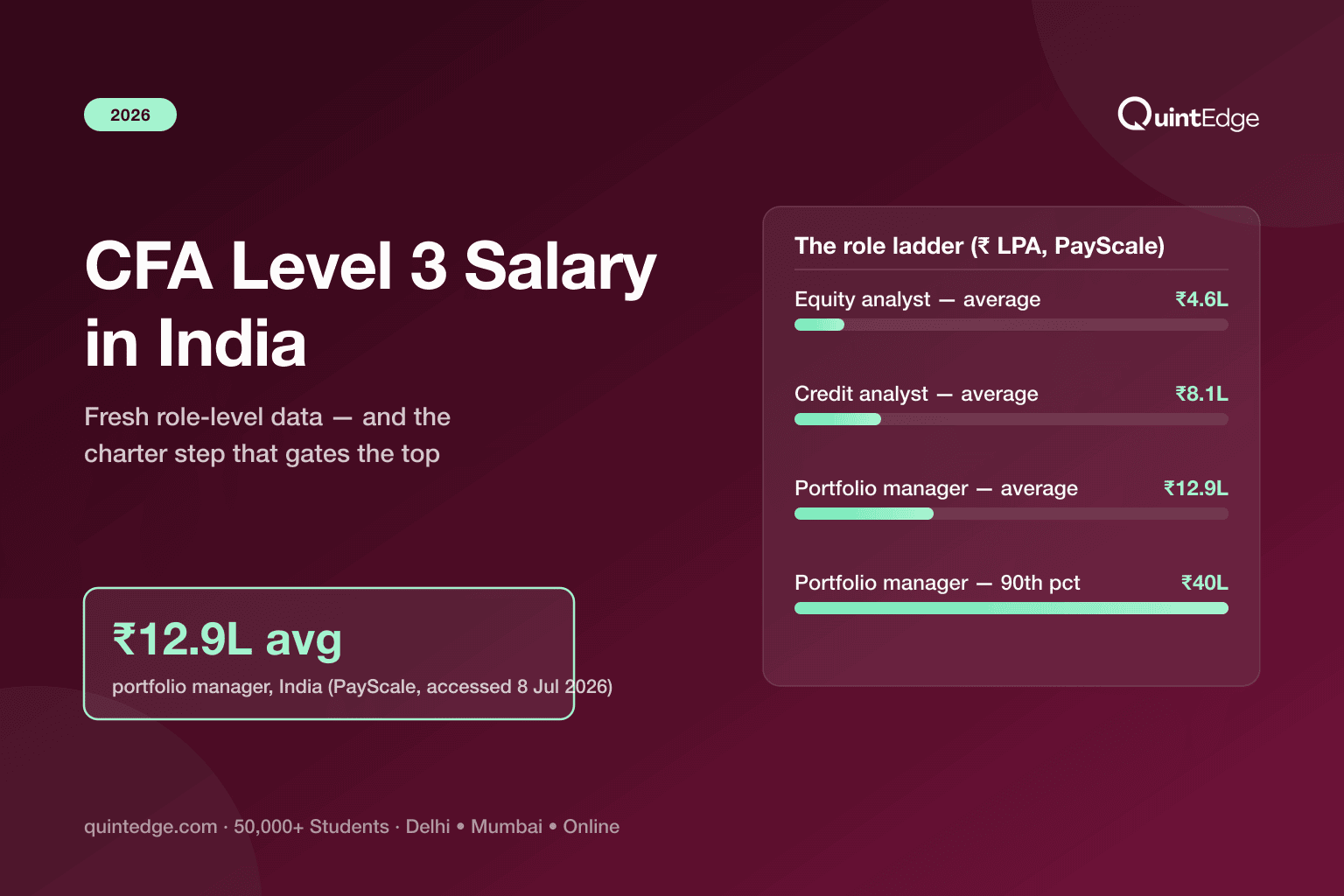
Here is the straight answer, from fresh data rather than folklore. No salary database tracks “CFA Level 3 passed” as a category — what exists is pay for the roles the last level unlocks. In India those look like this: equity analysts average about ₹4.6 lakh a year, credit analysts about ₹8.1 lakh, and portfolio managers about ₹12.9 lakh — with the top tenth of portfolio managers crossing ₹40 lakh (PayScale India, as of July 2026). Fund-manager averages run near ₹24 lakh in 6figr's 2026 dataset.
Two things decide where you land inside those spans. First, passing Level 3 and holding the charter are not the same thing — the charter needs 4,000 hours of qualifying work on top of the exams, and it is the charter that fully opens portfolio-manager-track roles. Second, the seat you already sit in: databases price roles, not exam results.
Quick vocabulary before we start. CTC means cost to company — the full package number in your offer letter. LPA means lakh per annum, or lakh per year. Every figure below is annual pay in India, from the named source beside it, and none of it is a guarantee.
Level 3 Passed vs Charterholder: What Changes?
Everything in this post hangs on one line from CFA Institute's rulebook: passing all three exams makes you a Level 3 passer, not a CFA. The charter arrives only after you also bank 4,000 hours of qualifying work experience over at least 36 months, submit 2–3 professional references, and join CFA Institute as a member.
Until then, there are strict naming rules under CFA Institute's Standard VII(B). You may state the fact — “Passed Level III of the CFA Program” — on your CV and LinkedIn. You may not write “CFA” after your name, and anything that implies a partial designation (“CFA Level 3”, “CFA in progress”) is a violation. CFA Institute even declines to issue a digital badge for passing Level 3 — deliberately, to protect the line between passer and charterholder. Recruiters in India know these rules; using the letters early reads as a red flag, not ambition.
Why does this matter for salary? Because employers price the two stages differently:
- Level 3 passed, charter pending tells an employer your knowledge is complete but your verified investment experience may not be. You are priced as a strong senior analyst.
- Charterholder tells an employer both boxes are ticked. This is where portfolio-manager, AVP and fund-track roles — the top of the pay data below — open fully. (AVP means assistant vice president, a common mid-senior title in Indian finance.)
Think of it like a driving licence. Passing Level 3 is acing the final driving test; the charter is the licence card in your wallet. Nobody hands you the car keys for the test result alone — but everyone can see the licence is only paperwork away.
What Does the Salary Data Actually Show?
Below is one consistent dataset — PayScale India, as of July 2026 — for the three role families most Level 3 candidates sit in or move toward. One dataset, so the rungs are comparable; sample sizes included, so you can judge the weight of each number.
| Role (India) | Average pay | Entry level (<1 yr) | 10th–90th percentile span | Sample |
|---|---|---|---|---|
| Equity analyst | ₹4.6L | ₹3.9L | ₹2.3L – ₹20L | 32 profiles |
| Credit analyst | ₹8.1L | ₹4.1L | ₹3.1L – ₹20L | 122 profiles |
| Portfolio manager | ₹12.9L | ₹7L | ₹3.5L – ₹40L | 57 profiles |
Plain takeaway: the spans are the story. The 90th percentile — the level only the top 10% cross — sits at roughly ten times the 10th-percentile figure for portfolio managers, and that gap is set by seat, city and employer, not by the exam certificate.
Read the table honestly and three things stand out:
- Averages look lower than coaching-brochure numbers. Because they average everyone — every city, every firm size, charterholders and non-candidates alike. Front-office Mumbai offers live in the top third of each span, not at the average.
- The ladder is real. Analyst → credit/senior analyst → portfolio manager roughly triples average pay in the same dataset. That is the ladder the CFA Program is built to climb.
- Datasets disagree, and that is normal. Indeed India pegs the average equity research analyst near ₹4.5 lakh (as of July 2026) — consistent with PayScale. 6figr's 2026 dataset, built on verified offers that skew senior, shows fund managers averaging about ₹24 lakh and credit analysts about ₹16 lakh. Same market, different populations. Treat every aggregator as a reference point, never an entitlement.
Which Roles Pay These Numbers?
Level 3 pay concentrates in roles trusted with investment judgement — deciding what a fund buys, what a bank lends against, or what a client's portfolio should hold. Four families dominate, and our CFA career opportunities guide maps each in more depth.
- Portfolio management track. Research analyst → senior analyst → assistant fund manager at AMCs (asset management companies — the mutual fund houses). The charter is close to a hard requirement at the top of this track — this is the ₹12.9L-average, ₹40L-at-the-90th-percentile column, and fund-manager averages near ₹24 lakh in 6figr's senior-skewed data.
- Equity research. Covering listed companies and publishing buy/sell calls, at brokerages (sell-side) or funds (buy-side — the investing side). The wide ₹2.3L–20L span reflects tiny regional brokerages and global desks living in one average.
- Credit and fixed income. Credit research at rating agencies, bond desks, and India's fast-growing credit funds. Note the credit-analyst average (₹8.1L) runs well above the equity-analyst average (₹4.6L) in the same dataset — credit hiring is deep and institutional right now.
- Global captives (GCCs). The India research and risk hubs of global banks and asset managers — steady hiring, structured pay, often the easiest door into an investment seat outside Mumbai.
Two honest exclusions. Wealth-management advisory pays on revenue more than credentials, so its numbers scatter too widely to table honestly. And back-office operations roles do not price the Level 3 pass at all — which is exactly why the seat change matters more than the pass.
What Actually Changes at Each CFA Level?
Candidates often ask for a “Level 1 salary vs Level 2 salary vs Level 3 salary” table. Honest answer: no public database splits Indian pay by CFA level — aggregators track roles and years, not exam stages. What each level demonstrably changes is role access:
- Level 1 works as a screening signal for analyst-tier seats — research support, credit operations, captive research desks. It gets CVs past filters; it rarely re-prices an existing role.
- Level 2 is the depth signal — the stage at which research desks start treating you as trained analytical capacity rather than a trainee.
- Level 3 plus the charter is the gate. PM-track, fund-management and senior buy-side roles — the top rungs of the data above — routinely specify the charter, and CFA Institute's designation rules mean only the charter, not the pass, goes after your name.
So the biggest pay step in the journey is not between two exams — it is between the last exam and the charter, because that is where the gated roles open. For the earlier rungs, our Level 1 and Level 2 salary guides cover those stages, and our international guide shows the same ladder abroad.
What Decides Where You Land in the Span?
Two people pass Level 3 in the same window and end up ₹10 lakh apart. That gap is rarely about the score. Four factors do most of the work:
- Your current seat. The single largest factor. An investment seat compounds the pass; a support seat parks it. The databases price the seat, and the figure below shows the same pass producing two different pay cheques.
- City. Front-office investment pay concentrates in Mumbai; Bengaluru, Hyderabad and Delhi NCR pay strongly through captives and funds but trail Mumbai front office at the same level. This is much of why the percentile spans run so wide.
- Base versus bonus. Fund-side offers lean on variable pay — PayScale's portfolio-manager data shows bonuses alone reaching ₹7.8 lakh at the top. A ₹24L fund offer may be ₹18L fixed plus ₹6L variable while a captive pays ₹21L nearly flat. Compare fixed pay, not headlines.
- Timing of the move. Level 3 results land in clear windows — switching jobs in the weeks after a pass, with “Passed Level III” freshly on the CV, prices better than waiting for your internal review cycle. Salary reviews are not vending machines; they pay out on the employer's calendar, not the exam's.
A small worked example (illustrative, for arithmetic only — anchored on the averages above): a credit analyst on ₹8 lakh passes Level 3 and moves to a senior research seat at ₹12 lakh — a ₹4 lakh step for the seat change. Two years later the charter arrives and a PM-track promotion takes the package past ₹20 lakh. Same person, two separate jumps: one for the seat, one for the charter.
From Level 3 Pass to Charter: The 4,000-Hour Step
Since the charter drives the biggest jump, here is exactly what it takes after the Level 3 result — all per CFA Institute's current membership rules. You need 4,000 hours of qualifying work experience, built over at least 36 months — roughly two to three years of full-time work. Four rules decide how fast you get there:
- The work must involve investment decision-making — CFA Institute's test is that at least 50% of your role directly relates to the investment decision-making process, or produces work that informs it. Equity and credit research, portfolio management, treasury dealing and valuation advisory generally qualify.
- Hours can be banked before, during and after the exams — full-time, part-time or remote, and paid full-time internships count. If you have already spent three years in an investment seat while clearing the levels, your charter application can go in almost immediately after the result.
- Support work generally does not count. Statutory audit, tax, accounting operations and generic MIS reporting usually fail the 50% test — CFA Institute's online work-experience self-assessment lets you check your exact role before you plan around it. This matters especially for CAs weighing the combo; our CFA after CA guide covers that lane in detail.
- The application needs 2–3 references who can vouch for your work, plus CFA Institute membership. Paperwork plus patience — but every month in a non-qualifying role is a month added between you and the charter-gated pay.
Two Level 3 specifics worth knowing as you plan. Since 2025, candidates choose a specialisation pathway at registration — Portfolio Management (the classic core), Private Wealth or Private Markets; the common core still carries roughly 65–70% of the exam weight, and all three pathways lead to the same charter. And the recent pass rates are genuinely encouraging by CFA standards: 50% passed in both August 2025 and February 2026, with first-time Level 3 takers at 59% in February 2026, per CFA Institute's published results. Format, pathways and strategy live in our CFA Level 3 exam guide; the running numbers are in our pass-rates tracker, and live windows and deadlines on the CFA exam dates hub.
Frequently Asked Questions About CFA Level 3 Salary
No salary database tracks "Level 3 passed" as a category — pay follows the role you hold. Fresh reference points for the roles Level 3 candidates sit in: equity analysts average about ₹4.6 lakh, credit analysts ₹8.1 lakh and portfolio managers ₹12.9 lakh, with the top tenth of portfolio managers crossing ₹40 lakh (PayScale India, as of July 2026). Fund managers average near ₹24 lakh in 6figr's senior-skewed 2026 data.
No. Employers reward the pass at review cycles or when you change roles — not on results day. The reliable jumps come from moving into a bigger seat soon after the result, or from the charter arriving and opening portfolio-manager-track roles. Candidates who stay in support roles after passing usually see little change.
No public dataset splits Indian pay by charter status either — the mechanism is role access. Senior portfolio-management and fund roles routinely require the charter, and those roles carry the highest numbers in the data: a ₹12.9 lakh portfolio-manager average stretching to ₹40 lakh at the 90th percentile (PayScale India, as of July 2026). The charter needs 4,000 qualifying hours over at least 36 months, so the pay gap is really the price of verified investment experience.
Portfolio-management and fund roles top the data — ₹12.9 lakh average and ₹40 lakh at the 90th percentile for portfolio managers, with fund-manager averages near ₹24 lakh in 6figr's 2026 dataset. Senior buy-side research and institutional credit roles follow. Mumbai front-office seats dominate the top of every span; wealth advisory can pay well but varies with revenue targets rather than credentials.
No. Under CFA Institute's Standard VII(B), only charterholders may use the CFA designation. Until your 4,000 qualifying hours, references and membership are approved, the accepted wording is "Passed Level III of the CFA Program" — and anything implying a partial designation, like "CFA Level 3", is a violation. CFA Institute deliberately issues no digital badge for the Level 3 pass, to keep that line clear.
It depends entirely on hours already banked. Experience earned before and during the exams counts — including paid full-time internships — so a candidate with three-plus years in qualifying investment work can apply almost immediately after the result. Starting from zero qualifying experience, plan roughly two to three more years: 4,000 hours over a minimum of 36 months, per CFA Institute.
No pay data exists by pathway yet — Portfolio Management, Private Wealth and Private Markets only began with the 2025 cycle, and the common core still carries roughly 65–70% of the exam weight. All three lead to the same charter. Choose by the roles you want: the classic PM pathway for fund and research tracks, Private Wealth for advisory careers, Private Markets for private equity and credit interests.


