
IB vs PE vs VC: What's the Real Difference?
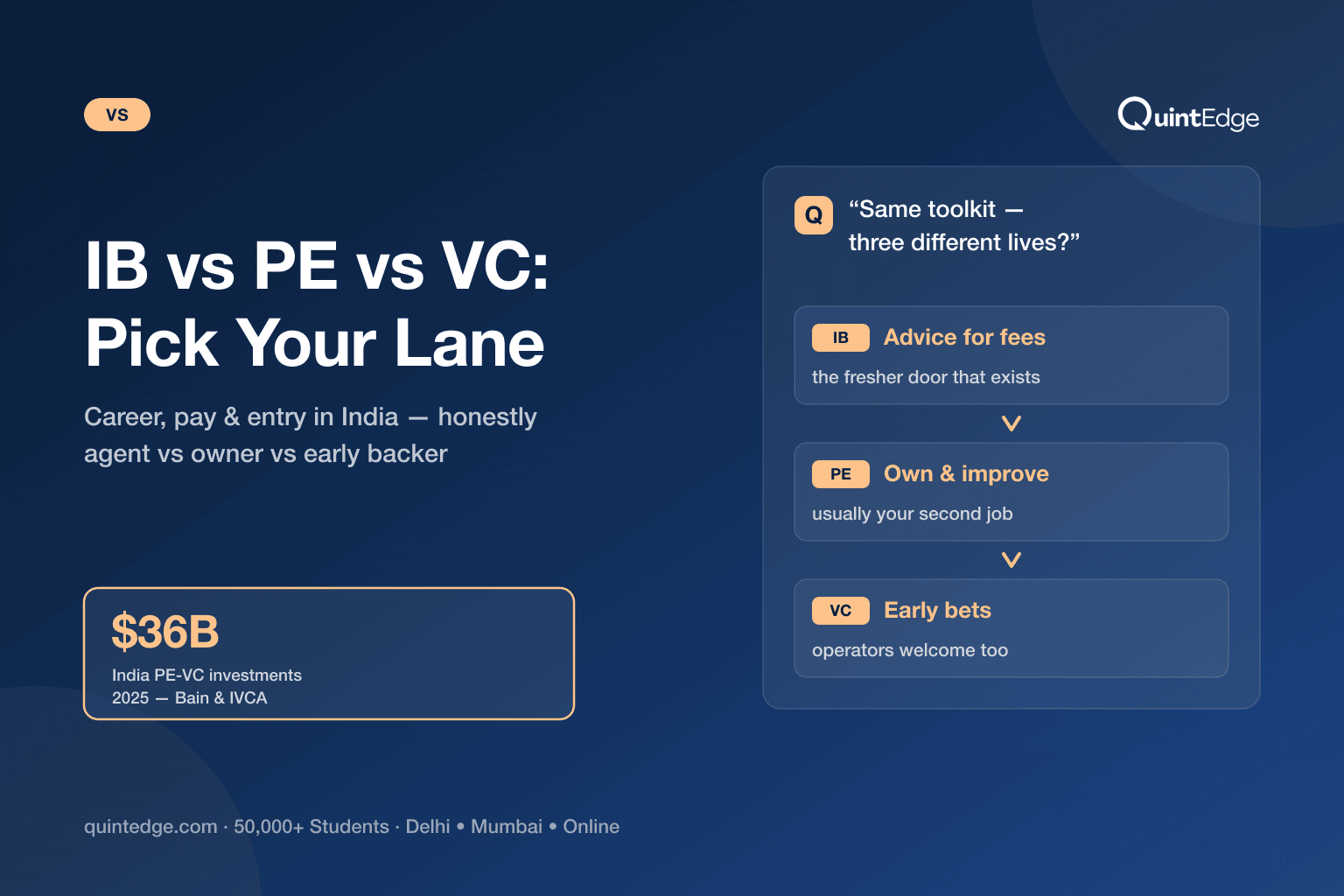
Here is the whole comparison in one line each. Investment banking (IB) is an advice business — banks help companies raise money or buy and sell other companies, and earn a fee for it. Private equity (PE) is an ownership business — funds buy stakes in mature companies, improve them for years, then sell at a profit. Venture capital (VC) is an early-bet business — funds buy small stakes in young startups, expecting most bets to fail and one or two to pay for everything.
Think of one building on one street. The IB analyst is on the broker's team that arranges the building's sale and earns a fee. The PE associate works for the investor who buys it, renovates for five years, and sells higher. The VC analyst funds the young builder next door who might construct a tower — or nothing.
For a fresher, the honest difference is the door. IB hires freshers in real numbers. PE and VC mostly hire people who already did IB, consulting or startup operating work. That single fact should shape your plan more than any salary table.
What Does Each Job Look Like Day to Day?
Job titles hide the real work. All three roles build financial models and read businesses, but they answer different questions. IB asks "what is this company worth to a buyer, and how do we close the deal?" PE asks "should we own this, and how do we make it better?" VC asks "could this tiny company become 100 times bigger?"
| Investment Banking | Private Equity | Venture Capital | |
|---|---|---|---|
| You work for | Clients doing deals (a bank advises; it does not own) | A fund that buys and owns companies | A fund that backs startups early |
| Typical day | Models, valuation, pitch decks, deal paperwork — deadline-driven | Screening targets, due diligence (deep checking of a company before buying), working with owned companies | Meeting founders, market research, investment notes, helping portfolio startups |
| How the firm earns | Fees on each deal closed | A management fee plus carried interest — a share of the profit the fund makes for its investors | Same fee-plus-carry model, at an earlier, riskier stage |
| Success looks like | Deals closed, clients kept | Companies sold for more than they cost | One startup in the portfolio becoming huge |
| Pace | Sprints around live deals; long hours are the norm | Fewer, deeper projects; intense during a buyout | Meeting-heavy; fewer late nights, more judgement calls |
Plain takeaway: IB trains execution speed, PE trains ownership thinking, VC trains pattern-spotting — pick by the question you want to answer all day.
If reading businesses and writing about them is the part you enjoy — without the deal sprints — also look at equity research, the fourth cousin of these three. And if you want the IB day-to-day in detail first, start with what an investment banker actually does.
How Do You Get In as a Fresher?
This is where the three careers stop being equal options. In India, IB has real fresher doors: Big 4 deal-advisory teams (Deloitte, PwC, EY, KPMG — the four largest professional-services firms), boutique advisory firms, and the global banks' back-and-middle-office hubs. PE and VC funds run small teams and mostly hire experienced analysts from those places.
So the standard Indian route into PE is: 2–3 years in IB or Big 4 transaction services first, then a fund. VC is slightly more open — funds also hire from startup operations, product roles and founders' offices, because judging startups needs operating instinct as much as modeling. But "slightly more open" still means a handful of analyst seats per fund per year.
Do not treat that as bad news. It simplifies your decision at 21: the first job is almost always IB-shaped anyway. Build the modeling-and-valuation toolkit, get deal exposure, and keep the PE/VC option alive. Our investment banking after B.Com roadmap maps those first doors, and how to become an investment banker in India covers the full route.
How Much Does Each Pay in India?
Salary comparisons between these three careers are usually fantasy. Public salary data in India is thin for funds, because PE and VC teams are small and senior pay flows through bonuses and carried interest, not base salary. Here is what named sources actually show — with sample sizes, so you can judge how much weight each number deserves.
| Role (India) | Average pay | Range shown | Sample |
|---|---|---|---|
| Investment banker | ₹8.9 lakh a year | entry ≈ ₹6.1 lakh; top 10% reach ₹30 lakh | 51 profiles, updated 26 Mar 2026 |
| Private equity associate | ₹8.1 lakh a year | ₹3–10 lakh band; mid-career profiles report ≈ ₹34 lakh | only 8 profiles — treat as a rough signal |
| Venture capital associate | ₹13.75 lakh a year | — | only 3 profiles — directional at best |
| Equity analyst (for contrast) | ₹4.6 lakh a year | entry ≈ ₹3.9 lakh; top 10% reach ₹20 lakh | 32 profiles, updated 14 Feb 2026 |
Source: PayScale India role pages, checked July 2026. Averages mix all experience levels; "top 10%" is PayScale's 90th-percentile figure.
Plain takeaway: at entry the three pay in the same broad band — the gap opens later, through IB bonuses, PE carry and seniority, not through the fresher offer.
Three honest notes on that table. First, small samples mean fund pay is indicative, not gospel — a boutique VC seat and a global PE seat differ hugely. Second, bank pay stacks bonuses on top of base — see our investment banker salary in India guide for the full stack by firm type. Third, PE carry pays out only when funds exit well — it is wealth, but slow wealth.
What Is the 2026 Market Telling You?
Zoom out before you pick a lane. India's deal market is busy but cautious. PE and VC funds together invested about $36 billion in India in 2025 — down roughly 17% from 2024 — yet the number of deals rose about 10% to around 1,700, per Bain & Company's India Private Equity Report 2026 (published with IVCA, the Indian Venture and Alternate Capital Association). Cheques got smaller; activity did not stop.
For your career maths, that detail matters more than the headline. More deals at smaller sizes means more work for mid-market advisors and analysts — exactly the seats freshers can actually reach. Growth and VC-style investing made up roughly $16 billion of the total, so the startup-funding engine keeps hiring judgement-heavy juniors too.
Who runs those deals? By deal count in CY2025, Big 4 firms led — EY advised 23 M&A deals, KPMG 20 and PwC 18 — while Morgan Stanley topped deal value with 9 deals worth $16.2 billion, per Tracxn's India M&A league table. Fee-per-deal is higher at the top; seats-per-year are more numerous in the middle. Our PE firms in India and VC firms in India lists name the funds behind the cheques.
Which Should You Pick? A 5-Question Test
Answer honestly. Count your A's, B's and C's — the majority wins.
- 1. Which question excites you most? "How do we close this deal?" → A. "How do we make this company better?" → B. "Could this startup be 100×?" → C.
- 2. How do you feel about 70-hour deal weeks at 22? Acceptable price → A. Prefer fewer, deeper projects → B. Prefer meetings and judgement calls → C.
- 3. When do you want your money reward? Yearly bonus → A. Long-term profit share → B. A decade-later jackpot that may not come → C.
- 4. What does your evidence say about your strengths? Fast, accurate execution → A. Digging deep into one business → B. Spotting products and founders early → C.
- 5. How patient is your career plan? Start earning and learning NOW → A. Two-step plan via IB is fine → B. Comfortable with a winding, network-driven path → C.
Mostly A's: aim at IB directly — the doors exist today. Mostly B's: still start in IB or Big 4 deal advisory, but pick deal-heavy teams and plan the PE jump at year 2–3. Mostly C's: consider a startup operating role or a fund internship alongside building the same finance toolkit — VC hires judgement with evidence behind it.
Whichever letter won, the fresher move is identical: learn to build and defend a model. That is the entrance exam all three careers share.
IB vs PE vs VC: Frequently Asked Questions
At entry level the bands overlap — PayScale India (checked July 2026) shows investment bankers averaging ₹8.9 lakh, PE associates ₹8.1 lakh and VC associates ₹13.75 lakh, though the fund samples are tiny. The real gap opens at senior levels: IB pays large yearly bonuses, while PE and VC pay carried interest — a share of fund profits that can dwarf salary but arrives years later.
It is rare. Indian PE teams are small and hire people who already learned deal execution elsewhere — usually 2–3 years in investment banking, Big 4 transaction services or management consulting. A handful of large funds run analyst programmes, but seats are few and competition is national. The reliable plan is IB first, PE at the two-to-three-year mark.
The toolkit overlaps — models, valuation, reading businesses — but the rhythm differs. IB is deadline sprints around live deals with pitch decks and data rooms. PE is fewer, deeper projects: screening targets, due diligence and working with owned companies for years. VC is meeting-heavy: founder calls, market maps and investment notes, with less modeling depth and more judgement.
Carried interest — "carry" — is the fund team's share of the profit it earns for its investors, typically paid after investors get their money back plus a minimum return. Illustrative example: a fund turns ₹100 crore into ₹160 crore; with 20% carry the team keeps roughly ₹12 crore of the ₹60 crore gain. Junior staff usually get little or no carry; it becomes meaningful at senior levels.
None of the three requires a specific degree by rule. In practice, Indian PE and front-office IB seats lean on pedigree — top-MBA or proven deal experience — while boutiques, Big 4 teams and VC funds hire on demonstrated skill: a defended model portfolio, deal or startup exposure, and clear thinking. A CFA charter helps most on the public-markets side, like equity research.
No deal career is recession-proof, but 2025 data is reassuring about activity: India saw about 1,700 PE-VC deals — up 10% by count even as value fell 17% to $36 billion, per Bain's India Private Equity Report 2026. Smaller cheques mean mid-market advisory stays busy. Skills-wise, the modeling-valuation toolkit transfers to corporate finance, credit and strategy roles, which is the real safety net.
Yes — it is the standard route. Funds typically recruit IB analysts with 2–3 years of deal experience, valuing execution skills they no longer need to teach. VC also takes startup operators. Move too early and you lack deal stories; too late and you are priced as a banker. The window most people target is between years two and four.


