
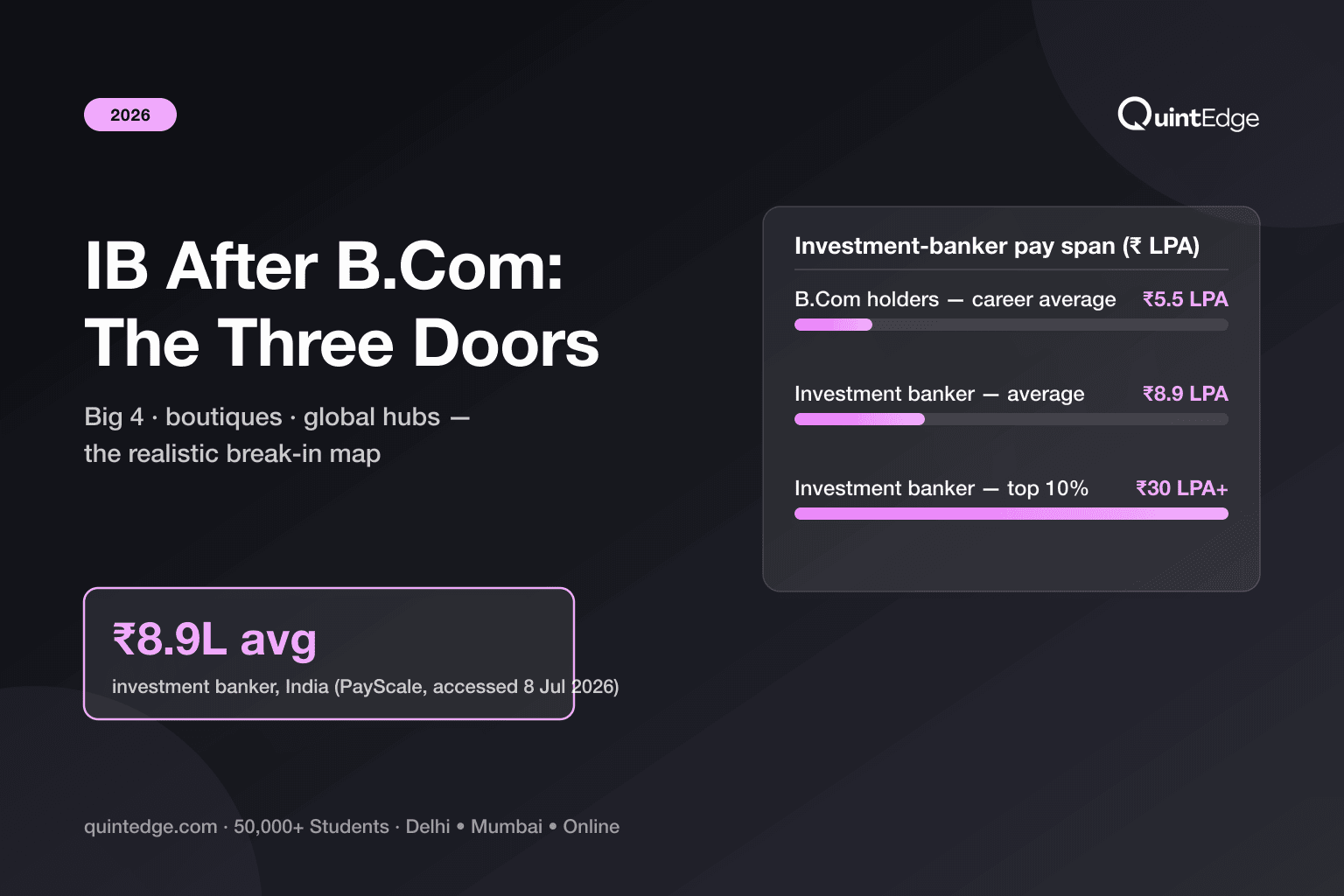
Investment Banking After B.Com at a Glance
Straight answer: yes, a B.Com graduate can get into investment banking — but usually not through the front door you are imagining. Global banks fill most front-office fresher seats from a short list of target campuses. A B.Com from a regular college is rarely on that list — and it does not matter as much as you fear, because three side doors exist.
The three real doors: Big 4 valuations and transaction advisory teams, domestic boutique investment banks, and global banks' India analyst hubs (deal-support desks in cities like Bengaluru and Hyderabad). All three hire on demonstrated skill — and lateral moves from them into front-office seats are a well-worn path.
What decides your entry is not your college. It is whether you can build a financial model under time pressure — most serious IB interviews include exactly that test. Skill is learnable; pedigree is not. That asymmetry is the entire strategy of this roadmap.
The money, honestly: investment bankers in India average ₹8.9 lakh, with entry level near ₹6.1 lakh and the top 10% earning above ₹30 lakh (PayScale, 51 profiles, as of July 2026) — an average that blends boutiques, domestic desks and global banks, with global front-office offers clustered toward the top of the span. Set that against the ₹5.5 lakh that B.Com holders average across entire careers (PayScale) — the gap is why this path is worth a real plan.
Can a B.Com Graduate Get Into Investment Banking?
Yes — through the doors that judge skill instead of stamp. Understand why the filter exists and it stops feeling personal: a bulge-bracket bank receiving fifty thousand fresher applications cannot interview them all, so it buys screening from college brands. That filter measures applicant volume, not your ability.
The side doors work because they screen differently:
- Door 1 — Big 4 valuations & transaction advisory. Deloitte-tier firms run valuation, due-diligence and deal-support practices that hire B.Com graduates with strong accounting and Excel. The work is genuinely deal work — and it is the classic two-year springboard into boutique or mid-market IB.
- Door 2 — domestic boutique investment banks. Smaller advisory firms run lean teams and cannot afford campus-brand hiring. They test you on a model and a case, and give freshers real deal exposure years before a big bank would.
- Door 3 — global banks' India analyst hubs. The big names run large analyst desks in Bengaluru, Hyderabad and Chennai doing comps, pitch materials and deal support for global teams. The badge is real, the training is real; the trade-off is distance from the deal table.
Every door leads somewhere. Two to three years of visible deal work plus a strong model portfolio is the standard lateral route into front-office seats — our 5-step investment banker roadmap maps that longer arc, and our types of investment banks guide explains the bulge-bracket vs boutique vs mid-market landscape these doors sit in.
What Does an Investment Banker Actually Do?
Strip the mystique: investment bankers help companies raise money (selling shares in an IPO, issuing debt) and buy or sell companies (mergers and acquisitions). Think of them as estate agents for companies — they find the buyer, argue the price, run the paperwork marathon, and charge a fee on the deal.
An analyst's actual week is less glamorous and more useful to know. You build financial models (spreadsheets projecting a company's future cash flows), assemble pitch decks (the presentations that win the bank its next deal), and maintain comps (tables comparing similar companies' valuations). Long hours are standard; the learning compounds fast.
Two of our guides go deeper if the day-to-day matters to your decision: investment banking in India explained for the industry map, and what bankers actually do all day for the hour-by-hour reality.
Which Roles Can You Realistically Target After B.Com?
Aim at the seats that exist for your profile, and treat titles as stages, not verdicts. Five role families take B.Com graduates seriously — each with a different mix of pay, exposure and lateral value:
| Role | What you actually do | Why it works for B.Com |
|---|---|---|
| Big 4 valuations / TAS analyst | Value companies, model deals, support due diligence | Hires on accounting depth — a B.Com's home ground |
| Boutique IB analyst | End-to-end deal work on smaller M&A and fundraises | Skill-tested entry; earliest real deal exposure |
| Global-bank hub analyst | Comps, models and pitch materials for global deal teams | Structured training, brand on CV, scale hiring |
| Equity research associate | Analyse listed companies, build forecasts, write notes | Adjacent door; same modeling toolkit, market-facing |
| Corporate finance executive | Fundraising and M&A support inside a company | Slower pace, same skills — a fine staging role |
Plain-language takeaway: "investment banker" is not a day-one title from B.Com — but every row above is a day-one job that trains and pays toward it.
For live hiring targets, our 30 investment banking firms hiring in India list maps the employer landscape door by door.
What Salary Should You Expect?
Anchor on real bands, not LinkedIn folklore. All figures below are PayScale India’s investment-banker dataset (51 profiles, as of July 2026). Base pay spans ₹2–30 lakh from the 10th to the 90th percentile — that is, the middle 80% of profiles — with reported bonuses adding up to ₹6 lakh at the top, and global front-office offers stack base and bonus toward the span’s ceiling. Level-by-level structure lives in our investment banking salary in India guide.
| Seat | What the data shows | Basis |
|---|---|---|
| B.Com holders — career average, all roles | ₹5.5 lakh | PayScale degree data, 2,226 profiles |
| Investment banker — entry level | ₹6.1 lakh average | PayScale India, checked in July 2026 |
| Investment banker — India average | ₹8.9 lakh | PayScale, 51 profiles |
| Investment banker — top 10% earn above | ₹30 lakh | PayScale; global front office clusters here |
Plain-language takeaway: the doors differ less at entry than the folklore says — the spread opens with desk and seniority, the top tenth of the data is where bulge-bracket front office lives, and senior pay is bonus-driven beyond what surveys capture.
Two honest footnotes. Bonuses are variable — a ₹2–30 lakh span means lean years sit near the bottom. And the top band belongs to a small number of seats; treat it as the ladder's shape, not a fresher's promise. The full level-by-level table (Analyst to Managing Director, plus city splits) is in the salary guide.
What Skills Actually Get You Hired?
One test decides most B.Com-route IB interviews: build a model, under time, and defend every number in it. Everything else on your CV buys you the chance to take that test. So the skill list is short, deep and entirely learnable:
- The three-statement model. Linking a company's profit & loss, balance sheet and cash flow so they move together. This is the foundation piece — our three-statement model guide builds one step by step.
- DCF valuation. Estimating what a company is worth from its future cash flows — the single most-tested method; walkthrough in our DCF guide.
- Comparable company analysis. Valuing a company against its listed peers — the analyst's daily bread; see our comps guide.
- Excel fluency and accounting depth. Here is the good news: accounting is the B.Com's genuine edge. You already read statements; you are learning to connect and project them, not decode them.
- Interview articulation. Practise walking through a model aloud. Our 66 IB interview questions and 22 modeling questions cover what actually gets asked.
Where does CFA fit? As an optional signal, not a requirement. Level 1 strengthens screening odds for research-flavoured seats especially — the full math on that route is in our CFA after B.Com guide.
How Do You Break In? The 6-Month Plan
Six focused months is a realistic runway from "B.Com, no network" to "interviewing at all three doors" — if every month produces something a recruiter can see. The plan has three blocks of two months each: learn, build, apply.
Months 1–2 — learn the toolkit properly. Three-statement modeling, DCF and comps, plus Excel speed. Free guides (start with what financial modeling is) cover the concepts; a structured course compresses the months and adds feedback.
Months 3–4 — build proof. Model two or three real listed Indian companies end to end, with written assumptions. Put them in a shareable folder and on your CV — then run the CV through our free resume evaluator. A B.Com with a visible model portfolio beats a B.Com with adjectives.
Months 5–6 — apply like a router, not a lottery player. All three doors in parallel: Big 4 advisory openings, boutique IBs (a three-month internship that converts is a fine outcome — boutiques promote from exactly there), and the global hubs' analyst programmes. Referrals via LinkedIn and alumni outreach to associates and VPs outperform job-portal applications; lead every message with the portfolio, not a request.
Who Should Skip the IB Path?
Skip it with a clear conscience if the trade does not fit. Investment banking pays for intensity — deal deadlines, late nights, weekend fire drills — and the honest move is to price that in before you spend six months aiming at it.
- You want predictable hours and steady rhythm. Corporate finance (FP&A) and credit roles use the same skills at a humane pace — and pay well; our financial modeling salary guide maps those role-wise bands.
- Markets fascinate you more than deals. Equity research and the CFA lane fit better — start with our CFA after B.Com guide.
- It is bulge-bracket front office or nothing for you. Then the realistic instrument is a Tier-1 MBA seat later — our IB course vs MBA comparison prices that route honestly against the skills-first one.
And if you are still surveying every option from B.Com, the wide-angle menu is in our 16 courses after B.Com guide.
Frequently Asked Questions About Investment Banking After B.Com
Yes. The MBA is one route into front-office seats, not the only one. Big 4 valuations teams, boutique investment banks and global banks' India analyst hubs all hire B.Com graduates on demonstrated modeling skill, and lateral moves from those seats into front-office IB are a well-worn two-to-three-year path. The MBA matters most if you specifically want bulge-bracket front office as your first seat.
No — it is a useful signal, not a requirement. IB interviews test hands-on modeling far more than certifications, and many analysts hold none. CFA Level 1 helps most at CV screening and for research-flavoured roles. If you pursue it, treat it as a parallel signal while your modeling portfolio does the heavy lifting.
Yes — via the same three doors, because they screen on skill rather than campus. A tier-3 B.Com with a defended model portfolio and a boutique internship routinely beats a brand-college CV with neither. What does not work from a tier-3 college is waiting for campus placement to deliver an IB seat; the off-campus route is the plan, not the backup.
Fresh aggregate data (PayScale India, 51 profiles, as of July 2026): investment bankers average ₹8.9 lakh, entry level sits near ₹6.1 lakh, and the top 10% earn above ₹30 lakh, with bonuses reported up to ₹6 lakh on top of base. The average blends boutiques, domestic desks and global banks — global front-office analyst offers cluster toward the top of that span, while GCC and support seats start lower.
The work is real — comps, models and pitch materials for live global deals — and the training systems are excellent. What differs is distance from the deal table: client contact and negotiation sit with the onshore team. Treat a GCC analyst seat as a paid, branded apprenticeship: real skills, real badge, and a recognised lateral route onshore or to boutiques after two to three years.
Pick by the work, not the prestige. CA builds an audit, tax and accounting career over four to five-plus years, with signing authority no other credential grants. The IB route builds deal skills in months and pays analyst-level compensation years earlier, at the cost of intensity and less certainty. If you love statements and statutory work, choose CA; if deals and markets pull you, take the skills-first IB route.
Around six months of focused preparation to your first offer at one of the three doors — learn the modeling toolkit, build a two-to-three-company model portfolio, then apply with referrals. A front-office seat at a larger bank typically takes a further two to three years of visible deal work and a lateral move. So: months to be in the industry, a few years to the marquee title.


