
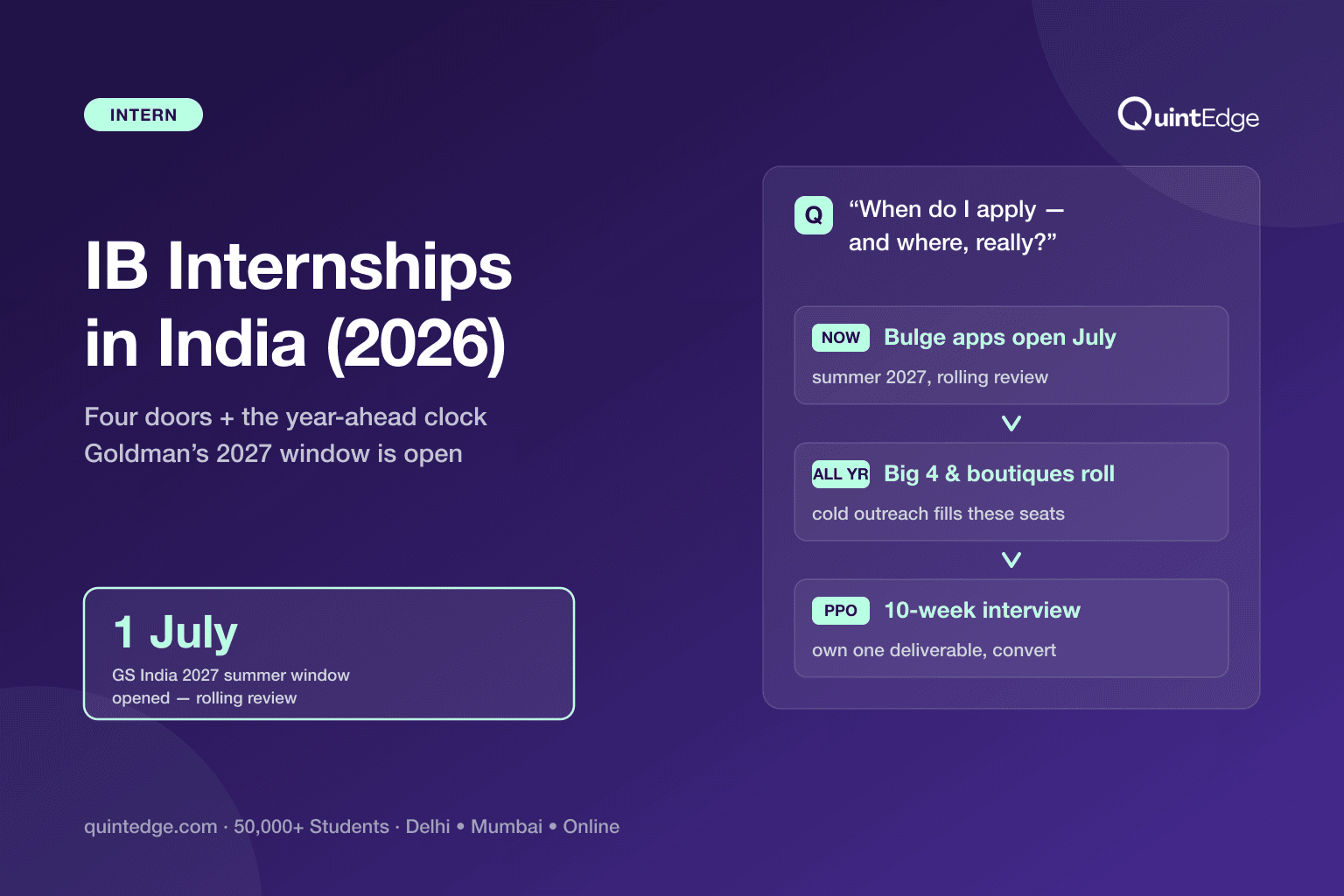
Which IB Internships Actually Exist in India?
Start with the honest map, because "IB internship" covers four very different things in India. The famous one — the summer analyst programme at a global bank — is real but tiny: an 8–10-week paid stint in your second-last college year, hired months in advance. Goldman Sachs opened applications for its India 2027 Summer Analyst Program on 1 July 2026, reviewing on a rolling basis (per its careers site, checked July 2026).
Around that famous door sit three bigger ones. Big 4 and boutique advisory internships (Deloitte, PwC, EY, KPMG deal teams, plus firms like Avendus or Equirus) hire through the year, often off-campus. Global capability centres (GCCs) — the India hubs of global banks — run structured internships in analytics, research and operations. And startup or fund internships teach real analysis with small or no pay.
All four count. What matters is what you can say afterwards: models built, decks touched, numbers owned. This playbook shows where each door is, when it opens, and how to walk through it.
When Should You Apply? The Real Timeline
The single most common internship mistake in India is applying when you want the internship, not when the door opens. Global banks hire summer interns nearly a year in advance. For summer 2027 (May–July), those windows opened in mid-2026 — and rolling review means early applications face less competition for the same seats, so if a bank's careers page still shows its programme open, apply this week.
| Door | When it opens (for summer 2027) | Who can apply |
|---|---|---|
| Goldman Sachs India Summer Analyst | Opened 1 July 2026; rolling review | Students graduating in 2028 (penultimate year); 8–10 weeks |
| J.P. Morgan India summer internship | Applications typically open in the months after mid-year; internship runs ~9–10 weeks, May–July 2027 | Penultimate-year students (graduating 2028) |
| Big 4 deal-advisory internships | Rolling, all year — tied to team workload | Students + freshers; off-campus applications work |
| Boutique IB / fund internships | Rolling, all year — often unadvertised | Anyone who can pass a modeling test; cold outreach required |
| Bank GCC internship programmes | Campus cycles (Aug–Jan) + portal postings | Depends on programme; often final-year students |
Sources: Goldman Sachs careers site (India 2027 Summer Analyst Program page) and J.P. Morgan India internship programme page, both checked July 2026. Big 4/boutique patterns: QuintEdge counsellor guidance from placement experience.
Plain takeaway: bulge doors open a year early and close when filled — everything else is rolling, so a good application month is this month.
One structural note: global banks' India deal teams sit mainly in Mumbai, while their global centres in Bengaluru, Hyderabad and Gurugram host research, analytics and operations internships. Both put a bank's name on your resume; only the first puts live deals on it. Our list of 30 IB companies hiring in India maps which firms run which seats.
How Do You Apply Off-Campus? The Cold-Outreach Playbook
If you are not at a target campus, cold outreach is your application portal. Done as a system, it works — boutiques and Big 4 teams genuinely staff interns from good cold emails, because interns solve a real problem: deal work spikes. Done as random LinkedIn messages, it fails. Here is the system, week by week:
- Week 1 — build the list. Pick 15 target firms (mix boutiques, Big 4 teams, GCC programmes). For each, find two real people: one analyst or associate, one VP or partner. LinkedIn and firm sites give you names; deal announcements give you an opening line.
- Weeks 2–4 — send 8 emails a week. Three short paragraphs: one line on who you are, two lines proving you did homework on their deals, one specific ask ("a 15-minute call" or "any internship need this quarter"). Attach your one-page resume — built per our IB resume guide — and one work sample (a model summary, not a 40-tab file).
- Follow up once, day 4–5. Two lines, same thread. No reply after one follow-up = move on; never send a third.
- Track like an analyst. A simple sheet: firm, person, date sent, follow-up date, reply. Gates: expect roughly 2–4 replies per 25 emails. Below 10% replies after 25 sends, rewrite your email (usually: less about you, more about their deals). Getting replies but no calls? The ask is too big — shrink it.
The work sample is what separates you. A fresher who attaches a one-page summary of a defended DCF on a listed company is no longer "a student asking for a chance" — they are a nearly-trained analyst asking for a desk. If you cannot produce that page yet, build it first: start with our three-statement model guide or take the structured route below.
What Do IB Interns Get Paid in India?
Honest answer: there is no reliable public stipend table, so be suspicious of any site that prints one. Banks do not publish India intern stipends, and self-reported numbers swing wildly. What the official pages do confirm is that global banks' summer analyst programmes are paid, run 8–10 weeks, and treat interns as first-year-analyst trainees.
From our placement-desk experience (QuintEdge counsellor guidance, not published data): global-bank summer stipends in India are strong — broadly in line with a fresh analyst's monthly pay; Big 4 and established boutiques typically pay modest monthly stipends; small boutiques and early-stage funds often pay little or nothing beyond certificates and exposure.
Decide with this rule: pay for your first internship in learning, not money — but never twice. One unpaid stint that yields real modeling work, a strong reference and named deliverables can be worth it. A second unpaid internship doing screenshots and data entry is not. If the work would not produce two strong resume bullets, decline it — see what real analyst work looks like in what an investment banker actually does.
How Do You Convert an Internship Into an Offer?
An internship is a 10-week interview. Banks openly use summer programmes as their main full-time hiring pipe, and boutiques extend offers when an intern makes themselves hard to un-hire. Conversion is not charm; it is a short list of observable behaviours:
- Own something end-to-end. Volunteer for one deliverable — a comps refresh, a weekly tracker, a section of a memo — and make it error-free every single time. Reliability is the analyst currency.
- Zero-defect basics. Formatting, file naming, date checks. Seniors extrapolate: sloppy tab names today, sloppy client deck tomorrow.
- Ask questions in batches, once a day — not twenty pings. Write down answers; never ask the same question twice.
- Pre-close in week 7. Ask your manager directly: "What would you need to see in the next three weeks to recommend me for a seat?" Then do exactly that, visibly.
- Exit loud. Final-day email to the team with what you built, plus a LinkedIn note to each senior. Boutique offers frequently arrive weeks later, when workload spikes and someone remembers the intern who owned the tracker.
If conversion does not come, the internship still worked: you now have deal-adjacent bullets, referees and stories for the next application — which is how most IB careers in India actually compound, and how B.Com students without target-campus tags break in (full route: investment banking after B.Com).
IB Internships in India: Frequently Asked Questions
Now. Goldman Sachs opened its India 2027 Summer Analyst applications on 1 July 2026 with rolling review, and other global banks recruit on similar year-ahead calendars for penultimate-year students. Big 4, boutique and GCC internships hire all year round, so those applications should run in parallel every week rather than waiting for a season.
Yes — through the rolling lane. Bulge summer programmes lean heavily on target campuses, but Big 4 deal teams, boutiques and GCC programmes hire on demonstrated skill: a defended model portfolio, a clean one-page resume and systematic cold outreach. Boutiques in particular staff interns when deal work spikes, whoever is ready that week.
Global banks' summer analyst programmes are paid — the programme pages confirm paid 8–10-week internships, and stipends are strong. Big 4 and established boutiques usually pay modest monthly stipends, while small boutiques and early-stage funds often pay little or nothing. No bank publishes official India stipend tables, so treat any precise figures you see online as unverified.
Once, and only for real work. If the stint gives you live modeling or deal-support work, a named reference and deliverables you can defend in interviews, one unpaid internship can be a fair trade early on. If the work is data entry and screenshots — or if it is your second unpaid stint — decline. The test: will this produce at least two strong, number-backed resume bullets?
Three layers: aptitude and logic tests online; technical basics — accounting links, valuation multiples, a DCF walkthrough; and fit questions on why banking and why that firm. Boutiques often add a small take-home modeling test. Every line on your resume is fair game, so only list work you can discuss for two minutes.
Two well-chosen ones beat four random ones. A sensible arc: a skills-building stint (startup, research or NBFC) in your second year, then a deal-adjacent internship (Big 4, boutique or bank programme) in your penultimate summer. Depth matters more than count — screeners read two internships with strong numbered bullets as far better evidence than four one-line entries.


