
What Makes an IB Resume Different?
An investment banking resume in India is a one-page proof document. It must prove three things fast: you can build financial models, you understand deals and valuation, and every claim you make carries a number. That is the whole game. Screeners are not reading for personality — they are scanning for evidence.
And the scan is brutal. The Ladders' 2018 eye-tracking study measured recruiters' initial resume scan at about 7.4 seconds. Treat your page like a billboard on a highway, not a letter: the reader decides at speed, from layout and the first words of each line.
This guide gives you the exact format (with our free downloadable template), a bullet formula with before/after rewrites, a kill-list of instant rejections, and a testing routine — including our free AI resume evaluator, which scores your PDF out of 100 for core finance roles. Work through it top to bottom and you will finish with a submission-ready page.
The One-Page Format That Works in India
Do not design a resume; copy a format that screeners already know how to read. Banks and Big 4 deal teams see thousands of pages, and anything unusual — columns, colours, photos, skill meters — slows the scan or breaks the software that reads it first (ATS, applicant tracking systems). Boring is a feature.
Here is the layout we recommend — the same one on our template:
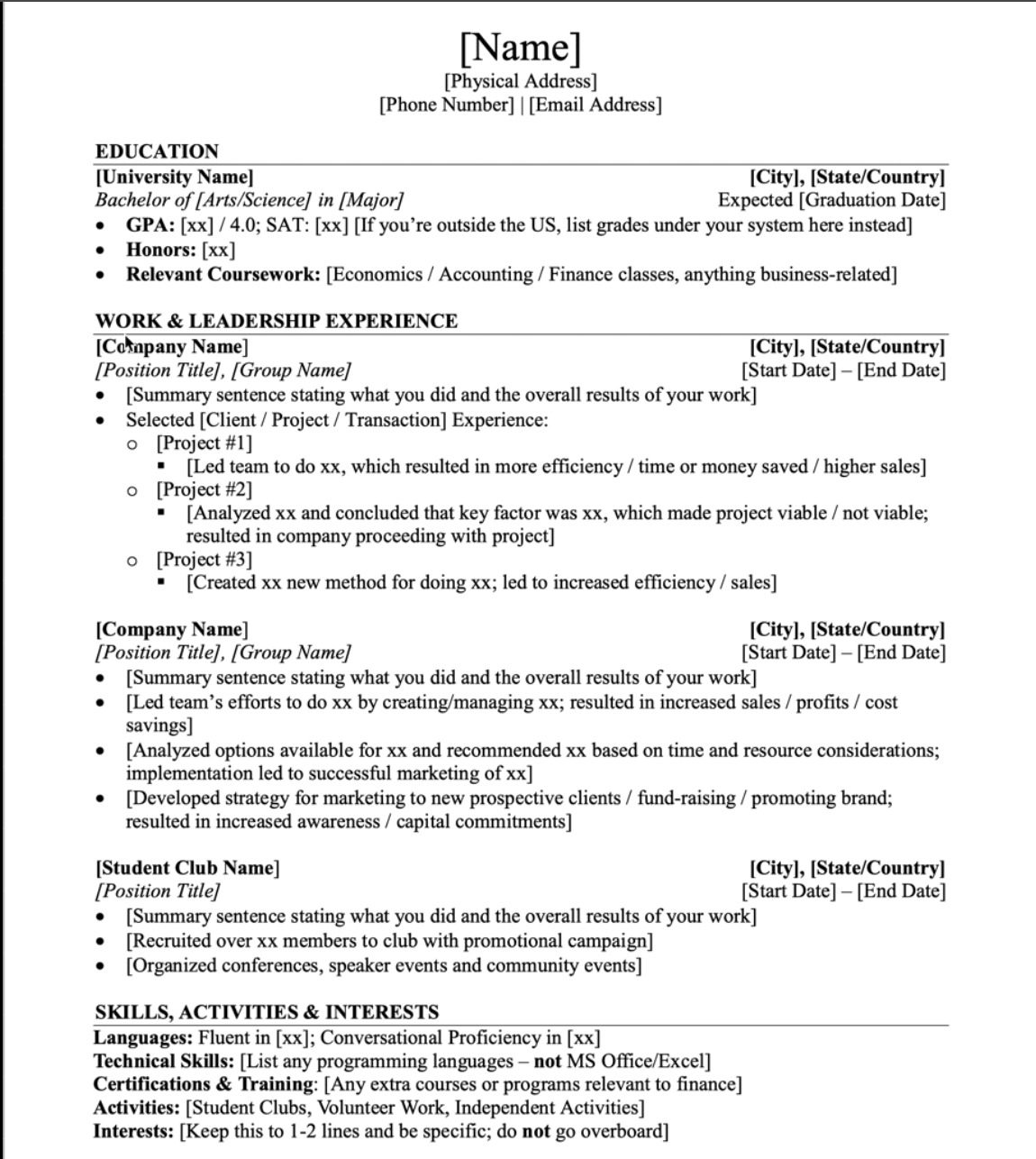
Four format rules to apply as you copy it:
- One page, always. A fresher or 0–3-year candidate with two pages signals poor judgement. Cut activities, never education or deals.
- Standard headers. "Education", "Work & Leadership Experience", "Skills, Activities & Interests". Software and humans both parse these instantly.
- Marks visible. Degree, college, year and percentage/CGPA in one clean line each for Class 10, Class 12 and graduation. Hiding marks reads as hiding something.
- Plain typography. One font, 10–12 pt, black on white, PDF only. Name the file FirstName-LastName-Resume.pdf — screeners search downloads folders by name.
How Do You Write Bullets Screeners Trust?
Bullets are where resumes are won. A screener trusts a bullet when it shows what you did, how, and what changed — in one line, starting with a verb, ending in a number where possible. Use this formula for every line:
Action verb + what you built or did + tool/method + size + measured result
Three honest fresher-level rewrites (illustrative — adapt to your real work, never invent):
| Before (gets skipped) | After (gets read) |
|---|---|
| "Worked on a financial modeling project." | "Built a three-statement model for a listed FMCG company in Excel; DCF implied 12% below market price; defended assumptions in a 10-slide review." |
| "Responsible for data collection during internship." | "Cleaned 3 years of sales data (1,400 rows) in Excel and built a monthly revenue dashboard used in two client reviews." |
| "Member of the college finance club." | "Ran the club's 6-week valuation bootcamp for 40 juniors; wrote the comps workbook they still use." |
Plain takeaway: the "after" bullets are not fancier English — they are the same work with the method and the number put back in.
No live-deal experience yet? Manufacture legitimate evidence: build models on real listed companies and present them as projects with named outputs. Our free guides walk through exactly the projects screeners respect — a three-statement model, a DCF valuation and a comps analysis. Three defended models beat any adjective.
What Goes in Each Section?
Order matters: put your strongest evidence in the top half of the page, because that is where the 7-second scan lives. For most students and freshers that means education first (with marks and coursework), then experience and projects. Here is the section-by-section fill guide:
- Header: name, city, phone, email, LinkedIn. Nothing else — no photo, no date of birth, no "objective" paragraph. The role you want is proven by the page, not announced.
- Education: one line per qualification — degree, college, year, percentage/CGPA. Add a "Relevant coursework" line naming accounting, economics or finance subjects. Pursuing CFA or FRM? State the level and next exam window honestly.
- Experience: internships, articleship, work — newest first. Company, role, city, dates on the header line; two to four formula bullets under each. If a company is small, add a five-word descriptor ("a Jaipur NBFC lender") so the screener can place it.
- Projects: the fresher's weapon. Named models on listed companies, competition entries, a published analysis. Treat each exactly like a job: name, date, bullets with numbers.
- Skills, activities & interests: only testable skills — Excel modeling, PowerPoint, SQL, Python if real. Never write "MS Office" as an achievement. One line of specific interests is fine; "travelling and music" is filler.
Everything on the page must survive one interview question: "Tell me more about this line." If you cannot speak for two minutes on a bullet, cut it — interviewers pick lines at random, and our 66 IB interview questions guide shows how deep they go.
What Gets a Resume Rejected First?
Most IB resumes die on formatting and fluff, not on weak colleges. Screeners reject fastest on signals that say "did not do the homework". Check your page against this kill-list before anything else:
| Kill signal | Why it kills | Fix |
|---|---|---|
| Two pages | Signals you cannot prioritise — the core IB skill | Cut to one page; drop weakest activities first |
| Photo, age, "objective" | Wastes prime scan space; dated format | Delete; let evidence speak |
| Fancy template with columns/graphics | ATS software misreads it; screeners distrust decoration | Single-column, plain text (our template above) |
| No numbers anywhere | Reads as claims, not evidence | Apply the bullet formula; add sizes and results |
| Missing marks | Looks like concealment | List Class 10/12 and degree scores plainly |
| Typos and inconsistent dates | IB is a zero-typo business — decks go to clients | Read aloud once; check every date pair |
| Buzzwords ("go-getter", "team player") | Unverifiable filler | Replace with a bullet that shows the trait |
Plain takeaway: before polishing sentences, remove kill signals — they end the scan before your content is ever read.
How Do You Test Your Resume Before Sending It?
Never send a resume you have not tested. Testing is a 20-minute routine, and it is the step most applicants skip — which is exactly why it works for those who do it. Run all three tests, in order:
- Test 1 — the 30-second read. Hand the page to a friend for 30 seconds, then ask: what did I build, where did I work, what are my marks, what is my strongest number? Four correct answers = pass. Anything missed sits too low or reads too slow — move it up or rewrite it.
- Test 2 — the "tell me more" drill. Pick any three bullets at random and speak on each for two minutes. Stumble = rewrite the bullet honestly or cut it.
- Test 3 — the machine score. Upload your PDF to our free AI resume evaluator. It is built for core finance roles — investment banking, equity research, portfolio management — and returns a 0–100 score with five category breakdowns. Gate: 85+. Below that, fix the weakest category it names and re-run before applying.
Then version-control your applications like an analyst: one master resume, small honest tweaks per role type (deal-advisory vs research), and a simple tracker of where each version went. When interview calls arrive, you must know exactly which page the interviewer is holding.
Resume done? Aim it at live openings next — our IB internships in India playbook covers the application calendar, and the 30 IB companies hiring in India list gives you the target map. Fresher starting from zero instead? Begin with the investment banking after B.Com roadmap.
IB Resume Guide: Frequently Asked Questions
Yes — one page is the standard for students, freshers and anyone under roughly five years of experience. Screeners scan quickly and read prioritisation itself as a skill. If you are fighting for space, cut generic activities and old school achievements before touching education, internships or modeling projects.
Build a projects section and treat it like experience. Model real listed companies — a three-statement model, a DCF valuation and a comps table — and write formula bullets with numbers for each. Screeners at boutiques and Big 4 teams routinely interview freshers on project work alone, because a defended model proves the same skills a deal does.
Yes — list them. Indian finance recruiting still uses academic consistency as a first filter, and omitting marks reads as concealment. One clean line each for Class 10, Class 12 and degree, with board or university named. If one score is weak, let strong projects and internships carry the page rather than hiding the number.
No. Multi-column layouts, icons, colour blocks and skill meters slow human scanning and often break applicant tracking software, which reads resumes as plain text. Banking rewards the boring standard: single column, one font, black on white, exported as PDF. Spend the saved effort on bullet quality — that is what screeners actually read.
Yes, if it is true and precisely worded — "CFA Level 1 candidate, February 2027 window" or "Registered for FRM Part 1, May 2027". Never imply a pass you do not have; credential bodies restrict how candidates may describe themselves, and interviewers check. An honest in-progress line signals commitment without risking your credibility.
You upload your resume as a PDF, DOC or DOCX at quintedge.com/resume-evaluator. The AI evaluates it against core finance roles — investment banking, equity research, portfolio management — and returns an overall score out of 100 plus five category-level scores, so you know exactly what to fix. It is free, and you can request a human expert review afterwards.


