
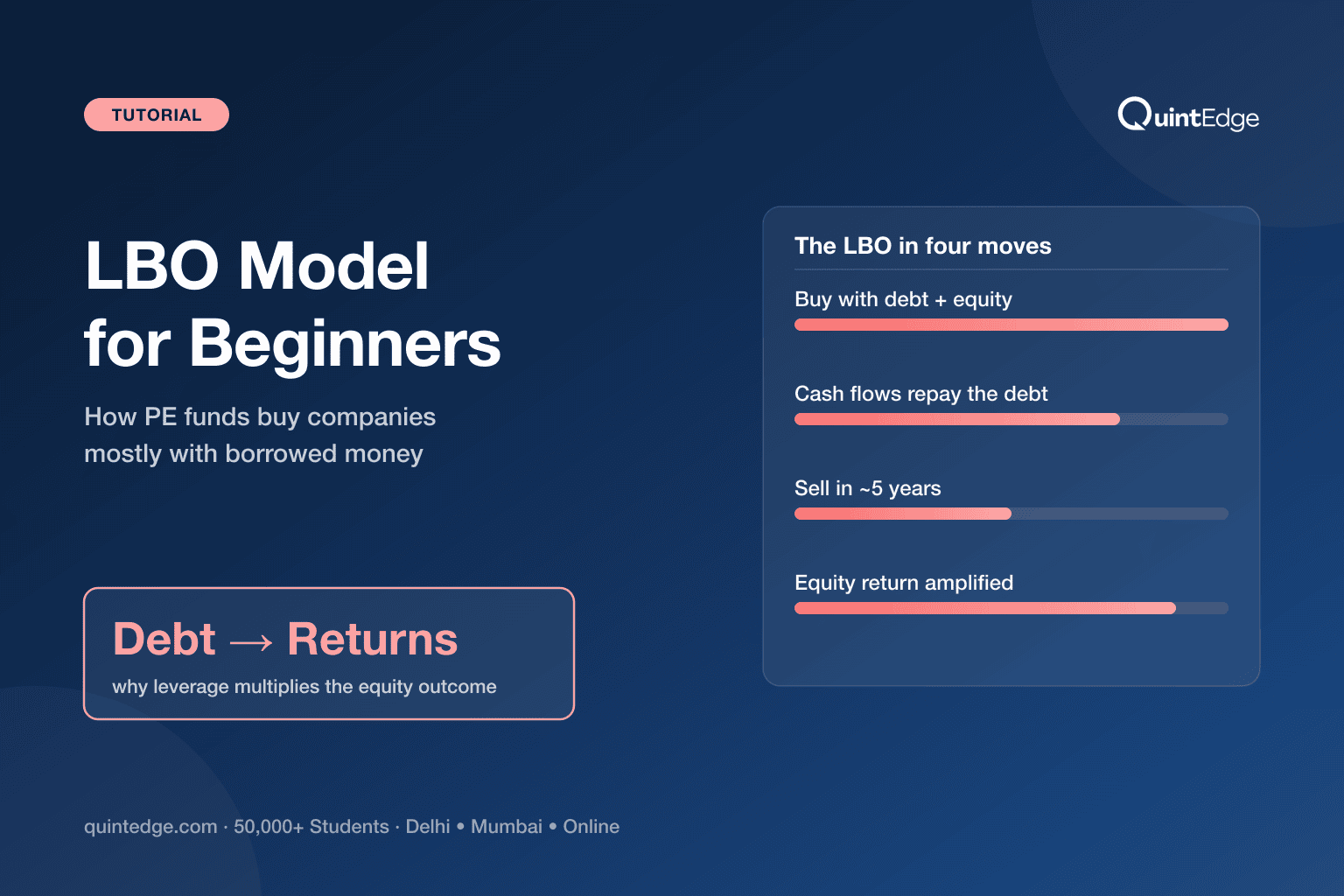
LBO Model at a Glance
A leveraged buyout (LBO) is when a buyer — usually a private equity (PE) fund — purchases a company using mostly borrowed money and only a small slice of its own cash. Think of it like buying a flat with a home loan: you put down 20–40% and the bank funds the rest. An LBO does the same thing, but the "borrower" is a company, and the loan gets repaid using that company's own future cash flows.
An LBO model is the spreadsheet that answers one question for the PE fund: if we buy this company with this much debt, run it for about 5 years, then sell it — what return do we make? That return is measured in two numbers: IRR (internal rate of return — your yearly % return) and MOIC (multiple on invested capital — money you get back divided by money you put in).
LBOs are real and active in India, though 2025 was a quieter year for them — PE investment fell to $19.6 billion, down 33%, per the Bain–IVCA India Private Equity Report 2026. A February 2026 RBI rule change, effective 1 July 2026, now lets Indian banks fund part of these deals for the first time — a shift this guide explains below.
What Is a Leveraged Buyout?
A leveraged buyout is the purchase of a company where debt — not the buyer's own cash — funds most of the price. "Leveraged" simply means "debt-heavy." The buyer puts in a smaller equity cheque, borrows the rest, and the target company's assets and cash flows back that borrowing.
Picture two ways to buy the same ₹100 crore company. In an all-cash purchase, you write a cheque for ₹100 crore from your own funds. In an LBO, you might put in ₹40 crore of your own money and borrow ₹60 crore — the company you just bought then uses its profits to pay off that ₹60 crore loan over the next few years.
This is exactly like a home loan. You do not pay for a ₹1 crore flat with cash. You pay ₹20–30 lakh upfront and borrow the rest from a bank, then repay the loan out of your salary over 15–20 years. In an LBO, the "salary" is the target company's own operating cash flow, and the repayment period is usually 5–7 years, not 15.
Private equity funds are the buyers in almost every LBO, which is why an LBO model is sometimes just called a "PE model." The fund's goal is not to run the company forever — it is to improve it, pay down the debt, and sell it (or list it) a few years later at a higher value.
Why Use So Much Debt?
Debt makes returns bigger when a deal goes well, because the buyer risks less of its own money to capture the same gain in the company's value. This effect is called leverage, and it is the entire reason PE funds structure deals this way instead of paying all-cash.
Here is the plain math. Say a company is worth ₹100 crore today, and in 5 years it will be worth ₹150 crore — a 50% gain in company value either way. Compare two buyers: one pays all-cash, one uses debt.
| Structure | Buyer's own cash | Debt used | Company value in 5 yrs | Debt repaid by then | Buyer's equity value in 5 yrs | Return on buyer's own cash |
|---|---|---|---|---|---|---|
| All-cash purchase | ₹100 cr | ₹0 | ₹150 cr | ₹0 | ₹150 cr | 50% total gain |
| Leveraged buyout | ₹40 cr | ₹60 cr | ₹150 cr | ₹60 cr (paid off) | ₹150 cr − ₹0 debt left = ₹150 cr | 275% total gain |
Plain-language takeaway: both buyers end up owning a company worth ₹150 crore, but the leveraged buyer only risked ₹40 crore of their own cash to get there — so the same ₹50 crore rise in company value turns into a far bigger percentage return on their own money.
The math works both ways, though. If the company's value had fallen to ₹70 crore instead of rising, the all-cash buyer loses 30% of their money. The leveraged buyer, who put in only ₹40 crore against ₹60 crore of debt, could lose most or all of their ₹40 crore — leverage amplifies losses just as it amplifies gains. This is why PE funds only use heavy debt on companies with steady, predictable cash flows that can reliably service a loan.
What Goes Into an LBO Model?
Every LBO model starts with a sources and uses table — a simple two-column list showing where the purchase money comes from ("sources") and where it goes ("uses"). It is the first tab any PE analyst builds, because everything else in the model depends on it.
"Uses" is usually short: the purchase price of the company, plus deal costs like legal and advisory fees. "Sources" is where the structure lives: how much is bank debt, how much is other loans, and how much is the PE fund's own equity cheque. The two columns must add up to the same total — you cannot use more money than you raised.
| Sources (where the money comes from) | ₹ crore | Uses (where the money goes) | ₹ crore |
|---|---|---|---|
| Bank / term loan debt | 600 | Purchase price of the company | 980 |
| PE fund's own equity | 400 | Deal fees & expenses | 20 |
| Total sources | 1,000 | Total uses | 1,000 |
Plain-language takeaway: sources and uses must balance — every rupee spent buying the company and paying deal fees has to be traced back to either a loan or the fund's own cash.
Once sources and uses are set, three more building blocks complete the model: a debt schedule (how the loan gets paid down each year), an operating forecast (revenue, profit and cash flow for the holding period — built the same way as a three-statement model), and an exit calculation (what the company sells for after 5 years, and what that means for the fund's return).
How Do You Build an LBO Model, Step by Step?
An LBO model follows four steps in a fixed order: set the purchase price and funding mix, build the debt schedule, project the exit, then calculate returns. Each step feeds the next, so skipping ahead breaks the model.
Step 1: Purchase Price and Funding Mix
Start with what the company costs and how you will pay for it. The purchase price usually comes from a comparable company analysis or a negotiated multiple of the target's profit. The funding mix — how much debt versus how much equity — is a judgment call based on how stable the company's cash flows are and how much debt lenders will provide.
Step 2: The Debt Schedule
The debt schedule tracks the loan balance every year: opening balance, minus repayments made from the company's free cash flow, plus interest charged on what is still outstanding, equals the closing balance. This is the mechanical heart of an LBO model — the company's own cash, not the PE fund's, pays down the debt year after year.
A simplified 3-year debt paydown, continuing the ₹600 crore loan from the sources-and-uses example above:
| Year | Opening debt | Cash used to repay debt | Closing debt |
|---|---|---|---|
| Year 1 | ₹600 cr | ₹80 cr | ₹520 cr |
| Year 2 | ₹520 cr | ₹90 cr | ₹430 cr |
| Year 3 | ₹430 cr | ₹100 cr | ₹330 cr |
Plain-language takeaway: every rupee the company earns and uses to repay debt is a rupee that will belong entirely to the PE fund's equity at exit — debt paydown is what converts operating performance into shareholder return.
Run that logic to the end of the worked example below — all ₹600 crore repaid by Year 5, company sold for ₹1,500 crore — and the ownership picture flips:
Step 3: Project the Exit
PE funds plan to sell, not hold forever — the typical hold period is around 5 years (5–7 years, per the "advanced" model conventions our DCF model guide and types-of-models reference use). At exit, the model applies a sale multiple — often similar to the purchase multiple, sometimes higher if the company has improved — to the company's projected profit in that final year, to estimate the sale price.
Step 4: Calculate IRR and MOIC
Two numbers tell the PE fund whether the deal was worth doing. MOIC (multiple on invested capital) is the simplest: total cash returned to the fund, divided by cash the fund originally put in. A MOIC of 2.5x means every ₹1 invested came back as ₹2.50. IRR (internal rate of return) converts that same gain into a yearly percentage, accounting for how long the money was tied up — a must-have because a 2.5x return over 3 years is a much better outcome than the same 2.5x over 8 years.
Illustrative Worked Example
The following figures are illustrative — small, round numbers chosen to make the arithmetic easy to follow, not a real transaction.
A PE fund buys a company for ₹1,000 crore. It funds the deal with 60% debt (₹600 crore) and 40% equity (₹400 crore) from the fund. Over the next 5 years, the company uses its cash flow to pay off the entire ₹600 crore of debt. At the end of Year 5, the fund sells the company for ₹1,500 crore.
| Item | Illustrative value |
|---|---|
| Purchase price (Year 0) | ₹1,000 cr |
| Debt used (60%) | ₹600 cr |
| Fund's own equity (40%) | ₹400 cr |
| Exit sale price (end of Year 5) | ₹1,500 cr |
| Debt remaining at exit (fully repaid) | ₹0 |
| Equity value to fund at exit | ₹1,500 cr |
| MOIC (₹1,500 cr ÷ ₹400 cr) | 3.75x |
| Approximate IRR (3.75x over 5 years) | ~30% per year |
Plain-language takeaway: the fund turned a ₹400 crore equity cheque into ₹1,500 crore — a 3.75x MOIC — because debt paydown from the company's own cash flow, not fresh fund money, retired the ₹600 crore loan by exit.
Do LBOs Actually Happen in India?
Yes — India's first major LBO closed in 2000, and PE-backed buyouts continue today, though 2025 was a slower year and a major rule change just arrived. Tata Tea's £271 million acquisition of UK's Tetley in 2000 is widely cited as the first successful leveraged buyout by an Indian company, funded mostly by debt through a UK special-purpose vehicle with roughly £70 million of equity behind it.
More recently, KKR announced a deal in February 2025 to acquire a controlling stake — up to 54% — in Healthcare Global Enterprises (HCG), one of India's largest oncology chains, in a transaction valued at $400 million.
But the broader PE market cooled in 2025. Private equity investment in India fell 33% to $19.6 billion, down from $29.2 billion in 2024, "as global funds pulled back from large buyouts," and overall buyout deal value declined roughly 55% over 2024 and 2025 — led by declines in IT services, real estate and infrastructure, and healthcare (Bain–IVCA India Private Equity Report 2026, published 14 May 2026). Zooming out to the full PE-VC market, Bain's report puts the wider decline at approximately 17% to $36 billion, with deal volumes actually rising about 10% — smaller, more numerous deals rather than a market that stopped completely.
| Metric | 2025 figure | Change |
|---|---|---|
| India PE investment | $19.6 billion | −33% vs 2024's $29.2 bn |
| Overall buyout deal value | — | −55% across 2024–25 |
| Total PE-VC investment (all deal types) | $36 billion | −17% |
| Deal volumes (all deal types) | — | +10% |
Plain-language takeaway: big-ticket LBOs got scarcer in 2025, but the PE industry itself did not shrink by nearly as much — it shifted toward more, smaller deals (Bain–IVCA India Private Equity Report 2026, 14 May 2026).
Here is why a slower 2025 does not mean a shrinking future: RBI changed a rule that had held Indian LBOs back for years. Until now, Indian banks were barred from lending money to fund the purchase of another company's shares — one reason Indian buyouts historically used offshore debt or private credit and carried less leverage than US deals.
That changed on 13 February 2026, when RBI issued final amendment directions permitting Indian commercial banks to fund share-acquisition deals for the first time, with the new framework taking effect 1 July 2026. Two conditions matter most for how future Indian LBOs will look: the acquiring company must fund at least 25% of the deal from its own money (so bank debt can cover at most about 75%), and the acquirer's total debt cannot exceed 3 times its equity after the deal closes.
In plain words: Indian banks can now be a debt source for these deals, where before they legally could not be. That does not mean every future LBO will suddenly be debt-loaded like a US deal — the 25% own-funds floor and 3:1 debt-equity cap are real guardrails — but it opens a domestic lending channel that simply did not exist for this purpose before 1 July 2026.
What Careers Use LBO Models?
LBO modeling is the core skill for a career in private equity, and it shows up in investment banking interviews too. A PE analyst's day-to-day work is building and stress-testing exactly the model this guide just walked through — for real target companies, with real debt terms.
You do not need to be a PE employee to be tested on this. LBO models are increasingly asked about in investment banking interviews at the associate level and above, because banks pitch LBO financing to PE clients and need bankers who understand the buyer's math. Comparable company analysis (the valuation input to Step 1) and the three-statement model (the engine behind the operating forecast in Step 2) are the two prerequisite skills — build those first.
On compensation, we've covered investment banking pay bands in detail in our investment banker salary in India guide — PE compensation follows a similar shape, with a smaller base and a much larger share tied to fund performance (carry) at senior levels.
Frequently Asked Questions About LBO Models
LBO stands for leveraged buyout — the purchase of a company funded mostly by borrowed money rather than the buyer's own cash. "Leveraged" means debt-heavy. The buyer, usually a private equity fund, contributes a smaller equity cheque and repays the debt using the target company's own future cash flows.
There is no fixed rule — it depends on how stable the target's cash flows are and how much lenders are willing to provide. This guide's illustrative example uses 60% debt and 40% equity to keep the arithmetic simple. Indian deals have historically used less leverage than US deals due to tighter acquisition-financing rules, though RBI's rule change effective 1 July 2026 may gradually shift that.
MOIC (multiple on invested capital) is simply money returned divided by money invested — a 3x MOIC means every ₹1 came back as ₹3, with no regard to how long that took. IRR (internal rate of return) turns the same gain into a yearly percentage, factoring in time. A high MOIC earned quickly gives a much higher IRR than the same MOIC earned slowly.
Private equity funds are the buyer in almost every LBO, which is why the LBO model is sometimes called simply a "PE model." The fund's plan from day one is to improve the company, use its cash flow to pay down acquisition debt, and sell or list it again after roughly 5 years for a return.
Yes. Tata Tea's £271 million acquisition of UK's Tetley in 2000 is widely cited as the first successful leveraged buyout by an Indian company, funded mostly by debt through a UK special-purpose vehicle. More recently, KKR announced a deal in February 2025 to acquire a controlling stake in Healthcare Global Enterprises (HCG) valued at $400 million.
Before this change, Indian banks were legally barred from lending money to fund the purchase of another company's shares. RBI's directions, issued 13 February 2026 and effective 1 July 2026, permit this for the first time — subject to the acquirer funding at least 25% from its own money and keeping total debt under 3 times equity. It opens a domestic bank-lending channel that did not previously exist for these deals.
Both. LBO modeling is the core daily skill in private equity, but investment banks pitch acquisition financing to PE clients, so IB interviewers increasingly test LBO concepts at the associate level and above. Learn the three-statement model and comparable company analysis first — they are the direct inputs an LBO model depends on.


