
Which AI Skills Do Finance Professionals Need in 2026?
Six, in a specific order:
- AI literacy and prompt craft — getting reliable work out of tools like ChatGPT, Claude and Copilot
- Modern Excel — Copilot and Python inside the spreadsheet
- Basic Python and data handling — the useful subset, not software engineering
- The verification habit — checking AI output like a reviewer, not a fan
- Regulation literacy — what RBI and SEBI now expect
- Domain depth — underneath everything, because AI raises the value of knowing which answer is wrong
Notice what is not on the list: becoming an AI engineer. Finance employers are not asking analysts to build neural networks. They are asking who can do a day's work in three hours with these tools — and still stand behind every number.
That is a learnable stack. This guide gives you the 30-day version.
What's Actually Changing (With Named Numbers)?
Strip the hype and the dated, sourced picture looks like this.
The skill ground is moving.
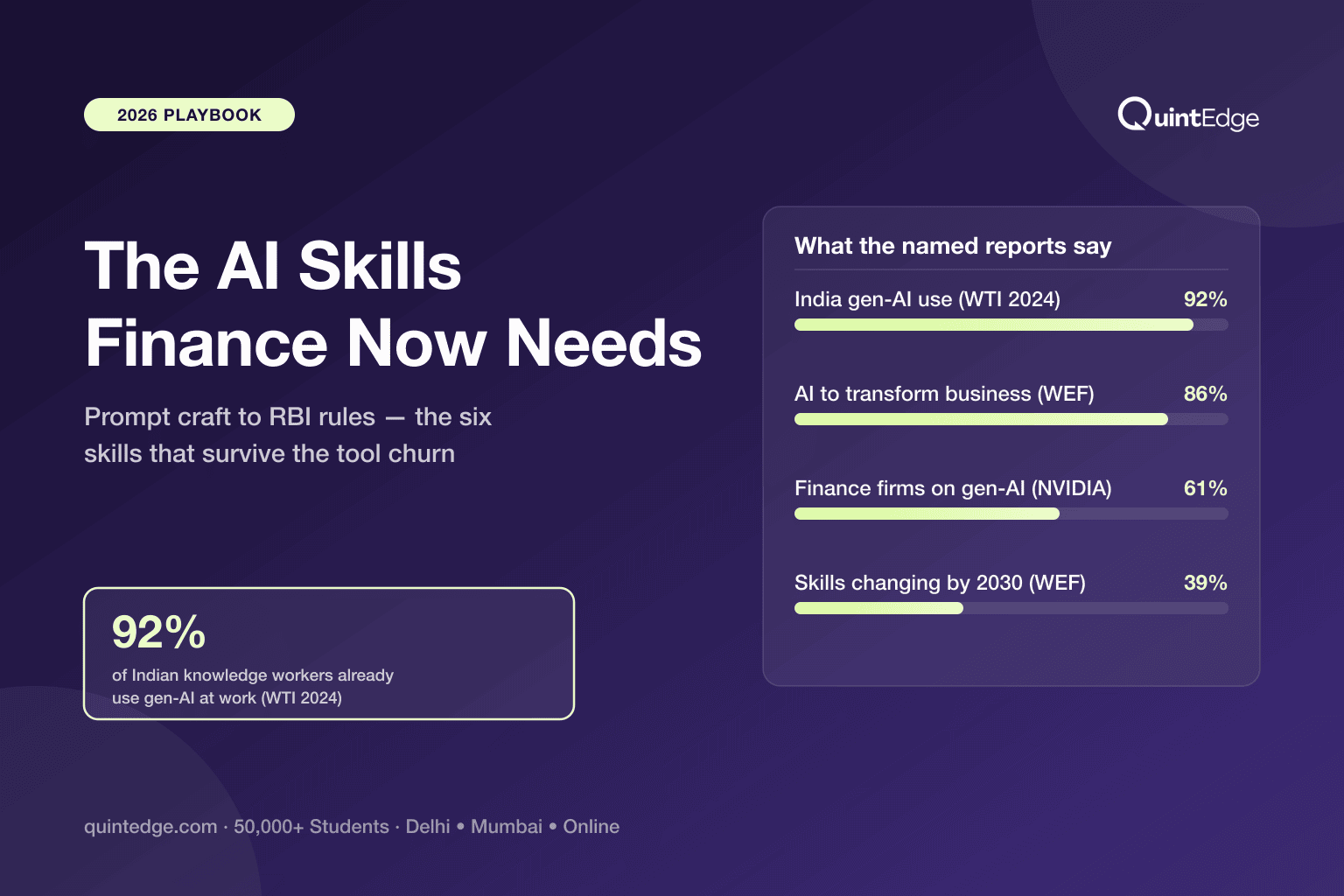
- World Economic Forum, Future of Jobs Report 2025 (Jan 2025): 39% of workers' existing skills will be transformed or outdated by 2030; AI and big data is the fastest-growing skill; 86% of employers expect AI to transform their business
- LinkedIn Work Change Report (Jan 2025): by 2030, 70% of the skills used in most jobs will change
- LinkedIn Skills on the Rise: AI literacy ranked #1 globally and in India for 2025; the 2026 India list is led by prompt engineering, workflow automation and LLMOps
India is not lagging — it is ahead on usage. From the Microsoft–LinkedIn Work Trend Index 2024:
- 92% of Indian knowledge workers already use generative AI at work, versus 75% globally
- 75% of Indian leaders say they would not hire someone without AI skills
- 80% would prefer a less-experienced candidate with AI skills over a more-experienced one without
Read that last pair twice if you are early-career. It is your arbitrage.
Finance firms specifically are committed.
- NVIDIA's State of AI in Financial Services 2026 survey (Jan 2026, 800+ professionals): 61% of financial firms are using or assessing generative AI; 42% the same for AI agents (21% already deployed); 89% say AI is helping revenue or costs
- JPMorganChase's internal LLM Suite went from zero to 200,000 employees in eight months
- Morgan Stanley's AskResearchGPT answers from 70,000+ research reports in about a tenth of the old time
- BBVA signed in Dec 2025 to roll ChatGPT Enterprise to all ~120,000 staff, after pilots showed roughly 3 hours saved a week
- In India: HDFC Bank disclosed its in-house generative-AI platform "Neev" — service, lending, operations — in its FY2025-26 annual report
The Indian talent math favours the prepared.
- Deloitte–NASSCOM (Aug 2024): India's AI talent demand grows from ~600,000–650,000 to 1.25 million+ by 2027
- EY India (Jan 2025): generative AI will touch 38 million Indian jobs by 2030 — 24% of tasks fully automatable, another 42% augmentable, freeing 8–10 hours a week for knowledge workers
Whether those hours become your leverage or your replacement depends on the six skills below. (For the role-by-role safety analysis, read will AI replace finance jobs?)
Skill 1 — AI Literacy and Prompt Craft
AI literacy means knowing three things about a large language model: what it is good at (drafting, summarising, transforming, explaining), where it fails (arithmetic at scale, fresh facts, anything it can hallucinate), and how to brief it.
LinkedIn's 2026 India list ranks prompt engineering among the fastest-rising skills for a reason. The gap between a lazy prompt and a professional one is the gap between an intern's output and an associate's.
The pattern that works for finance tasks — role, context, task, format, checks:
Weak: "Summarise this annual report."
Strong: "You are a credit analyst. From the attached annual report, extract revenue, EBITDA, total debt and cash for FY24–FY26 into a table, then flag the three biggest year-on-year changes with the management commentary that explains each. If a number is not in the document, say 'not found' — do not estimate."
That last sentence — the anti-hallucination instruction — is the single highest-value habit in this post. Practise on real documents: an annual report, a rating rationale, a concall transcript.
Skill 2 — Modern Excel: Copilot, Python, Agents
Excel is still finance's operating system; it just grew new organs:
- Copilot in Excel — natural-language analysis, formula generation, pattern spotting; generally available since 16 Sep 2024 (Microsoft 365 Copilot Wave 2)
- Python in Excel — pandas-grade analysis inside the grid, running in Microsoft's cloud, no local install; GA the same day
- Agent Mode (announced Sep 2025) — Copilot that plans multi-step spreadsheet work, executes, checks itself and iterates
- =COPILOT() — a function that calls an AI model straight from a cell formula (needs a qualifying Copilot licence, like Agent Mode)
What to actually practise: rebuild one recurring workbook with Copilot end-to-end — data in, ratios, variance commentary out. Note where it shines (drafting, formatting, explanation) versus where you must step in (assumptions, edge cases, anything unusual).
Classic keyboard-first discipline still matters underneath: deal-desk Excel is the base layer these tools sit on.
Skill 3 — Python and Data Handling (the Useful Amount)
You do not need to become a developer. You need the working subset:
- Read a CSV and clean it with pandas
- Join two datasets
- Chart a trend
- Automate the report you currently assemble by hand every Monday
That subset is weeks of practice, not years. And it is precisely the layer AI assistants make easier to learn — they write the first draft of the code while you supply the intent and the checks.
In banking specifically, Python is where the modeling ecosystem has moved — the tooling shift is mapped honestly in Python vs SAS for credit risk. Pair the language with data literacy: why a mean misleads, what a percentile is, when a sample is too small to trust. The same instincts make you a sceptical reader of AI output.
Skill 4 — The Verification Habit
Microsoft's 2026 Work Trend Index found 86% of AI users treat AI output as a starting point rather than a final answer. In finance that is not a preference; it is survival. Language models produce fluent, confident, occasionally wrong numbers — and fluency makes the wrongness harder to spot.
The professional's checklist, every time:
- Trace — can every number be traced to a source document or cell?
- Recompute — spot-check the arithmetic on the two or three numbers that drive the conclusion
- Stress — ask the model to argue against its own answer (genuinely useful)
- Own — never forward AI output you could not defend line-by-line if your name were on it. Because it is.
Treat AI like a brilliant, tireless junior with no professional liability: everything it drafts, someone accountable must review. That someone is you — and being good at it is a promotable skill. Ask any model validation team.
Skill 5 — Regulation Literacy: What RBI and SEBI Now Expect
India's regulators moved from watching to writing. Knowing this landscape is now interview material for any bank-side role.
RBI — two documents to know:
- The FREE-AI report (committee constituted Dec 2024 under Prof. Pushpak Bhattacharyya of IIT Bombay; report delivered 13 Aug 2025): seven "sutras" — trust as the foundation, people first, accountability, understandability among them — plus 26 recommendations, including an AI innovation sandbox and incident-reporting for AI failures
- The model-risk draft (24 Jun 2026): draft Guidance on Regulatory Principles for Model Risk Management — AI, ML and statistical models across banks and NBFCs; board-approved frameworks, model inventories, risk-based tiering. It is still a draft (comments were open to 24 Jul 2026), but it tells you exactly where bank AI governance is heading — and which jobs it creates
SEBI — one principle to remember:
- Since Feb 2025, Regulation 16C makes any regulated entity using AI — its own or a vendor's — solely responsible for the output's integrity, data security and compliance
- A June 2025 consultation paper proposed fuller guidelines (senior-management accountability, model testing, client disclosure); as of mid-2026 those remain proposals
The direction is unambiguous: "the AI said so" will never be a defence in Indian finance.
For you, regulation literacy means three things. Know these documents exist. Know the accountability principle they share. And if you work near models, understand why validation, documentation and audit trails are becoming hiring themes.
Skill 6 — Domain Depth (the Skill AI Multiplies)
Every skill above is a multiplier on this one. An analyst who deeply understands how a model works, why an assumption is aggressive, or what a loan condition means gets 10× leverage from AI — they can direct it precisely and catch its errors instantly. An analyst without that depth gets speed without safety: wrong answers, faster.
This is why "AI will replace juniors" is half-wrong. It replaces junior output, not junior learning — but only for juniors who use the freed hours to build judgment.
Spend your EY-estimated 8–10 reclaimed weekly hours on the parts of the craft AI cannot do: sitting in the review meeting, defending a number, understanding the business behind the spreadsheet.
The Tools Worth Learning First (July 2026)
| Tool | What it does for finance work | Access reality |
|---|---|---|
| Copilot in Excel | Natural-language analysis, formulas, Python integration inside the grid | Needs a Microsoft 365 Copilot licence — GA since Sep 2024 |
| ChatGPT / Claude / Gemini | Drafting, summarising documents, explaining concepts, first-cut code | Free tiers are enough to build the skill; firms increasingly provide enterprise versions (BBVA runs ChatGPT Enterprise firm-wide; Anthropic launched Claude for Financial Services in Jul 2025 and a Claude-for-Excel beta in Oct 2025) |
| Python (pandas) | Data cleaning, joins, automation, analysis at sizes Excel dislikes | Free; AI assistants now draft the code while you supply intent and checks |
| Power BI | Dashboards the CFO's office actually asks for; pairs with Excel skills | Free desktop version to learn on |
| NotebookLM-style document tools | Interrogating long filings, transcripts and rulebooks with citations | Free tiers exist; verify citations by habit (Skill 4) |
Plain takeaway: one grid tool (Excel+Copilot), one general assistant used professionally, one data skill (Python), one presentation layer (Power BI) — mastered shallow-to-deep in that order — covers 90% of what 2026 job postings mean by "AI skills".
The 30-Day AI Upskilling Plan
One hour a day, real artefacts only — no course-collecting. Each week has a gate; do not advance without passing it.
| Week | Daily hour | Gate before moving on |
|---|---|---|
| 1 — Prompt craft | Run 5 real work tasks/day through an assistant using the role-context-task-format-checks pattern; keep a prompt journal of what worked | You can turn a 40-page annual report into a verified one-page brief in under 30 minutes |
| 2 — Modern Excel | Rebuild one recurring workbook with Copilot (or practise equivalent flows free: AI-drafted formulas pasted and verified) | The rebuilt workbook matches your manual version to the rupee — and you found at least one AI error on the way |
| 3 — Python basics | Daily 20-line scripts on real CSVs: load, clean, join, chart; let AI draft, you verify line-by-line | You automate one report you previously assembled by hand, end to end |
| 4 — Judgment layer | Verification drills: give the assistant flawed inputs and catch the confident nonsense; read the RBI FREE-AI summary and SEBI 16C once each | You can name, from your own drills, three failure modes you caught — and explain the accountability principle in one sentence |
Fall-behind rule: if a week slips, repeat it — the gates compound, and Week 4 without Week 1 produces exactly the confident-nonsense professional the market is learning to filter out.
AI Skills for Finance: Frequently Asked Questions
A working subset of Python helps enormously — reading CSVs, pandas cleaning, simple automation — but full software engineering is unnecessary for most finance roles. The priority order: prompt craft and verification first (usable this week), modern Excel second, Python third. AI assistants now draft code for you, which lowers the bar further. Your job is supplying intent and checking output, not memorising syntax.
Be sceptical of certificate-first thinking here — AI tooling changes faster than syllabi, and employers screen for demonstrated use, not badges. A portfolio beats a certificate: an automated report, a Copilot-rebuilt workbook, a prompt journal. If you want structured credentials anyway, GARP's Risk & AI certificate exists for risk professionals, and CFA Institute has added Python practical-skills modules — see best finance certifications 2026.
No honest database isolates an "AI-skills premium" for Indian finance roles yet — distrust precise claims. The named evidence: 75% of Indian leaders told the 2024 Work Trend Index they would not hire without AI skills; 80% would prefer a less-experienced candidate who has them. That is a hiring filter today, compounding into pay. The mechanism is mapped in the highest-paying finance jobs.
The trend is "yes, through approved channels": JPMorganChase's internal LLM Suite reached 200,000 employees, BBVA is rolling ChatGPT Enterprise firm-wide, and HDFC Bank built its own platform, Neev. The rule that never varies: client and company data goes only into firm-approved tools. Under SEBI's Regulation 16C a human ultimately stays responsible for AI output — unofficial tool use with real data is a career risk, not a shortcut.
Writing instructions to an AI the way a good manager briefs a junior: who to be ("you are a credit analyst"), what context matters, exactly what to produce (a table with these columns), and what to do when unsure ("say 'not found', never estimate"). LinkedIn's 2026 India list ranks it among the fastest-rising skills — not because it is deep computer science, but because most people brief AI badly.
Fastest change where work is document- and draft-heavy: reporting, reconciliation, first-cut research, deck production. Slowest where accountability is the product: credit committees, risk sign-off, client advisory — anything a regulator holds a named human responsible for. EY India's estimate (24% of tasks automatable, 42% augmentable) describes tasks, not jobs. The role-by-role map is in will AI replace finance jobs?


