
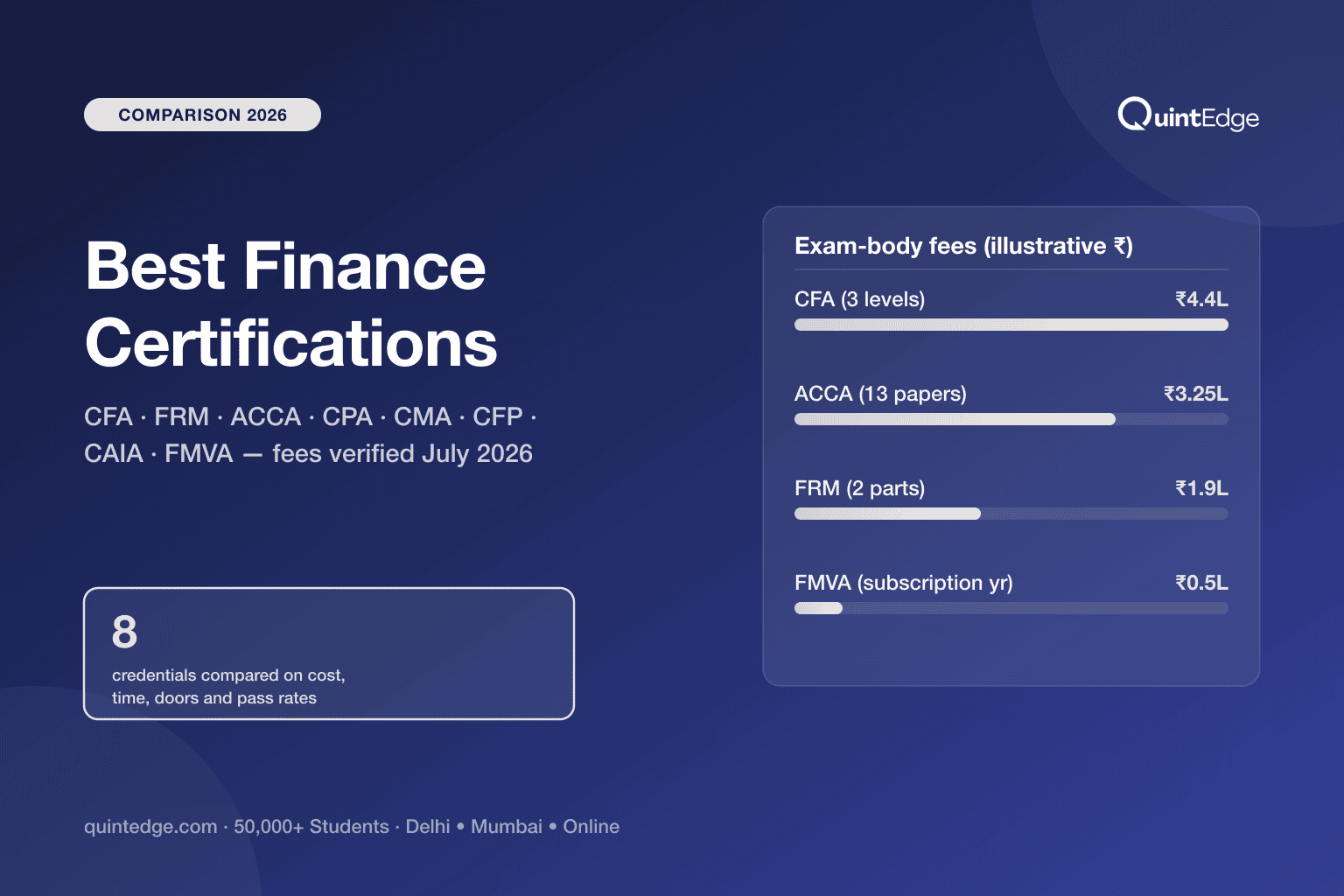
Which Finance Certification Is Best in 2026?
There is no single best finance certification — there is a best one per goal:
- Investment and research careers → CFA
- Risk careers → FRM
- Global accounting → ACCA
- US-market accounting → CPA · management accounting → CMA
- Personal financial advice → CFP · alternative investments → CAIA
- Fast, job-ready modeling skills → a course credential like the FMVA, or a mentored financial modeling programme
This is the full comparison — every fee verified on the certifying body's own site (checked between July and October 2026), every pass rate from official announcements, and every "who should pick it" verdict written to be argued with. Rupee conversions use ≈₹95.5 per US dollar and ≈₹128 per pound — indicative mid-July 2026 rates, labelled illustrative.
| Your goal | Best fit | Exam-fee cost (illustrative ₹) | Realistic timeline |
|---|---|---|---|
| Equity research, portfolio management, buy-side | CFA | ≈₹3.4–4.4L | 2.5–4 years |
| Bank / fund risk management | FRM | ≈₹1.5–1.9L | 1–2 years |
| Global accounting, Big 4, international mobility | ACCA | ≈₹3–3.5L | 3–4 years |
| US-market accounting & audit | US CPA | ₹1.8L+ intl fees alone | 1–2 years |
| Management accounting, FP&A, GCC finance roles | US CMA | ≈₹1–1.6L | 1–2 years |
| Personal financial planning / wealth advice | CFP | ≈₹1.3–1.5L | 1–2 years |
| Alternatives: PE, hedge funds, private credit | CAIA | ≈₹2.3–3.1L | 1–1.5 years |
| Job-ready modeling skills, fastest | FMVA / FM course | ≈₹0.5L (FMVA, 1-yr sub) | 3–6 months |
Plain takeaway: pick the destination first, then the credential — every row above is the best answer to a different question.
The Five Axes That Actually Matter
Rankings that shout "#1 certification!" skip the thinking. Compare any two credentials on five axes and the right one usually declares itself:
1. Career doors. Which desks interview for it by name? A CFA on a resume speaks to fund houses; an FRM to risk offices; an ACCA to global accounting teams. A credential that opens the wrong doors brilliantly is still the wrong credential.
2. Total cost. Exam fees are only the start — add materials, coaching if you choose it, retakes (multiply by realistic pass rates), and annual fees. We show exam-body fees below; coaching is a separate, personal decision.
3. Time and structure. Three levels over three years suits some lives; two parts in one year suits others. Working professionals should weight this axis double.
4. Difficulty as pass rates show it. Official recent numbers: CFA Level 1 passed 43% in August 2026 (CFA Institute); FRM Part 1 47% and Part 2 50% in Nov 2025 (GARP); ACCA's June 2026 paper rates ranged 39–55% (ACCA). Low pass rates mean retake risk — budget for it in both money and morale.
5. India recognition vs global portability. Some credentials price you for Indian employers, some for global ones, a few for both. Match to where you actually plan to work in five years.
CFA — the Investment Credential
Three levels on investment analysis, portfolio management and ethics, run by CFA Institute. It is the default filter for research and buy-side roles worldwide. Details in plain words: what CFA is.
Fees (official, effective for exams from Feb 2026): Levels 1 and 2 cost US$1,140 early / US$1,490 standard each; Level 3 US$1,240 / US$1,590. There is no enrollment fee — CFA Institute eliminated the one-time US$350 charge from 29 April 2025. All three levels: CFA Institute's own stated range is US$3,520–4,570 (≈₹3.4–4.4 lakh, illustrative).
Structure and windows: Level 1 runs four times a year (Feb/May/Aug/Nov), Level 2 three times (May/Aug/Nov), Level 3 twice (Feb/Aug) — live dates on the CFA exam-dates hub. Plan around 300 hours per level (CFA Institute's own guidance).
Latest official pass rates: Level 1 — 43% in Aug 2026 (49% for first-timers); Level 2 — 45% in Aug 2026; Level 3 — 50% in Feb 2026. All from CFA Institute's results announcements.
Eligibility: a bachelor's degree, or being within 23 months of finishing one, or 4,000 hours of work/education over 3+ years — any discipline. Routes: after B.Com, after CA, without a finance background.
Pick CFA if markets and investing genuinely pull you and you can commit multi-year exam cycles. Skip it if you need employable skills this year — read FM vs CFA for that honest sequencing call.
FRM — the Risk Credential
Two parts on market, credit and operational risk, run by GARP. It is the recognised badge for bank and fund risk desks. Primer: what FRM is.
Fees (official): one-time US$400 enrollment + US$600 early / US$800 standard per part. Both parts early ≈ US$1,600 (≈₹1.5 lakh); both standard ≈ US$2,000 (≈₹1.9 lakh). The full ₹ anatomy is in FRM's total cost in India.
Structure and windows: both parts offered in May, August and November — live deadlines on the FRM exam-dates hub. No education prerequisite at all: students and engineers register freely. You get four years after passing Part 1 to clear Part 2, and certification needs two years of relevant experience (submittable within 10 years).
Latest official pass rates: Part 1 — 47%, Part 2 — 50% (Nov 2025, GARP). GARP's own survey says candidates average about 240 study hours.
Pick FRM if risk work attracts you — it is faster and cheaper than CFA and quant-friendlier. Engineers: FRM for engineers. Weighing it against actuarial science? FRM vs actuary.
ACCA — the Global Accounting Qualification
Thirteen papers from fundamentals to strategic level, run by ACCA (UK), leading to audit, reporting and finance roles at the Big 4 and multinationals across 180+ markets. Primer: ACCA course details.
Fees (official ACCA India price list):
- Initial registration £30 (reduced from £89 on the India list); annual subscription £140 (2026)
- December 2026 session: £151 per Applied Skills paper (PM, TX, FR, AA, FM); £268 for SBL; £191 each for SBR and the two options papers
- The three Applied Knowledge papers and LW are on-demand exams: ACCA sets the fee, and the licensed CBE centre may add a capped margin
- From-scratch exam-path total: roughly ≈₹3–3.5 lakh illustrative at ≈₹128/£ — B.Com and CA holders cut this meaningfully via exemptions
Full breakdown: ACCA cost in India.
Structure and pace: 3 Applied Knowledge + 6 Applied Skills + 4 Strategic Professional papers, plus an ethics module and 36 months of experience with 9 performance objectives (the PER guide). ACCA's own guidance: 3–4 years typical. Knowledge and Skills passes never expire; Strategic Professional papers must be finished within 7 years of your first SP pass. Live sessions: ACCA exam dates.
Latest official pass rates (June 2026, global): PM 41%, TX 55%, FR 52%, AA 47%, FM 48%, SBL 51%, SBR 47% (ACCA pass rates).
Pick ACCA if you want a global accounting career and possibly an early start — it is the one credential here you can begin right after 12th (how). Weighing the Indian CA instead: ACCA vs CA; the MBA question: ACCA vs MBA.
US CPA — the American Accounting License
The US accounting license — four exam sections under the 2024 "CPA Evolution" model: three cores (AUD, FAR, REG) plus one discipline of your choice (BAR, ISC or TCP), each a four-hour exam. Primer: CPA course details.
India logistics (official NASBA): you can test in India — eight Prometric cities, with continuous testing since 1 January 2021. International candidates pay a US$460-per-section administration fee for India on top of state-board exam fees (which vary by jurisdiction — no honest single national figure exists). That is ₹1.75 lakh+ in international fees alone before domestic fees and evaluation costs.
Eligibility and rules: 120 US-equivalent credit hours to sit (150 for the license, board-dependent) — Indian graduates usually need a credentials evaluation, and B.Com alone often falls short without add-ons. Once you pass your first section, most boards give a rolling 30-month window to finish the rest (NASBA's 2023 rule change).
Pick CPA if you target US-market accounting — Big 4 GCC teams in India hire for it aggressively. Salary picture: CPA salaries in India.
US CMA — the Management Accounting Sprint
Two parts on planning, analytics and strategic financial management, run by IMA — the fastest serious accounting credential. Primer: US CMA course details.
Fees (official IMA): professionals pay a US$300 entrance fee + US$545 per part + US$295 annual membership (≈US$1,685 ≈ ₹1.6 lakh); students pay US$225 + US$407 per part + US$49 membership (≈US$1,088 ≈ ₹1 lakh). Note these are the current 2026 fees — older blogs still quote lower ones.
Structure and rules: two 4-hour exams (100 MCQs + two essays each), offered in Jan/Feb, May/Jun and Sep/Oct windows at Prometric. You must finish both parts within 3 years of entering the program, and certification needs two years of relevant experience (within 7 years of passing). Many candidates clear both parts inside a year.
Pick CMA if you want FP&A and management-accounting roles — especially at the US-multinational GCCs across India — with the shortest credible exam path. Comparison: US CMA vs Indian CMA.
The Specialists: CFP, CAIA and FMVA
CFP (Certified Financial Planner) — the global standard for personal financial advice, run in India by FPSB.
- Path: three specialist certifications (investment planning; retirement & tax; risk & estate), then the integrated CFP exam — four exams total
- Official India fees: ₹18,000 registration; ₹8,000 per specialist exam; ₹25,000 for the final assessment-plus-exam bundle — ≈₹1.3–1.5 lakh all-in with materials (FPSB India fee annexure; exam fees effective 1 Jun 2025)
- Experience: 3 years, or 1 supervised
- Pick it for: wealth management and advisory careers — India had 3,534+ CFP professionals per the FPSB page, a genuinely under-supplied niche
CAIA (Chartered Alternative Investment Analyst) — two levels on alternatives (PE, hedge funds, real assets, private credit), offered each March and September.
- Official fees: US$400 one-time enrollment + US$995 early / US$1,395 standard per level — first-time standard total US$1,795 ≈ ₹1.7 lakh; both levels ≈₹2.3–3.1 lakh
- Effort: CAIA recommends 200+ hours per level; it publishes no pass rates
- Pick it as: a second credential once you already work near alternatives. As India's AIF market grows it differentiates — but it rarely opens the first door alone. Context: CFA vs CAIA
FMVA (Financial Modeling & Valuation Analyst) — CFI's online skills certification: 14 core courses + 3 electives, ~100–120 hours, a 3-hour final exam (70% to pass), no prerequisites, US$497/year self-study subscription (≈₹47,000).
It proves modeling skill, not credential depth — which is exactly its use. The honest framing: self-paced badge (FMVA) versus mentored programme with placement support (a structured FM course) — same skill family, different support levels. What the skill leads to: FM career paths.
The Full Cost & Time Table
| Credential | Exam-body fees (verified) | Illustrative ₹ | Exams | Typical timeline | Latest official pass rates |
|---|---|---|---|---|---|
| CFA | US$1,140–1,490/level (L3: 1,240–1,590); no enrollment fee | ₹3.4–4.4L | 3 levels | 2.5–4 yrs | L1 43% · L2 45% (Aug '26) · L3 50% (Feb '26) |
| FRM | US$400 + US$600–800/part | ₹1.5–1.9L | 2 parts | 1–2 yrs | P1 47% · P2 50% (Nov '25) |
| ACCA | £30 reg + £140/yr + £151–268/paper | ≈₹3–3.5L from scratch | Up to 13 papers | 3–4 yrs | Jun '26 papers: 39–55% |
| US CPA | US$460/section intl fee + state fees (vary) | ₹1.75L+ intl fees alone | 4 sections | 1–2 yrs | Not compiled officially for 2026 — check AICPA |
| US CMA | US$300 + US$545/part (student: 225 + 407) | ₹1–1.6L | 2 parts | 1–2 yrs (3-yr limit) | IMA does not publish current rates |
| CFP (India) | ₹18,000 reg + ₹8,000×3 + ₹25,000 final (FPSB India) | ≈₹1.3–1.5L | 4 exams | 1–2 yrs | Not published |
| CAIA | US$400 + US$995–1,395/level | ₹2.3–3.1L | 2 levels | ~1–1.5 yrs | Not published |
| FMVA | US$497/yr subscription (all-inclusive) | ≈₹0.5L | Course + 1 final exam | 3–6 months | n/a — course-based |
Plain takeaway: exam fees range from about half a lakh (FMVA) to over four lakh (CFA) — before materials, coaching and retakes. Conversions at ≈₹95.5/US$ and ≈₹128/£, indicative for mid-July 2026; always check the body's own fee page before registering.
One honesty note the table cannot show: retake math. At a 43–50% pass rate, plenty of capable candidates pay a level's fee twice. A cheaper credential you clear once can cost more than a pricier one you are properly prepared for — which is an argument for preparation quality, whatever you decide about coaching.
Which Should You Pick? Verdicts by Profile
| Your profile | First choice | Why — and the honest runner-up |
|---|---|---|
| B.Com student / fresh graduate | CFA (markets) or ACCA (accounting) | Both accept you now — CFA up to 23 months pre-graduation. Need a job inside a year? A modeling course first, credential second. Map: courses after B.Com |
| After 12th | ACCA | The only one here that formally starts after school. CFA must wait for degree proximity; FRM can technically start but assumes college-level statistics |
| CA / CA student | Modeling skills now; CFA or FRM next | Your accounting is already elite — add the forward-looking lens (FM for CA students), then CFA for investing or FRM for risk |
| Engineer | FRM (risk/quant) or CFA (markets) | No accounting prerequisite hurts you in neither; your math advantage compounds in FRM. Full map: finance careers after engineering |
| Working professional, 1–5 yrs in | The credential your target desk names | Check five job postings for the seat you want; the credential they repeat is your answer. CFA-while-working logistics: here |
| Aiming at Big 4 / MNC accounting | ACCA (global) or CPA (US-facing) | ACCA for breadth and an earlier start; CPA if your target teams serve US clients — see ACCA vs CPA |
| Wealth / advisory ambitions | CFP | Purpose-built and under-supplied in India; pair with markets knowledge as you grow |
Still undecided between two? The classic head-to-heads are written up honestly: CFA vs FRM, ACCA vs CFA, CFA vs MBA, CPA vs CMA. And the salary side of this whole decision — what these seats actually pay — is mapped with named sources in the highest-paying finance jobs in India.
Which Combinations Work (and Which Waste Money)?
Works: credential + skill. CFA + modeling, FRM + Python, ACCA + modeling — proof-you-know plus proof-you-can-build is the strongest resume pattern we see, and the skill half takes months, not years.
Works: base + specialist. CA + CFA (audit → investing), CFA + CAIA (mainstream → alternatives), CMA + CPA (management accounting → US license) — the second badge rides on the first one's foundation at lower marginal effort.
Rarely works: two long credentials in parallel. CFA and ACCA simultaneously doubles exam risk on divergent syllabi and stalls both. Sequence, don't parallel.
One rule stands above all of it: no certification substitutes for demonstrated skill in interviews. A CFA candidate who cannot build the model loses to a graduate who can. Whichever badge you pick, keep one hand on a real portfolio.
Best Finance Certifications: Frequently Asked Questions
Demand is desk-specific, not general. Fund houses and research teams filter on CFA; bank risk offices on FRM; Big 4 and MNC accounting teams on ACCA or CPA; US-multinational GCCs increasingly on CMA. The practical test: read five postings for the exact seat you want and count which credential appears — that is your local answer, more reliable than any national ranking.
By verified exam-body fees: FMVA (US$497/year ≈ ₹0.5 lakh) is cheapest, then US CMA on student pricing (≈₹1 lakh) and CFP India (≈₹1.3–1.5 lakh), then FRM (≈₹1.5–1.9 lakh). CFA is the priciest at ₹3.4–4.4 lakh across levels. But price the retake risk too: at 43–50% pass rates, a failed attempt adds a full fee — the truly cheapest certification is the one you pass on schedule.
Sequentially, yes — it is a respected pairing for risk-aware investment roles, and there is real syllabus overlap in quantitative methods and fixed income. In the same exam season, no: both demand hundreds of study hours and their windows cluster in the same months (May/Aug/Nov). Clear CFA Level 1 or FRM Part 1 first, then alternate. The full comparison is in CFA vs FRM.
Different purchases. A top-IIM MBA costs ₹26–27.5 lakh in fees plus two years of income, and buys brand, network and a placement market. Certifications cost ₹0.5–4.4 lakh, keep you earning, and buy technical credibility in one domain. The certification wins when you know your lane; the MBA wins when you need a career reset or general-management doors. Deeper dives: CFA vs MBA and ACCA vs MBA.
None of the multi-year credentials, honestly — skills do. A modeling portfolio takes 3–6 months and gives interviewers something to probe immediately; FMVA or a mentored FM programme both serve. Among credentials, CMA and FRM Part 1 show progress fastest (a passed part is a resume line within months — see jobs after FRM Part 1). The strong play is skills now, credential compounding behind it.
Passed CFA levels and the charter itself do not expire (membership dues apply for the charter). FRM certification stands once earned. ACCA needs the £140 annual subscription as a student and member fees after. CMA requires the $30 annual maintenance plus CPE hours; CPA licenses renew with state-board CPE; CFP renews annually (₹11,000 in India). Budget the maintenance line, not just the exam line, when comparing lifetime cost.


