
Which Finance Jobs Pay the Highest in India?
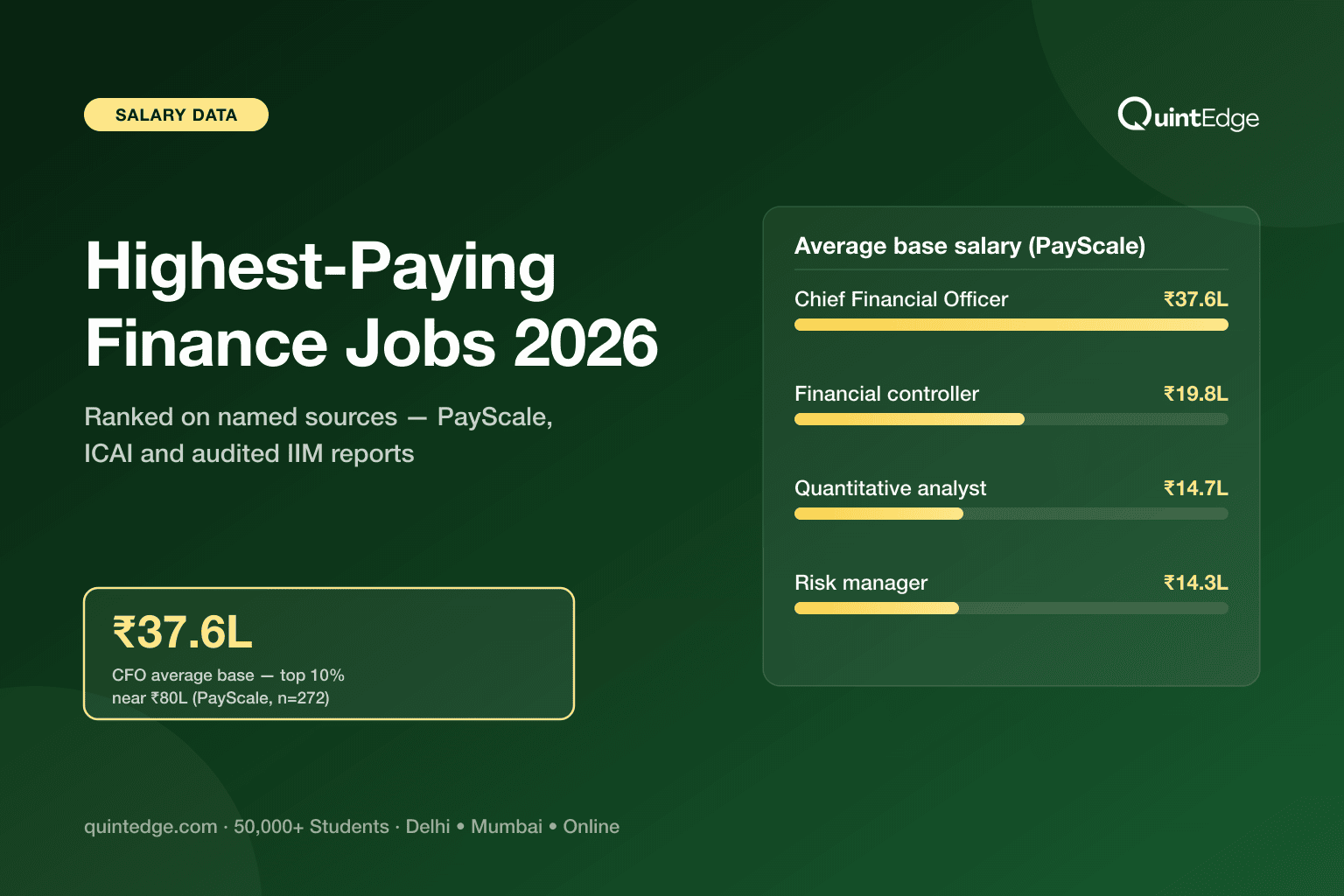
By average base salary on PayScale India (checked in July 2026), the top of the table looks like this:
- CFO — ₹37.6 lakh
- Financial controller — ₹19.8 lakh
- Quantitative analyst — ₹14.7 lakh
- Risk manager — ₹14.3 lakh
- Portfolio manager — ₹12.9 lakh
Alongside the job titles sit two packaged credential routes: the CA (ICAI-reported campus average ₹12.88 lakh) and the IIM MBA (audited earning-potential means near ₹35 lakh). They are paths, not titles — covered in their own section below.
Every number in this post carries its source, its sample size and its date, because "highest paying" lists are where invented salaries thrive. And remember: averages are not offers. Most of these roles show top-10% figures two to four times their average. The seat you land — employer type, city, desk — decides which end you see.
| # | Role | Average base | Top 10% about | Behind the number |
|---|---|---|---|---|
| 1 | Chief Financial Officer | ₹37.6 lakh | ₹80 lakh (total comp to ₹1 crore) | n=272, updated 18 Feb 2026 |
| 2 | Financial Controller | ₹19.8 lakh | ₹40 lakh | n=313 — largest sample here, updated 16 Apr 2026 |
| 3 | Quantitative Analyst | ₹14.7 lakh | ₹30 lakh | n=21 — small sample, updated 28 Apr 2026 |
| 4 | Risk Manager | ₹14.3 lakh | ₹30 lakh | n=97, updated 6 Aug 2025 |
| 5 | Portfolio Manager | ₹12.9 lakh | ₹40 lakh | n=57, updated 6 Nov 2025 |
| 6 | Treasury Manager | ₹12.3 lakh | ₹30 lakh | n=36, updated 25 Jun 2025 |
| 7 | Actuary | ₹10.2 lakh | ₹50 lakh | n=26 — small sample with a huge spread, updated 8 Apr 2026 |
| 8 | Investment Banker | ₹8.9 lakh | ₹30 lakh | n=51, updated 26 Mar 2026 |
| 9 | Credit Analyst | ₹8.1 lakh | ₹20 lakh | n=122, updated 27 May 2026 |
Plain takeaway: the top of this table is seniority (CFO, controller), the middle is specialisation (quant, risk, portfolio), and the famous names (investment banking) earn their reputation through the top-10% column, not the average.
How Should You Read Salary Data (Before Believing Any List)?
Three habits separate readers who understand pay data from readers who get misled by it:
- Ask "average of whom?" PayScale averages self-reported base salaries across all experience levels — freshers mixed with 15-year veterans. Entry pay runs far below: investment bankers average ₹8.9 lakh, but entry level is about ₹6.1 lakh on the same page.
- Ask "how many people?" A 313-profile sample (controller) is a measurement. A 21-profile sample (quant) is an indication. An 8-profile sample is an anecdote. We label everything under 30 as small — and we excluded roles too thin to rank (PE associate: 8 profiles; fund manager: no usable page). Those get honest prose instead.
- Ask "which pay definition?" Base salary ≠ CTC ≠ earning potential. IIM Ahmedabad's audited report publishes "Maximum Earning Potential" — the highest possible payout including variable pay. Comparing an MEP to a base salary is comparing a ceiling to a floor.
#1–2: The CFO Track — Compounding by Seat, Not by Years
The single best-paid finance job in India, on the broadest data, is the one nobody starts in.
- CFO: ₹37.6 lakh average base; top 10% near ₹80 lakh; total compensation reaching ₹1 crore (n=272, updated 18 Feb 2026)
- Financial controller (one rung below): ₹19.8 lakh average (n=313 — the largest sample in this post, updated 16 Apr 2026)
The route is a ladder of seats: financial analyst (₹5.7 lakh average, n=1,102) → FP&A / finance manager → controller (₹19.8 lakh) → CFO (₹37.6 lakh). Each promotion roughly doubles the number. Years served without a seat change do not.
That is the plainest lesson in this post: pay compounds by seat, not by tenure.
Who it favours: accountants and FP&A professionals with reporting depth — CAs disproportionately hold these seats — plus modeling skill for the planning half of the job. Entry doors: the FP&A lane, or the CA route below.
#3: Quantitative Analysts — the Highest Entry Pay in Finance
Quants build pricing, trading and risk models — mathematics and code applied to markets.
- Average: ₹14.7 lakh; top 10% near ₹30 lakh (n=21 — small sample, updated 28 Apr 2026)
- The remarkable figure — entry level: about ₹11.4 lakh total compensation for under a year of experience. The highest fresher number anywhere in this post
Why so high at entry? Trading firms compete with tech giants for the same brains. Who it favours: engineering and mathematics backgrounds with real coding ability — the profile mapped in finance careers after engineering. India's proprietary-trading firms hire this pool aggressively at the IITs.
#4: Risk Managers — the Steady Six-Figure Specialisation
Risk managers set and police the limits banks and funds operate inside.
- Average: ₹14.3 lakh; top 10% around ₹30 lakh (n=97, updated 6 Aug 2025)
- Demand is unusually reliable — regulators require the function to exist
The recognised credential ladder is the FRM (what FRM is, FRM salaries in India). The hands-on modeling side is the credit-risk track, where India's ECL transition keeps teams hiring.
#5: Portfolio Managers — Where CFA-Land Pays Off
Portfolio managers run money — mutual funds, PMS, AIFs.
- Average: ₹12.9 lakh; top 10% near ₹40 lakh (n=57, updated 6 Nov 2025)
- The destination seat of the research ladder: equity analyst → senior analyst → PM — the route the CFA is built for (CFA Level 3 salaries maps the rungs)
One honesty note: "fund manager" as a separate PayScale India page does not exist in usable form, so we rank the portfolio-manager data instead of inventing a bigger number. Senior fund-management pay in India clearly exceeds these figures — but we will not print what we cannot source.
#6–7: Treasury Managers and Actuaries — the Quiet Specialists
Treasury managers handle a company's cash, borrowings and currency risk.
- Average: ₹12.3 lakh; top 10% near ₹30 lakh (n=36, updated 25 Jun 2025)
- Every large company needs one; few students plan for it — the lane stays uncrowded
Actuaries are insurers' risk mathematicians.
- Average: ₹10.2 lakh on a small 26-profile sample (updated 8 Apr 2026)
- The widest stretch in this post: top 10% reaches ₹50 lakh — winner-skewed, because qualified Fellows are genuinely scarce
The honest comparison with FRM — exams, timelines, who should pick which — is in FRM vs actuary.
#8: Investment Banking — and the PE/VC Asterisks
Investment bankers average ₹8.9 lakh base — modest-looking until you see the range:
- 10th percentile: ₹2 lakh. Top 10%: ₹30 lakh (n=51, updated 26 Mar 2026) — plus deal bonuses on top
- Bank tier decides everything: bulge-bracket and top-boutique analysts live at the right end; small-shop analysts at the left
The full picture: IB salaries in India; the entry mechanics: how to become an investment banker.
Private equity and VC belong on any "highest paying" list by reputation — but India's public data is too thin to rank responsibly:
- PayScale's PE-associate page: ₹8.1 lakh on just 8 profiles, last updated January 2025 (stale); mid-career total comp of ₹34 lakh hints at the real slope
- Its VC-firm industry page: ₹20 lakh average across roles (n=30, updated 17 May 2026)
- Directional truth: PE associates typically out-earn IB batchmates per seat, on far fewer seats, entered via IB or Big 4 first — see IB vs PE vs VC
Related datapoint worth its caveat: professionals who list "mergers & acquisitions" as a skill average ₹20 lakh across job titles (n=73, updated 24 May 2026) — a skill-level figure spanning many roles, not an M&A-associate salary.
The Credential Anchors: CA and MBA Routes
Two packaged routes bracket this whole table and deserve their own numbers:
| Route | Headline number | Definition & source |
|---|---|---|
| CA — ICAI campus, 62nd round (Aug–Sep 2025 drive) | ₹12.88 lakh average; top domestic ₹26.60 lakh | 3,795 offers, 157 organisations; ICAI-reported average via Taxscan's 1 Nov 2025 report of ICAI's release |
| CA — 63rd round (Dec 2025–Jan 2026) | Top domestic ₹32.33 lakh | 2,480 offers, 145 organisations; ICAI publishes no average for this round (ICAI 64th-round brochure, checked in July 2026) |
| IIM Ahmedabad MBA (Class of 2025, audited) | MEP mean ₹35.5 lakh, median ₹34.6 lakh | "Maximum Earning Potential", n=395 accepted offers; IPRS-audited report, 9 Sep 2025 — a ceiling measure, not base salary |
| IIM Bangalore MBA (Class of 2025) | Mean ₹34.9 lakh, median ₹32.6 lakh | 602 students, 660 offers; official CDS Placement Report 2025 |
| IIM Calcutta MBA (Class of 2025) | Average ₹34.2 lakh, median ₹34 lakh | 456 students, 538 offers; 60th-batch final placement report, via IMS India's coverage |
Context those headline MBA numbers hide:
- The IIM route costs ₹26–27.5 lakh in fees alone (IIM-A PGP 2025–27: ₹27.5 lakh, official) — plus two years of forgone salary
- At IIM Ahmedabad, BFSI recruiters made 99 of 395 offers, with Goldman Sachs the largest IB recruiter at 9 offers (audited report)
- The CA route costs a fraction in fees — but years of exams and articleship
Both work. They are different trades of time, money and certainty. For the certification-by-certification version, read the best finance certifications in 2026.
Plain takeaway: the ₹35-lakh MBA headline is a ceiling measure after a ₹27-lakh fee; the ₹12.88-lakh CA average is a floor-ish campus number before Big-4 acceleration. Naming the measure is half of understanding it.
What Actually Moves Your Pay (More Than the Job Title)?
- The seat. The same "financial analyst" title pays differently at a global capability centre, a domestic NBFC and a startup. Employer type is the biggest multiplier hiding inside every average above.
- The city. Mumbai and Gurugram host the front-office seats — trading floors, fund houses, deal teams. Bengaluru and Hyderabad host the global centres. The top-10% figures in this post live overwhelmingly in these cities.
- The stack. Credential + demonstrable skill beats either alone: a risk manager who can build the model, an analyst with a real modeling portfolio, a research associate with Python on top of domain knowledge. Employers pay for proof — and skills are the fastest proof to acquire.
- The tournament you choose. Compressed professions (controller, treasury) pay dependably. Tournament professions (IB, PE, fund management, actuarial) pay their winners multiples of their median. Neither is wrong — but know which game you entered.
Routes to the Top Table, by Starting Point
| You are… | Highest-probability route to this table | Start reading |
|---|---|---|
| A B.Com student/graduate | FM skills → deal-side or FP&A seat → controller/CFO track or IB ladder | Courses after B.Com |
| An engineer | Quant/risk lane via FRM + Python, or trading-firm route from campus | Finance after engineering |
| A CA or CA student | Big 4 advisory → IB/PE, or industry FP&A → controller → CFO | What to do after CA |
| Aiming at markets/research | CFA ladder: analyst → senior analyst → portfolio manager | CFA Level 1 salaries |
| Already in banking ops/tech | FRM or credit-risk modeling to cross into the risk office | Jobs after FRM Part 1 |
Highest-Paying Finance Jobs: Frequently Asked Questions
On the broadest available data, the CFO seat: ₹37.6 lakh average base with total compensation reaching ₹1 crore (PayScale India, 272 profiles, updated Feb 2026). Among roles you can enter within a few years, quantitative analysts show the highest entry pay — about ₹11.4 lakh for under a year of experience. Investment banking and fund management pay their top 10% around ₹30–40 lakh, with bonuses beyond.
Quantitative roles at trading firms, on the data we can verify: PayScale shows quant analysts at roughly ₹11.4 lakh total compensation for under a year of experience (small sample). Campus evidence points the same way — IIT Delhi's placement releases name proprietary-trading firms among recruiters making double-digit offers. Outside quant: fresh CAs via ICAI campus average ₹12.88 lakh (62nd round), and entry investment bankers about ₹6.1 lakh with steep growth.
Not by average — IB's ₹8.9 lakh PayScale average sits below risk managers and controllers. IB's reputation lives in its distribution: the top 10% earn around ₹30 lakh base plus deal bonuses, top-tier banks pay well beyond self-reported averages, and the exit doors (private equity, corporate development) compound earnings further. It is a tournament: spectacular for winners, ordinary for the median entrant.
No — it is one of several routes, and the priciest. Top-IIM MBAs show audited earning-potential means near ₹35 lakh, but cost ₹26–27.5 lakh in fees plus two years of income. CFOs are disproportionately CAs; quants and risk heads rise on FRM-plus-skills; fund managers climb the CFA ladder. The MBA buys brand and a placement market; the specialisations buy scarcity. Different currencies, same destination table.
Because they measure different things on different people: pay definition (base vs CTC vs earning potential), sample (self-reported juniors vs audited campus offers), period and city mix all vary. That is why every figure here names its source, sample size and update date — and why we omitted roles (fund manager, PE associate) where public data is too thin. Distrust any list that shows none of these.
The pattern across this table: roles built on accountability and judgment — CFO, controller, risk manager, credit committees — resist automation best, because someone must own the decision. Mechanical-production roles compress fastest. The winning move in every lane is the same: let AI draft, add the judgment layer yourself. Mapped honestly in will AI replace finance jobs? and the AI skills guide.


