
Can Engineers Get Into Finance? (Short Answer: You're Recruited, Not Tolerated)
Yes — and not as outsiders. Finance actively recruits engineers for the roles where its money is made and protected: quantitative trading, risk modeling, data-driven analytics and fintech.
The evidence is on campus notice boards:
- IIT Delhi's own placement releases name Goldman Sachs, Barclays, and proprietary-trading firms Graviton Research Capital and Quadeye among recruiters making double-digit offers in a single season
- IIT Bombay's 2023-24 placement report counts 113 finance offers from 33 financial firms — before adding consulting and analytics seats that hire the same profile
What transfers from a B.Tech is exactly what finance's hardest desks need: real mathematics, comfort with code, and systems thinking. What does not transfer — accounting vocabulary, valuation craft, market context — is learnable in months. This guide maps the five doors, what each pays on named data, and a six-month switch plan.
Why Does Finance Hire Engineers at All?
Because modern finance runs on models and machines. Trading firms price and execute in microseconds; banks estimate default probabilities with statistics; the RBI's expected-credit-loss regime is pushing every large lender to build and validate models. All of that is engineering work wearing a finance badge.
The employers are concrete. All of the following have India offices verified on their own sites (checked in July 2026):
- D.E. Shaw India — Hyderabad, Bengaluru, Gurugram (software, financial research, operations)
- Tower Research Capital — Gurugram and GIFT City
- WorldQuant — Mumbai, Delhi, Bengaluru
- Goldman Sachs — Bengaluru and Hyderabad; about 9,000 professionals per the firm's own India page, with the Bengaluru campus its third-largest office globally
- Graviton Research Capital — Gurugram · Quadeye — Gurugram, Kolkata, GIFT City
- Optiver — Mumbai, opened 2024 · IMC Trading — Mumbai, since 2021
Two of those names — Graviton and Quadeye — made ten-plus offers each at IIT Delhi per the institute's 2024-25 release.
Add the scale story: India's digital-payment rails processed over 22 billion UPI transactions in June 2026 alone (about 757 million a day, as reported by IBEF citing NPCI), and the Ministry of Finance marked UPI's tenth anniversary noting it now carries nearly half the world's real-time payment volume. Every fintech riding those rails hires engineers who understand money.
The Five Doors From Engineering Into Finance
Door 1 — Quant and Trading: Where Your Math Is the Product
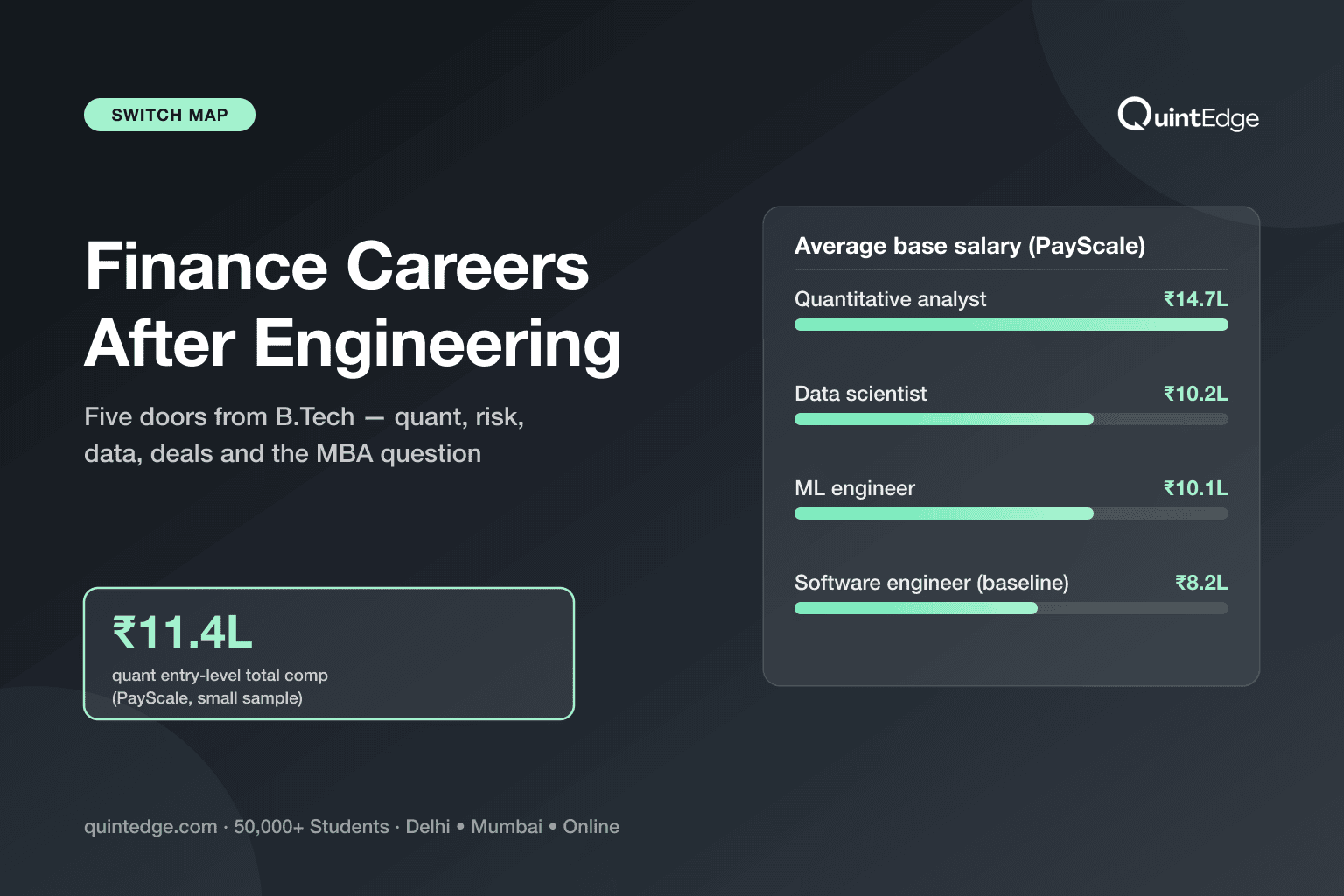
Quantitative analysts and traders build pricing, signal and execution models. It is the purest monetisation of an engineering education — probability, linear algebra, C++/Python — and it pays accordingly (PayScale India, n=21 — small sample, updated 28 Apr 2026; checked in July 2026):
- Average: ₹14.7 lakh
- Entry level: about ₹11.4 lakh total compensation — the strongest fresher figure in any finance lane
- Top 10%: near ₹30 lakh
How the door opens: largely on campus and through coding-plus-probability interviews. Practise puzzles, expected-value questions and clean code under time. Off-campus entries exist via data roles inside the same firms. The firms named above hire year-round in Gurugram, Mumbai, Hyderabad and Bengaluru.
Door 2 — Risk Management: the Credentialed Crossover
Risk teams estimate how much a bank or fund can lose — market risk, credit risk, operational risk — using exactly the statistics your degree drilled. The globally recognised badge is the FRM, and it is engineer-friendly by design:
- No education prerequisite — final-year students register
- Two parts, offered May/August/November
- GARP's official Nov 2025 pass rates: 47% (Part 1), 50% (Part 2)
The full case for this route is in FRM for engineers.
Pay context: risk analysts average ₹6.3 lakh (203 profiles, as of Aug 2025) growing to risk managers at ₹14.3 lakh with the top 10% near ₹30 lakh (97 profiles) on PayScale India. The hands-on modeling side — PD/LGD/EAD and ECL work — is mapped in the credit-risk career guide, and it is hiring through India's ECL transition.
Door 3 — Data and Fintech: the Volume Door
Every bank, NBFC and fintech in India runs analytics teams — fraud models, credit scoring, customer analytics — and they hire engineers directly, no finance credential required at entry. The PayScale India numbers:
- Data scientists: ₹10.2 lakh average (n=1,342 — the biggest sample in this post, updated 28 May 2026)
- Machine learning engineers: ₹10.1 lakh (n=255)
- Both show top-10% figures near ₹20–30 lakh
- For contrast — the software-engineer baseline you may be leaving: ₹8.2 lakh (n=5,221)
The move: aim your existing Python/SQL at financial problems and learn the domain layer — what a default is, how payments flow, why a lender cares about vintage curves. That domain layer is precisely what separates a "data scientist" from a "fintech data scientist" in interviews.
Door 4 — Core Finance: IB, Valuation and Research (via the Portfolio Bridge)
Deal desks and research teams do hire engineers — for rigour, not for nostalgia. But this door demands new craft: accounting fluency, financial modeling, valuation judgment.
The bridge is a demonstrated portfolio — a 3-statement model, a DCF, a comps set on real companies — built in 2–3 months of focused work. Once it exists, you compete for the same seats as commerce graduates. Route details: how to become an investment banker; the lane map: FM career paths.
If the markets themselves pull you — research, portfolios — the CFA explicitly welcomes engineers: any bachelor's discipline qualifies, and you can register up to 23 months before graduating (CFA Institute policies page, checked in July 2026). The from-zero plan is in CFA without a finance background.
Door 5 — Do You Need an MBA to Switch?
No — you need one only for specific destinations. The audited numbers frame the trade honestly:
- Fees: IIM Ahmedabad PGP ₹27.5 lakh (2025–27 batch, official); IIM Bangalore ₹26 lakh
- Outcome anchor: IIM-A's audited "maximum earning potential" mean ₹35.5 lakh, median ₹34.6 lakh (Class of 2025, IPRS-audited) — a ceiling measure, not base salary
- Finance demand there is real: BFSI recruiters made 99 of 395 offers at IIM-A, with Goldman Sachs the largest IB recruiter at 9
The honest decision rule: take the MBA door when you want management routes, brand reset or the placement market itself. Skip it when your target is quant, risk or data — those doors judge skills and pay you while you learn. A certification-plus-skills stack costs a tenth as much: the full comparison is in best finance certifications 2026 and the head-to-head in CFA vs MBA.
What Transfers From Engineering — and What You Must Add
| Already in your toolkit | Where it cashes in | What you must add |
|---|---|---|
| Probability & statistics | Quant desks, risk models, A/B-tested lending | Financial context: what the distribution is of |
| Python / C++ / SQL | Every door except pure IB — and increasingly IB too | pandas-for-finance patterns, clean data habits |
| Systems thinking | Payments, trading infra, model pipelines | Market microstructure and product knowledge |
| Optimisation under constraints | Portfolio construction, execution, capital allocation | The regulatory constraints (Basel, RBI norms) |
| — | — | Accounting fluency: the one genuinely new language — statements, ratios, accruals |
Plain takeaway: you are roughly one language short, not one degree short. Accounting-and-valuation literacy is the gap; everything else you own already.
The 6-Month Switch Plan (While Still Employed or Studying)
Eight focused hours a week. Each phase has a gate; the fall-behind rule is at the end.
| Months | Build | Gate before moving on |
|---|---|---|
| 1 | Pick your door (1–4) by reading one practitioner account and doing one honest self-test: do you want markets, models or deals? Learn statement basics alongside | You can read a P&L and balance sheet without translating every term |
| 2–3 | Build the door's artefact: quant → two clean projects (backtest + pricing model); risk → FRM Part 1 registration + first third of syllabus; data → one end-to-end fintech dataset project; IB/FM → 3-statement model + DCF | The artefact survives a senior's 20-minute grilling (find one on LinkedIn; engineers respond to engineers) |
| 4 | Add the domain layer: markets context, Basel/RBI basics for risk-side doors, product knowledge for fintech | You can explain, in plain words, how your artefact would make or save a firm money |
| 5–6 | Applications and reps: 12–15 tailored applications a week; interview drills nightly (quant puzzles, or FM questions, or credit-risk questions per your door) | 3+ interview processes live; zero unanswered "walk me through your project" questions in mocks |
Fall-behind rule: slippage costs scope, not quality — cut to one artefact done excellently rather than two done adequately. An interviewer remembers the depth of one project, never the count.
Finance After Engineering: Frequently Asked Questions
The one that reuses the most of your degree: quantitative roles if your math and code are strong (quant entry ≈₹11.4 lakh on PayScale — finance's best fresher figure), risk analytics if you like statistics with steadier hours, and data roles at fintechs for the widest seat count. Core IB/valuation is open too — after you build a modeling portfolio.
Any branch works — the filters are math comfort and (for doors 1–3) working Python, both learnable regardless of branch. Risk and FRM routes in particular care about probability, not your department; GARP imposes no educational prerequisite at all. Non-CS engineers who dislike coding should look hardest at door 4 (IB/valuation via a modeling portfolio) where Excel craft replaces programming.
FRM if risk, statistics and banks attract you — it is shorter (2 parts), cheaper (≈₹1.5–1.9 lakh in GARP fees), has no entry gate, and your quantitative edge compounds hardest there. CFA if markets, research and portfolio careers call — any-discipline eligible, three levels, ₹3.4–4.4 lakh in exam fees. Both are argued honestly in CFA vs FRM; start from the job you want, not the badge.
Depends on the door. Against the software-engineer average of ₹8.2 lakh (PayScale, n=5,221): quant averages ₹14.7 lakh, data science ₹10.2 lakh, and risk-manager trajectories reach ₹14.3 lakh — all compare well or better. Entry analyst roles in core finance can start lower before deal-side growth kicks in. Honest framing: doors 1–3 are usually pay-neutral-to-positive immediately; door 4 trades one or two flat years for a steeper curve.
Campus pipelines are IIT-heavy — IIT Delhi's releases show trading firms among its double-digit recruiters — but not the only entrance. The same firms hire off-campus for engineering and research roles (D.E. Shaw India, WorldQuant and Tower Research all list open India roles on their careers pages), and strong competitive-programming signals travel well. Non-IIT candidates typically enter via engineering roles, then move desk-ward internally.
No — you are arguably better positioned than a fresher: production coding habits, workplace maturity, savings. The six-month plan above fits exactly this profile (8 hours a week around a job). IT experience counts directly for door 3 and supports door 2 — banks value production-grade discipline in model teams. The genuinely hard switch is one without any artefact. Start the build this month.


