
CFA Without a Finance Background at a Glance
Straight answer: you can absolutely do the CFA Program without a finance degree. CFA Institute accepts a bachelor's in any discipline — engineering, science, arts, law, medicine, anything — or even no degree at all via a work-experience pathway. There is no entrance test and no finance prerequisite.
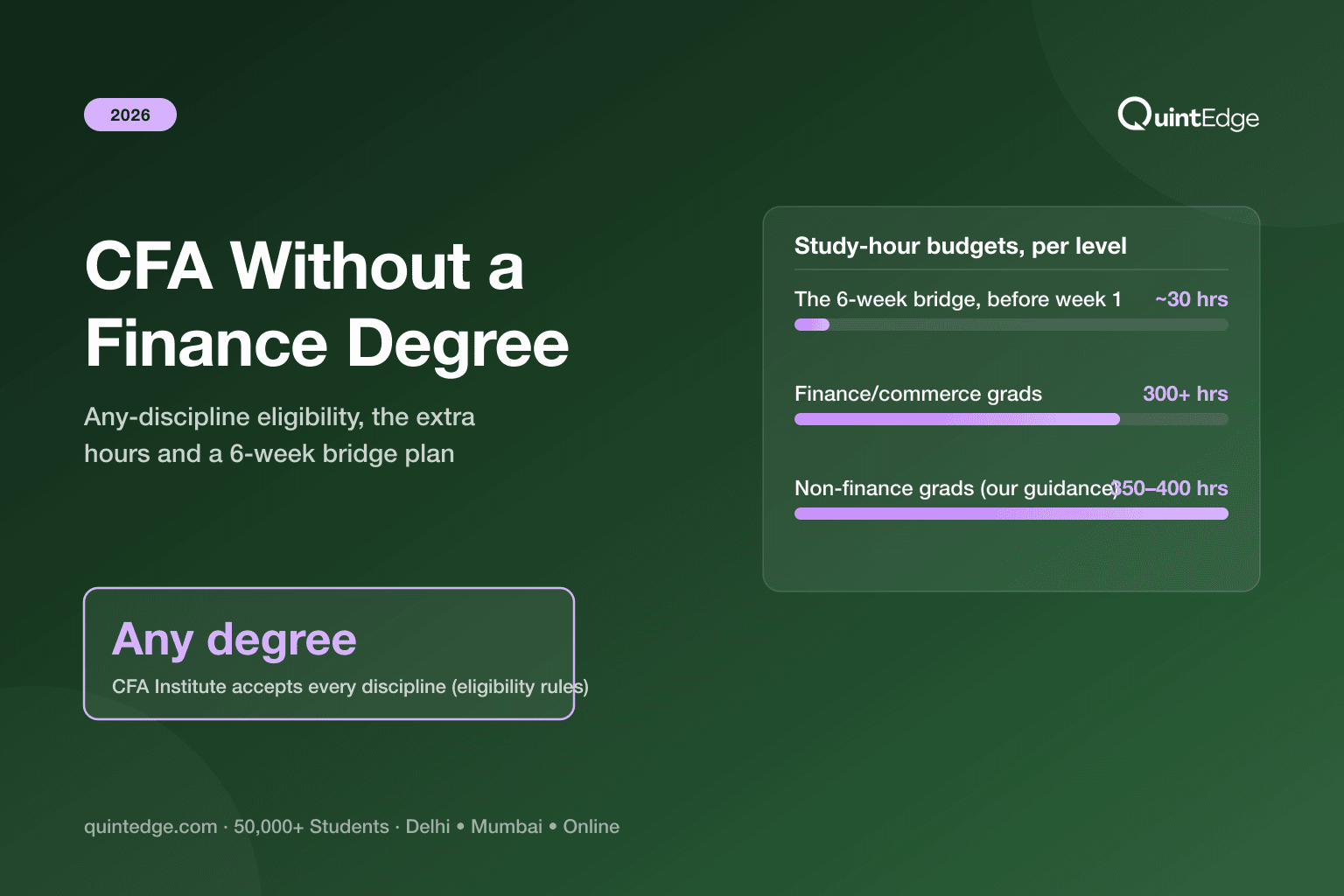
The honest part: eligibility is not the hurdle — vocabulary and pace are. The Level 1 curriculum teaches everything from scratch, but it moves fast, and classmates from commerce backgrounds start with words you will be meeting for the first time. Budget 350–400 study hours instead of the 300+ that CFA Institute's guidance suggests candidates typically report, and spend a deliberate six weeks bridging the basics before week one.
This guide covers exactly that: the eligibility rules, an honest topic-by-topic difficulty map for your background, and the six-week bridge plan our faculty use with non-finance students.
Does CFA Institute Care What You Studied?
No. The eligibility rules — covered fully in our CFA eligibility guide — ask only that you meet one of three pathways:
- A bachelor's degree in any discipline. B.Tech, B.Sc, BA, LLB, MBBS — all equal in CFA Institute's eyes. Marks and university tier are never asked.
- Final-year student status: you can register while still studying, as long as you are within 23 months of graduating when you sit Level 1.
- 4,000 hours of professional work experience — in any field, not just finance — earned over at least three sequential years, or a combination of study and work totalling the same.
Two practical add-ons: you need a valid international travel passport to register, and the exams are conducted in English — comfort reading dense English passages matters more than any subject you studied. Registration mechanics are step-by-step in our registration guide.
Worth saying clearly: there is no separate “non-finance” exam, no viva where someone asks why an engineer wants finance, and no disclosure of your degree to graders. The exam is anonymous multiple choice. Your B.A. in history is invisible to it.
What Does Level 1 Actually Assume You Know?
Formally, nothing. The curriculum defines every term at first use — it assumes you are new to the city and hands you a map. Informally, the bus moves fast: readings introduce a concept once and start using it, and questions arrive in the vocabulary of annual reports and market news.
Concretely, Level 1 leans on three kinds of prior comfort:
- School-level math, used constantly. Percentages, ratios, powers and compounding — nothing beyond class-12 math, but applied at speed across 180 questions. (The full exam structure is in our Level 1 overview.)
- Financial-statement vocabulary. The single biggest gap for non-commerce candidates. Balance sheet, P&L, accruals, depreciation — Financial Statement Analysis (FSA) is among the heaviest-weighted Level 1 topics, and commerce graduates have a multi-year head start on its language.
- Markets awareness. Knowing roughly what a share, bond, index and mutual fund are before the curriculum formalises them. Cheap to build — twenty minutes of business news a day — but only if you start early.
None of these is a wall. Each is a vocabulary tax: pay it deliberately in the first weeks, or pay it with interest during the syllabus proper.
How Hard Is Each Topic Without a Finance Degree?
Difficulty is not uniform — it depends on which muscles your degree already built. The map below is QuintEdge faculty guidance from coaching non-finance cohorts; everyone sits the same paper, so treat it as a study-hour allocator, not a verdict.
| Level 1 topic area | Engineering / Science | Arts / Humanities / Law | Commerce (non-finance) |
|---|---|---|---|
| Quantitative Methods | Head start | Steep | Moderate |
| Financial Statement Analysis | Steep | Steep | Head start |
| Economics | Moderate | Moderate | Head start |
| Equity & Fixed Income | Moderate | Steep | Moderate |
| Derivatives & Alternatives | Moderate | Steep | Moderate |
| Portfolio Management | Head start | Moderate | Moderate |
| Ethics | Moderate | Head start | Moderate |
Plain takeaway: your background decides where your extra hours go — engineers buy FSA time with their quant savings, arts graduates budget for both but bank Ethics early.
Whatever your column says, the weights decide the stakes: FSA, Quantitative Methods, Equity and Fixed Income together carry the largest share of Level 1 marks. A steep cell in a heavy topic — FSA for engineers, Quant for arts graduates — is where your bridge weeks and extra hours belong. (Wondering about overall difficulty? Our honest take: Is CFA difficult?)
What Head Start Does Your Degree Give You?
Non-finance is not one category — each background brings a real asset to this exam. Play yours deliberately:
- Engineers and science graduates. Quantitative Methods and the statistics behind Portfolio Management will feel like revision, and formula-heavy topics hold no fear. Your entire risk sits in FSA and in reading speed for wordy Ethics cases. You are also the profile quant desks, risk teams and fintechs actively hunt — more on that below.
- Arts, humanities and law graduates. The steepest columns — but the exam's most underrated skills are yours: reading fast, holding long arguments, and judging case-based Ethics questions. Bank Ethics early and cheaply; give Quant a gentle, early, little-and-often runway rather than a late sprint.
- Commerce graduates without a finance major. Your accounting vocabulary is the single best head start Level 1 offers — FSA and Economics start half-done. Your gap is usually the investments side: securities, portfolio math, derivatives. (On a B.Com specifically? Our CFA after B.Com roadmap covers timing, the 23-month rule and salary math.)
The one asset everybody needs regardless of column: Excel-and-calculator comfort. Finance thinks in spreadsheets and keystrokes, and both are learnable in a fortnight — which is exactly what the bridge plan below schedules.
The 6-Week Bridge Before Your First Study Week
Stretch before the run. Six weeks, 5–6 hours a week, before your official study plan begins — each week with one job and a pass gate that tells you it stuck. This is the bridge our faculty set non-finance students, and it converts the scary cells above into normal ones.
| Week | The job | Pass gate — do not move on without it |
|---|---|---|
| 1 | Meet the three financial statements: what the P&L, balance sheet and cash flow statement each show, and how they connect | Explain the three statements to a friend, without notes, in under five minutes |
| 2 | The accounting equation in action: track 10 simple transactions of an imaginary chai stall into a mini P&L and balance sheet in Excel | Your balance sheet balances, and you can say why each entry went where it did |
| 3 | Markets vocabulary: 20 minutes of a business daily every day; build a 50-term glossary in your own words (share, bond, yield, index, NAV…) | Pick one earnings headline and explain it in plain words to a non-finance friend |
| 4 | Numbers comfort: percentages, powers and compounding by hand; buy your calculator and do its day-one setup (our BA II Plus guide is the checklist) | Grow ₹10,000 at 10% for 3 years by hand and on the calculator — both say ₹13,310 (illustrative) |
| 5 | The CFA landscape: tour the Level 1 syllabus and exam format (Level 1 overview), confirm your eligibility pathway and passport (eligibility guide) | Write one sentence stating your eligibility pathway — and your passport's expiry date |
| 6 | Commit: pick a window with live dates from the exam dates hub, register early (the fee math is in our fees guide), choose your runway and set up the weekly grid | Registered, runway chosen, and week 1 of the study plan sitting in your calendar |
Plain takeaway: six weeks converts “I’ve never seen a balance sheet” into “I’m a registered candidate with working vocabulary” — before the clock starts on the real 350–400 hours.
From week 7 onward you are a normal candidate: follow the Level 1 study plan week by week. Working full-time alongside? The grid, gates and fall-behind rules in our CFA-while-working playbook apply to you unchanged.
How Many Hours Should a Non-Finance Candidate Budget?
CFA Institute's guidance is that candidates typically report 300+ hours per level. Our faculty ask non-finance students to budget 350–400 for Level 1 — the bridge weeks plus a heavier FSA allocation account for the difference. Where the extra 50–100 hours go, in order:
- FSA, first and most. The heaviest vocabulary tax lives here. Double the practice questions, not just the reading time.
- Your column's steep cells from the difficulty map — Quant for arts graduates, valuation topics for everyone non-commerce.
- Question volume over note-making. Non-finance candidates over-invest in beautiful notes to feel in control. Questions expose the vocabulary gaps notes hide — our study techniques guide makes the same argument for every background.
Encouragement with evidence: CFA Institute publishes pass rates globally — roughly 40–50% per level in recent cycles — and publishes no split by academic background. The exam does not know your degree. Hours, questions and gates decide this credential, and all three are fully under your control.
Will Employers Take You Seriously?
For entry-level investment roles, employers hire proof of direction: a cleared Level 1, an internship or two, Excel fluency, and the ability to talk about markets like you follow them. A finance degree is one way to signal that; it is not the only way. For pay expectations, fresh aggregator data puts entry-level equity analysts near ₹3.9 lakh and entry-level credit analysts near ₹4.1 lakh (PayScale India, as of July 2026) — with front-office and Mumbai offers sitting well above those averages. Our Level 1 jobs guide and role-by-role breakdown map where L1 candidates actually land.
Background-specific honesty:
- Engineers are actively sought where math meets money — risk teams, quant research, fintech, data-heavy equity research. CFA Level 1 on an engineering CV reads as direction, not desperation. The combination is genuinely in demand.
- Arts and law graduates face more early filtering at pure-analysis desks, and clear it with evidence: an investment club, a research write-up on a real company, a completed internship. Client-facing wealth roles, investor relations and financial writing value your communication edge from day one.
- Everyone: “CFA Level 1 candidate” is a real but modest signal; a pass is a strong one. Let the result do the talking, and pair it with one concrete artefact — a stock pitch, a model, a published note.
The realistic promise: the CFA route does not erase your first degree — it repositions it. An engineer-plus-L1 is a quant candidate. A lawyer-plus-L1 is a compliance-and-wealth candidate. The credential works with what you already are.
Frequently Asked Questions About CFA Without a Finance Background
Yes. CFA Institute accepts a bachelor's degree in any discipline — engineering, science, arts, law, medicine, anything. Final-year students can register if they are within 23 months of graduating when sitting Level 1, and there is even a pathway based on 4,000 hours of work experience in any field. A valid international passport is required to register.
The exam is identical for everyone, and CFA Institute publishes no pass-rate split by academic background. The honest difference is hours: the curriculum teaches from scratch but moves fast, so non-finance candidates pay a vocabulary tax — mostly in Financial Statement Analysis. Budget 350–400 hours instead of 300 and run a bridging plan before you start, and the gap closes.
Often, yes. Engineers start with a real edge in Quantitative Methods and portfolio math, and employers actively seek the math-plus-markets profile in risk, quant research, fintech and data-heavy equity research. The gap to respect is accounting — Financial Statement Analysis is new ground — which is exactly what a six-week bridge plan and extra FSA question volume fix.
Plan 350–400 hours for Level 1 against the 300+ that CFA Institute says candidates typically report — that is QuintEdge faculty guidance from non-finance cohorts. The premium goes to Financial Statement Analysis first, then to whichever topics are steep for your background, and into extra practice questions rather than extra note-making.
Yes — with the steepest start and therefore the most deliberate plan. Take the longer 9-month runway, run the six-week bridge first, give Quantitative Methods small daily doses from the beginning, and bank Ethics early where strong readers hold a genuine advantage. The exam tests preparation, not pedigree.
For entry roles, yes — hiring runs on proof of direction: a cleared Level 1, internships, Excel fluency and market awareness. Engineers are actively recruited into quant and risk roles; strong communicators from arts backgrounds do well in wealth, investor relations and research writing. Pair the credential with one concrete artefact, like a stock pitch or research note, and the degree question fades.


