
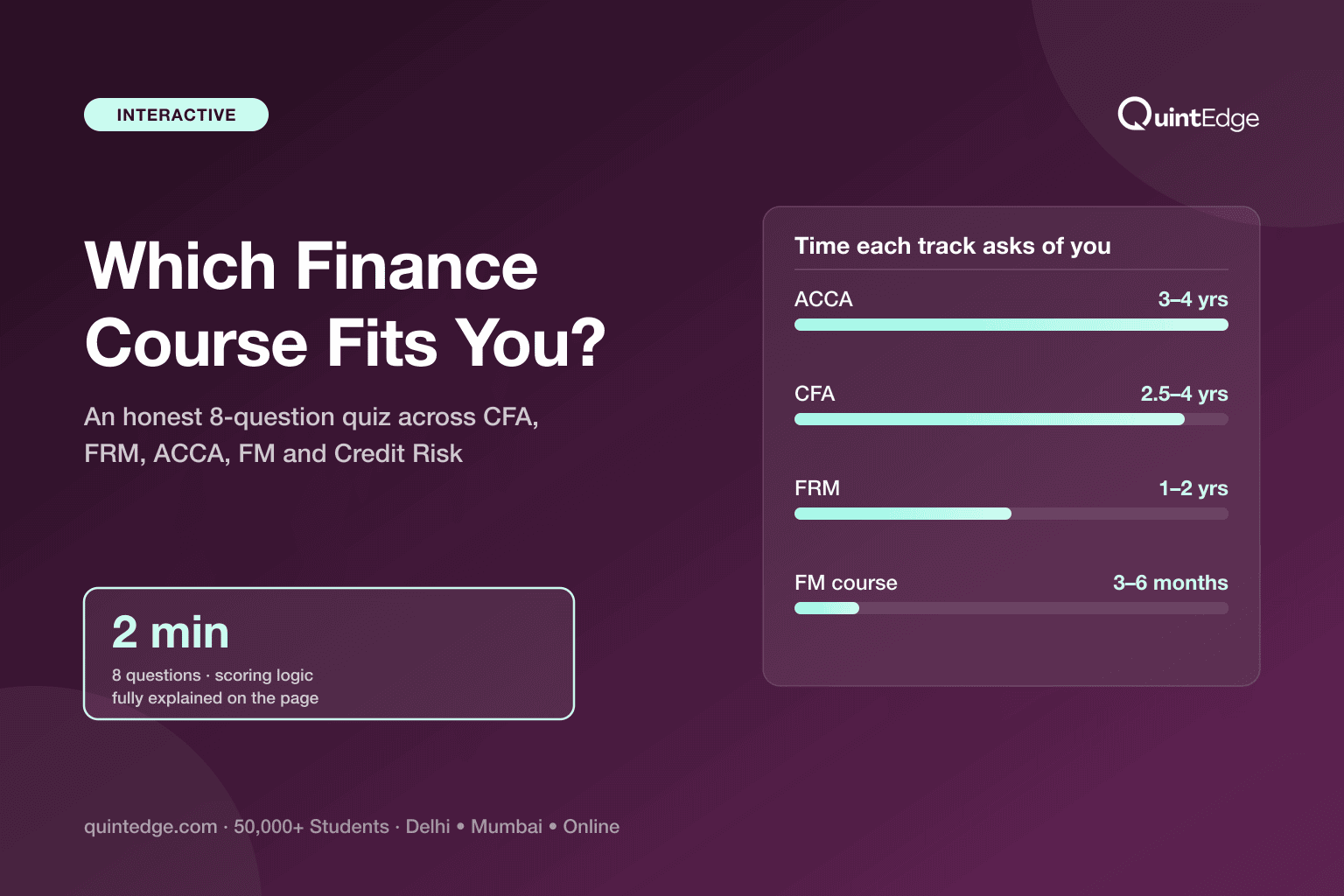
Which Finance Course Should You Do?
There is no single "best" finance course — there is a best course for your situation. The right answer depends on five things: your education stage, the work you enjoy, your math comfort, how fast you need a job, and how much you can invest.
The quiz below weighs exactly those five things and recommends one of five tracks:
- CFA — investments and research
- FRM — risk
- ACCA — global accounting
- Financial Modeling / Investment Banking — job-ready deal skills
- Credit Risk Modeling — bank-side analytics
It takes about two minutes. Your answers never leave this page — the scoring runs entirely in your browser, and we explain the logic openly further down. If you prefer to read instead of click, the decision table below the quiz covers every path.
Take the 2-Minute Quiz
Answer all eight questions, then hit "Show my result". You can retake it as many times as you like — try answering as your honest self first, then as the person you want to be in three years. If the two results differ, that gap is your real decision.
Plain takeaway: the quiz weighs your stage, interests, math comfort, timeline and budget — the same five questions a good counsellor would ask you first.
How Does the Scoring Work?
No black box. Every answer adds points to one or more of the five tracks, and the track with the most points wins. Three rules drive most results:
Rule 1 — your stage sets the doors that are open.
- ACCA can begin right after 12th
- FRM has no entry conditions at all — GARP, the body that runs it, lets anyone register
- CFA needs a bachelor's degree, or being within 23 months of finishing one
- Skill courses like Financial Modeling have no gate — they work at any stage
The quiz never recommends a course you cannot yet register for as your primary result.
Rule 2 — interest beats everything else. The "which pulls you more" and "dream first job" questions carry the heaviest weights. A credential you find boring is a credential you will abandon halfway — the most expensive outcome of all.
Rule 3 — timeline and budget act as tie-breakers. If you need to earn within six months, the job-skill tracks (Financial Modeling, Credit Risk Modeling) score up. If you can commit years, the deep credentials (CFA, ACCA) score up.
The Decision Table (No JavaScript Needed)
Prefer scanning to clicking? This table is the whole quiz on one screen. Find the row that sounds most like you and read across.
| If this is you… | Best-fit track | Why | Start here |
|---|---|---|---|
| Just finished 12th, want a global qualification | ACCA | The only track here you can formally begin right after school | ACCA after 12th |
| B.Com student who loves markets and investing | CFA | You can register up to 23 months before graduating; the credential for research and buy-side roles | CFA after B.Com |
| B.Com student who wants a deal-desk job fast | Financial Modeling | Job-skill course, no entry gate, 3–6 months to interview-ready models | IB after B.Com |
| Engineer who enjoys math, stats and systems | FRM | No prerequisites, quant-heavy syllabus, risk desks value the engineering toolkit | FRM for engineers |
| Engineer who wants to code for a living, in finance | Credit Risk Modeling | Python + statistics + bank models; India's ECL transition is hiring for exactly this | What is credit risk modeling? |
| CA student or fresh CA who wants deal-side work | Financial Modeling, then CFA if research calls | Your accounting depth + models = Big 4 TAS, IB and ER doors | FM for CA students |
| Audit-inclined, want Big 4 and international mobility | ACCA | 13 papers, exemptions for B.Com/CA, recognised across 180+ markets | ACCA course details |
| Working professional aiming at portfolio/research roles | CFA | Evening-batch-friendly, employer-respected, deep investment syllabus | CFA while working |
| Working in banking ops/tech, want the risk office | FRM | Purpose-built risk credential; pairs with your bank context | What is FRM? |
Plain takeaway: your current stage removes some options, your interests pick the lane, and your deadline decides credential-first versus skills-first.
What Each Track Actually Is, in One Paragraph Each
CFA is a three-level exam credential from CFA Institute focused on investment analysis — equities, fixed income, portfolio management and ethics. Most candidates take 2–4 years. It opens research and investment-management doors. Eligibility needs a bachelor's degree or being within 23 months of finishing one. Start with what CFA is and the current exam windows.
FRM is a two-part exam credential from GARP focused on risk — market, credit, operational, liquidity. It has no education prerequisite, so engineers and final-year students register freely. It is the standard badge on bank and fund risk desks. Start with what FRM is and the exam windows.
ACCA is a 13-paper global accounting qualification you can begin after 12th, with generous paper exemptions for B.Com graduates and CAs. It leads to audit, reporting and finance roles at the Big 4 and multinationals, and travels well internationally. Start with the course details and exam dates.
Financial Modeling (with Investment Banking prep) is a skills course, not an exam credential: you learn to build the 3-statement model, DCF, comps and LBO that deal teams use daily. It is the fastest of the five tracks to a hireable portfolio — typically months, not years. Start with what financial modeling is and where it leads.
Credit Risk Modeling is the specialist track: PD, LGD and EAD models, IFRS-9-style ECL provisioning and model validation, usually in Python or SAS. India's banks are moving to expected-credit-loss provisioning on the RBI's timeline, which keeps these teams hiring. Start with what credit risk modeling is and PD, LGD & EAD explained.
Which Combinations Work Well?
Plenty of readers end up doing two of these, in sequence. The pairs that consistently make sense:
| Combo | Who it suits | Sequence logic |
|---|---|---|
| Financial Modeling → CFA | Freshers who need a job soon but want research later | Skills pay the bills first; the charter deepens the same work — see FM vs CFA |
| CA + CFA | CAs moving from audit to investment roles | Accounting depth + investment lens — see CFA after CA |
| CA + FRM | CAs targeting bank risk and credit | Statement fluency + risk toolkit — see FRM after CA |
| FRM + Credit Risk Modeling | Risk aspirants who also want hands-on model-building | The credential proves theory; the modeling course proves you can build — see the credit-risk career map |
| ACCA + Financial Modeling | ACCA students who want advisory/deals rather than pure audit | Reporting knowledge + valuation skills widen you beyond assurance |
Plain takeaway: combine a credential (proof you know) with a skill course (proof you can build) rather than stacking two long credentials back-to-back.
Three Honest Checks Before You Commit
Check 1 — talk to one person doing the job. A 20-minute LinkedIn call with a risk analyst or an IB analyst will teach you more about the daily reality than any syllabus page. Ask them what a Tuesday looks like.
Check 2 — price the whole journey, not the first fee. Registration is only the visible cost. Add exam attempts, materials, coaching if you choose it, and the months of your time. Our fee guides break these down honestly — for example FRM's total cost in India and FM course fees.
Check 3 — sample the actual study material. Watch one full lecture of the track you picked. If the CFA ethics reading or the FRM statistics chapter bores you at minute ten, believe that signal now rather than ₹50,000 later. This is also exactly what a counsellor call is for — ask us the awkward questions; we will tell you if a track does not fit.
Choosing a Finance Course: Frequently Asked Questions
It depends on the job you want. Markets and research → CFA (you can register up to 23 months before graduating). Deal desks and IB fast → Financial Modeling. Big 4 and global accounting → ACCA (B.Com earns paper exemptions). Bank risk → FRM. Take the quiz above, then read the full courses-after-B.Com guide.
ACCA, yes — it is designed to begin after school. FRM technically has no prerequisite, but its syllabus assumes college-level statistics, so most start later. CFA requires a bachelor's degree or being within 23 months of finishing one, so 12th-pass students must wait. Skill courses like Financial Modeling have no gate, though most students take them alongside or after graduation when hiring begins.
No — it is the homework before counselling. The quiz narrows five tracks to one or two in two minutes, using the same first questions a counsellor would ask. A real conversation then pressure-tests the result against your marks, finances, city and timeline. Arrive with your quiz result and the call gets useful twice as fast.
Trust that reaction — it is data. If the quiz says FRM and your stomach sinks, you have just learned that risk work does not excite you, which is worth more than the recommendation itself. Retake the quiz answering for the career you daydream about, compare the two results, and read one beginner post from each track before deciding.
Usually yes, for credentials — running CFA and FRM prep in the same season doubles your exam risk. The exception is pairing one credential with one skill course: many students do Financial Modeling in the gap months between exam windows, because it produces a portfolio they can interview with while the credential is still in progress.
No. The scoring runs entirely in your browser and nothing is transmitted or stored — refresh the page and it forgets you. If you want to keep your result, screenshot it or note the recommended track and runner-up.


